Ipamorelin_Dosage, benefits & legal status
Also known as NNC 26-0161
A gentle shot that nudges your body to release its own growth hormone.
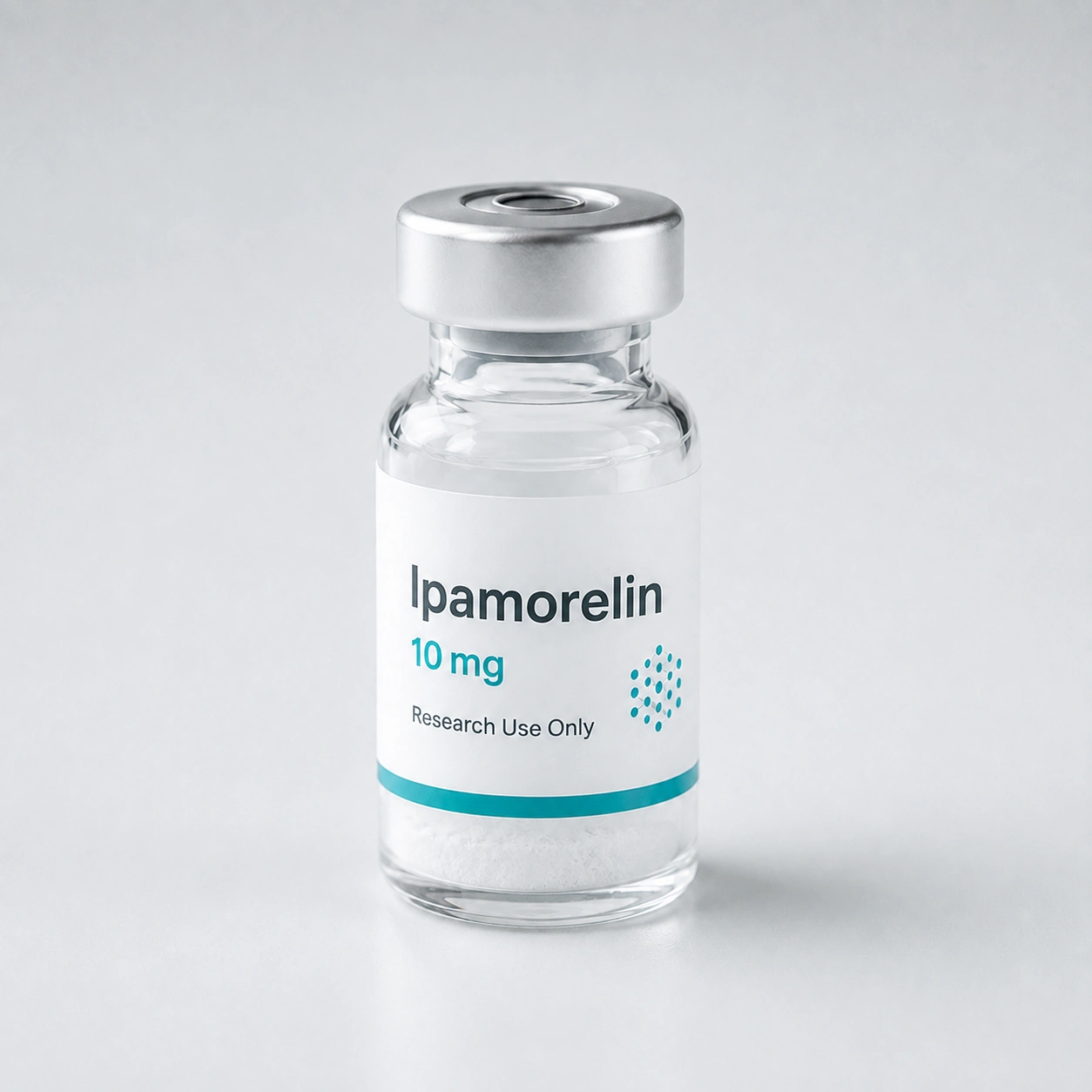
Common vial size is what vendors typically sell, not a recommendation. Enter your own vial in the calculator.
What is Ipamorelin?
Plain language first. The technical label stays, but it never stands alone.Overview
You do not inject growth hormone with this one. Instead it signals your pituitary to release a clean pulse of your own, with little effect on hunger or stress hormones.
Ipamorelin is a growth hormone secretagogue, specifically a ghrelin-receptor agonist (a GHRP).
What it's used for
A gentle nudge for your body to release more of its own growth hormone. People use it to recover faster from workouts, sleep deeper, build lean muscle, and lose a little fat.
How does Ipamorelin work?
What it does in the body, and where.Ipamorelin does not contain growth hormone. It signals your pituitary to release your own, by copying ghrelin, the hormone that makes you feel hungry.
- 01
- 02Your pituitary releases a pulse of its own growth hormoneA pulse rather than a constant level, which is closer to how your body normally releases it than an injection of growth hormone would be.
- 03It leaves cortisol and prolactin aloneOlder peptides in this family also spiked stress hormones. Ipamorelin's selectivity is its main advantage over them.
A schematic of the compound's mechanism, not a diagnostic image.
What else is it used for?
Each group carries its own evidence level.Approved means regulators have cleared it for that purpose. Investigational means it is in trials. Early research means it is being studied and is not established.
Growth hormone release
Research only- Animal studyIn rats it triggered growth hormone release cleanly, without raising stress hormones even at doses 200 times higher.
- Lab studyIn rat pituitary cells it was active at very low concentrations.
- Animal studyIn rats it increased leg bone growth from 42 to 52 micrometers per day over 15 days.
What happened in people
Research only- Human trialThe one real human trial, testing bowel recovery after surgery, did not meet its goal and development was discontinued.
- No dataNo human trial supports its use for fat loss, muscle gain, anti-aging, or sleep.
Popular claims about fat loss, muscle gain, and anti-aging have no human trial behind them. The only real human trial tested bowel recovery after surgery and failed.
The published record
Papers and trials about Ipamorelin
Searched: Ipamorelin, NNC 26-0161.
27 papers tagged human · 16 not reviews or lab · 2 clinical trial publications
3 registered trials · none with posted results
Furthest stage reached: Phase 2, completed, no results posted
Compare this against the whole library →
Category 2RegulatorsCounted from Europe PMC indexing, not read by a person; a human tag can land on reviews, commentary or lab papers; clinical trial publications is the narrower count.
At a glance
Four things to know about Ipamorelin
How much, and do you cycle it?
The range, and whether you take breaks.0.2 up to 0.3 mg per dose (start low, increase slowly), daily, often at night. Commonly cycled, often quoted as 5 days on and 2 days off, or 8 to 12 weeks on and 4 off Community practice
The reason for cycling is real; the schedule is not. Sustained exposure to a ghrelin-receptor peptide blunts the growth hormone response to a later dose, which has been shown in people. But no published study has tested any on/off pattern for ipamorelin, and ipamorelin's own desensitisation has never been measured in humans. Every specific number you see traces back to vendor and clinic pages, including one widely repeated citation to a 2019 study that does not exist.
About 2 hoursCommunity practice
Widely repeated. We have not traced it to a published human measurement.
Not yet traced to a primary source.
You can compare this against the whole library to see where it sits.
How do I dose and price it?
Enter your vial and your dose. Pick a mix. We show the draw and the cost.The vial holds a fixed amount of drug. Adding more water does not make more drug, it just spreads it thinner, so you draw a bigger number on the syringe for the same dose.
Choose your mix
Measuring the water1 mL = one full 100-unit syringe.
Ipamorelin starts at $9.34 across 167 vendors, typically $3.83 – $10.00 per mg.
294 listings, last read Oct 24, 2026. Shipping and card fees are not included.
How do you store it?
Before mixing, and after.Dry powder in the freezer or fridge. Once mixed, fridge, and use within about a month.
Unmixed lyophilized Ipamorelin keeps for a long time cold. Once you add water the clock starts: most reconstituted vials hold up for roughly 28 to 30 days at fridge temperature. Keep it out of light, and do not freeze it after mixing.
What are the side effects and cautions?
Known cautions and warnings for this compound.Solubility, computed: 60% charged residues, 60% hydrophobic. Water usually sufficient.
A first-pass rule from peptide manufacturers' guidance. It does not account for disulfide bridges, salt form or how the powder was dried, and it predicts what should be easy rather than what will happen in your vial.
Who should avoid it
- Active cancer, as a precaution with anything raising growth hormone
- Pregnancy
- Banned in drug-tested sport
Stop and get help
- Signs of an allergic reaction
- New lumps or masses
Common effects
- Headache
- Injection-site reactions
- Temporary fluid retention
- Reported in early-stage studies only. There is no large controlled safety database for general use
Where this page says nothing is established, that means nobody has studied it, not that a compound is safe.
Is Ipamorelin approved?
And where the numbers on this page come from.No. Ipamorelin is not approved for any use, anywhere. It is sold labeled for laboratory research only, and there is no legal route to buy it for human use.
- Approval statusResearch only
- RouteUnder the skin (subcutaneous)
- Checked22 July 2026
- DoseFrom community reports. No regulator or trial established this dose.
- Vial sizeFrom what vendors typically list; not a recommendation.
- Sources
What has happened recently
We have not yet written a full regulatory note for this compound. The status above is current as of the date shown.
What regulators say
From official documentsIn category 2 (503B); nomination withdrawn from 503A
A published study identified serious adverse events including death when given intravenously for gastric motility
Checked 11 September 2026FDA: Certain Bulk Drug Substances for Use in Compounding that May Present Significant Safety Risks (category 2 and withdrawn nominations), current as of April 22, 2026Prohibited at all times, in and out of competition. S2.2.4 Growth hormone releasing factors: growth hormone secretagogues (GHS) and their mimetics (ipamorelin named). Non-Specified.
Checked 12 September 2026WADA: The 2026 Prohibited List (in force 1 January 2026)Category 2
Listed as Ipamorelin Acetate; added September 29, 2023
Checked 11 September 2026FDA: Bulk Drug Substances Nominated for Use in Compounding Under Section 503B (interim categories 1, 2, 3), updated March 21, 2025
Banned in drug-tested sport. Most research peptides are prohibited under WADA's S0 category, which covers any substance with no approval from any regulatory authority for human use. That means a compound can be banned without ever being named on the prohibited list. Check with your own anti-doping authority rather than assuming absence from the list means permitted.
You can compare this against the whole library, or read how to check a seller.
What else is like Ipamorelin?
Others in Growth hormone peptides, side by side.If you're weighing Ipamorelin, it's worth reading CJC-1295 no DAC (Mod GRF 1-29), Sermorelin, and Ipamorelin + CJC-1295 (no DAC) blend in the same class.
A gentle shot that nudges your body to release its own growth hormone.
- Dose
- 0.2 up to 0.3 mg per dose (start low, increase slowly)
- How often
- Daily, often at night
A short-acting growth-hormone pulse, usually paired with ipamorelin.
- Dose
- 0.1 mg per dose
- How often
- Daily to 2x daily
A gentle shot that prompts your body to make more of its own growth hormone.
- Dose
- 0.2 up to 0.5 mg per dose (start low, increase slowly)
- How often
- Daily/nightly
The popular growth-hormone combo in one shot, for muscle, recovery, and sleep.
- Dose
- ~0.1 mg CJC-1295 per dose, with the ipamorelin fixed at whatever ratio the vial was mixed at
- How often
- Daily, often at night
Compared with
They act on different receptors and are usually sold in the same vial. Each has human trials; the combination everyone buys has none.
Read comparison →Same receptor, a pill against an injection. MK-677 has far more human data, and that is exactly why we know more about what is wrong with it.
Read comparison →Two growth hormone peptides sold side by side. One was an approved drug and can still be compounded on prescription. The other was voted down in October 2024.
Read comparison →Three act on the GHRH receptor and one copies ghrelin. Only tesamorelin is approved, and the two with the weakest outcome data were both voted down by the FDA in late 2024.
Read comparison →Guides for this compound
- How to Reconstitute a Peptide
Mix peptide powder with bacteriostatic water, step by step.
- How to Read an Insulin Syringe
Read the units, convert to millilitres, and draw the exact dose.
- mcg vs mg: The Peptide Dosing Mistake to Avoid
Your vial says mg and your protocol says mcg. Here is the conversion and how to check it.
- How to Read a Peptide COA
What the purity number does and does not tell you, and how to spot an edited report.
- How to Vet a Peptide Vendor
Independent COAs, HPLC purity, and the red flags that mean walk away.
Sources
- Raun ipamorelin study, European Journal of Endocrinology, 1998
- Ipamorelin post-operative ileus trial, ClinicalTrials.gov
Beyond these, 70 records are indexed. Browse the records