Peptide Decoding
All comparisons

Sermorelin vs Tesamorelin vs Ipamorelin vs CJC-1295

Three of these are versions of the same hormone and act on the same receptor, and ipamorelin uses a different door into the same gland. CJC-1295 here means the DAC version, which is the one with human trials behind it. The evidence runs from two completed Phase 3 trials down to none, and the legal positions run from FDA approved to voted down by the agency's own advisory committee. Those two rankings do not line up the way you would expect.

  • Growth hormone
  • Four compounds, two receptors
  • All four named on the WADA list
Published September 18, 2026
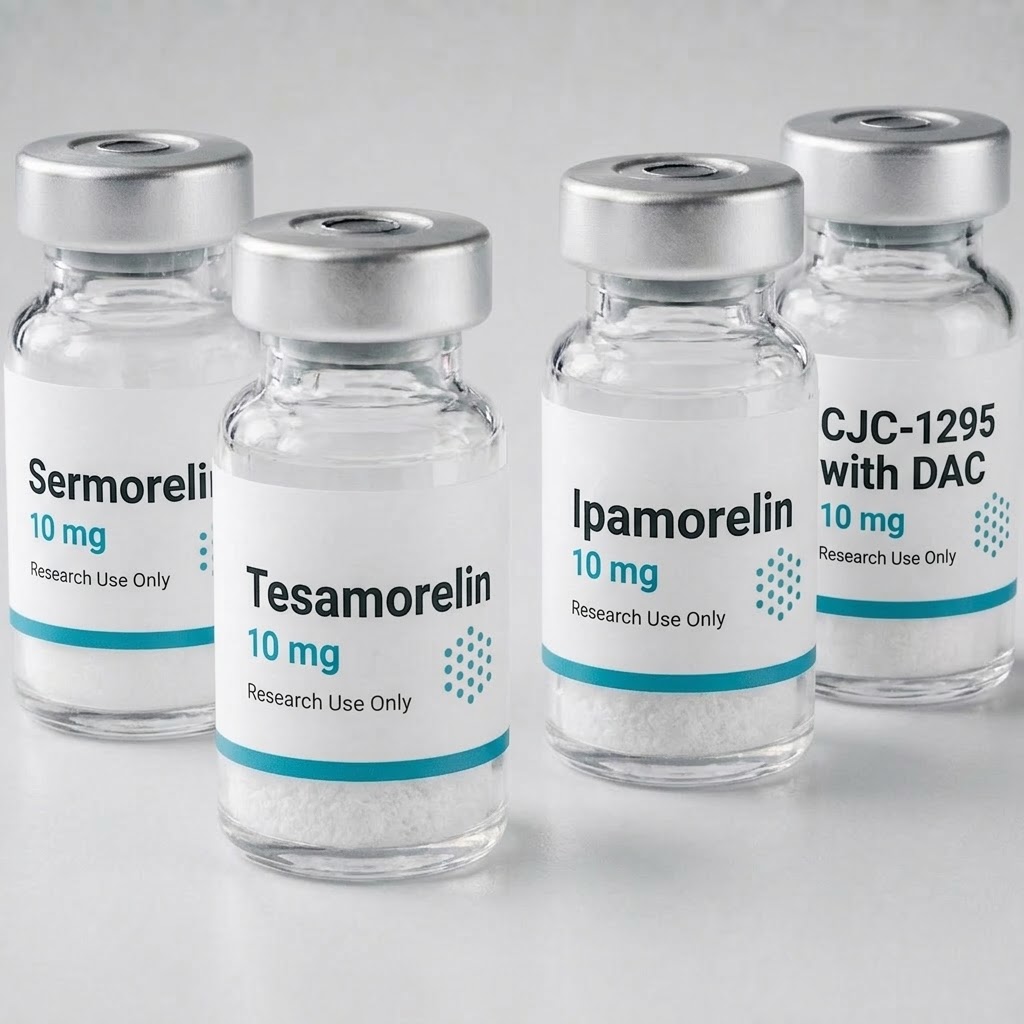
Research vials labelled Sermorelin, Tesamorelin, Ipamorelin and CJC-1295 with DAC under low blue light
The short answer

Four compounds, two doors into one gland, and four different legal positions.

Three are copies or fragments of GHRH and one copies ghrelin. Tesamorelin is approved, sermorelin can be compounded, and ipamorelin and CJC-1295 were both voted down by the FDA's advisory committee in late 2024.

The four compounds at a glance
AttributeSermorelinTesamorelinIpamorelinCJC-1295
Length29 amino acids44 amino acids5 amino acids30, with DAC
ReceptorGHRHGHRHGhrelinGHRH
FDA approvedWas, 1990 and 1997Yes, 2010NoNo
Can be compoundedYesYesNoNo
Best human evidence110 children, open label816 patients, two Phase 3114 patients, missed endpoint66 adults, hormone levels only
Human half-lifeAbout 11 to 12 minutesShort, dosed dailyAbout 2 hours5.8 to 8.1 days

Scroll the table sideways to see all four

Duration runs from minutes to days across these four. Half-life figures and their sources are set out in the mechanism section below.

The four

What each one actually is

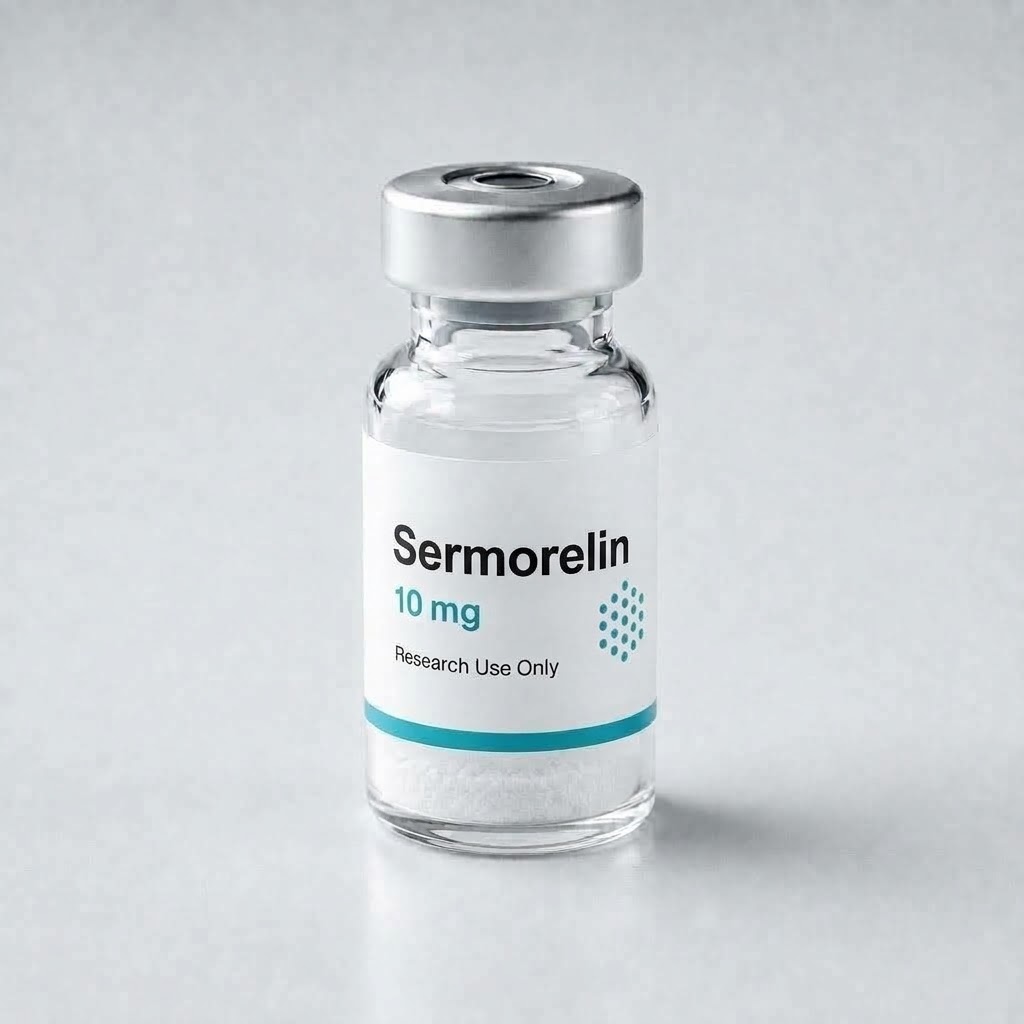
Research vial labelled Sermorelin 10 mg
29 aa · Compoundable

Sermorelin

The first 29 amino acids of GHRH, and those 29 are the whole working part of the hormone. Nothing added, nothing swapped, and it clears in minutes as a result. Held an FDA approval for eighteen years and lost it for commercial reasons.

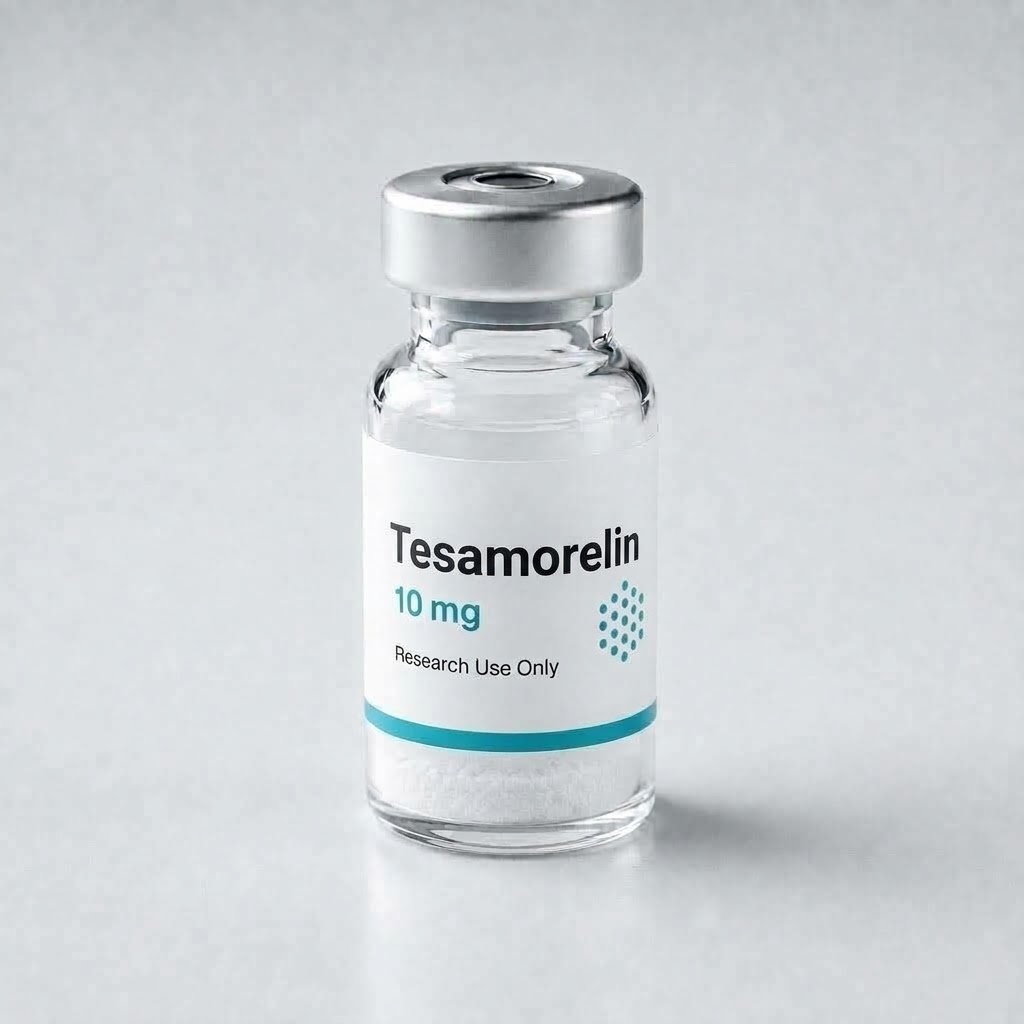
Research vial labelled Tesamorelin 10 mg
44 aa · Approved

Tesamorelin

The entire GHRH hormone with a small chemical group on the front to slow its breakdown. The only one of the four with a current FDA approval and a label.

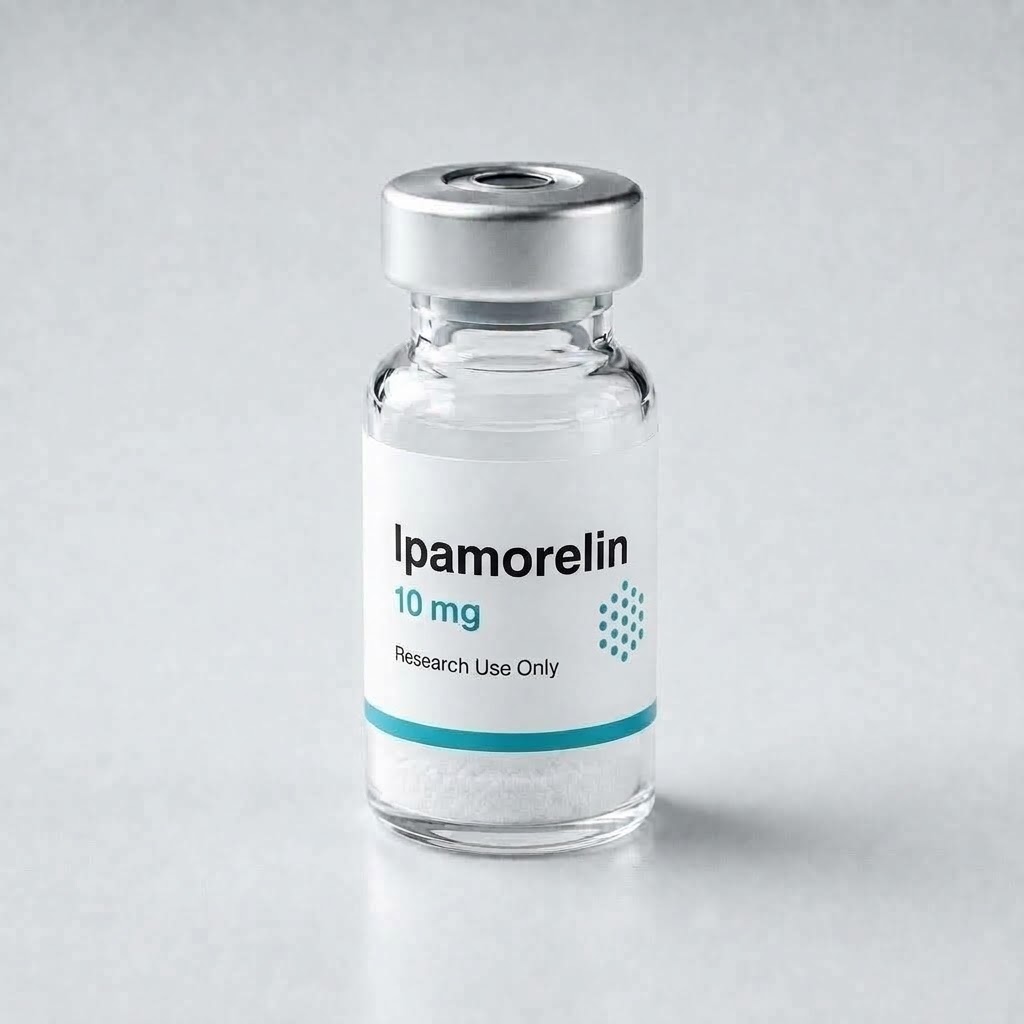
Research vial labelled Ipamorelin 10 mg
5 aa · Voted down

Ipamorelin

Five amino acids designed from scratch, copying ghrelin instead of GHRH. Uses a different receptor to reach the same gland.

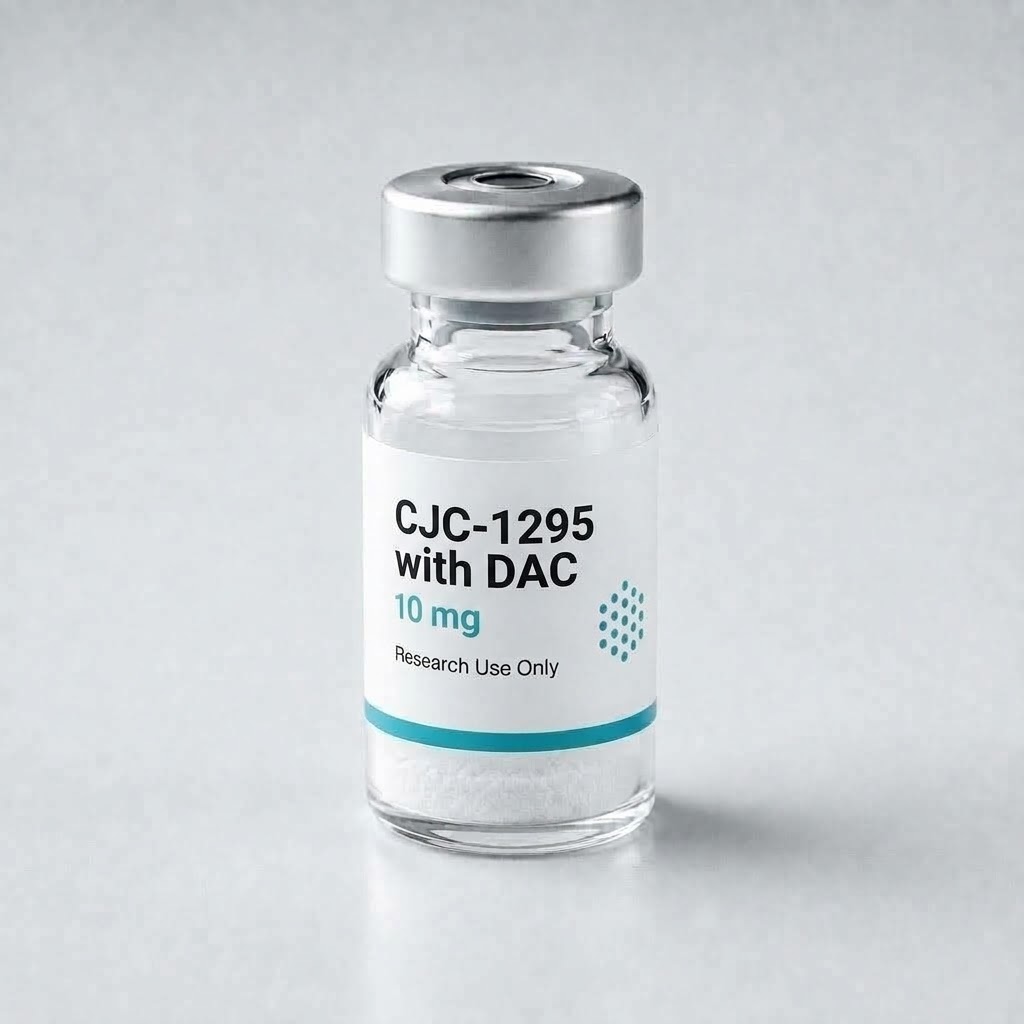
Research vial labelled CJC-1295 with DAC 10 mg
30 aa, with DAC · Voted down

CJC-1295

The same 29-residue fragment as sermorelin with four amino acids swapped, plus a thirtieth residue carrying a hook that binds albumin and stretches it to about a week. This page means the DAC version throughout.

A note on which CJC-1295 this page means. Two different compounds are sold under the name CJC-1295, and the distinction matters more than the shared name suggests.

CJC-1295 with DAC

Carries a Drug Affinity Complex, a hook on a thirtieth residue that binds albumin in your blood and stretches the signal to roughly a week. This is the original compound, identified as such in 2005, and it is the one Teichman tested in humans.

CJC-1295 without DAC

Is Modified GRF 1-29, the same 29-residue fragment with the four substitutions and no hook. It is a different molecule with a different duration, and it has never appeared in a published human trial.

The figure usually quoted for it is about 30 minutes. That number appears in the FDA's own advisory committee presentation, which is not nothing, and that presentation cites no human pharmacokinetic study behind it. Nobody has published a measurement.

Everything on this page refers to the DAC version, because that is the one with human data. The December 2024 advisory committee vote covered five substances, CJC-1295 free base and acetate, which are the versions without DAC, and CJC-1295 DAC as free base, acetate and trifluoroacetate. All five were rejected, so the compounding position is identical for both versions. We have a full comparison of the two versions if that is the question you arrived with.

The relay

One gland, two doors, and where each one enters

Same gland, same output, two different ways in.

01

Start here if the names mean nothing to you yet.

Your pituitary, a gland the size of a pea sitting under your brain, makes growth hormone. Growth hormone travels to your liver and other tissues and prompts them to make IGF-1, and IGF-1 does most of the work people associate with growth hormone: building tissue, breaking down fat, repairing what is damaged. Output falls as you get older, and that decline is the reason this whole category exists.

None of these four is growth hormone itself. Each is a way of asking your own pituitary to make more, and that carries a different ceiling than supplying it directly. Real growth hormone is a prescription drug with a criminal statute attached to its off-label distribution, and these are not that.

02

What people take them for.

Body composition, recovery, sleep quality and the general category of feeling younger. None of those is an approved use for any of the four. Tesamorelin's approval covers belly fat in people with HIV. Sermorelin's covered growth failure in children. Ipamorelin's only efficacy trial was about recovery after bowel surgery.

03

The door a compound uses decides what it can do.

Your hypothalamus releases GHRH, and that signal tells the pituitary to make and release growth hormone. Sermorelin, tesamorelin and CJC-1295 are all copies or fragments of it. Ghrelin is a separate hormone, released mainly by the stomach, and it triggers a burst of growth hormone through a different receptor called GHS-R1a. Ipamorelin copies that.

The practical difference between the two doors.

GHRH tells the pituitary to produce growth hormone while ghrelin tells it to release what it already has. People stack one of each for that reason, instead of two of the same kind. No published human trial has tested any of those combinations.

04

A length ladder makes the relationships clearer.

Tesamorelin44 aa
CJC-129530 aa, with DAC
Sermorelin29 aa
Ipamorelin5 aa

Tesamorelin at 44 amino acids is the complete GHRH hormone, modified at the front. Sermorelin at 29 is the working fragment of it, unmodified. CJC-1295 with DAC at 30 is that same fragment with four swaps plus an albumin-binding hook. Ipamorelin at 5 was designed from scratch and copies nothing in this family.

05

Why the duration figures diverge so sharply.

SermorelinAbout 11 to 12 minutes
TesamorelinShort, dosed daily
IpamorelinAbout 2 hours
CJC-12955.8 to 8.1 days

Sermorelin runs about 11 to 12 minutes after subcutaneous injection, tesamorelin is short and dosed daily, ipamorelin clears with a half-life of about 2 hours, and CJC-1295 with DAC runs 5.8 to 8.1 days. The version without DAC is quoted at about 30 minutes, a figure that appears in an FDA presentation with no study cited. Sermorelin is the shortest because it is unmodified GHRH and the enzyme DPP-IV cleaves it almost immediately. CJC-1295 is the longest because its whole design is to avoid exactly that.

Sermorelin's figure comes with a sourcing problem.

A widely used pharmacology reference work states in its text that no human pharmacokinetic studies of sermorelin appear in the literature, and then lists a human plasma half-life of 4.3 minutes from a 1994 infusion study in its own table on the same page. The 11 to 12 minute figure has independent support in a 2020 peer-reviewed review table and in the FDA's own advisory committee presentation on CJC-1295. The figure circulating most widely on vendor sites is 6.2 minutes, taken from rats.

Supply, not evidence

Mostly because they are sold as a set

01

Sold as components, not a choice

These four are not usually presented as a choice. They are presented as components. The single most sold product in this corner of the market is a premixed vial of CJC-1295 with ipamorelin, and sermorelin plus ipamorelin and tesamorelin plus ipamorelin are both sold the same way. All three blends exist as their own listings, with their own pricing, alongside the four single compounds.

02

What that framing does

So the comparison usually gets framed as which GHRH analog to pair with ipamorelin, not which of the four to use. Neither consequence of that framing is stated in the listings.

03

The blends have never been tested

Not one published human trial has examined any pairing of these four compounds, in anyone, for anything. Every trial in the timeline below studied a single compound on its own.

04

Two of the four cannot legally be compounded

Any blend containing ipamorelin or CJC-1295 is therefore a research chemical regardless of what the other half is, including the tesamorelin blends, where one component has an FDA approval and the other was voted down.

Side by side

Putting the numbers side by side

The four compounds with the cheapest in-stock listing for each
CompoundWhat it isRouteHow it actsLowest in-stock
SermorelinGHRH fragment, 29 aaCompounding pharmacy, on prescriptionGHRH receptor$23.99
TesamorelinFull GHRH, modified, 44 aaApproved as Egrifta, and compoundableGHRH receptor$20.00
IpamorelinDesigned ghrelin mimic, 5 aaResearch chemical, cannot be compoundedGhrelin receptor, GHS-R1a$17.56
CJC-1295GHRH fragment with DAC, 30 aaResearch chemical, cannot be compoundedGHRH receptor$29.50

Scroll the table sideways to see every column

Prices are the cheapest in-stock single-compound listing we track for each, recomputed every time this page is served. Vial sizes and concentrations differ substantially, so these are what a buyer faces at checkout rather than a like-for-like comparison. Two of these prices are for compounds that cannot legally be compounded: ipamorelin and CJC-1295 are sold as research chemicals, and the listings we track reflect that market. The cheapest route is not on this table either. Tesamorelin exists as an approved product, Egrifta, and sermorelin is dispensed through compounding pharmacies, and neither route appears in vendor pricing data.

The evidence

The question underneath all four

All four compounds are ways of raising growth hormone. That is the entire point of the category, and it invites a question almost no page in this space asks: what does raising growth hormone actually do in a healthy adult? It has been examined, twice, by the same group at Stanford.

Systematic review · healthy older adults
18
studies pooled
220
participants
107
patient-years
−2.1 kg
fat mass
+2.1 kg
lean mass

A systematic review of growth hormone in healthy older adults pooled 18 studies covering 220 participants across 107 patient-years. Fat mass fell 2.1 kilograms and lean mass rose 2.1 kilograms, with no change in total weight and no change in bone density. Treated participants were significantly more likely to develop soft tissue swelling, joint pain, carpal tunnel syndrome and gynaecomastia. The authors concluded that growth hormone cannot be recommended as an anti-aging therapy.

Second review · athletic performance

A second review from the same group looked at athletic performance. Growth hormone increased lean body mass and did not improve strength, may have worsened exercise capacity, and increased adverse events.

The result comes with several qualifications. Those reviews studied growth hormone given directly, not these four compounds, and whether asking the pituitary to produce it yields a different result has not been tested. The changes were real but modest, and two kilograms of lean mass arrived without a gain in strength.

And the effect ceiling for these four is lower by design. Growth hormone injected directly can be dosed to whatever level a prescriber chooses. Sermorelin, tesamorelin, ipamorelin and CJC-1295 are all limited by what your own pituitary will produce. That is a safety feature and also a cap.

The best evidence on the output these four compounds aim at says the effect in healthy adults is modest, comes with a recognisable set of side effects, and does not include the strength improvement people expect. Whether the indirect route changes that is unknown.

The evidence, in the order it arrived

The evidence ranking and the legal ranking do not match.

816
Phase 3 patients behind tesamorelin, against none for CJC-1295
2 of 4
can be legally compounded today
0
published human trials of any combination of these four
1980s
Sermorelin

The shortest fragment that still works

Sermorelin is developed as the shortest GHRH fragment that keeps full biological activity, and becomes the first GHRH analog to reach approval.

28 Dec 1990
Sermorelin

Approved as a diagnostic

The FDA approves Geref Diagnostic, for testing pituitary function.

26 Sep 1997
Sermorelin

Approved for growth failure in children

The pivotal study was open label with no control group. 110 children received 30 micrograms per kilogram daily. 47 of the 56 who remained in the analysis met the growth threshold at twelve months, and 20 of the 54 excluded were removed specifically for failing the efficacy criteria at six months.

1998
Ipamorelin

Characterised at Novo Nordisk

Raun and colleagues report that ipamorelin releases growth hormone without raising cortisol or prolactin, unlike older compounds in its class. Rat cells and pigs.

1999
Ipamorelin

The human pharmacokinetic study

Gobburu publishes it. Growth hormone peaks around 30 to 40 minutes and ipamorelin clears with a half-life of about 2 hours.

2005
CJC-1295

The albumin-binding version is identified

Jetté identifies CJC-1295 as the long-acting, albumin-binding analog. Rat study.

2006
CJC-1295

Two randomised trials in 66 adults

Teichman publishes two randomised, placebo controlled, double blind ascending-dose trials in 66 healthy adults aged 21 to 61, running 28 and 49 days. A single injection raises growth hormone 2 to 10 times baseline for six days or more, with a half-life of 5.8 to 8.1 days.

These measured hormones in blood, not outcomes.

Jul 2006
CJC-1295 with DAC

The Phase 2 trial is halted

The trial in 192 people stops after a participant died of a heart attack. Causality was never established and development ended. No efficacy results were ever published.

2007
Tesamorelin

The first Phase 3 trial

In the New England Journal of Medicine. 412 patients, 2 milligrams daily for 26 weeks. Visceral fat fell 15.2 percent against a 5.0 percent rise on placebo, p less than 0.001.

2008
Sermorelin

Production stops

EMD Serono stops making Geref. The FDA withdraws the approval the following year.

Nov 2010
Tesamorelin

Approved as Egrifta

On two Phase 3 trials totalling 816 patients. It remains the only approved GHRH analog.

2013
Sermorelin

The paperwork that still matters

A Federal Register determination records that Geref was not withdrawn for reasons of safety or effectiveness. That single sentence is why sermorelin can still be legally compounded.

2014
Ipamorelin

The only completed efficacy trial

114 patients, recovery of gut function after bowel surgery. Patients tolerated food about seven hours sooner, and it missed its primary endpoint at p equals 0.15. Development discontinued.

2019
Tesamorelin

The liver trial

Stanley publishes it in Lancet HIV. 61 patients, 12 months, liver fat down 4.1 points against a 0.9 rise, with biopsies at both ends.

29 Oct 2024
Ipamorelin

Voted down

The FDA's advisory committee reviews ipamorelin and votes against adding it to the compounding list. One of four substances rejected that day.

4 Dec 2024
CJC-1295

Five forms, five rejections

The same committee reviews five CJC-1295 substances and votes against all of them, four unanimously at 13 to nothing and the fifth at 12 to 1.

Today
All four

Two in, two out

Two of the four can be legally compounded. Two were specifically examined and turned down.

On evidence, tesamorelin is first by a distance, then ipamorelin, then CJC-1295, then sermorelin. On legal availability the order is different: tesamorelin and sermorelin can both be compounded, and ipamorelin and CJC-1295 cannot. So the compound with the weakest evidence of the four sits in the second-best legal position, because a Federal Register notice in 2013 recorded that its approval was withdrawn for commercial reasons rather than safety ones. That is a paperwork fact, and it is worth more in practice than CJC-1295's three published human trials.

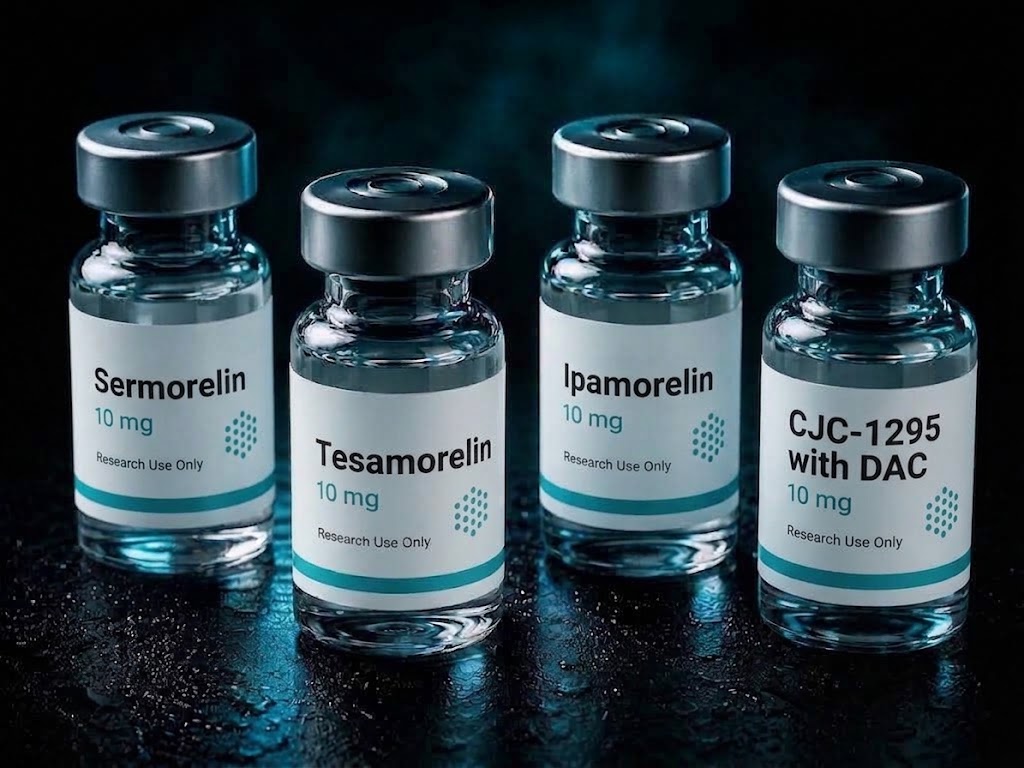
Sermorelin, tesamorelin, ipamorelin and CJC-1295 vials together on a white surface
Four vials, two receptors, and four different legal positions.
Combining, and the numbers people quote

The combination question, answered honestly

The most common way these are sold is as a pair: a GHRH analog with ipamorelin. The reasoning offered is that two doors produce a larger release than one, and the reasoning is mechanistically coherent.

It has never been tested in a published human trial. Not CJC-1295 with ipamorelin, not sermorelin with ipamorelin, not tesamorelin with ipamorelin. There is no published trial of any of these combinations in humans, which means no efficacy data, no safety data and no dosing data specific to the pairing.

Whatever a premixed vial is, it is not a tested product. It is two untested-together compounds in one solution, and in two of the three common pairings at least one of them cannot be legally compounded.

Key differences

What separates the four

All four raise growth hormone, all four are injected, and all four are named on the WADA prohibited list. What separates them is length, receptor, duration, evidence and legal position.

Key differences between the four compounds
AttributeSermorelinTesamorelinIpamorelinCJC-1295
Length29 aa44 aa5 aa30 aa, with DAC
OriginGHRH fragmentFull GHRH, modifiedDesigned, copies ghrelinGHRH fragment, modified
ReceptorGHRHGHRHGhrelin, GHS-R1aGHRH
DurationAbout 11 to 12 minutesShort, dosed dailyAbout 2 hours5.8 to 8.1 days
Best trial110 children, open label412 patients, randomised114 patients, randomised66 adults, hormone levels
That trial's result47 of 110 met the thresholdVisceral fat down 15.2 percentMissed, p equals 0.15No outcome measured
ApprovalWithdrawn 2008CurrentNoneNone
CompoundableYesYesNo, voted down 2024No, voted down 2024
WADANamed, S2.2.4Named, S2.2.4Named, S2.2.4Named, S2.2.4

Scroll the table sideways to see all four

CJC-1295 throughout this table means the DAC version. Sermorelin's duration figure is from a peer-reviewed review table and the FDA's own advisory committee presentation, and the sourcing caveat is set out above.

What nobody has answered

Four gaps, and the biggest one covers the thing everyone actually does

Nobody has tested any combination of these.It is the largest gap on the page: the most sold product in this space has no human trial behind it.

Sermorelin's pharmacokinetic record is a mess for a compound that held an approval for eighteen years.Human data exists, giving roughly 11 to 12 minutes after subcutaneous injection and 4.3 minutes by constant infusion, and a standard reference work asserts in its text that no human studies exist while citing one in its own table. The figure most widely quoted on vendor sites is from rats. Nobody has run a modern dedicated pharmacokinetic study of it.

Nobody knows what CJC-1295 does to anything.Its published human trials measured hormone levels in blood, and the one designed to measure an outcome was halted in 2006 and never published. That is the DAC version. The version without DAC has no published human trial at all, so nothing about it has been measured in a person, including how long it lasts.

Nobody has tested any of the four for what they are mostly prescribed for, either.Tesamorelin's approval covers visceral fat in HIV lipodystrophy. Sermorelin's covered growth failure in children. Ipamorelin's trial was about bowel surgery. The adult anti-aging, sleep and body composition uses that drive nearly all demand have never been an approved indication for any of them.

In practice

Four questions, and the evidence answers only one of them

Can you legally get it? Tesamorelin and sermorelin can be dispensed through a compounding pharmacy on prescription. Ipamorelin and CJC-1295 cannot, and what is sold under those names is a research chemical. For most people this settles it before anything else enters the conversation.

Is your pituitary working? All four depend on it. Three push the GHRH receptor and one pushes the ghrelin receptor, and all four are asking the same gland to respond. If it cannot, none of these has anything to push on, and the compound that works in that situation is growth hormone itself, which is a different conversation with a criminal statute in it.

Are you tested in sport? All four are named on the Prohibited List under the same section. There is no safe choice here, and being an approved drug does not help, since tesamorelin is named despite having a label.

What evidence do you want behind it? This is the only question where the four separate cleanly. Tesamorelin has two Phase 3 trials, 816 patients and an approval. Ipamorelin has a measured half-life and a trial that missed. CJC-1295 has hormone measurements and no outcome. Sermorelin has an open-label study with no control group and a pharmacokinetic record that contradicts itself across sources.

The last question and the first give different answers, and that mismatch is the finding this page is built on.

Safety and buying

Four different positions, and only one has a label

Evidence register4 fields · 16 entriesCompiled from FDA labelling, published trials and US market conditions
01On the label

Tesamorelin, the only one with one

Everything here is public because an approved drug has to report it.

  • Anti-drug antibodies in about half of patients at 26 weeks, without any loss of efficacylabel
  • IGF-1 more than 2 standard deviations above normal in about 47 percent by 26 weekslabel
  • Fluid retention, causing swelling and musculoskeletal discomfortlabel
  • Injection site reactions, the most common complaint across the classlabel
02Reported

From the other three's trials

Smaller datasets, and in one case almost none.

  • Ipamorelin was well tolerated in its 114-patient trial, with events comparable to placebotrial
  • CJC-1295 produced injection site reactions in roughly 70 to 100 percent across two studies, and headache in 63 percent against 14 percent on placebotrial
  • Sermorelin's labelled cautions from its approved years include untreated hypothyroidism, epilepsy, obesity and raised blood sugarlabel
  • Facial flushing was reported with sermorelin during its marketed periodlabel
03Unstudied

Nobody has looked

Nobody has run these studies. That is different from a clean result.

  • Any combination of these four, in any published human trialnone
  • Sermorelin's pharmacokinetics in a modern human studynone
  • Any outcome for CJC-1295, as opposed to hormone levelsnone
  • Long-term use of any of the four, the proposition being soldnone
04Supply

What you are actually buying

Four compounds, three different legal positions.

  • Tesamorelin exists as an approved product, Egrifta, and can also be compoundedapproved
  • Compounded sermorelin is legal and is not an FDA approved productcompounded
  • Ipamorelin and CJC-1295 cannot legally be compounded, so anything sold is a research chemicalresearch
  • Testing of seized peptides found purity between 5 and 75 percent, plus arsenic and leadmarket

*Compiled from FDA labelling and published trials. Entries describe what has been reported, not what any individual should expect.

The tesamorelin antibody figure deserves a note, because it is the kind of number that misleads when compared across the four.

Roughly half of tesamorelin patients developed antibodies, and that is on the label in detail. Teichman found none with CJC-1295. Read quickly, CJC-1295 looks cleaner. In fact tesamorelin was studied in 816 patients for up to a year with mandatory reporting, and CJC-1295 in 66 healthy adults across two trials running 28 and 49 days.

A shorter safety record is not a cleaner one.

Sport and regulatory status

All four are named, and evidence explains almost none of the legal positions

In sport

Section S2.2.4 of the 2026 Prohibited List covers growth hormone releasing factors and secretagogues. Sermorelin, tesamorelin and CJC-1295 are all named among the GHRH analogues, and ipamorelin is named among the growth hormone secretagogues. All four are prohibited at all times, in and out of competition, and everything in S2 is a non-specified substance carrying a default four year ban for a first violation.

Being an approved prescription drug makes no difference. Tesamorelin is on the list by name despite having a label. Growth hormone is among the most actively tested classes in sport, with both direct detection and biomarker methods in routine use, and the releasing factors are named separately for exactly that reason.

Legal position, one compound at a time

Sermorelin

Legally compoundable, and not approved. Geref was approved in 1990 and 1997 and withdrawn in 2008 when production stopped. A Federal Register determination in March 2013 recorded that it was not withdrawn for reasons of safety or effectiveness, and that determination is what permits compounding under sections 503A and 503B. That permission is narrower than it sounds: compounded sermorelin is not an FDA approved product, the FDA does not verify compounded preparations, and the adult uses it is prescribed for were never approved for anyone.

Tesamorelin

Approved. The FDA approved it in November 2010 as Egrifta, for reducing excess abdominal fat in people with HIV-associated lipodystrophy, on two Phase 3 trials totalling 816 patients. Because it is an approved drug substance, it can also be legally compounded.

Ipamorelin

Examined and rejected. It went into Category 2 of the 503A bulk substances list in September 2023, came off in September 2024 when the nomination was withdrawn, and was taken to the advisory committee anyway. On 29 October 2024 the committee reviewed it for growth hormone deficiency and postoperative ileus and voted against adding it.

CJC-1295

Examined and rejected more emphatically. On 4 December 2024 the same committee reviewed five CJC-1295 related substances and voted against all five, four of them unanimously at 13 to nothing and the fifth at 12 to 1.

What that distribution means. Two of these four can be obtained through a licensed pharmacy against a prescription. Two cannot legally be compounded at all, and what is sold under those names is a research chemical. The line between those groups was not drawn by evidence. It was drawn by whether a substance held an approval that was withdrawn for commercial reasons, and by what a committee decided on two specific days in late 2024.

Common questions

Questions people ask

Sermorelin vs ipamorelin: which is better?

They do different jobs and are usually run together instead of chosen between. Sermorelin tells the pituitary to produce growth hormone and ipamorelin tells it to release what it has. The practical difference is legal: sermorelin can be prescribed through a compounding pharmacy, and ipamorelin cannot, because the FDA's advisory committee voted against it in October 2024.

CJC-1295 vs sermorelin: what is the difference?

CJC-1295 is sermorelin's 29-residue fragment with four amino acids swapped for stability, and in one version a hook that stretches its half-life to about a week. Sermorelin is that fragment unmodified. CJC-1295 has a modern measured human half-life and sermorelin's pharmacokinetic record contradicts itself across sources. Sermorelin can be legally compounded and CJC-1295 cannot.

Tesamorelin vs sermorelin: which has better evidence?

Tesamorelin, by a wide margin. Two Phase 3 trials totalling 816 patients, a current FDA approval, and a separate liver trial with biopsies at both ends. Sermorelin's approval rested on an open-label study with no control group, and no modern dedicated human pharmacokinetic study of it has ever been published.

Which of the four can I actually get legally?

Tesamorelin and sermorelin, through a compounding pharmacy on prescription. Ipamorelin and CJC-1295 cannot legally be compounded, because the FDA's advisory committee voted against both in late 2024.

Why can sermorelin be compounded if it is not approved?

Because a Federal Register determination in March 2013 recorded that Geref was not withdrawn from sale for reasons of safety or effectiveness. A substance whose approval lapsed for commercial reasons can be compounded under sections 503A and 503B.

Is the CJC-1295 and ipamorelin blend tested?

No. Not one published human trial has examined that pairing, or any other pairing of these four compounds, in anyone. It is the most sold product in this corner of the market and it has no human trial behind it. Both components also cannot legally be compounded, so any blend containing them is a research chemical.

Which GHRH peptide should I pair with ipamorelin?

Tesamorelin has by far the most human data of the three, with 816 Phase 3 patients and a current FDA approval. No tested pairing exists, so that is an answer about the components, not the combination. On legality, tesamorelin and sermorelin can be compounded and CJC-1295 cannot, and ipamorelin itself cannot either, so every version of this pairing includes at least one research chemical.

Which of these four is cheapest?

Ipamorelin, at $17.56 for the lowest in-stock listing we track, followed by tesamorelin at $20.00, sermorelin at $23.99, cjc-1295 at $29.50. Vial sizes differ substantially, so these are checkout prices rather than a cost-per-dose comparison. The comparison is less useful than it looks. Vial sizes differ substantially, two of the four prices are for compounds that cannot legally be compounded, and neither prescription route, tesamorelin as Egrifta or compounded sermorelin, appears in vendor pricing at all.

Can you stack them?

People do, constantly, and no published human trial has tested any combination of these four. The reasoning behind pairing a GHRH analog with ipamorelin is sound, since one tells the pituitary to produce and the other tells it to release. Two of the four also cannot legally be compounded, so the standard protocol involves at least one research chemical.

Tesamorelin vs ipamorelin: what is the difference?

They act on different receptors on the same gland. Tesamorelin is the full GHRH hormone and tells the pituitary to produce growth hormone. Ipamorelin copies ghrelin and tells it to release what it has. Tesamorelin has an FDA approval and 816 Phase 3 patients behind it; ipamorelin's only efficacy trial missed its endpoint and the FDA's advisory committee voted against it in 2024.

CJC-1295 vs ipamorelin: which is better?

They are not alternatives, which is why they are sold together. CJC-1295 acts on the GHRH receptor and ipamorelin on the ghrelin receptor. Ipamorelin has a measured human half-life of about 2 hours and a randomised trial that missed its endpoint; CJC-1295 has a measured half-life of 5.8 to 8.1 days and no outcome data at all. Neither can legally be compounded.

Does raising growth hormone actually do anything?

Modestly, and less than people expect. A Stanford systematic review of growth hormone in healthy older adults found 2.1 kilograms of lean mass gained and 2.1 lost as fat, with no change in bone density and significantly higher rates of swelling, joint pain, carpal tunnel syndrome and gynaecomastia. It concluded that growth hormone cannot be recommended as an anti-aging therapy. A second review found no improvement in strength. Both studied growth hormone given directly rather than these four compounds, and whether the indirect route differs has not been tested.

What is the difference between GHRH and ghrelin peptides?

GHRH peptides tell the pituitary to produce growth hormone, and ghrelin peptides tell it to release what it already has. Sermorelin, tesamorelin and CJC-1295 are all GHRH-based. Ipamorelin copies ghrelin and uses a different receptor on the same gland. That is why the two types get paired rather than chosen between.

Does this page mean CJC-1295 with or without DAC?

With DAC, throughout. That is the original compound and the one with human trials behind it, including the measured half-life of 5.8 to 8.1 days. The version without DAC is Modified GRF 1-29, a different molecule that has never appeared in a published human trial. The 30 minute half-life quoted for it appears in an FDA advisory committee presentation with no study cited behind it. Both were covered by the December 2024 advisory committee vote, so neither can be legally compounded.

Which one lasts longest?

CJC-1295 with DAC, at 5.8 to 8.1 days measured in humans. Ipamorelin clears in about two hours. Sermorelin is the shortest at roughly 11 to 12 minutes after subcutaneous injection, because it is unmodified GHRH and an enzyme called DPP-IV cleaves it almost immediately. Tesamorelin clears quickly by design, so that growth hormone still arrives in pulses.

Are they all banned in sport?

Yes, all four, by name, under section S2.2.4 of the 2026 Prohibited List. Being an approved drug makes no difference, and tesamorelin is named despite having a label.

Which one is approved by the FDA?

Tesamorelin only, as Egrifta since November 2010, for excess abdominal fat in HIV-associated lipodystrophy. Sermorelin was approved in 1990 and 1997 and withdrawn in 2008. Ipamorelin and CJC-1295 have never been approved anywhere.

The published record

What Europe PMC and ClinicalTrials.gov hold for each, on the same rule.

Sermorelin has 236 records, Tesamorelin 129, Ipamorelin 65 and CJC-1295 38. 63, 48, 16 and 11 original human studies, 27, 24, 3 and 1 registered trials, respectively.

Sermorelin: FDA: Category 1, component of an FDA-approved drug · WADA: Prohibited at all times, in and out of competition. S2.2.4 Growth hormone releasing factors: GHRH and its analogues (sermorelin named). Non-Specified.

Tesamorelin: WADA: Prohibited at all times, in and out of competition. S2.2.4 Growth hormone releasing factors: GHRH and its analogues (tesamorelin named). Non-Specified. · FDA via DailyMed: Indicated for the reduction of excess abdominal fat in HIV-infected adult patients with lipodystrophy. Limitations of use: long-term cardiovascular safety has not been established; not indicated for weight loss management

Ipamorelin: FDA: Category 2 · FDA: In category 2 (503B); nomination withdrawn from 503A · WADA: Prohibited at all times, in and out of competition. S2.2.4 Growth hormone releasing factors: growth hormone secretagogues (GHS) and their mimetics (ipamorelin named). Non-Specified.

CJC-1295: FDA: Nominated but withdrawn; previously category 2 · WADA: Prohibited at all times, in and out of competition. S2.2.4 Growth hormone releasing factors: GHRH and its analogues (e.g. CJC-1293, CJC-1295, sermorelin and tesamorelin). Non-Specified.

The published recordSermorelin

Research index

236

Papers and trials about Sermorelin

106 papers with human data · 63 original studies

27 registered trials · 11 with posted results

Category 1, component of an FDA-approved drugRegulators

Browse the records

In animalsPro
In the labPro
ReviewsPro
Senior author sharePro

Evidence summary

Counted from Europe PMC indexing, not read by a person; human includes reviews and cell work, original studies exclude both.

The published recordTesamorelin

Research index

129

Papers and trials about Tesamorelin

98 papers with human data · 48 original studies

24 registered trials · 10 with posted results

Prohibited at all times, in and out of competition. S2.2.4 Growth hormone releasing factors: GHRH and its analogues (tesamorelin named). Non-Specified.Regulators

Browse the records

In animalsPro
In the labPro
ReviewsPro
Senior author sharePro

Evidence summary

Counted from Europe PMC indexing, not read by a person; human includes reviews and cell work, original studies exclude both.

The published recordIpamorelin

Research index

65

Papers and trials about Ipamorelin

26 papers with human data · 16 original studies

3 registered trials · none with posted results

Category 2Regulators

Browse the records

In animalsPro
In the labPro
ReviewsPro
Senior author sharePro

Evidence summary

Counted from Europe PMC indexing, not read by a person; human includes reviews and cell work, original studies exclude both.

The published recordCJC-1295

Research index

38

Papers and trials about CJC-1295

22 papers with human data · 11 original studies

1 registered trials · none with posted results

Nominated but withdrawn; previously category 2Regulators

Browse the records

In animalsPro
In the labPro
ReviewsPro
Senior author sharePro

Evidence summary

Counted from Europe PMC indexing, not read by a person; human includes reviews and cell work, original studies exclude both.

References

What this page is built on

  1. 01Sermorelin regulatory and trial history. FDA approval of GEREF Diagnostic, NDA 19-863, 28 December 1990, and GEREF, NDA 20-443, 26 September 1997, both EMD Serono. Production discontinued 2008, approval withdrawn effective 18 June 2009. Federal Register determination, 4 March 2013, FR Doc 2013-04827: GEREF was not withdrawn from sale for reasons of safety or effectiveness, which is what permits compounding under sections 503A and 503B. Pivotal study from the Geref prescribing information: multicentre, open label, no control group, 110 prepubertal children at 0.03 mg/kg/day; 56 evaluable at 12 months, 47 of those met the 2 cm/year threshold. Regulatory documents and prescribing information via secondary sources.
  2. 02Tesamorelin. Falutz J, Allas S, Blot K, et al. Metabolic effects of a growth hormone-releasing factor in patients with HIV. N Engl J Med. 2007;357(23):2359-2370. PMID 18057338. Falutz 2008, AIDS 22(14):1719-1728, PMID 18690162. Stanley TL, et al. Lancet HIV. 2019;6(12):e821-e830. PMID 31611038. 412 patients randomised 2:1, 2 mg daily, 26 weeks, visceral adipose tissue down 15.2 percent against a 5.0 percent rise on placebo. Two Phase 3 trials totalled 816 patients; FDA approval as EGRIFTA, November 2010. Label figures: anti-tesamorelin antibodies in 49.5 percent at 26 weeks, IGF-1 above 2 SDS in 47.4 percent.
  3. 03CJC-1295. Teichman SL, Neale A, Lawrence B, et al. Prolonged stimulation of growth hormone and IGF-I secretion by CJC-1295 in healthy adults. J Clin Endocrinol Metab. 2006;91(3):799-805. PMID 16352683. Jetté L, et al. Endocrinology. 2005;146(7):3052-8. PMID 15817669. ClinicalTrials.gov NCT00267527. Two studies, 42 and 24 subjects. Half-life 5.8 to 8.1 days on a single dose, growth hormone 2 to 10 times baseline for six days or more. Injection site reactions roughly 70 to 100 percent, headache 63 percent against 14 percent on placebo, no significant antibody formation. The Phase 2 trial in 192 participants halted 17 July 2006, no results published.
  4. 04Ipamorelin. Gobburu JV, Agersø H, Jusko WJ, Ynddal L. Pharm Res. 1999;16(9):1412-6. PMID 10496658. Beck DE, Sweeney WB, McCarter MD. Int J Colorectal Dis. 2014;29(12):1527-34. PMID 25331030, trial NCT00672074. Raun K, et al. Eur J Endocrinol. 1998;139(5):552-61. Half-life about 2 hours, growth hormone peak 30 to 40 minutes. 114 patients, 0.03 mg/kg IV for postoperative ileus, missed its primary composite endpoint at p equals 0.15, time to food tolerance 25.3 hours against 32.6. Development discontinued. Selectivity work in rat pituitary cells and swine.
  5. 05FDA Pharmacy Compounding Advisory Committee meeting, 29 October 2024, reviewing ipamorelin acetate and ipamorelin free base for growth hormone deficiency and postoperative ileus. Summary minutes at fda.gov/media/185412, docket FDA-2024-N-4188. The committee voted against adding it to the 503A bulks list, one of four substances rejected that day. Regulatory document, meeting summary read via secondary sources.
  6. 06FDA Pharmacy Compounding Advisory Committee meeting, 4 December 2024, docket FDA-2024-N-4777, briefing document at fda.gov/media/183819. Five substances reviewed and all five rejected, four unanimously at 13 to 0 and CJC-1295 acetate at 12 to 1. The forms covered are CJC-1295 free base, CJC-1295 acetate, CJC-1295 DAC free base, CJC-1295 DAC acetate and CJC-1295 DAC trifluoroacetate, so both versions were included. A presentation to the same meeting gives 30 minutes for CJC-1295 without DAC against 11 to 12 minutes for sermorelin, with no human study cited for the former.
  7. 07Sermorelin pharmacokinetics. Ishida et al., Growth hormone secretagogues: history, mechanism of action, and clinical development. JCSM Rapid Communications 2020, DOI 10.1002/rco2.9. Soule et al. 1994, J Clin Endocrinol Metab. Elsevier, Comprehensive Medicinal Chemistry, sermorelin entry. The review tabulates human pharmacokinetics of Tmax 5 to 20 minutes and half-life 11 to 12 minutes after subcutaneous administration. Soule measured 4.3 minutes by constant intravenous infusion. The reference work states in its text that no human studies appear in the literature while its own table on the same page lists the 4.3 minute human figure. The 6.2 minute figure quoted on vendor pages is from rats.
  8. 08World Anti-Doping Agency, 2026 Prohibited List, effective 1 January 2026, section S2.2.4. Covers growth hormone releasing factors and secretagogues, naming sermorelin, tesamorelin, CJC-1293 and CJC-1295 among the GHRH analogues and ipamorelin among the secretagogues. All S2 substances are non-specified, carrying a default four year sanction.
  9. 09Janvier S, Cheyns K, Canfyn M, et al. Impurity profiling of the most frequently encountered falsified polypeptide drugs on the Belgian market. Talanta. 2018;188:795-807. DOI 10.1016/j.talanta.2018.06.023. Purity between 5 and 75 percent for cysteine-containing peptides, plus arsenic and lead. Peer reviewed analytical study.
  10. 10Peptide Decoding vendor pricing data. Lowest in-stock single-compound listings, filtered to single-compound SKUs that are in stock. Our own dataset, computed at page load, no external link.
  11. 11Liu H, Bravata DM, Olkin I, et al. Systematic review: the safety and efficacy of growth hormone in the healthy elderly. Ann Intern Med. 2007;146(2):104-115. PMID 17227934. 18 studies, 220 healthy older participants, 107 combined patient-years. Fat mass fell 2.1 kg and lean mass rose 2.1 kg with no change in weight or bone density, and treated participants were significantly more likely to experience soft tissue oedema, arthralgias, carpal tunnel syndrome and gynaecomastia. Concluded that growth hormone cannot be recommended as an antiaging therapy. Studied growth hormone given directly, not these four compounds.
  12. 12Liu H, Bravata DM, Olkin I, et al. Systematic review: the effects of growth hormone on athletic performance. Ann Intern Med. 2008;148(10). Growth hormone increased lean body mass, did not improve strength, may have worsened exercise capacity, and produced more soft tissue oedema and fatigue. Peer reviewed systematic review, abstract read.