
CJC-1295 with DAC vs without DAC
One name, two drugs, and only one of them has ever been tested in a person. CJC-1295 with DAC has a measured half-life of 5.8 to 8.1 days and three published human trials. The version sold as CJC-1295 without DAC is a different molecule with its own proper name, and no published human study has tested it for anything.
This pair sits inside a larger group. For the map of all eleven growth hormone compounds and how they relate, start with the growth hormone peptides guide.
- Growth hormone
- Two distinct compounds
- Neither FDA approved
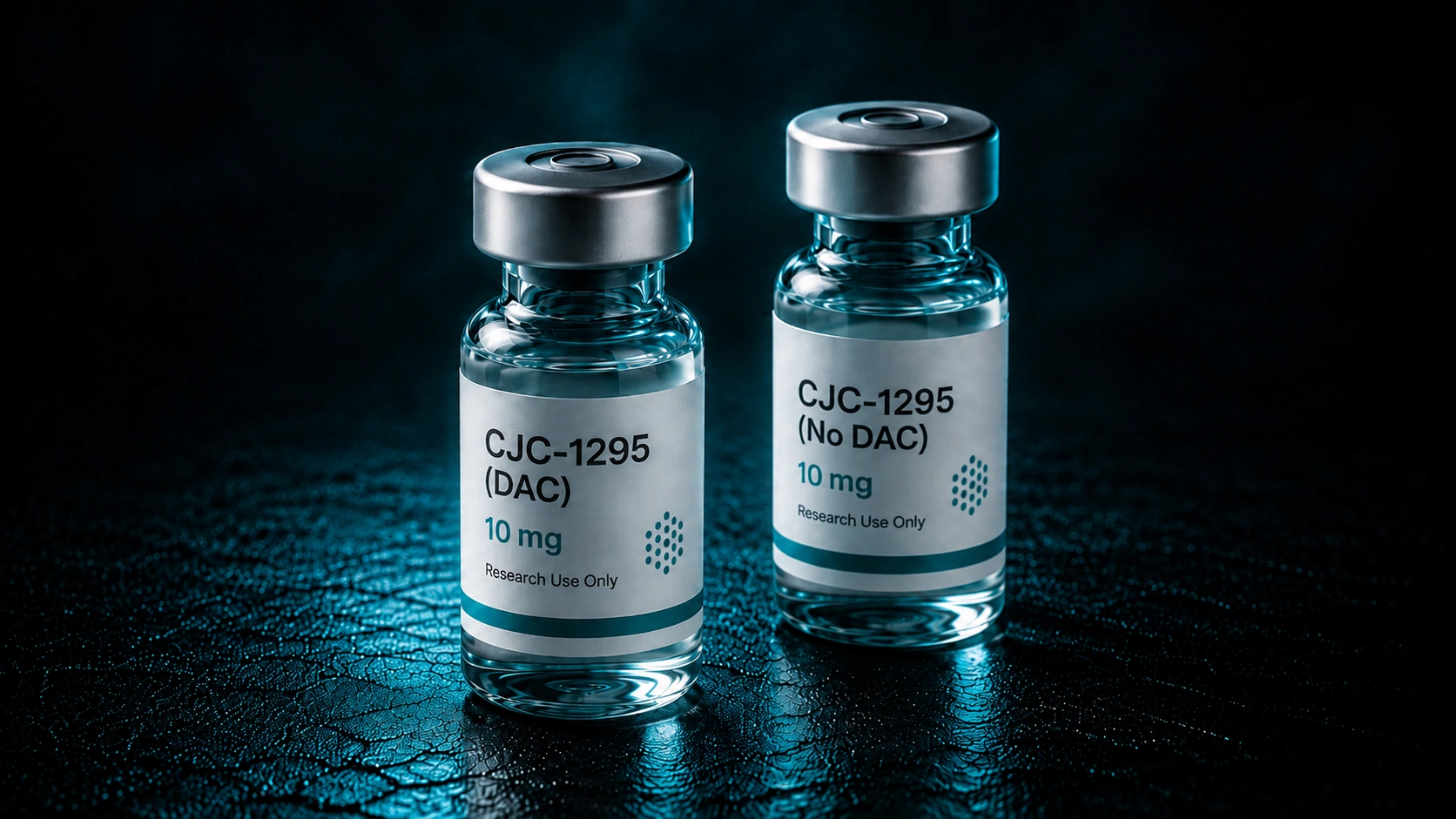
Which one has actually been measured?
CJC-1295 with DAC has published human pharmacokinetics. Modified GRF 1-29, the compound sold as CJC-1295 without DAC, has none. Vendors sell both under the same name.
| Attribute | With DAC | Without DAC |
|---|---|---|
| Proper name | CJC-1295 | Modified GRF 1-29 |
| Length | 30 amino acids | 29 amino acids |
| Formula | C165H269N47O46, about 3647 daltons | C152H252N44O42, about 3368 daltons |
| PubChem CID | 91971820 | 91976842 |
| Half-life | 5.8 to 8.1 days, measured [1] | Never measured in people |
| Human trials | Three published [1][2][3] | None found |
| FDA status | Not approved. Cannot be compounded [7] | Not approved. Cannot be compounded [7] |
Doses in the published trials are in micrograms per kilogram of body weight.
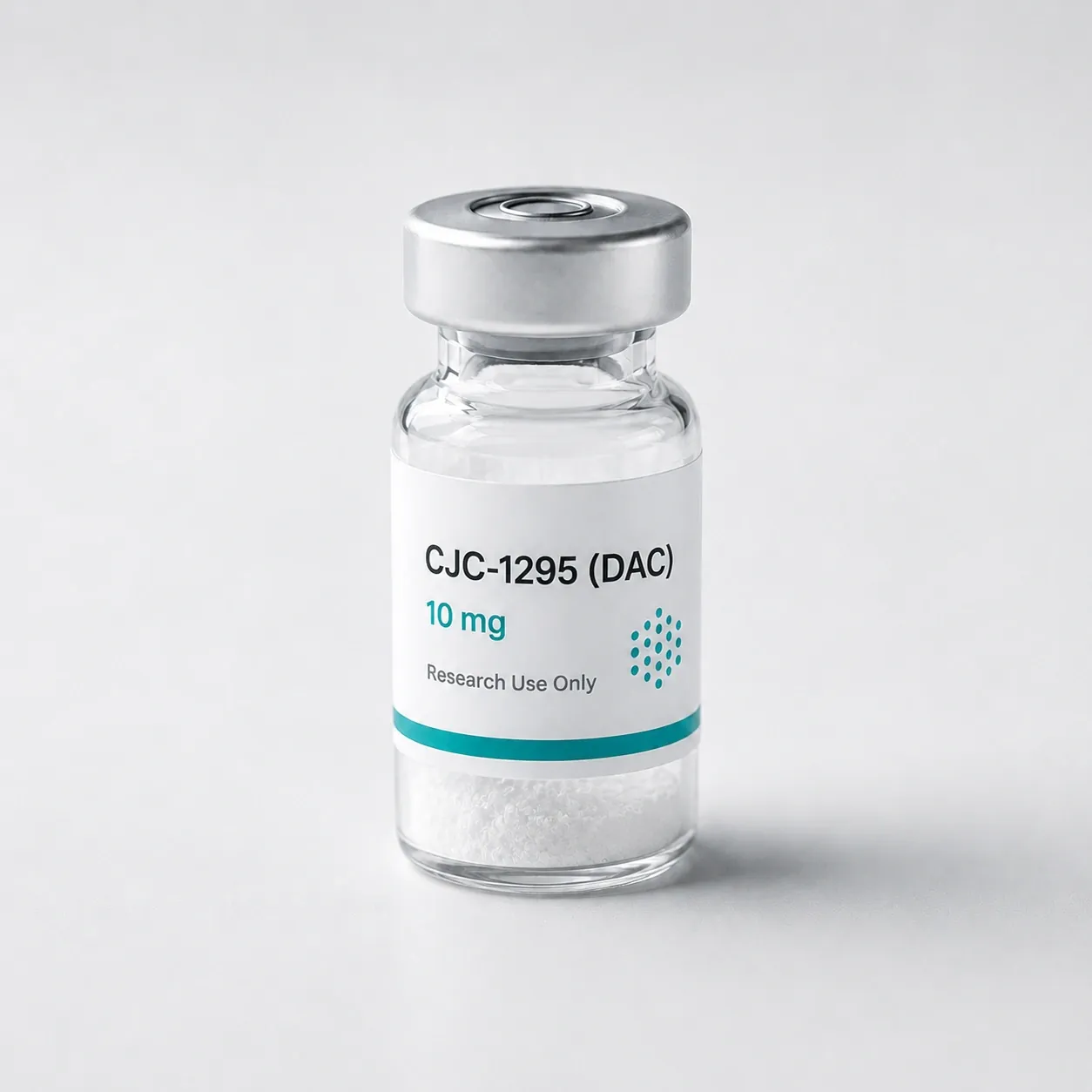
With DAC
The molecule ConjuChem actually named CJC-1295. A lysine carrying a maleimidopropionyl group at position 30 grabs onto albumin and holds on, so the peptide travels around attached to a protein the body clears slowly.
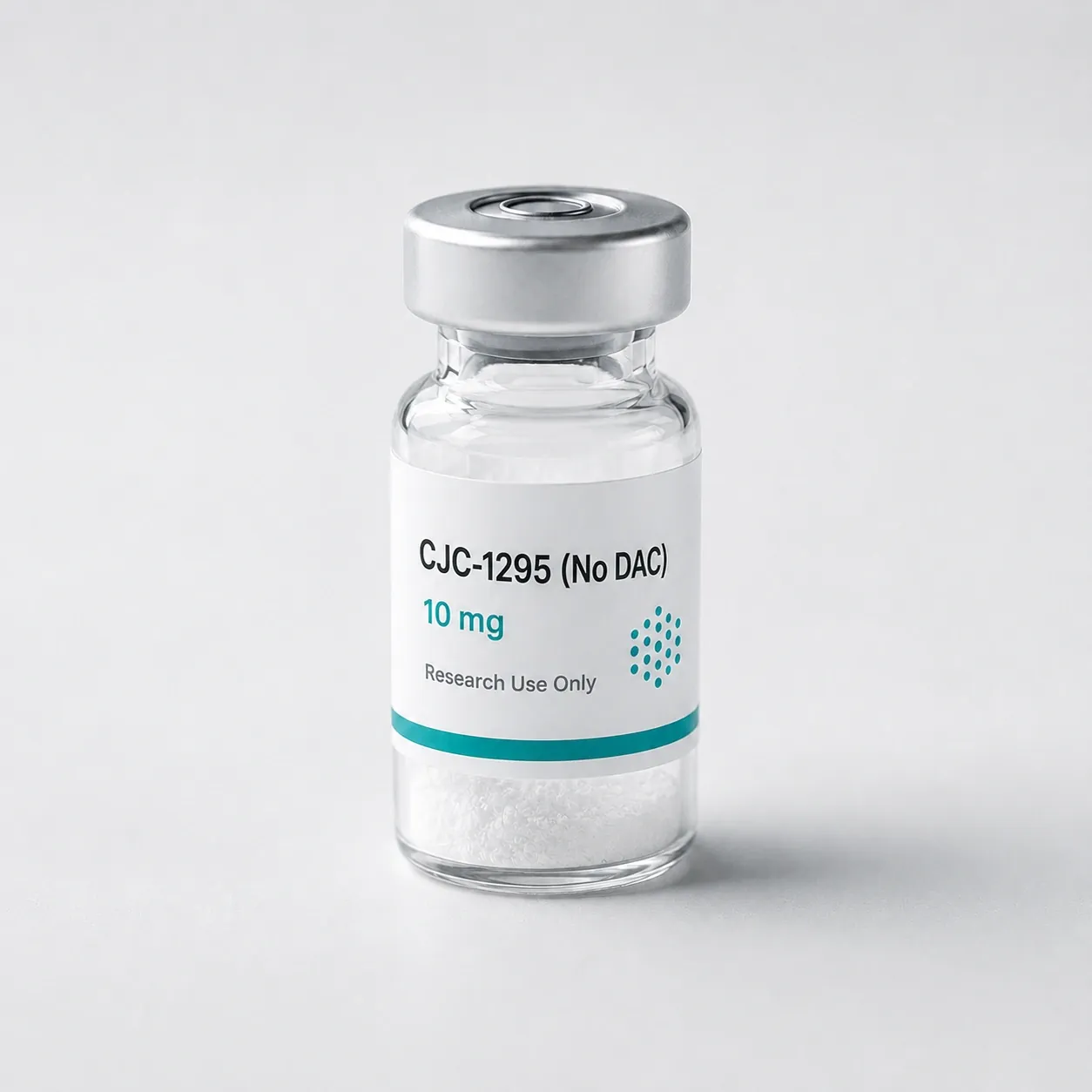
Without DAC
A molecule that already had a name before the peptide market borrowed CJC-1295 for it. Four substitutions on the 29 amino acid GHRH fragment, and nothing added on the end.
Where did the name confusion come from?
ConjuChem named it. The Canadian company made CJC-1295 in the mid 2000s, and the compound they named had the DAC on it. The 2005 paper describes it as a long lasting analog precisely because of the albumin binding. [4] So CJC-1295 with DAC is really just CJC-1295.
The other one had a name already. The thing sold as CJC-1295 without DAC is Modified GRF 1-29, and before that tetrasubstituted GRF 1-29. It existed on its own. It was never a version of CJC-1295. The market attached the name later because the two share a backbone.
Why this matters when you buy. A vial labeled only CJC-1295 is ambiguous. The original meaning of that name is the DAC version. The most common thing sold under it is not.
What is the actual difference between them?
Same 29 amino acids, same four swaps. One has a 30th. Everything else on this page follows from that single position.
The backbone is shared. All 29 positions, including all four substitutions, are the same in both. D-Ala at 2 makes the front end harder for DPP-4 to cut, Gln at 8 stops a chemical rearrangement, Ala at 15 improves activity, and Leu at 27 stops the methionine there from oxidizing.
The 30th does the work. Position 30 is what hooks onto albumin, the most common protein in the blood, and stretches the half-life from minutes to days. [4]
The formulas prove it. Without DAC is C152H252N44O42, around 3368 daltons. With DAC is C165H269N47O46, around 3647 daltons. The gap is about 280 daltons.
What does the evidence actually show?
What does the evidence actually show?
Geref Diagnostic approved
The FDA approves the unmodified 29 amino acid parent for testing pituitary function.
The closest measurement that exists
Soule, King and Millar give 10 healthy men an intravenous infusion of GRF 1-29 and of a version carrying only the D-Ala swap at position 2. Disappearance half-time 6.7 minutes, against 4.3 for the plain fragment. This is the nearest human data to Modified GRF 1-29 that exists, and it is a different molecule. [5]
- one substitution, not four
- intravenous, not subcutaneous
- not Modified GRF 1-29
Geref approved for children
Cleared by the FDA for growth hormone deficiency in children.
Jetté identifies the albumin binder
CJC-1295 is described as a long lasting GRF analog because of the albumin bioconjugate. Rat study. [4]
Teichman publishes two trials
Randomized, placebo controlled and double blind, in healthy adults aged 21 to 61 at two sites. Half-life 5.8 to 8.1 days in the single-dose study and 5.4 to 9.2 days in the repeat-dose study. Growth hormone up 2 to 10 times baseline for six days or more. [1] Ionescu and Frohman publish alongside, showing growth hormone still comes out in bursts. [2]
- randomized
- placebo controlled
- double blind
The Phase 2 stops
The trial in 192 people with HIV related visceral obesity is halted. A participant in Argentina died of a heart attack roughly three hours after his eleventh weekly injection. The attending physician concluded it was undiagnosed coronary artery disease with a plaque rupture, unrelated to the drug. Causality was never established. ConjuChem ended development as a precaution and no efficacy results were ever published. [6]
Approval withdrawn
Withdrawn after the maker stopped production. A later Federal Register notice states plainly that it was not withdrawn for reasons of safety or effectiveness. [16]
The class finishes a Phase 3
The FDA approves tesamorelin for the same condition CJC-1295 was being tested for when its trial stopped. 412 patients, 26 weeks, randomized and placebo controlled. IGF-1 rose 81 percent against a 5 percent fall on placebo. [13][14]
Category 2 at the FDA
Placed in Category 2 of the 503A bulk substances list, the category for substances that may present significant safety risks. The exact day is not confirmed, so this is stated as September 2023.
Removed, then voted down anyway
Removed from Category 2 after the nominations were withdrawn, then taken to the advisory committee regardless. On 4 December the committee votes with the FDA that none of the five CJC-1295 substances should be allowed for compounding. Four votes were unanimous at 13 to nothing; the fifth was 12 to 1. [7]
Nothing new since 2006
No new trial has been registered or published for either compound.
Modified GRF 1-29 appears on this timeline exactly once, and only as a molecule that resembles the one actually measured in 1994. Nobody has measured how long it lasts in a person, how much growth hormone it releases, what it does to blood sugar, or whether it provokes antibodies. Everything written about it draws on sermorelin research, on that 1994 measurement of a different molecule, or on animal work. [4][9] That is the real gap between these two products, and it is larger than the half-life difference.
Sermorelin and tesamorelin are useful reference points. Sermorelin is the unmodified parent, approved by the FDA and later pulled for commercial reasons rather than safety ones. Tesamorelin is the GHRH analog that finished development, with a full Phase 3 package behind it, and it succeeded in the exact condition where CJC-1295 stopped. Between them they show what this class looks like with a complete evidence file. Neither compound on this page has one.
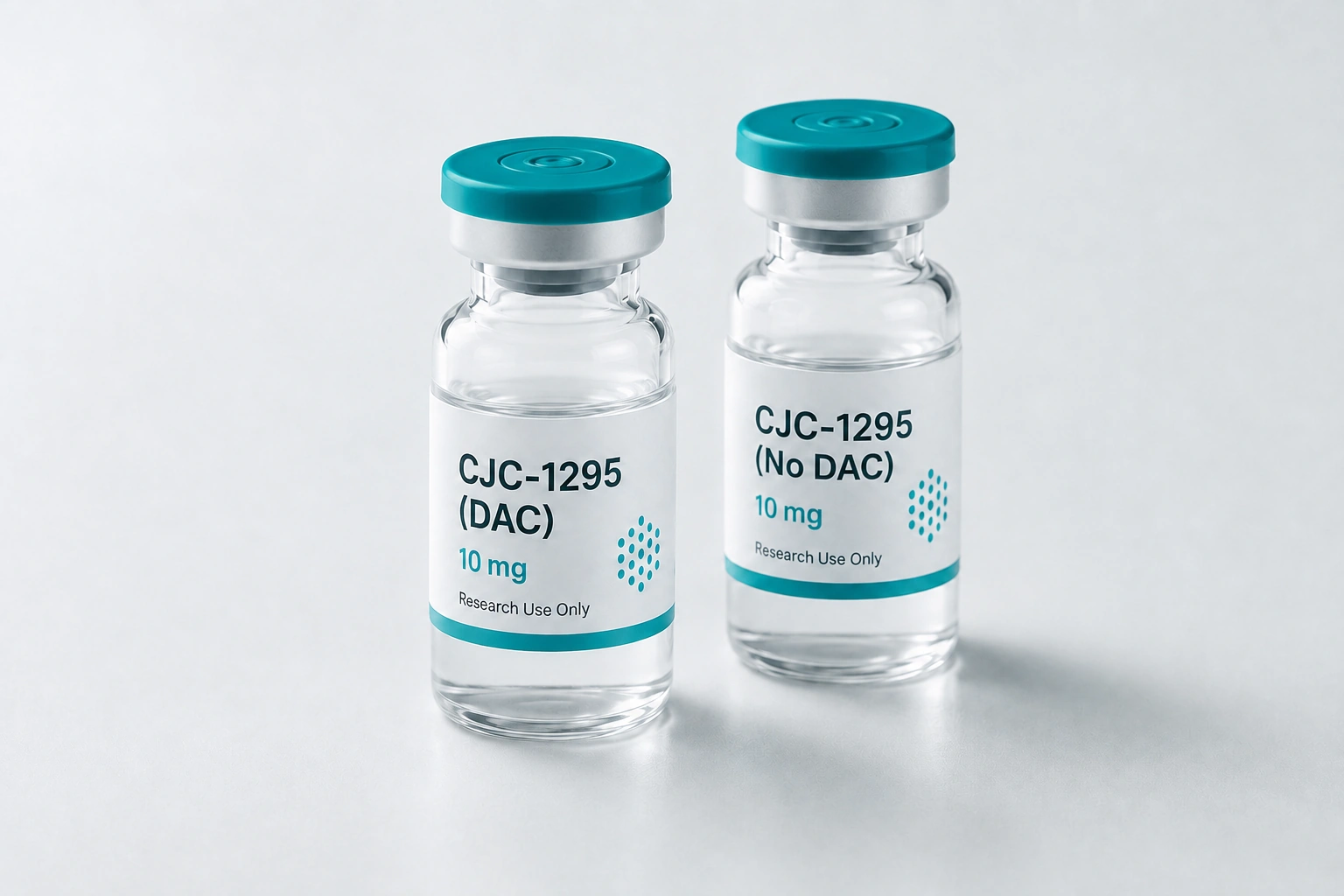
How do they compare, side by side?
How do they compare, side by side?
| Attribute | CJC-1295 with DAC | Modified GRF 1-29 |
|---|---|---|
| Also sold as | CJC-1295, DAC:GRF | CJC-1295 no DAC, CJC-1295 without DAC, tetrasubstituted GRF 1-29 |
| Amino acids | 30 | 29 |
| Structure | Four substitutions plus a lysine and maleimidopropionyl group at position 30 | Four substitutions, nothing added |
| How it lasts | Binds to albumin in the blood | Nothing beyond the substitutions |
| Half-life | 5.8 to 8.1 days, measured [1] | Not measured in any published human study |
| Human trials | Three published [1][2][3] | None found |
| Phase 2 | Started, halted 2006, never published [6] | Never started |
| GH effect | 2 to 10 times baseline for 6 days or more [1] | Not measured |
| IGF-1 effect | 1.5 to 3 times baseline for 9 to 11 days [1] | Not measured |
| Antibodies | Measured, none detected [1] | Never measured |
| FDA status | Never approved. Not permitted for compounding [7] | Never approved. Not permitted for compounding [7] |
| WADA status | Named on the Prohibited List [8] | Prohibited as an unnamed analog [8] |
How is each one built, and what does that do?
CJC-1295 with DAC
The same four-swap backbone, plus one lysine carrying a maleimidopropionyl group at position 30. That group grabs onto albumin and holds on, so the peptide circulates attached to a protein the body clears slowly. [4]
The consequence is measured rather than argued. A single injection raised growth hormone 2 to 10 times above baseline for six days or more, and IGF-1 1.5 to 3 times above baseline for nine to eleven days. After repeat dosing IGF-1 stayed above baseline for up to 28 days. [1]
Cortisol, prolactin, TSH and LH were measured in the 60 microgram per kilogram group and none of them changed. ACTH, FSH and insulin were not measured. [1]
Modified GRF 1-29
GHRH is the hormone the hypothalamus uses to tell the pituitary to make growth hormone. The first 29 amino acids do the whole job, and that fragment on its own is GRF 1-29, or sermorelin. Plain GRF 1-29 falls apart fast, because DPP-4 clips the front end off and leaves an inactive piece behind.
The four substitutions slow that down. They do not add length, and they do not bind anything in the blood, so nothing holds the molecule in circulation.
How short is short is the open question. The widely quoted 30 minutes has no published human measurement behind it. The nearest real figure, 6.7 minutes, belongs to a single-substitution molecule given through a vein in 1994. [5]
What did the trials actually find?
The doses. In the first Teichman trial, running 28 days, 42 people got one of four single doses: 30, 60, 125 or 250 micrograms per kilogram. In the second, running 49 days, 24 people were split into four groups: 30 micrograms per kilogram twice, 60 twice, 30 three times, or 20 three times, spread over two weeks. [1] Those numbers do not appear in the published abstract, which is why other sites report them wrong.
What happened to people, first trial. 33 of 35 people on the drug had some side effect, against 2 of 7 on placebo. Injection site reactions, meaning irritation, redness, hardness, pain or itching, happened in about 70 percent. A temporary hive-like rash at the injection site happened in nearly 30 percent. Headache in 63 percent, against 14 percent on placebo. Diarrhea in 43 percent. Flushing, warmth or a brief drop in blood pressure in 30 percent. Higher doses brought more of it. Hardness at the injection site could last up to five days, and no reaction spread wider than 10 centimetres. [1]
Second trial. Every actively treated person had an injection site reaction, all mild. Flushing rose with dose, from 40 percent in the low group to 100 percent in the high group. Headache ran from 20 to 80 percent depending on group. Two people had brief dizziness and low blood pressure after a first 30 microgram per kilogram injection. One person had short-lived involuntary leg muscle contractions and mild loss of coordination after a second. No serious adverse reactions occurred in either trial. [1]
A number to ignore. Many sites report that 80 percent of subjects had injection site reactions. That figure appears nowhere in the paper. The real figures are about 70 percent in the first trial and 100 percent in the second.
Antibodies and blood sugar. The trial looked for antibodies against the drug and found none, a result that applies to pharmaceutical grade material made under controlled conditions. It found no consistent changes in lab values including glucose, but no fasting insulin and no HbA1c were measured, so that question was never properly answered for this compound. In tesamorelin trials the effect was small and mostly temporary. [1][15]
What are the key differences?
What actually separates them?
- The names are backward. CJC-1295 was the DAC molecule from the start. The thing sold as CJC-1295 without DAC already had a name of its own, Modified GRF 1-29.
- One structural difference: a lysine carrying a maleimidopropionyl group at position 30. The 29 positions underneath, including all four substitutions, are identical.
- With DAC the half-life is measured at 5.8 to 8.1 days in randomized, placebo controlled, double blind trials. Without DAC, no published human study has measured anything at all.
- Three human trials exist for the DAC version. None exist for the version without it. The widely repeated 30 minute figure is an estimate, not a measurement.
- The DAC version holds growth hormone up for days. The short acting version is assumed to make a sharper, more natural burst, which nobody has demonstrated in a person.
- Neither has ever been FDA approved, and in December 2024 the advisory committee voted that neither should be allowed for compounding.
- Both are prohibited in sport at all times. CJC-1295 is named on the list; Modified GRF 1-29 is caught as a GHRH analog, which is not a loophole.
What has nobody answered?
What has nobody answered?
Does a week-long signal matter?Growth hormone normally comes in bursts, mostly at night, with quiet stretches in between, and those stretches appear to matter for how tissues respond. Ionescu and Frohman looked at whether the bursts survived under sustained stimulation and found growth hormone was still released in discrete pulses rather than flattening into a straight line. [2] The concern is reasonable, and the one measurement that tested it did not support the worst version of it.
Does raising IGF-1 raise cancer risk?No study of either compound shows that. A UK Biobank analysis of 394,388 people found higher natural IGF-1 associated with breast, prostate, colorectal, melanoma, kidney and thyroid cancers, and with lower rates of several others. [10] A review pooling 96 studies found higher IGF-1 raised overall cancer risk by about 15 percent. [11] Those studies measured the IGF-1 people naturally have, not IGF-1 raised by a drug, and association is not cause. [12]
How long is long term?The longest published trial of either compound ran 49 days. When tesamorelin was approved, the FDA required a long term study of heart events and cancer risk, because the effect of years of raised IGF-1 was not known. That question is still open for the whole class.
What are the side effects, and what are you buying?
What are the side effects?
The contraindications below are taken from the tesamorelin label, the only approved GHRH analog. Neither compound on this page has an approved product to compare against.
Firm contraindications
Taken from the tesamorelin label.
- Active cancer, newly found or returnedabsolute
- Pregnancyabsolute
- Known allergy to the peptideabsolute
- Any disruption of the hypothalamic and pituitary systemabsolute
Conditions growth hormone can worsen
Raising growth hormone is not neutral in these situations.
- Diabetes or prediabetes, since growth hormone raises blood sugarcaution
- Diabetic retinopathy, which growth hormone can worsencaution
- Untreated low thyroid, which growth hormone can unmaskcaution
- Any history of cancercaution
What is in the vial
Identity rests entirely on the seller's word.
- Seized peptides tested 5 to 75 percent pure, plus arsenic and lead [17]analysis
- A US lab reported problems in almost 30 percent of samples, including bacteria [18]testing
- A high purity certificate does not rule out contaminants standard testing misses [19]caveat
- FDA warning letters to bulk peptide makers over sterility and testing failuresregulatory
*Where this page says nothing is established, it means nobody has studied it. It does not mean a compound is safe.
One more thing from the FDA review. In animal studies submitted for CJC-1295, the agency noted DNA damage in pituitary cells and inflammation and tissue death at injection sites, alongside reduced food and water intake, looser stools, less activity, vomiting, lower hemoglobin and higher cholesterol. [7] Those are animal findings, and they were part of why the agency did not want the substance compounded. Our guide on reading a certificate of analysis covers what to actually look for.
Are they banned in sport?
Are they prohibited in sport?
This reflects the 2026 Prohibited List, in force from 1 January 2026. WADA publishes a new list each September, so check the current version if you are reading this later in the year.
Section S2.2.4 names GHRH and its analogs, giving CJC-1293, CJC-1295, sermorelin and tesamorelin as examples. CJC-1295 is named outright.
Modified GRF 1-29 is not named anywhere on the list, and this is not a loophole. The section covers GHRH and its analogs, with the named compounds given as examples rather than a complete list. Modified GRF 1-29 is a GHRH analog, so it is prohibited on the same footing. WADA also states plainly that absence from the list does not mean a substance is allowed.
Both are prohibited at all times, in and out of competition. Testing labs have methods that detect the intact peptide and its breakdown products, and the long half-life of the DAC version gives it the longest detection window of the GHRH analogs. Substances in this class are non-specified, which means a default four year ban.
Are they FDA approved?
What is the regulatory position?
Sep 2023
- CJC-1295 placed in Category 2 of the 503A bulk substances list
- That category is for substances that may present significant safety risks
- Compounding pharmacies could no longer make it
Sep 2024
- Removal is cited everywhere as the FDA changing its mind on safety
- What happened is that the nominating parties withdrew their nominations
- The FDA states a flagged substance may be absent for exactly that reason
Dec 2024
- All five CJC-1295 related substances kept off the final 503A list
- Four votes unanimous at 13 to nothing, the fifth 12 to 1 [7]
- The nomination covered CJC-1295, Modified GRF 1-29 and CJC-1295 with DAC together
As things stand, neither version is on the 503A list, neither is on the 503B outsourcing facility list, neither has a USP monograph, and neither is part of any approved drug. There is no legal route to compound either one for human use.
Questions people ask
Are CJC-1295 no DAC and Mod GRF 1-29 the same thing?
Yes. Same molecule, two names. Modified GRF 1-29 is the older and more accurate one, since the compound was never a version of CJC-1295 to begin with.
Which one is in the CJC-1295 and ipamorelin blends?
Usually the no-DAC version, meaning Modified GRF 1-29. That is not guaranteed and it is not always stated on the label. Ask before you buy and check the certificate of analysis.
Does CJC-1295 with DAC really last a week?
The measured half-life is 5.8 to 8.1 days. In the trials a single injection kept growth hormone up for six days or more and IGF-1 up for nine to eleven days.
Is the 30 minute half-life for the no-DAC version accurate?
Nobody has published a human measurement of it. The nearest real data, from 1994, measured a related single-substitution molecule at 6.7 minutes through a vein. The 30 minute figure gets repeated as though it were measured.
Does it cause cancer?
No study shows that. Large studies do link higher natural IGF-1 to higher rates of several cancers, and these compounds raise IGF-1. Nobody has run a long term study of either one, so the question is open rather than answered.
Will it mess up my blood sugar?
The trials found no consistent glucose changes, but they never measured fasting insulin or HbA1c. In tesamorelin trials the blood sugar effect was small and mostly temporary. If you have diabetes or prediabetes, this is a conversation for a doctor.
Are they FDA approved?
No. Neither has ever been approved for any use, and in December 2024 the FDA's advisory committee agreed neither should be allowed for compounding.
Which one should I use?
We do not give dosing or usage advice. What we can say is that one has published human data and one has none, and any comparison treating them as two settings of the same product is skipping that.
What this page is built on
- 01Teichman SL, Neale A, Lawrence B, Gagnon C, Castaigne JP, Frohman LA. Prolonged stimulation of growth hormone (GH) and insulin-like growth factor I secretion by CJC-1295, a long-acting analog of GH-releasing hormone, in healthy adults. J Clin Endocrinol Metab. 2006;91(3):799-805. PMID 16352683. Human clinical trial, CJC-1295 with DAC.
- 02Ionescu M, Frohman LA. Pulsatile secretion of growth hormone (GH) persists during continuous stimulation by CJC-1295, a long-acting GH-releasing hormone analog. J Clin Endocrinol Metab. 2006;91(12):4792-7. PMID 17018654. Human study, CJC-1295 with DAC.
- 03Sackmann-Sala L, et al. Activation of the GH/IGF-1 axis by CJC-1295, a long-acting GHRH analog, results in serum protein profile changes in normal adult subjects. Growth Horm IGF Res. 2009;19(6):471-7. Human study, CJC-1295 with DAC.
- 04Jetté L, et al. Human growth hormone-releasing factor (hGRF)1-29-albumin bioconjugates activate the GRF receptor on the anterior pituitary in rats: identification of CJC-1295 as a long-lasting GRF analog. Endocrinology. 2005;146(7):3052-8. PMID 15817669. Animal and laboratory study.
- 05Soule S, King JA, Millar RP. Incorporation of D-Ala2 in growth hormone-releasing hormone-(1-29)-NH2 increases the half-life and decreases metabolic clearance in normal men. J Clin Endocrinol Metab. 1994;79(4):1208-11. PMID 7962295. Human pharmacokinetic study of the single D-Ala2 molecule, not Modified GRF 1-29.
- 06ClinicalTrials.gov NCT00267527. A study to evaluate CJC-1295 in HIV patients with visceral obesity. Trial registry. Halted 17 July 2006. No results published.
- 07US Food and Drug Administration. Pharmacy Compounding Advisory Committee briefing documents and vote record, 4 December 2024. Nomination docket FDA-2024-N-4777. Regulatory documents.
- 08World Anti-Doping Agency. The 2026 Prohibited List, section S2.2.4. Effective 1 January 2026. Regulatory document.
- 09Alba M, et al. Once-daily administration of CJC-1295, a long-acting GHRH analog, normalizes growth in the GHRH knockout mouse. Am J Physiol Endocrinol Metab. 2006;291(6):E1290-4. Animal study.
- 10Watts EL, et al. Circulating insulin-like growth factor-1 and risk of total and 19 site-specific cancers: cohort study analyses from the UK Biobank. Cancer Res. 2020;80(18):4014. PMID 32856611. Human cohort study, 394,388 participants.
- 11Chen W, et al. Phenotypes and genotypes of insulin-like growth factor 1, IGF-binding protein-3 and cancer risk: evidence from 96 studies. Eur J Hum Genet. 2009. PMID 19491931. Meta-analysis.
- 12Patel AV, et al. IGF-1, IGFBP-1, and IGFBP-3 polymorphisms predict circulating IGF levels but not breast cancer risk. PLoS One. 2008;3(7):e2578. Human consortium study.
- 13Falutz J, et al. Metabolic effects of a growth hormone-releasing factor in patients with HIV. N Engl J Med. 2007;357:2359-2370. PMID 18057338. Human Phase 3 trial, tesamorelin.
- 14Falutz J, et al. Long-term safety and effects of tesamorelin. J Acquir Immune Defic Syndr. 2010;53:311-322. PMID 20101189. Human Phase 3 extension, tesamorelin.
- 15Clemmons DR, et al. Safety and metabolic effects of tesamorelin in patients with type 2 diabetes: a randomized, placebo-controlled trial. PLoS One. 2017;12(6):e0179538. Human clinical trial, tesamorelin.
- 16Federal Register. Determination that Geref (sermorelin acetate) injection was not withdrawn from sale for reasons of safety or effectiveness. 4 March 2013. FR Doc 2013-04827. Regulatory document.
- 17Janvier S, Cheyns K, Canfyn M, Goscinny S, De Spiegeleer B, Vanhee C, Deconinck E. Impurity profiling of the most frequently encountered falsified polypeptide drugs on the Belgian market. Talanta. 2018;188:795-807. DOI 10.1016/j.talanta.2018.06.023. Peer-reviewed analytical study.
- 18NBC Washington. Lab finds problems in 30% of peptide vials tested. December 2024. News report of commercial laboratory testing, not peer reviewed.
- 19Castellino F, et al. Mutagenic contaminants in azide-coupled synthetic peptides. 1991. Peer-reviewed analytical study.