
How to Read a Peptide COA (Certificate of Analysis)
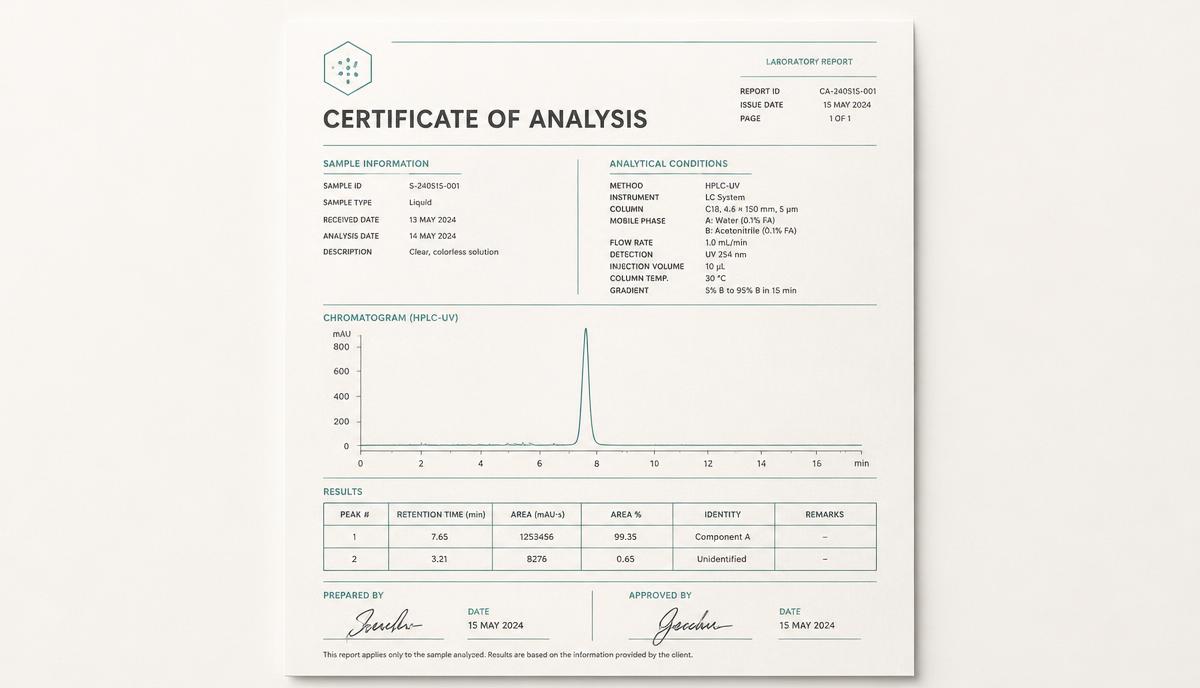
Every vendor worth buying from will hand you a COA. Most people look at the purity number, see 99%, and close the file. That number is close to the least useful thing on the page.
Here is what the document contains, what each test can and cannot establish, and what to check before you trust it.
What is a COA?
A Certificate of Analysis is a lab report on one batch of one compound. It says: we tested this material, here is how pure it was, here is evidence it is the molecule it claims to be.
The words doing the work there are "one batch." A COA does not certify the vendor, the product line, or the compound in general. It covers a single production lot. Most of the checks below follow from that.
What does the purity number mean?
Purity comes from HPLC, high performance liquid chromatography. The sample gets pushed through a column that separates it into its components, and a detector records what comes out and when. The output is a chromatogram, a line with peaks on it, each peak a different substance in the sample.
The percentage is the area of the main peak divided by the area of all peaks combined. A result of 99.1% means the main component accounted for 99.1% of what the detector saw.
So HPLC tells you the sample is mostly one thing. It cannot tell you what that thing is. A vial can test at 99% and be the wrong peptide, purely and consistently. Identity is a separate question, answered by a separate test.
What purity is good enough?
Most vendors claim 98% or higher and that is what to expect. Above 99% is common for short, simple peptides. Long or structurally complex ones can come in at 95% without anything being wrong.
Below 95%, ask what the impurities are. Below 90%, walk away.
The decimal places matter less than people think. A purity figure depends on the column, the gradient, and the detection wavelength, and two competent labs testing identical material can report results a couple of percentage points apart. This is why a decent COA states the method, something like "98.6% by HPLC at 220 nm," instead of a bare number.
A 99.6% claim on a document you cannot verify is worth less than a 98.1% result from a named lab on a lot number that matches your vial.
Does the lot number match your vial?
Find the batch or lot number on the COA. Look at the label on your actual vial. If they do not match, the report describes material you do not have.
If your vial has no lot number at all, nothing can be tied to it, and the COA is decoration.
Check the test date while you are there. A report dated two years ago, attached to something you just bought, means the vendor is reusing it across new batches.
What does mass spectrometry prove?
Mass spectrometry measures molecular weight. Every peptide has a fixed weight set by its amino acid sequence, so a measured mass that matches the expected mass is strong evidence you have the right molecule.
On a COA this shows up as two numbers, theoretical or expected mass and observed or found mass. They should sit within roughly one unit of each other for most peptides. A wider gap means something else is in the vial.
Two limits worth knowing. Peptides built from the same amino acids in a different order weigh exactly the same, so a matching mass supports identity without proving it. Confirming the actual sequence takes MS/MS or peptide sequencing, which consumer-facing COAs almost never include. Mass spec also says nothing about how much of the vial is that molecule, which is what the purity test is for.
| HPLC purity | Mass spectrometry | |
|---|---|---|
| What it measures | The main peak's share of total peak area | Molecular weight |
| What it establishes | Most of what is in the vial is one thing | Very probably the right molecule |
| What it cannot tell you | What that thing is | How much of the vial is that molecule |
| Where it fails | A pure sample of the wrong peptide passes | Peptides with the same residues in a different order weigh the same |
| What you should see | A method and wavelength alongside the figure | Theoretical and observed mass, close together |
Between them the two tests cover the two questions. Mass spec, very probably the right compound. HPLC, most of what is in the vial is that compound.
Who ran the test?
A vendor testing its own product and an independent lab testing it are different things.
An in-house COA still shows the vendor has quality control at all, which many do not. The incentive problem is obvious enough that it should never be the only document you have.
A third-party COA should name the lab clearly, with contact details or a website, and usually a report number. Some labs let you enter that number on their own site and pull up the original. Do it when the option exists. Most COA fraud is not fabricated from nothing, it is a real report from a real lab with the fields edited, and checking against the source kills it.
An unnamed lab, a generic letterhead, or a free email address as the only contact means you are holding a vendor claim rather than independent evidence.
How can you tell if a COA has been edited?
Open the file properties. Right-click, then Properties or Get Info, then the document details.
You are looking at two things: what software created the file, and when. Lab reports come out of lab or reporting software. If the creating application is an image editor or a word processor, someone built that document by hand. If the creation date falls weeks after the stated test date, ask about it.
Try to highlight the text as well. A COA that is one flat image with nothing selectable has usually been screenshotted and re-saved, which is what you would do to hide an edit.
How do you read the chromatogram?
A stated percentage with no chromatogram is a claim. Ask for the version with the trace on it.
Look for one dominant peak with a flat baseline around it. That is a clean sample.
Small peaks clustered right beside the main one are usually related impurities, sequences that came out of synthesis slightly wrong, missing a residue or carrying an extra fragment. A few tiny ones are normal. A crowd of them, or one that is a real fraction of the main peak, points to sloppy synthesis or poor purification.
A large peak at the very start of the run is the solvent front. Normal, and labs generally exclude it from the calculation.
Somewhere on the page there should be a detection wavelength, usually 214 or 220 nanometres. Its absence tells you how much care went into the report.
What is net peptide content?
Purity is a percentage of the peptide-related material the detector saw. It is not a percentage of the powder in your vial.
Synthesised peptides carry counterions from purification, usually trifluoroacetate or acetate, plus some residual water. That is real weight in the vial that is not peptide. Net peptide content is the figure that accounts for it, measured separately by amino acid analysis or nitrogen determination.
Most COAs in this space do not report it. Without it you cannot tell whether the milligram number on the label is gross weight or actual peptide, which is one of the quieter reasons two vials of the same nominal size can behave differently. Ask a vendor about it directly. Whether they understand the question is informative on its own.
Blends are a different document
A vial holding two or more compounds needs a report that treats them separately: purity for each, mass confirmation for each, and the ratio between them.
A single purity figure on a blend tells you almost nothing. It does not say how much of each compound is in the vial, which is the only number you can dose from, and our guide on spotting a wrong dose calculation covers what happens when someone uses the label total instead.
Ask for a component breakdown. A vendor selling a blend without one either has not tested it that way or is not telling you the ratio, and both answers matter.
What a COA does not cover
Sterility and bacterial endotoxin are separate analyses that standard peptide COAs leave out. Labs do offer them, so a vendor paying for endotoxin testing is telling you something real about how seriously they take this.
Fill accuracy is separate too. The batch can be exactly what the report says and your particular vial still be short.
Handling is outside it entirely. Material that tested at 99% can be degraded by heat in transit or by months in a warm warehouse.
Then there is the join between the report and the vial in your hand, which rests on the vendor's word and the lot number matching.
What are the red flags on a fake COA?
Any one of these is reason to stop and ask questions.
- No lot number, or a lot number that does not appear on your vial.
- A purity figure with no chromatogram behind it.
- The lab is not named, or cannot be found.
- A stated purity of exactly 100.0%. Real analytical results essentially never land there.
- No method or wavelength given alongside the purity figure.
- The same chromatogram appearing under different compound names on one vendor's site.
- Mismatched fonts, misaligned text, or fields pasted into an otherwise clean document.
- A PDF created in an image editor or word processor, or a flat image with no selectable text.
- A test date that predates the batch, or no date at all.
- A compound name that does not exactly match what you ordered.
The first one on that list does most of the work. A vendor who will not give you a report tied to your lot number has already told you what you needed to know.
What your own vial should look like
Since the COA stops at the lab door, your eyes handle the rest.
A properly freeze-dried peptide is a white to off-white cake or powder. It might be a solid disc at the bottom, it might be loose powder, it might have broken up in transit. All normal.
Yellow or brown tint is not. Neither is an oily or wet look, a cake collapsed into a sticky smear, a loose stopper, or a damaged seal. Those point to moisture getting in or the vial getting warm, and no certificate covers what happened in shipping. If a mixed solution comes out cloudy or has anything floating in it, do not use it.
Can you test it yourself?
You can, and it is the answer if you finish this and conclude you cannot fully trust a document handed to you by someone selling you something.
Independent labs will test a sample you send. You buy the vial, ship a portion, and get a report requested in your name rather than the vendor's. Pricing varies enormously, from labs that specialise in serving this community to pharmaceutical analytical services charging several times more for the same core tests, so get a current quote before assuming either. Group testing, where several people who bought the same batch split the cost, is common and brings the per-person figure down.
Nobody does this for every vial. Doing it once, on the first order from a new vendor, tells you more about the rest of their catalogue than any COA they send you.
Working through one
Ask for the COA matching your lot number rather than the one on the product page. Check the lot, the date, the lab, and the file properties. Compare observed mass against expected. Look at the chromatogram if there is one.
A COA describes what a sample of a batch looked like on one day in one lab. The rest of the picture is the vendor, which is the next thing to work through.
Common questions
Do all peptide vendors provide a COA?
No, and the ones that do vary in what they mean by it. Some publish a single report on the product page that covers the compound generally rather than the batch you were sent. Others hold reports and send them on request. A vendor with nothing at all is not worth working through the rest of this guide for.
What if a vendor will not give me the COA for my lot?
Treat that as an answer. A vendor who tests batches has the report and can send it. One who does not can say so, and some will, which is more useful than a generic PDF. What you want to avoid is the third response, where you ask for your lot and get the same product-page document back a second time.
Can a COA be faked?
Yes, and usually not in the way people expect. Fabricating a report from scratch is rare. Far more common is reusing a genuine report across batches it does not cover, or taking a real lab's document and editing the compound name, the lot number, or the purity figure. Verifying the report number with the lab and checking the file properties catch most of both.
Is a COA the same as third-party testing?
No. A COA is a document format, not a statement about who produced it. A vendor testing its own material issues a COA too. The lab name on the report is what separates the two, and its absence is the tell.
What should a COA for a blend show?
Each compound separately: its own purity, its own mass confirmation, and the ratio between them. A single purity figure on a multi-compound vial does not tell you how much of each compound you have, and that ratio is the only thing you can dose from.
Does a COA mean a peptide is safe to inject?
It does not. A COA speaks to the identity and purity of a batch of powder. Sterility, bacterial endotoxins, how accurately the vial was filled, and what happened to it in shipping all sit outside the report. Material sold for research is not manufactured to injectable standards regardless of how good its purity figure looks.
Why does the COA say "for research use only"?
Because the material has not been produced or assessed for human use. It appears on essentially everything in this category. The phrase is not a formality, it means no regulator has looked at the facility, the process, or the finished product, and it is true even when the compound itself is an approved drug in another form.
How recent does a COA need to be?
There is no fixed shelf life, but it has to correspond to the batch you were sent. A report cannot describe material produced after it was written, so a COA predating your vial's production is disqualifying no matter how good the numbers are. Where a vendor tests each batch, the test date and the batch date should be roughly in line.
Can two labs report different purity for the same vial?
Yes, routinely. Purity depends on the column, the gradient, and the detection wavelength, so two competent labs can land a percentage point or two apart on identical material. A gap of that size is normal. A gap of ten points means one of the two reports is wrong.
My COA says 97%. Should I send it back?
Probably not, on that number alone. Some peptides are longer and harder to synthesise, and 95 to 97% is a legitimate result for them. The question worth asking the vendor is what the remaining few percent consists of. Spend the effort on verifying the report is real rather than on the decimal places.
Do I need to check a COA from a well-known vendor?
The checks cost you a couple of minutes either way. Reputation also lags reality: vendors change contract manufacturers, batches vary, and the goodwill a seller earned two years ago says nothing about the vial in front of you now.
Keep reading
- How to Vet a Peptide Vendor
Independent third-party COAs, HPLC purity, mass spectrometry, US synthesis, and the red flags that mean walk away.
- How to Reconstitute a Peptide
Mix peptide powder with bacteriostatic water, step by step.
- mcg vs mg
1 mg equals 1,000 mcg.
- My Peptide Vendor Vanished. What Now?
How you paid decides most of what happens next.
- The Nootropic Peptides, Sorted Out
Five compounds, five kinds of thing.
The peptide stuff worth knowing.
Get new guides, tools, compound pages, and important peptide news in your inbox 1–3 times a month. If there’s nothing worth sending, we don’t send one.