
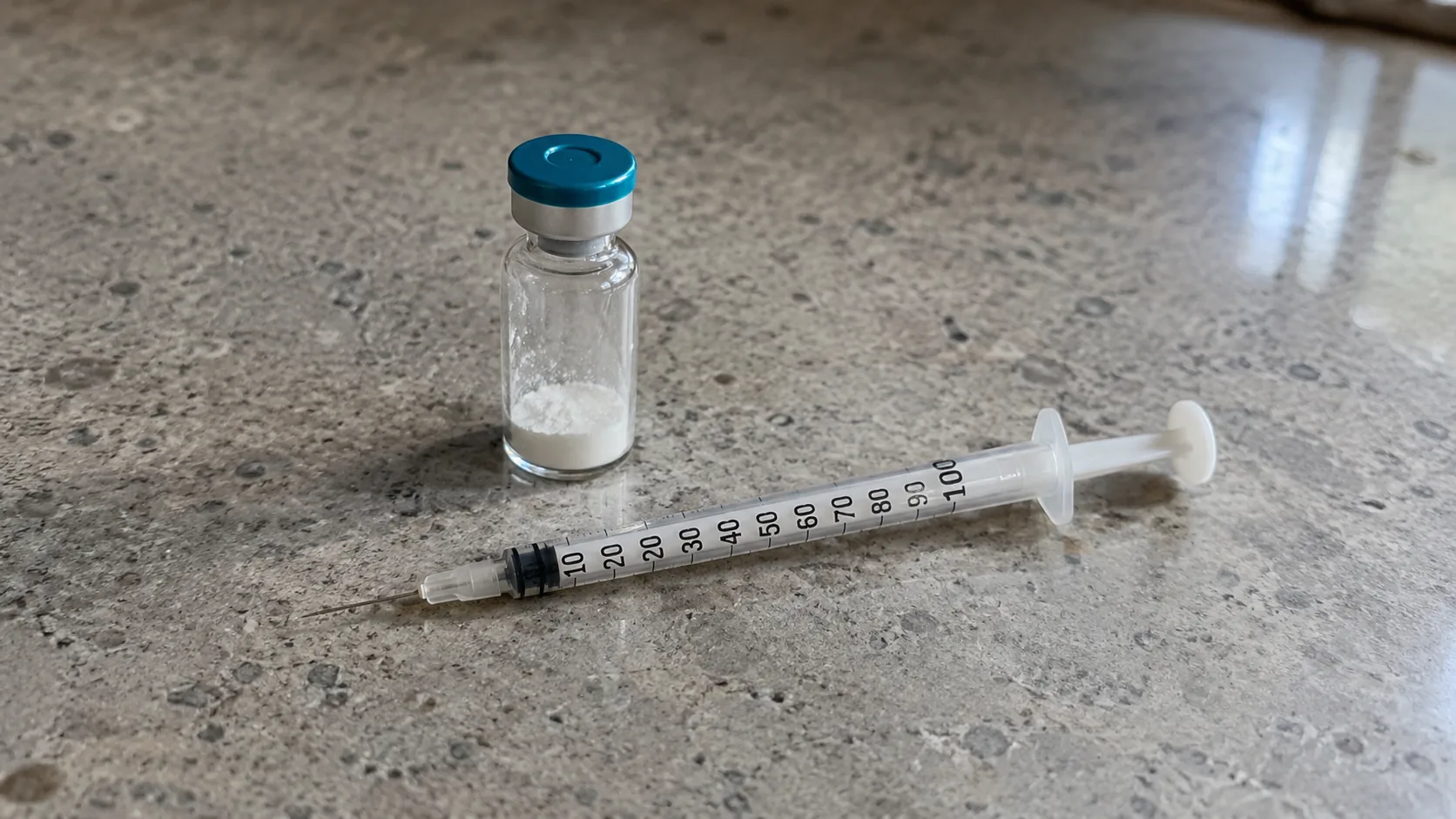
Start with the difference between arithmetic and modeling if two calculators disagree.
Four answers that should stop you
| Check | What you see | What it usually means |
|---|---|---|
| Under 2 units | A draw near the bottom of the barrel | Too little water, or a unit typed wrong |
| Over 50 units | More than half a syringe | Milligrams and micrograms swapped, unless it is a mg-dosed compound |
| Fewer than three doses in the vial | Doses per vial of 1, 0, or a decimal | A thousand-fold error |
| A blend | Any number derived from the label total | The vial total is not the concentration of anything in it |
Why the answer is the thing to check
The arithmetic is not hard. Divide, multiply, done, and a dozen free calculators will do it for you.
What none of them do is ask whether your inputs were sensible or where that dose figure came from, or account for the fact that your vial may hold less peptide than the label says. Type 250 mg where you meant 250 mcg and a calculator returns a confident number. Type 0.25 mcg where you meant 0.25 mg and it does the same.
There is a comment thread on one of those calculator pages where somebody asks how much to draw for a 5 mg dose from a 5 mg vial. The reply is the useful one: all of it, and are you sure your numbers are correct.
That question is the check, and everything below is how to run it on your own numbers.
The checks
Under 2 units
If your calculated draw is one or two units, something is probably wrong, and even if it is right you should change it.
Each unit on a U-100 insulin syringe is 0.01 mL. At two units you are trying to hit a mark near the very bottom of the barrel, where a small slip is a large proportion of the dose.2 Missing by half a unit at 2 units is a 25% error. Missing by half a unit at 20 units is 2.5%.
A tiny draw comes from one of two places. Either you used far too little water, or you typed the dose in the wrong unit.
If the number is genuinely right and just small, add more water. The same dose from more diluent lands further up the barrel,2 which is the whole reason to think about reconstitution volume at all.
Over 50 units
More than half a full syringe for a single dose is unusual outside the GLP-1 drugs, and it usually means milligrams and micrograms have been swapped somewhere.
A worked case. Tesamorelin at 2 mg from a 5 mg vial in 2 mL comes out at 80 units, which is correct, because the approved dose really is that large relative to the vial. Most growth hormone peptides do not behave that way. Ipamorelin at 200 mcg from the same vial is 8 units.
So a large draw does not automatically mean an error, and it does mean checking whether your compound is one where large draws are normal.3
Fewer than three doses in the vial
The quietest of the four, and the most useful, because it catches the thousand-fold error in a single glance.
A 5 mg vial at 250 mcg per dose contains 20 doses. At 200 mcg, 25 doses.
Type 250 mg instead of 250 mcg and the calculator will happily tell you to draw 10 units. The tell is in the doses. Your 5 mg vial now contains one two-hundredth of a single dose, and you would need a hundred vials for one injection.
A decent calculator shows doses per vial. If that number is 1, or 0, or a decimal, stop.
A blend where you used the number on the label
This one produces a wrong answer with no visible symptom at all.
A blend vial holds two to four different compounds, and the number printed on the front is the total of all of them. That total is not the concentration of anything in the vial.
Take a GLOW vial labeled 70 mg. In the most common configuration it holds 50 mg of GHK-Cu, 10 mg of BPC-157 and 10 mg of TB-500, and formulations vary between vendors, which is its own reason to check.6 Reconstitute in 2 mL and aim for 250 mcg of BPC-157.
Using the vial total: 70 mg in 2 mL reads as 35 mg/mL, and 250 mcg works out at 0.71 units.
Using the BPC-157 content: 10 mg in 2 mL is 5 mg/mL, and 250 mcg is 5 units.
Seven times apart. And the wrong answer has a tell built in, because 0.71 units is not a number you can draw on any syringe. Anyone who got that figure had to guess at a real one.
Our dose calculator handles blends by component. If you are using a general one, do the division on the component you actually care about, not the number on the front of the vial. And mixing two compounds yourself is not a way around a ratio somebody else fixed.
And the check that needs no arithmetic at all
If you have dosed this compound before and today's number is different, something changed.
It catches errors the other four miss, because it does not require knowing what a correct answer looks like. It only requires noticing that last time you drew 10 units and today the calculator says 25.
Legitimate reasons for it to change: a different vial size, a different amount of water, a different syringe, or a deliberate dose change. If none of those happened, you have a typo.
All of which depends on remembering what you did last time, so write it down.
Write the concentration on the vial
Ten seconds, and it removes most of the guesswork above.
When you reconstitute, write the concentration and the date on the vial itself. Not the vial size, which is already printed on it. The concentration you created, and for a blend, the component you dose by.
2.5 mg/mL, 12 Aug.
Three weeks later you do not have to remember whether you used 2 mL or 3, and you do not have to reconstruct it from a calculator. The number that governs every draw is on the thing you are drawing from.
For a blend, write the component you actually dose by, since the vial label will not give you that number.
The volume is a choice, not a rule
"Under 2 units" reads as a warning when it is usually an instruction.
There is no correct amount of water. There is an amount that puts your dose somewhere readable on the syringe.2
Same 5 mg vial, same 250 mcg dose. In 1 mL it is 5 units. In 2 mL it is 10. In 5 mL it is 25. All three deliver the identical amount of peptide. They differ only in how easy the mark is to hit and how many days the vial lasts once mixed.
| Water added | Concentration | 250 mcg draw |
|---|---|---|
| 1 mL | 5 mg/mL | 5 units |
| 2 mL | 2.5 mg/mL | 10 units |
| 5 mL | 1 mg/mL | 25 units |
So a two-unit draw is a prompt to pick a different volume next time, not a problem to live with.
Two more that catch different errors
Your dose and your vial label are in different units. Vials are almost always labeled in milligrams. Doses are almost always described in micrograms.2 That mismatch is where the thousand-fold error lives, and one conversion sits between them: 1 mg is 1,000 mcg. Our guide on mcg vs mg covers the three ways it actually goes wrong.
Units are not millilitres and neither is IU. A unit on a U-100 syringe is a volume, 0.01 mL. IU is a potency measure, not a weight or a volume, and it turns up on HGH and HCG more than on other peptides. A 25-unit draw becomes 25 IU only at one specific reconstitution.1
The check that costs nothing
Before you draw, say the whole thing out loud as a sentence.
This vial holds 5 milligrams. I added 2 millilitres. That is 2.5 milligrams per millilitre. I want 250 micrograms, which is a quarter of a milligram, so I need a tenth of a millilitre, which is 10 units.
If any part of that sentence sounds wrong as you say it, it is. The errors above are difficult to spot in a calculator field and obvious in a sentence, because a sentence forces the units to line up.
What changes your numbers after you have set them
These three invalidate a calculation you already did.
Adding more water later. Every dose you worked out was based on the volume you started with. Adding to it changes the concentration and every future draw with it.
Switching vial size. A 10 mg vial is not a 5 mg vial with a different label. Same dose, same water, double the concentration, half the draw.
Changing syringes. U-100 and U-40 syringes both say units and mean different things.5 On a U-100, 100 units is 1 mL. On a U-40, 40 units is 1 mL. Drawing to the same mark on the wrong syringe gives you a different volume.
If you realise afterward
Everything above is about catching it beforehand. Somebody reading this having already injected needs a different answer, and it depends on the direction.
Too little is usually a wasted dose, not a hazard. The common response is waiting for the next scheduled one instead of topping up, because topping up turns one uncertain dose into two.
Too much depends on how much and which compound. A dose that came out at twice what you intended is a different situation from one that came out a thousand times over, and the compounds differ enormously in what that means.
A thousand-fold error is not a wait-and-see. If you calculated in milligrams where the protocol said micrograms and drew accordingly, call a clinician or a poison control line, and do not wait for symptoms.
In either direction, write down what actually happened before you reconstruct it from memory. What the vial said, how much water went in, what the syringe showed, and when. If you end up speaking to somebody, those four facts are what they will ask for.
Our guide on injection site reactions covers what to watch at the site itself, which is a separate question from the dose. If the dose has already gone in, what to do if you already injected covers the first ten minutes after the mistake.
Common questions
How many units is 250 mcg?
There is no single answer, and knowing why helps more than being annoyed by it. It depends entirely on how much water you added. From a 5 mg vial in 2 mL, 250 mcg is 10 units. From the same vial in 5 mL, it is 25 units. Same vial, same dose, different number, because the concentration changed.
My calculator says to draw 0.7 units. What do I do?
Do not try to draw it. A number below 2 units means either far too little water or a unit typed wrong, and 0.7 in particular often means a blend where the vial total was used instead of the component. If the figure is genuinely correct, add more diluent so the same dose lands further up the barrel.
My calculator says 80 units. Is that wrong?
Not necessarily. Some compounds genuinely need large draws, and tesamorelin at 2 mg from a 5 mg vial in 2 mL really is 80 units. Check whether your compound is one where the dose is measured in milligrams instead of micrograms. If it is a microgram-dosed compound, 80 units almost certainly means a unit got swapped.
How do I know if I mixed up mg and mcg?
Look at doses per vial. A 5 mg vial should give you roughly 20 doses at 250 mcg. If your calculator says one dose, or half a dose, you have typed milligrams where you meant micrograms and the answer is out by a factor of a thousand.
Why is my blend different?
Because the number on the front of a blend vial is the total of everything inside it, and no single compound is at that concentration. A 70 mg GLOW vial holds 50 mg, 10 mg and 10 mg of three different things. Dividing by 70 gives a number seven times too small for the BPC-157 in it.
I already injected and now I think the number was wrong.
Depends on the direction. Too little is usually a wasted dose, and the common response is waiting for the next scheduled one instead of topping up. Too much depends on how much and which compound. A thousand-fold error, from calculating in milligrams where the protocol said micrograms, means calling a clinician or poison control, not watching and waiting. Write down what the vial said, how much water you added, what the syringe showed and when, before you start reconstructing it from memory.
How do I stop this happening again?
Write the concentration and the date on the vial when you mix it. Not the vial size, which is already printed there, but the concentration you created. Three weeks later the number that governs every draw is on the thing you are drawing from, and you are not reconstructing it from memory or recalculating from scratch.
Do I need to redo my math if I add more water?
Yes, all of it. Concentration is the amount in the vial divided by the liquid in the vial, so adding liquid changes it and changes every dose you calculated from it.
Is a unit the same as a millilitre?
No. On a U-100 insulin syringe, one unit is 0.01 mL and 100 units is 1 mL. The error that matters is treating the numbers as interchangeable: drawing to the 10 mark when a protocol said 10 mL would give you a hundredth of what was intended, and a syringe cannot hold 10 mL in any case.
What about IU?
IU measures potency, not weight or volume, and it appears mainly on HGH and HCG. It converts to units on a syringe only through the specific concentration you mixed, so it needs the same division as everything else and cannot be read straight off the barrel.
Sources
- [Institute for Safe Medication Practices. Medication errors during insulin administration for patients with hyperkalemia. Nurse AdviseERR, 2018](https://www.ismp.org/sites/default/files/attachments/2018-03/20180208.pdf) — Patient safety organisation, read at source. *Reports that most dosing errors have involved measuring insulin doses in mL instead of units, for example 10 mL instead of 10 units, misreading the measurement markings on syringes, and failing to recognise that U-100 strength equates to 100 units in each mL.* ↩
- [FDA. A Microgram of Prevention is Worth a Milligram of Cure](https://www.fda.gov/animal-veterinary/resources-you/microgram-prevention-worth-milligram-cure-preventing-medication-errors-animals) — Regulatory, read at source. *States that the abbreviations mcg and µg can be mistaken for mg, creating a thousand-fold overdose, and that misreading U for units following a number has produced fatal tenfold insulin overdoses. Notes the joint FDA and ISMP education campaign on error-prone abbreviations.* ↩
- [National Poison Center Trends in GLP-1 Receptor Agonist Exposures Following FDA Approval for Weight Loss. Journal of Medical Toxicology, 2026](https://link.springer.com/article/10.1007/s13181-026-01121-z) — Peer-reviewed analysis of over 10,000 GLP-1 receptor agonist exposures reported to the National Poison Data System, 2012 to 2023. *Reporting on this work attributes tenfold overdoses specifically to vial-supplied compounded GLP-1s and confusion over units dosing.* ↩
- [Institute for Safe Medication Practices. Guidelines for Optimizing Safe Subcutaneous Insulin Use in Adults, 2017, revised 2018](https://www.ismp.org/sites/default/files/attachments/2018-09/ISMP138D-Insulin%20Guideline-090718.pdf) — Patient safety organisation. *Addresses insulin concentration confusion and the overdose that results, using U-100 against U-500 as its worked case. The same mechanism applies to U-40 syringes sold for veterinary use.* ↩
- Peptide Decoding compound data, GLOW blend entry. *Component breakdown: a 70 mg vial in the most common configuration holds 50 mg GHK-Cu, 10 mg BPC-157 and 10 mg TB-500.* ↩