
How Much Water Do I Add to a Peptide?
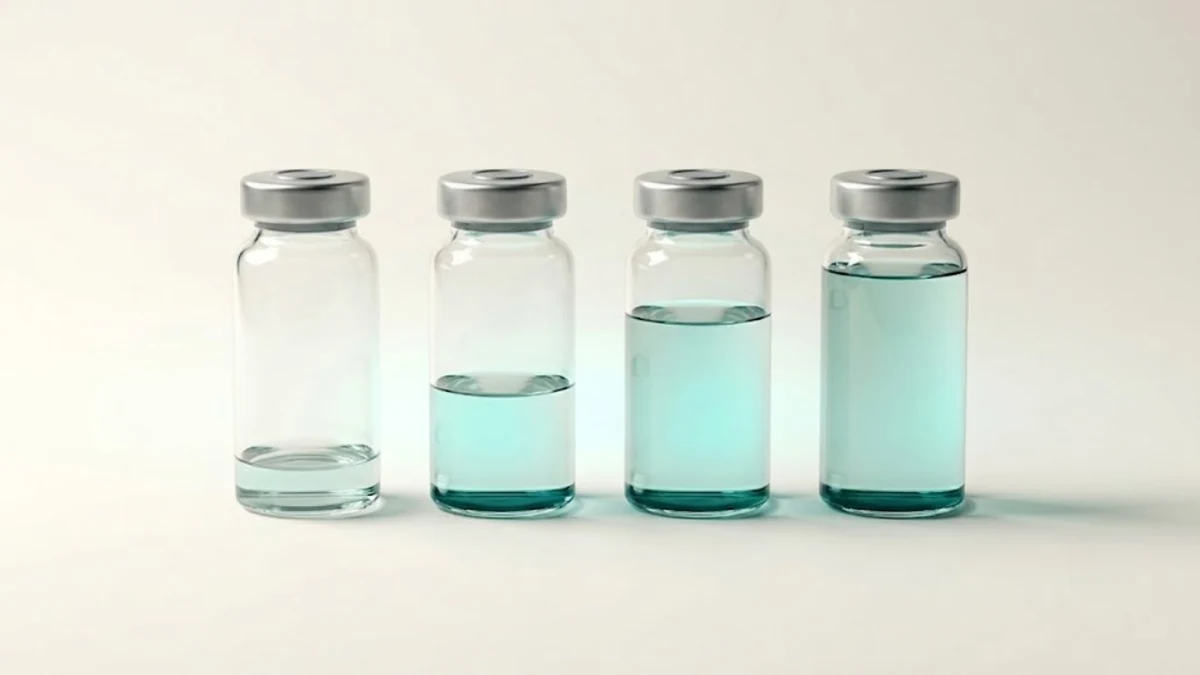
Search this question and you will get a hundred confident answers: "add 1 mL," "always use 2 mL," "3 mL is standard." They are all sort of right and all sort of wrong, because there is no single correct amount. Here is what the water actually does, so you can pick the right amount for you instead of copying a stranger.
The short answer
The amount of water you add does not change how much peptide you have. It only changes how concentrated the liquid is, which changes the number you draw to on the syringe. You pick the amount that makes your dose easy and accurate to measure. That is the whole decision.
What the water actually changes
When you mix a vial, the strength of the liquid is just the peptide divided by the water:
concentration = vial amount in mg / water in mL
Add more water and each drop is weaker, so your dose sits at a higher mark on the syringe. Add less water and each drop is stronger, so the same dose sits at a lower mark. The peptide in the vial never changes. You are only deciding how watered-down it is.
A worked example
Say you have a 10 mg vial and you want to model a 500 mcg (0.5 mg) dose.
| Water added | Concentration | Draw for a 0.5 mg dose | Doses per vial |
|---|---|---|---|
| 0.5 mL | 20 mg/mL | 2.5 units | 20 |
| 1 mL | 10 mg/mL | 5 units | 20 |
| 2 mL | 5 mg/mL | 10 units | 20 |
Look at what changed and what did not. Every one of these gives you the exact same 0.5 mg dose and the same 20 doses per vial. The only thing that moved is the mark you draw to. More water, higher mark. Less water, lower mark.
So which amount is best?
The one that lands your dose in a range you can measure accurately. A 2.5 unit draw is tiny and easy to get wrong by eye. A 10 unit draw is simple to see and hard to mess up. So in the example above, the 2 mL option is the easiest to measure, not because it is more correct, but because it is more readable.
A rough rule: aim for a water amount that puts your usual dose somewhere in the easy-to-see middle of the syringe, not crammed down at the bottom. If a dose comes out to just a couple of units, use more water. The same amount of peptide spread through more liquid lands further up the barrel, where a slip costs you a smaller share of the dose.
Our calculator does this comparison for you. Enter your vial size and your dose, and it lays out the water options side by side with the draw for each, and marks the one that is easiest to measure.
Two limits on how much you can add
The vial has to hold it. Most peptide vials are 2 or 3 mL, so a large dilution can simply not fit. Check the vial before planning around a number.
And the clock starts when you mix, not when you first draw. A reconstituted vial has a beyond-use window measured in weeks, and it runs whether you use the vial or not. Diluting heavily to get a comfortable draw is free only if you will finish the vial inside that window. Our guides on storage and on vial punctures cover where that limit comes from.
Does more water make it weaker or stronger?
Per drop, yes: more water is more dilute, less water is more concentrated. But per dose, no. You still draw the same total amount of peptide either way, just from a bigger or smaller volume of liquid. Some people prefer a bit more water when mixing so the peptide is easier to measure, and some prefer less so they inject a smaller volume. Both are fine.
The one exception
Almost everything uses bacteriostatic water. The exception worth knowing is IGF-1 LR3, which is usually mixed with a dilute acetic acid solution instead. Plain water can degrade it[1], so follow that product's own instructions.
One thing the water amount does not change is your dose. It is a measuring decision, not a dosing one.
Common questions
How much bacteriostatic water do I add to a 10 mg vial?
Whatever makes your dose easy to measure. There is no correct amount. For a 0.5 mg dose, 2 mL gives you a 10 unit draw, which is comfortable to read.
Does more water mean a weaker dose?
No. The liquid is more dilute, and you draw more of it, so the same amount of peptide goes in. Only the mark on the syringe changes.
Can I add more water later?
You can, and it invalidates every dose calculation you made from the original volume. Recalculate everything before your next draw.
What happens if I add too much water?
Two things. It may not fit in the vial. And a very dilute mix means a large draw, which can exceed what a syringe holds for bigger doses.
What if I add too little water?
Your draw gets very small. Below about two units the measurement error becomes a large share of the dose, which is a reason to use more water next time rather than a reason to worry about the vial.
Does the water amount change how many doses are in the vial?
No. Doses per vial is the vial size divided by your dose, and water is not in that calculation.
Do all peptides use bacteriostatic water?
Almost all. IGF-1 LR3 is the common exception, usually mixed with a dilute acetic acid solution instead, because plain water degrades it[1]. Follow the product's own instructions.
References
- R&D Systems, part of Bio-Techne. Recombinant Human LR3 IGF-I/IGF-1 GMP Protein, CF. Product specifications state the protein is lyophilized from acetic acid and should be reconstituted in sterile 100 mM acetic acid. Read at source.
Once you have picked your water amount, the calculator turns it into your exact syringe draw, cost per dose, and how long a vial lasts.
Our guide on GHK-Cu burning and dilution examines why volume is a commonly suggested fix, and what remains untested.
Keep reading
- How to Reconstitute a Peptide
Mix peptide powder with bacteriostatic water, step by step.
- How to Read an Insulin Syringe
U-100 insulin syringes are the standard measuring tool for peptides.
- What Does a Peptide Actually Cost Per Dose?
Sticker price is misleading.
The peptide stuff worth knowing.
Get new guides, tools, compound pages, and important peptide news in your inbox 1–3 times a month. If there’s nothing worth sending, we don’t send one.