
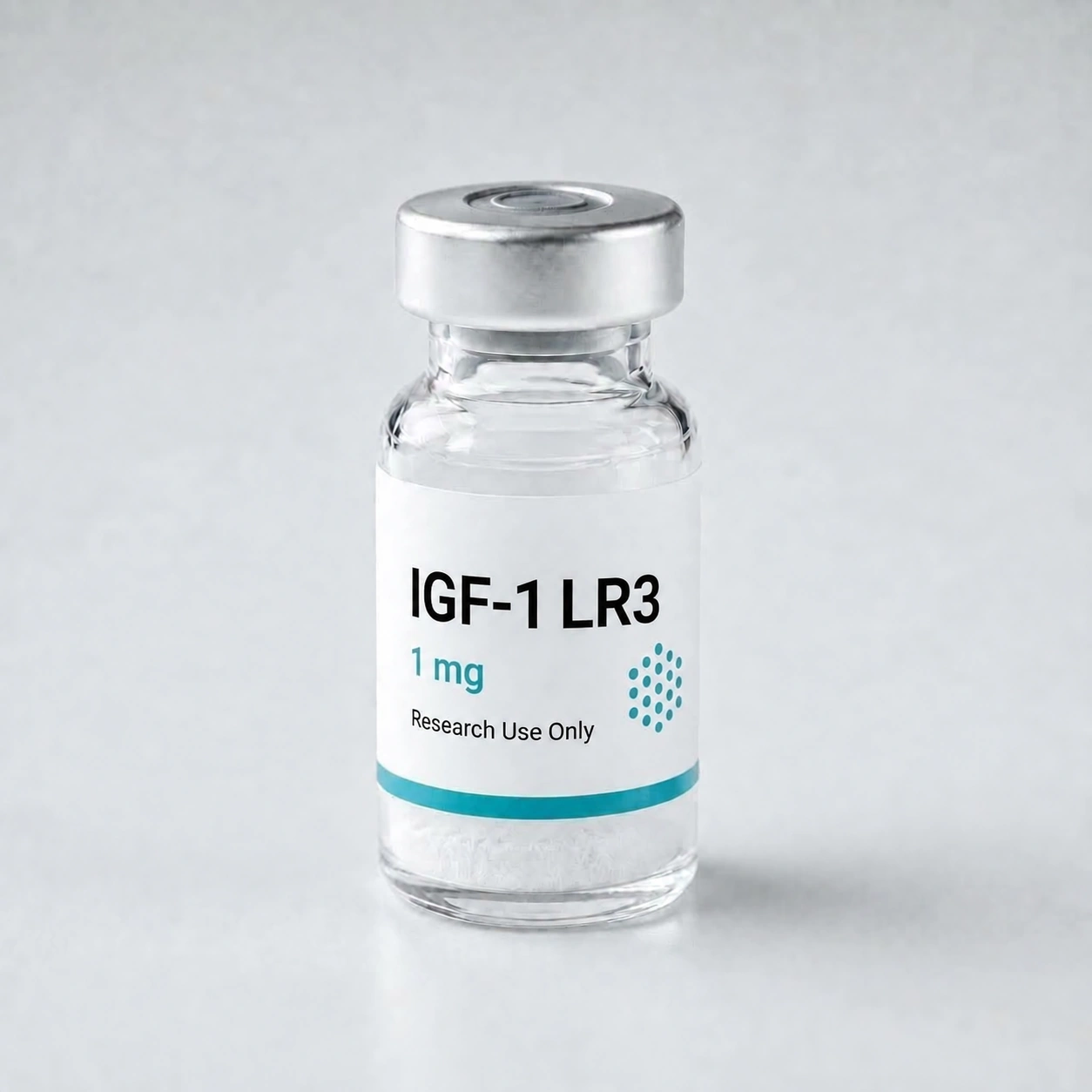
IGF-1 LR3_Dosage, benefits & legal status
Also known as Long R3 IGF-1, LR3, IGF-1 LR3 1mg, IGF1-LR3, Receptor Grade IGF-1 LR3
A powerful muscle-builder that also drops blood sugar hard.
Common vial size is what vendors typically sell, not a recommendation. Enter your own vial in the calculator.
What is IGF-1 LR3?
Plain language first. The technical label stays, but it never stands alone.Overview
It directly drives muscle cells to grow and repair and stays active for hours, but it also drops blood sugar hard.
IGF-1 LR3 is a long-acting version of insulin-like growth factor 1, the hormone that growth hormone works through to build tissue.
What it's used for
A powerful muscle-builder that drives growth in muscle cells and speeds recovery, staying active for hours.
How does IGF-1 LR3 work?
What it does in the body, and where.IGF-1 LR3 is a modified version of the hormone that growth hormone works through, engineered to stay active far longer than the natural form.
- 01It binds IGF-1 receptors on muscle cellsDriving growth and repair directly, without going through growth hormone at all.
- 02The modification stops it being bound and storedNatural IGF-1 is mostly held inactive by binding proteins. LR3 evades them, which is what makes it potent and long-lasting.
- 03Blood sugar dropsIGF-1 is structurally close to insulin and acts partly like it. Hypoglycaemia is a real and immediate risk, not a theoretical one.
- 04There is no human trial supporting its use for muscleEverything is extrapolated from what IGF-1 does physiologically.
A schematic of the compound's mechanism, not a diagnostic image.
What else is it used for?
Each use below carries its own evidence level. Approved means regulators have cleared it for that purpose. Investigational means it is in trials. Early research means it is being studied and is not established.
- Driving muscle growth directlyResearch only
- Speeding recovery from trainingResearch only
The published record
Papers and trials about IGF-1 LR3
Searched: IGF-1 LR3, IGF-I LR3, Long R3 IGF-1, Long R3 IGF-I, LR3-IGF-1, LR3-IGF-I, LR3 IGF-1, LR3 IGF-I.
Left out: LR3 (too short without context).
28 papers tagged human · 18 not reviews or lab · 0 clinical trial publications
Furthest stage reached: No clinical trial on record
Compare this against the whole library →
Prohibited at all times, in and out of competition. S2.3 Growth factors and growth factor modulators: Insulin-like growth factor 1 (IGF-1, mecasermin) and its analogues. Non-Specified.RegulatorsCounted from Europe PMC indexing, not read by a person; a human tag can land on reviews, commentary or lab papers; clinical trial publications is the narrower count.
At a glance
Four things to know about IGF-1 LR3
How much, and do you cycle it?
The range, and whether you take breaks.0.02 up to 0.05 mg per day (start low, increase slowly), daily, cycled. Commonly run in 4 week blocks Community practice
The block length comes from community practice. The stated concern is that holding IGF-1 high for long periods drives growth in tissue you did not intend, and it can drop blood sugar hard. No human study establishes a schedule or a safe duration.
Not establishedCommunity practice
The 20 to 30 hours repeated across vendor sites traces to no primary source, and animal clearance data points the other way. LR3 is built to slip past the binding proteins that hold ordinary IGF-1 in circulation, which should make it clear faster rather than slower.
Not yet traced to a primary source.
You can compare this against the whole library to see where it sits.
How do I dose and price it?
Enter your vial and your dose. Pick a mix. We show the draw and the cost.The vial holds a fixed amount of drug. Adding more water does not make more drug, it just spreads it thinner, so you draw a bigger number on the syringe for the same dose.
Choose your mix
Measuring the water1 mL = one full 100-unit syringe.
IGF-1 LR3 starts at $8.99 across 127 vendors, typically $49.50 – $134.99 per mg.
147 listings, last read Oct 24, 2026. Shipping and card fees are not included.
How do you store it?
Before mixing, and after.Dry powder in the freezer or fridge. Once mixed, fridge, and use within about a month.
Unmixed lyophilized IGF-1 LR3 keeps for a long time cold. Once you add water the clock starts: most reconstituted vials hold up for roughly 28 to 30 days at fridge temperature. Keep it out of light, and do not freeze it after mixing.
What are the side effects and cautions?
Known cautions and warnings for this compound.Mixing exception: reconstitute this one with a dilute acetic acid solution, not bacteriostatic water. Plain BAC water can degrade it, so follow the product's own mixing instructions.
Solubility, computed: 23% charged residues, 51% hydrophobic. Acid may help.
A first-pass rule from peptide manufacturers' guidance. It does not account for disulfide bridges, salt form or how the powder was dried, and it predicts what should be easy rather than what will happen in your vial.
Who should avoid it
- Any history of cancer, given the growth-promoting mechanism
- Diabetes, or any use of insulin, because the blood-sugar drop can be dangerous
- Pregnancy
- Banned in drug-tested sport
Stop and get help
- Signs of very low blood sugar such as shaking, sweating, confusion, or fainting, which needs fast-acting sugar and urgent help
- New lumps or masses
- Severe headaches or vision changes
- Signs of an allergic reaction such as face or throat swelling, hives, or trouble breathing
Common effects
- Low blood sugar, which is the main and most dangerous effect
- Injection-site reactions
- Joint pain
- Water retention
Where this page says nothing is established, that means nobody has studied it, not that a compound is safe.
Is IGF-1 LR3 approved?
And where the numbers on this page come from.No. IGF-1 LR3 is not approved for any use, anywhere. It is sold labeled for laboratory research only, and there is no legal route to buy it for human use.
- Approval statusResearch only
- RouteUnder the skin or into muscle
- Checked22 July 2026
- DoseFrom community reports. No regulator or trial established this dose.
- Vial sizeFrom what vendors typically list; not a recommendation.
- SourcesNone traced yet.
What has happened recently
Not approved for any use. The low-blood-sugar risk is the practical danger, and it is the reason combining it with insulin is described as dangerous.
What regulators say
From official documentsProhibited at all times, in and out of competition. S2.3 Growth factors and growth factor modulators: Insulin-like growth factor 1 (IGF-1, mecasermin) and its analogues. Non-Specified.
Checked 12 September 2026WADA: The 2026 Prohibited List (in force 1 January 2026)
Banned in drug-tested sport. Most research peptides are prohibited under WADA's S0 category, which covers any substance with no approval from any regulatory authority for human use. That means a compound can be banned without ever being named on the prohibited list. Check with your own anti-doping authority rather than assuming absence from the list means permitted.
You can compare this against the whole library, or read how to check a seller.
What else is like IGF-1 LR3?
Others in Muscle building, side by side.If you're weighing IGF-1 LR3, it's worth reading PEG-MGF, Follistatin (FST-344), and MGF (Mechano Growth Factor) in the same class.
A powerful muscle-builder that also drops blood sugar hard.
- Dose
- 0.02 up to 0.05 mg per day (start low, increase slowly)
- How often
- Daily, cycled
A longer-lasting muscle-repair peptide on a less-frequent schedule.
- Dose
- 0.2 up to 0.4 mg per dose (start low, increase slowly)
- How often
- 1-2x per week
An experimental muscle-builder that releases the body's brake on growth.
- Dose
- Research only
- How often
- Cycled
A local muscle-repair peptide injected near a worked muscle.
- Dose
- 0.1 up to 0.2 mg per dose (start low, increase slowly)
- How often
- Post-workout
Guides for this compound
- How to Reconstitute a Peptide
Mix peptide powder with bacteriostatic water, step by step.
- How to Read an Insulin Syringe
Read the units, convert to millilitres, and draw the exact dose.
- mcg vs mg: The Peptide Dosing Mistake to Avoid
Your vial says mg and your protocol says mcg. Here is the conversion and how to check it.
- Why Does My Peptide Injection Itch or Welt
Injection-site irritation, a histamine reaction, or a true allergy, and how to tell them apart.
- How to Read a Peptide COA
What the purity number does and does not tell you, and how to spot an edited report.
Sources
No primary source has been traced for this compound yet. Treat everything on this page as unverified until one is. How we grade evidence
Beyond these, 92 records are indexed. Browse the records