
How to Read an Insulin Syringe
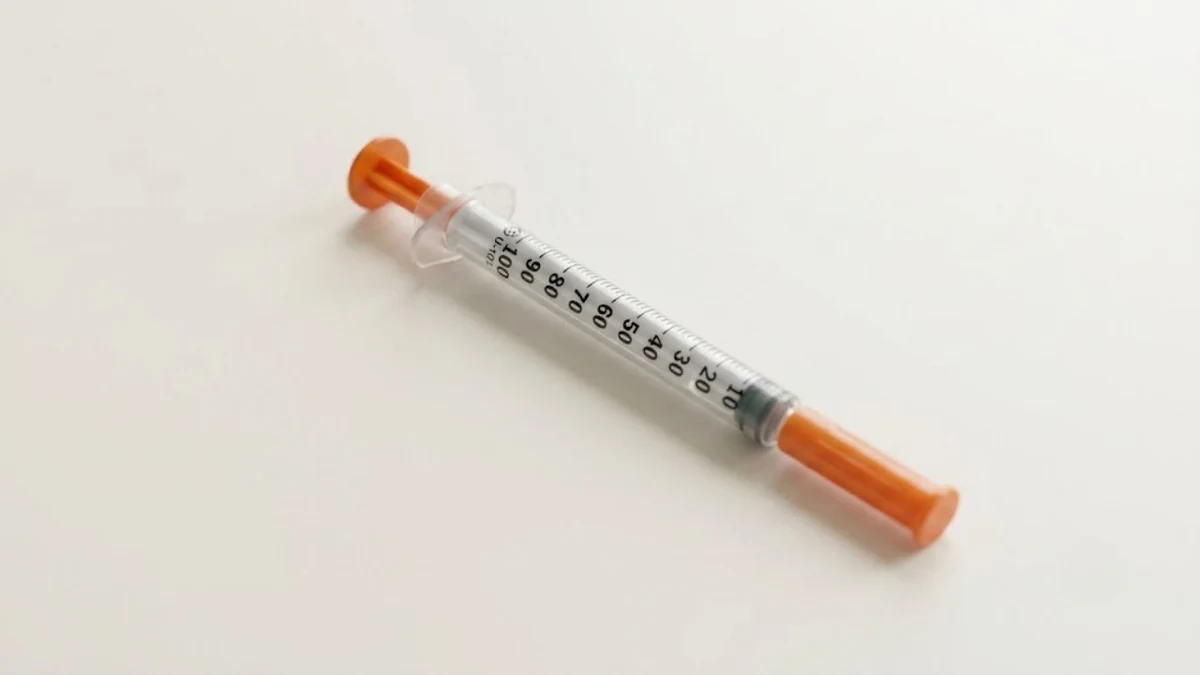
Peptide doses are almost always measured and drawn with a U-100 insulin syringe. It is the same tool diabetics use, and the markings are already in the units you need. The only trick is knowing what those units mean for your dose.
What U-100 actually means
U-100 stands for 100 units per milliliter. A standard 1 mL U-100 syringe holds exactly 1 mL of liquid, and that 1 mL is divided into 100 units. The conversion is simple: 10 units equals 0.1 mL, 50 units equals 0.5 mL, and 100 units equals 1.0 mL.
| Units | Volume |
|---|---|
| 5 units | 0.05 mL |
| 10 units | 0.1 mL |
| 25 units | 0.25 mL |
| 50 units | 0.5 mL |
| 100 units | 1.0 mL |
This is why the syringe is so convenient. You do not need to think in milliliters once you know your dose in units. The hard part is figuring out the dose in units, and that depends on how you mixed your peptide.
Units measure volume, not peptide
The syringe markings only tell you how much liquid you are pulling out. They do not tell you how much peptide is in that liquid. The concentration of your reconstituted vial does that.
If you put 2 mg of peptide into 1 mL of water, then 1 mL contains 2 mg. That means 0.1 mL — 10 units on the syringe — contains 0.2 mg. If you put the same 2 mg into 2 mL of water, then 10 units only contains 0.1 mg. Same syringe, same reading, different dose.
This is why reconstitution and dose planning are two halves of the same task. You can read the syringe perfectly and still be wrong if your concentration is off. Our water amount guide walks through the choice.
Reading the barrel
On a standard U-100 syringe, the numbered marks run from 10 to 100, usually in increments of 10. Between each numbered mark are smaller ticks. On a 1 mL syringe the small ticks usually represent 2 units each, so five gaps make up the distance between 10 and 20. On 0.5 mL and 0.3 mL syringes each tick is a single unit.[1]
When you draw, read the top of the plunger rubber stopper, not the bottom, not the plunger handle. The top edge of the rubber stopper is where the measured volume ends. If the top of the stopper sits on the 25 mark, you have 25 units. If it sits halfway between 20 and 30, you have 25 units only if the smaller ticks confirm it.
Tip the syringe so the liquid settles at the bottom and the air bubble rises. Tap the barrel to bring the bubble to the top, then push it out with the plunger. Recheck your mark. A small air bubble changes the volume more than most people expect.
Converting units to milligrams
Once you know your concentration, the math is straightforward.
Units to milligrams: mg = (units ÷ 100) × concentration in mg/mL
Milligrams to units: units = (dose in mg ÷ concentration in mg/mL) × 100
Concentration is your vial size divided by the water you added. A 5 mg vial in 1 mL is 5 mg/mL. The same 5 mg vial in 2 mL is 2.5 mg/mL. Use the concentration, not the number printed on the vial.
Example: your vial is 5 mg mixed with 1 mL, so the concentration is 5 mg/mL. You want 0.5 mg. (0.5 ÷ 5) × 100 = 10 units. You draw to the 10 mark.
Example: your vial is 2 mg in 2 mL. Concentration is 1 mg/mL. You want 0.25 mg. (0.25 / 1) × 100 = 25 units. You draw to the 25 mark.
If you would rather skip the algebra, the calculator does this conversion and shows the draw amount on a syringe diagram. To go the other way and convert a number you already have, use the converter.
Common mistakes
Reading the bottom of the plunger instead of the top. The bottom edge is closer to the needle, but the measurement is the top edge of the rubber stopper.
Using a bigger syringe than your dose needs. All three sizes are U-100, and they are not marked the same way. A 1 mL barrel is usually marked every 2 units, while 0.5 mL and 0.3 mL barrels are marked every 1 unit, and some 0.3 mL barrels every half unit.[1] A 12-unit dose falls between two lines on a 1 mL syringe and lands exactly on one on a 0.5 mL. Pick the smallest barrel that comfortably holds your dose, and hold the syringe at eye level when reading the mark.
| Barrel | Holds | Each small line | Best for |
|---|---|---|---|
| 0.3 mL | 30 units | 1 unit, sometimes half a unit | Draws under 30 units, and anything needing fine resolution |
| 0.5 mL | 50 units | 1 unit | The practical default for most peptide doses |
| 1.0 mL | 100 units | 2 units | Volumes above 50 units only |
Leaving air bubbles in. A bubble displaces liquid. If you inject 30 units with a bubble, you did not inject 30 units of peptide solution. The bubble does not hurt you, but the missing volume does matter for dosing.[3]
Treating units as milligrams. 50 units is not 50 mg. It is 0.5 mL of liquid. The actual milligram dose depends on the vial concentration, not the syringe.
Buying U-40 syringes by accident. These are sold for veterinary insulin and look similar to U-100. One unit on a U-40 syringe is 0.025 mL rather than 0.01 mL, so drawing to the same mark delivers well under half of what you intended. Check the barrel says U-100 before you use it.[2]
Ignoring dead space. Dead space is the liquid left behind in the hub and needle after the plunger bottoms out. Low dead space syringes waste less of each draw, which over a multi-week vial can be the difference of a dose or more.
Common questions
How many units is 0.5 mL?
50 units on a U-100 syringe. The scale is 100 units per millilitre, so 0.1 mL is 10 units and 1 mL is 100.
Is 100 units the same as 1 mL?
On a U-100 syringe, yes. That is what U-100 means. It is not true of U-40 syringes, which are sold for veterinary insulin and are marked differently.
What does each small line mean on an insulin syringe?
It depends on the barrel. On a 1 mL syringe each small line is usually 2 units. On 0.5 mL and 0.3 mL syringes each line is 1 unit, and some 0.3 mL syringes are marked in half units.
Which part of the plunger do I read?
The top edge of the rubber stopper, meaning the edge closest to the needle. Not the bottom edge and not the plunger handle.
How many units of peptide should I draw?
That depends on your concentration, not on the syringe. Divide your dose in milligrams by your concentration in milligrams per millilitre, then multiply by 100.
Is 10 units of peptide the same as 10 units of insulin?
No. Units on a syringe measure liquid volume, not drug. Ten units is 0.1 mL of whatever is in your vial.
Does an air bubble matter?
Not as a danger from a subcutaneous injection, but it matters for accuracy, because the bubble takes up space that should hold liquid. Clear it before you read the mark.
Which syringe size should I buy for peptides?
The smallest that holds your usual dose. For most peptide volumes a 0.5 mL syringe is the practical default, and a 0.3 mL is better if your draws are consistently under 30 units.
One last thing
A syringe is just a ruler for liquid. The precision of your injection depends on reading the ruler correctly and removing the variables that throw it off: air bubbles, wrong concentration, and reading the wrong edge of the plunger. Get those right and the rest is repetition.
Sources
- 1.US National Library of Medicine, AccessGUDID device registry, BD Ultra-Fine Insulin Syringes, 3/10 mL Half-Unit Scale, with the manufacturer's insulin syringes technical data sheet for the Micro-Fine and Ultra-Fine ranges. Manufacturer product specifications, read at source. The 0.3 mL barrel is sold in a half-unit scale variant alongside the standard 1-unit scale; the 0.5 mL is marked in single units and the 1 mL in 2-unit increments.
- 2.Merck Animal Health, Syringe Administration: How to Administer Using a U-40 Insulin Syringe. Manufacturer guidance for the leading U-40 veterinary insulin, read at source. U-40 insulin is 40 IU per mL and must be used with U-40 syringes only; one unit on a U-40 syringe is 0.025 mL against 0.01 mL on U-100, so crossing the two underdoses by well over half.
- 3.Institute for Safe Medication Practices, 2017 ISMP Guidelines for Optimizing Safe Subcutaneous Insulin Use in Adults (PDF). Medication safety body guidance, read at source. Syringe selection should match the dose, and preparation technique covers removing air from the syringe because trapped air displaces liquid and compromises dose accuracy.
Keep reading
- mcg vs mg
1 mg equals 1,000 mcg.
- How Much Water Do I Add to a Peptide?
There is no single right amount.
- How to Reconstitute a Peptide
Mix peptide powder with bacteriostatic water, step by step.
- How to Tell Your Dose Calculation Is Wrong
A calculator gives you an answer whether or not your inputs made sense.
- Can You Mix Two Peptides in One Syringe?
Nobody has tested it for peptides.
- When You Cannot Face the Needle
Between 20 and 30% of adults have needle fear.
The peptide stuff worth knowing.
Get new guides, tools, compound pages, and important peptide news in your inbox 1–3 times a month. If there’s nothing worth sending, we don’t send one.