
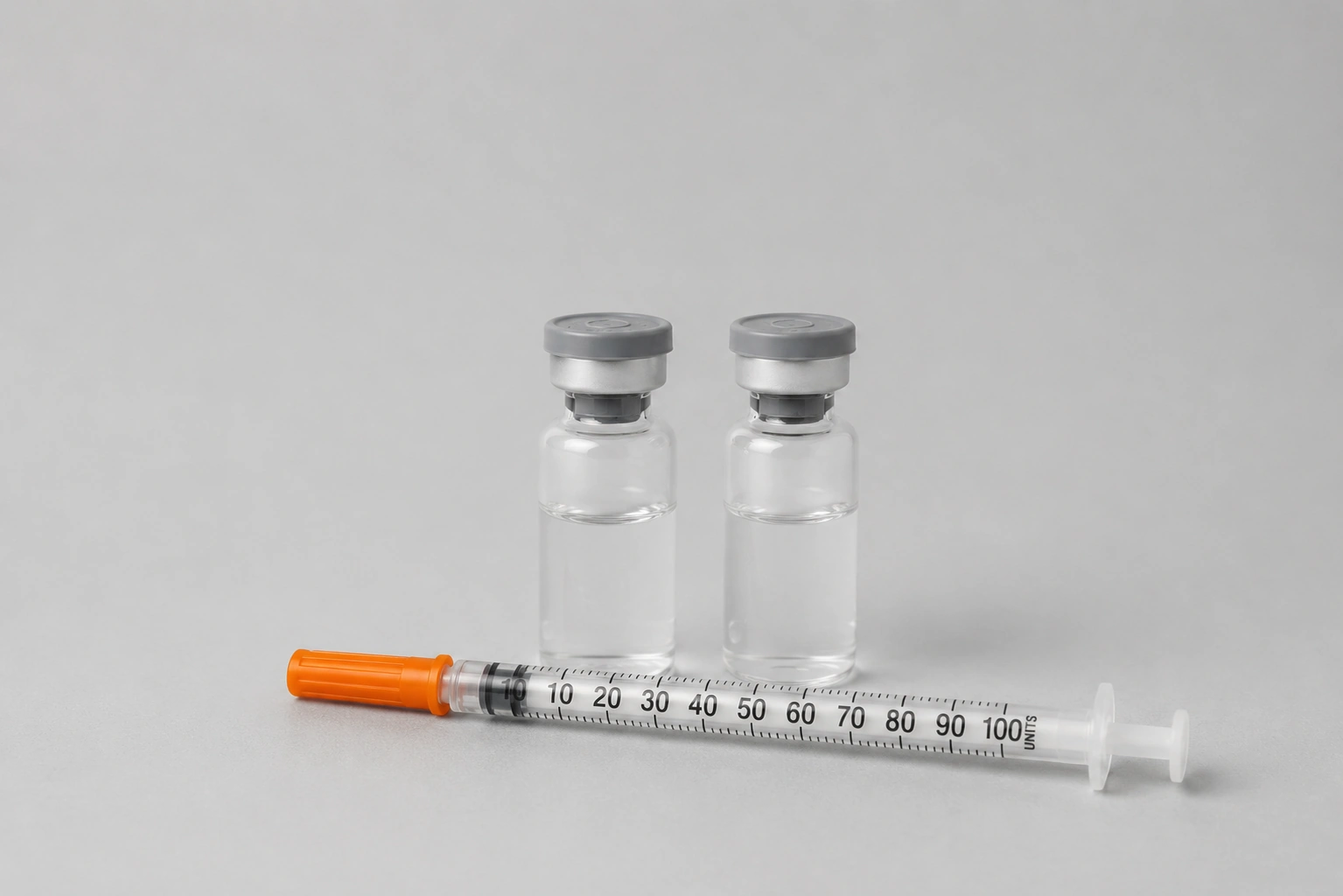
Nobody has tested it. No study has looked at what happens when two research peptides are drawn into the same barrel.
There is one drug class where mixing has been studied for decades, and that is insulin. The answer there is narrow: one pairing is allowed, drawn in one specific order, and three common insulins must never be mixed with anything at all.
That is how much has to be known before mixing is safe. For peptides, none of it is.
The practical answer is two syringes. They cost pennies, they remove every problem described below, and the cost is one extra pinprick.
Why the question comes up
Fewer injections. Somebody running two compounds daily is looking at fourteen injections a week, and halving that is worth asking about.
And blends already exist. GLOW, KLOW and the rest are several peptides in one vial, sold as a single product. If a manufacturer can put three compounds together, mixing two yourself looks like the same thing.
A third reason usually goes unsaid, and it rests on a misunderstanding. Somebody following a protocol that specifies two compounds together can read the combination as the point, and mixing as the way to comply with it.
It is not. Two injections deliver the same two compounds to the same person within the same minute. Nothing about a combination requires one barrel, and no protocol anywhere depends on it. The choice is about convenience, which makes it a preference with a cost attached, not a rule you might be breaking.
The blend comparison is a different matter, and the reason it fails takes a section of its own.
What insulin actually teaches
Insulin is the only injectable in this space where mixing has been examined properly. The rules are narrow, and they are narrow for reasons that were established by testing.
Only one combination is sanctioned. Intermediate-acting NPH can be mixed with regular or rapid-acting insulin, and no other pairing is sanctioned.[^1]
Three cannot be mixed with anything. Glargine, detemir and degludec must never be combined with another insulin in the same syringe.[^1][^5]
The order matters and it is fixed. Clear insulin is drawn before cloudy, because drawing cloudy first risks pushing particles back into the clear vial and altering it for every future dose.[^2]
Some mixtures have a shelf life measured in minutes. A rapid-acting insulin mixed with NPH has to be injected immediately, because NPH will bind to it and delay its onset.[^1]
The detail that matters most for peptides
Glargine is clear. It looks exactly like the insulins it can be mixed with, and mixing it destroys it.
Its slow release depends on precipitating out of solution when it meets the body's pH. Putting it in a syringe with something at a different pH causes that precipitation to happen early, in the barrel, which ruins the release profile it was designed around.[^3]
Nothing about the vial tells you that. Nothing about the appearance of the mixture tells you either. It was established by testing, and it is the reason mixing rules exist as rules instead of judgment calls.
Now apply that to a research peptide. Its pH is unpublished, its buffer is unpublished, and nobody has tested it against anything else. The situation where you cannot tell by looking is the normal situation here, and it is exactly the situation the insulin rules exist to cover.
Why blends do not prove mixing is fine
This is where the reasoning from blends breaks down.
A blend is formulated as one product. The components are combined before lyophilisation, dried together, and dissolved together in one solution. Whatever compatibility problems exist were either resolved at the formulation stage or shipped in the vial from the start.
Mixing two reconstituted peptides is a different operation. Two separate solutions, each with its own buffer, preservative and pH, combined by you at the point of injection, with no formulation work behind it.
Whether that matters depends entirely on the two compounds, and nobody has looked.
Our GHK-Cu guide examines the BPC-157 buffer claim and why dilution is not evidence of compatibility.
Blends carry a separate problem that our guide on spotting a wrong dose calculation covers, which is that a manufacturer fixed the ratio and a GLOW vial delivers it whether it suits you or not. That is a reason for care with blends, and not an argument for mixing your own.
What could go wrong that you would not see
Four things, and none is visible in the syringe.
pH incompatibility
Two solutions at different pH values produce a third pH, and either compound may be less stable there. Peptide stability is pH-dependent, which is why formulations are buffered in the first place.
Precipitation
The glargine problem. Something comes out of solution, sometimes visibly and sometimes not.
Aggregation
Peptides clumping into forms the body may treat as foreign. Our cloudy vial guide covers why aggregation is the failure that does not reverse, and why the FDA named it specifically.
Preservative interactions
Two vials of bacteriostatic water bring twice the benzyl alcohol into one injection, which our bacteriostatic water guide puts in context.
These four are plausible and undocumented. Nobody has demonstrated harm from mixing two specific peptides, because nobody has run the experiment.
Can you reconstitute two peptides in the same vial?
A second version of this question gets asked far less often: whether to reconstitute two compounds into a single vial, or to combine two mixed vials into one.
Everything on this page applies, and three things get worse.
It commits the whole supply. A mixture in a syringe is one dose. A mixture in a vial is every dose for the next few weeks, and there is no way back once it is done.
It removes your ability to diagnose anything. The one method available for working out whether a compound is causing a problem is stopping it and watching. Once two compounds share a vial, neither can be stopped without stopping both, and any reaction, any change in the solution, any result at all belongs to the mixture and not to either component.
And the beyond-use clock now applies to something nobody has tested. Our storage guide covers where the numbers behind that clock come from, and every one of them describes a single compound in a known formulation. A mixture sits outside all of it.
So whatever you decide about syringes, do not do it in the vial.
Two problems that are documented
Separate from compatibility, two things go wrong reliably.
Cross-contamination between vials
Putting a needle into vial A and then into vial B moves a little of A into B. The amount is small and it accumulates, in a vial you will keep using for the rest of the month.
Insulin guidance is emphatic about this, which is why the order rule exists. It also flags a version people do not think about: reusing a syringe across two different insulins effectively mixes them, with residue from the first altering the second.[^4]
Our guide on how many times you can puncture a vial covers what repeated entry does to the stopper, and a mixing routine doubles the punctures on both vials.
Dose accuracy
Drawing two compounds into one barrel means two measurements in sequence, with no way to correct the second if you overshoot. Insulin guidance says to discard the syringe and start over instead of adjusting, because there is no way to remove one component once both are in.[^2]
Then there is dead space, the liquid left in the hub and needle after the plunger bottoms out. It now holds a mixture, so the amount of each compound you actually deliver is less certain than it was.
Volume is the other half of it. Two compounds means a larger injection, and larger subcutaneous volumes sting more and leak back more often. It also pushes people up a barrel size, which costs measurement precision: a 0.5 mL syringe is marked every unit and a 1 mL syringe every two, so a bigger barrel is a blunter one.
Our guide on where to inject covers why the smallest barrel that holds your dose is the accurate one. Our guide on spotting a wrong dose calculation covers the numbers that give an error away before you inject.
If you are going to anyway
The answer to this whole page is two syringes. What follows is for people who have decided otherwise.
Do not mix anything with a GLP-1 drug. Semaglutide and tirzepatide come in pens or prefilled devices for a reason, they are prescribed products with defined formulations, and there is no version of this where combining one with a research peptide is a considered decision.
Draw the more expensive or scarcer compound second. If you overshoot, the syringe gets discarded, and it may as well be the cheaper one you waste twice.
Inject immediately. The insulin precedent is that some mixtures change within minutes, so a mixed syringe is not something to prepare in advance.
Change one thing at a time. Starting two compounds together in one syringe means any result, good or bad, cannot be attributed to either. The same problem comes up when running more than one compound, syringes or not.
Watch the vials as well as the site. A vial that goes cloudy after you start a mixing routine is telling you something, and our cloudy vial guide explains what.
What has never been tested
Whether two specific peptides are compatible. That would require testing each pairing, and it has not been done for any of them.
Whether anyone has been harmed by mixing. No case reports exist, and an absence of reports is a weak form of evidence.
Whether a compound's pH or buffer makes it a poor mixing candidate. Research vendors do not publish formulation details, and our COA guide covers what a certificate does and does not tell you.
Common questions
Can you mix BPC-157 and TB-500 in one syringe?
Nobody has tested it. They are sold together constantly and that reflects marketing and not a compatibility study. Our guide on the pairing covers why the two are sold as a set.
Can you mix CJC-1295 and ipamorelin?
Same answer, and it is the most common version of this question because those two are routinely sold as a pair. No published work has examined mixing them in a syringe.
If blends exist, why can I not make my own?
A blend is combined before freeze-drying and dissolved as one solution. Mixing two reconstituted peptides combines two finished solutions with their own buffers and pH, which is a different operation with no formulation work behind it.
Does mixing waste less?
Marginally, and it can waste more. Dead space in the hub and needle now holds a mixture of both compounds, and an overdraw means discarding a syringe containing two things instead of one.
Is it safe to use one needle for two vials?
It moves a small amount of each vial into the other, and that accumulates. Insulin guidance treats this as a real problem and not a theoretical one, and it is the reason the draw order is specified.
Can I reconstitute two peptides into the same vial?
Avoid this one. It is a different decision from mixing in a syringe. A syringe holds one dose. A vial holds every dose for the next few weeks, it cannot be undone, and it takes away your ability to stop one compound and watch what changes. The beyond-use date stops meaning much either, since those numbers describe single compounds in known formulations.
My protocol says to take both. Do I have to mix them?
No. Two injections deliver the same two compounds to the same person at the same time. No protocol requires one syringe, and treating the combination as a reason to mix is a misreading of it.
What if I already have been mixing?
Most likely nothing has gone wrong. Watch for the vial going cloudy, and for injection site reactions changing character. If either happens, separate them and see whether it resolves.
Can I mix a peptide with my GLP-1 injection?
No. Those are prescribed products with defined formulations and delivery devices, and nothing is known about what a research peptide does to them.
Sources
[^1]: American Diabetes Association. 9. Pharmacologic Approaches to Glycemic Treatment: Standards of Care in Diabetes—2026. Diabetes Care 2026;49(Suppl. 1):S183–S215. Primary guideline, read at source. The twice-daily split-mixed plans set out in the insulin dosing tables pair NPH with regular or a rapid-acting analogue and state that those insulins can be mixed in one syringe. The guideline also notes that human insulins can be given separately, self-mixed, or as premixed NPH/regular formulations such as 70/30. Which specific insulins may be combined is set by each product's label rather than by the guideline, which is why the restrictions below come from the labels themselves.
[^2]: Eli Lilly and Company. HUMULIN N (insulin human) injection, suspension — prescribing information. FDA-approved label, read at source via DailyMed. States that HUMULIN N may be mixed with HUMULIN R or HUMALOG before injection, and that a new syringe or needle should be used for every injection. The draw-order convention described in the body text, air into the cloudy vial first and clear insulin drawn before cloudy, is standard nursing and pharmacy procedure taught to avoid carrying protamine and zinc back into the clear vial; it is a handling convention rather than a labelled instruction.
[^3]: Sanofi-aventis U.S. LLC. LANTUS (insulin glargine) injection, solution — prescribing information. FDA-approved label, read at source via DailyMed. States plainly: "Do not dilute or mix LANTUS with any other insulin or solution," and in the patient instructions, "Do not mix LANTUS with any other type of insulin or liquid medicine." Glargine is formulated at an acidic pH and forms its subcutaneous depot by precipitating at physiological pH, so mixing it with a solution at a different pH disrupts that release profile. Glargine is a clear solution and looks like insulins it cannot be combined with, which is why the restriction is a rule rather than a visual judgment.
[^4]: Eli Lilly and Company. HUMULIN N prescribing information, patient instructions for use. FDA-approved label, read at source via DailyMed. "Always use a new syringe or needle for each injection to help ensure sterility and prevent blocked needles." Reusing a syringe between two insulin types leaves residue from the first in the barrel, which is an unintended mix, and is the reason a fresh syringe is specified rather than a rinsed one.
[^5]: Novo Nordisk. TRESIBA (insulin degludec) injection — prescribing information and LEVEMIR (insulin detemir) injection — prescribing information. FDA-approved labels, read at source via DailyMed. Tresiba: "Do not dilute or mix TRESIBA with any other insulin or solution." Levemir: "Do not dilute or mix LEVEMIR with any other insulin or solution." Together with the glargine label these are the three long-acting analogues named in the body text.