
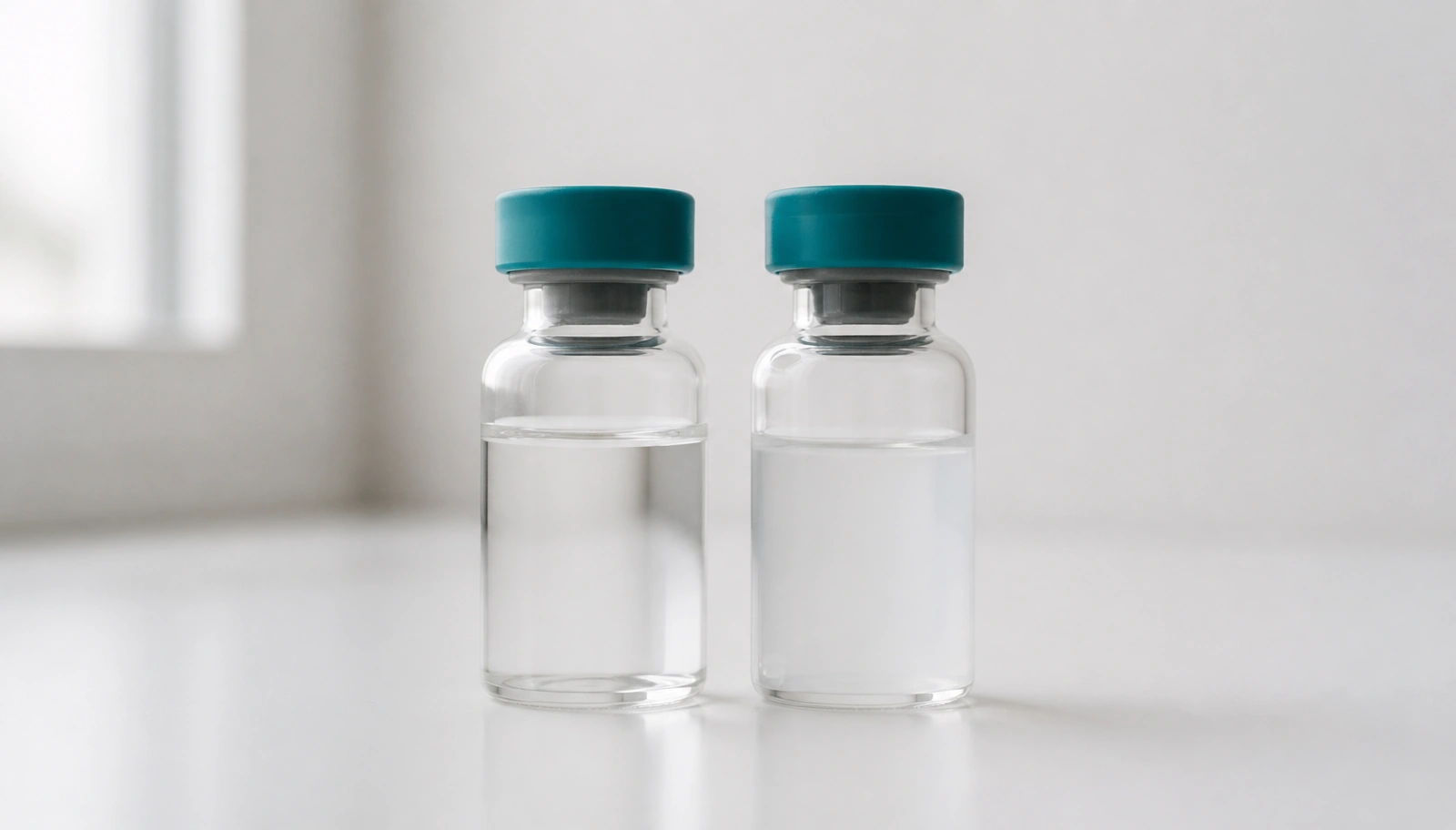
Why the advice you have found contradicts itself
Search this question and you will get three answers.
One says a cloudy vial is a discarded vial, full stop. Another is headlined "cloudy isn't bad." A third says cloudiness does not automatically mean anything is wrong.
All three are describing something real. They are also describing different situations, and mostly not saying which.
Cloudiness is a symptom, not a diagnosis. Several unrelated things produce it, some harmless and some not, and the useful question is which one you are looking at.
With a pre-filled pen, even this visual check is harder; see why you cannot inspect a pen the way you can a clear vial.
Before the water goes in
The cake tells you something first, and most people are not looking at it.
A properly freeze-dried vial holds a small solid disc or a light powder, usually white, sitting at the bottom. What it should not be is any of the following.
Collapsed into a puddle or a sticky film. The powder has already been through moisture or heat, most likely in transit, and it is the vial most likely to give you trouble later.
Shrunken away from the glass, or crumbled to dust when it was a cake. Both suggest the same thing.
Stuck around the sides or up the neck. Usually rough handling in shipping. Mostly cosmetic, but it makes the volume harder to judge and some material may not go into solution.
Any color other than white or off-white.
A vial that arrived warm, or that you know sat in a hot mailbox or on a porch, regardless of how the powder looks.
None of these guarantee a problem. All of them raise the odds of the cloudiness this page is about, and noticing before you add water saves you the mixing step and gives you a much better case with the vendor.
The one question that sorts it
Did it go cloudy immediately, or later?
Immediately, as the water went in or within the first several minutes, points to a dissolving problem. The peptide has not gone bad. It has not gone into solution yet, or it cannot at that concentration or temperature.
Later, meaning it was clear and then was not, points to aggregation or contamination. The molecules have clumped, or something is growing in there. Neither reverses.1
That distinction runs through everything below, and it is the thing most articles skip.
| Cloudy immediately | Cloudy days later | |
|---|---|---|
| What it usually is | Not dissolved yet, or cannot dissolve at this concentration or temperature | Aggregation or contamination |
| Reversible | Often | No |
| What helps | More diluent, room temperature, patience, gentle swirling | Nothing |
| What it means | A mixing or conditions problem | Discard |
When it goes cloudy straight away
Four of them, and every one is about conditions in the vial, not the peptide itself.
There is not enough water. Most peptides have a solubility limit. Put 10 mg into 1 mL and some compounds simply cannot all dissolve, so undissolved material sits in suspension and looks like haze.2 Adding more diluent is the standard response, and it changes your dosing arithmetic, so recalculate before drawing anything.
Everything is too cold. Dissolving is slower and less even when the vial and the water come straight from the fridge.3 Letting both reach room temperature first is the usual fix, and it is also the usual prevention.
The water went in too hard. A fast jet directly into the powder cake hydrates part of it while the rest stays dry, which can produce a gel-like texture or temporary cloudiness. A mixing problem, not a chemical one.3 Aiming the stream down the inside wall of the vial avoids it.
Or the compound does not dissolve in water at all, which is its own category and the one that surprises people.
When it is not cloudy but simply will not dissolve
Different symptom, different answer, and everywhere else runs the two together.
Cloudiness is a uniform haze through the liquid. Undissolved powder is visible material: a cake sitting at the bottom that will not break up, or particles you can see moving separately when you tilt the vial.
For the ordinary case, do these in order.
Wait longer than feels reasonable. Some compounds take ten or fifteen minutes with occasional gentle swirling. People decide at ninety seconds that something is wrong.
Swirl, do not shake. Rolling the vial between your palms or swirling on the counter works. Shaking introduces air and can make things worse.
Then consider whether there is enough water. If a cake has visibly shrunk but stopped dissolving, you may be at the solubility limit for that compound at that volume, and more diluent is the usual answer. Recalculate your dosing before drawing anything.
If it has not gone after all of that, you are into one of the cases below.
Gelling is its own state
Distinct from haze and the outlook is worse.
A vial that has gone thick, syrupy or jelly-like, or that has visible strands and fibers instead of an even cloud, has done something structural. The molecules have not just clumped, they have assembled into a network.1
Strongly water-repelling compounds do exactly that when they meet plain water, and a badly aggregated vial ends up in the same place.
The practical difference is that haze occasionally clears with more diluent or time. A gel does not. Nothing you can do at a kitchen counter unwinds it.
Some peptides are not supposed to dissolve in water
AOD-9604 and HGH Fragment 176-191 are the two that generate most of these questions. Both are water-repelling, and bacteriostatic water alone often will not dissolve them no matter how long you swirl.4
That is chemistry, not a bad batch. The molecule does not live in water.
The laboratory answer is a small amount of dilute acetic acid before the water, which lowers the pH and breaks up the interactions holding the peptide together. Vendors sell 0.6% acetic acid for exactly this, and every reconstitution guide in this space publishes a protocol for it.
We are not going to publish one.
The reason is not squeamishness. Adding a measured volume of an acid at a specific concentration, in a specific order, to change the pH of something is a compounding step. It is a different activity from reconstituting a vial, it has a dose-dependent failure mode, and the guides that publish it frame the whole thing as in vitro laboratory procedure while plainly expecting you to inject the result.
If a compound needs acid to dissolve, know that before you buy it. What to do about it is a question for whoever is prescribing or preparing it.
When it goes cloudy later
Clear on day one, cloudy on day four, is a different situation and the outlook is worse.
Aggregation. The peptide has lost its shape and the misfolded molecules are clumping. Small clumps stay suspended and look like haze. Larger ones settle out as visible specks or sediment.2 Aggregated peptide does not work, and you cannot dose around the part that still does, because you have no way to know how much that is.
Contamination. Something is growing. Using sterile water instead of bacteriostatic in a vial you re-enter over days is how that starts, and it is covered in our guide on the two waters.
Neither is reversible at home. Warming, swirling, filtering and waiting all fail, because the problem is not that the peptide has not dissolved.
Why aggregation matters more than "it stopped working"
This part comes from the FDA, not a vendor.
When the FDA explained why it restricted several peptides from compounding, one of the reasons it gave repeatedly was the risk of an immune reaction arising from aggregation and peptide-related impurities.6
Aggregation is the same word. The clumping in a cloudy vial is the specific thing a regulator named as a safety concern, not just a potency problem, and injecting clumped protein is how you provoke a response to something your body would otherwise have ignored.
So "is it still strong enough" is the wrong question to ask about a vial that has aggregated.
Things that look wrong and are not
These three send people to the bin unnecessarily.
| What you see | What it usually is | The tell |
|---|---|---|
| Clear droplets inside the vial | Condensation | Near the top, and it means nothing |
| A cloud of tiny bubbles | Air from vigorous mixing | Clears on standing within half an hour |
| Cloudy from the fridge, clear when warm | Cold precipitation | Resolves on warming, returns on cooling |
Condensation on the glass. Small clear droplets clinging to the inside of the vial, especially near the top, are usually water and not precipitate. They look alarming and mean nothing.
Microbubbles. Vigorous mixing produces a cloud of tiny bubbles that clears on standing. If it looks like haze and disappears in half an hour without you doing anything, it was air.
Cold precipitation. Some compounds come out of solution in the fridge and go back in as they warm.5 A vial that is cloudy straight from the fridge and clear at room temperature is behaving, not failing.
The distinguishing feature in all three is that they resolve on their own. Aggregation does not.
If you already injected from it
Most of the time nothing happens, and that is worth saying first.
What to watch depends on which problem the vial had. If it was contamination, the signal is at the injection site or systemic: redness that spreads, heat, increasing pain over days, pus, or a fever. Our guide on when an injection site reaction means stop and get seen covers where the line is.
If it was aggregation, there is nothing to watch for in the usual sense. The concern the FDA names is an immune response, which does not announce itself on the day and is not something you can check for at home.6
Either way, stop using the vial, keep it rather than binning it, and photograph it. If you do end up speaking to a clinician, the vial and the lot number are what they will want.
A fever after injecting is the one that warrants a call rather than a wait.
When to stop trying
The list where the vial is finished.
Any color at all. Yellow, pink, brown. Color means chemistry has happened.1
Strands, fibers or clumps that will not disperse. Distinct from general haze. Structured material is aggregate.1
Anything floating that was not there yesterday.
Cloudiness that appeared days after a clear reconstitution, per everything above.
Anything that smells wrong, or a stopper that is bulging or weeping.
And a vial you are unsure about after all of this. The value of a vial is lower than the value of not injecting something you cannot identify, and that arithmetic does not change no matter what it cost.
The vial is also a vendor question
Most people bin a bad vial and say nothing. Break that habit.
A vial that arrived with a collapsed cake, arrived warm, or went cloudy on first reconstitution is a product problem, not a user problem, and reputable sellers replace them. The ones that do not are telling you something useful about what happens the next time.
Photograph it before you do anything else, including the cake before you add water if you have got that far, and keep the lot number. Our guide on reading a certificate of analysis explains why that number matters more than anything else on the label.
For a compound that needs a non-water solvent, the more useful complaint is that the product page did not say so.
And then what do you do with it
An awkward practical point that no guide seems to answer.
A vial of liquid you have decided not to inject is not a sharps item, and the glass and its contents are two separate questions. Most guidance treats empty vials as ordinary household waste and used needles as sharps requiring a proper container.
Rules on this genuinely differ by state, more than most people expect, and some states prohibit household disposal of things others explicitly permit. Check your own state before assuming. It is the only advice that is correct everywhere.
What this cannot tell you
Every other page on this subject implies more certainty than exists. The limits, then.
A clear solution is not a safe solution. Bacterial contamination frequently produces no visible change at all, and clarity tells you nothing about whether the powder was what the label said in the first place.
Nobody can diagnose a vial from a description, and photographs on forums are worse than useless because a phone camera and a kitchen light change what haze looks like.
And the entire framework above assumes the vial contained what it was supposed to. If the compound was mislabelled or impure to begin with, its dissolving behavior is not something a guide can predict. Our guide on reading a certificate of analysis is the step that comes before this one.
Common questions
Is a cloudy peptide safe to inject?
Depends entirely on when it went cloudy. If it was cloudy from the moment the water went in, you likely have a dissolving problem, and more diluent or room temperature often clears it. If it was clear and then went cloudy, the peptide has aggregated or the vial is contaminated, and neither reverses.
I already injected from a cloudy vial. What now?
Most of the time nothing happens. If the vial was contaminated, the signal shows at the injection site or as a fever: spreading redness, heat, increasing pain over days, or pus. A fever after injecting warrants a call rather than a wait. If the vial had aggregated, there is nothing to check for at home, because the concern the FDA names is an immune response. Stop using the vial, keep it, and photograph it with the lot number.
Can I fix a cloudy vial?
Sometimes, and only the immediate kind. More diluent for a concentration problem, room temperature for a cold one, patience and gentle swirling for slow dissolution. Nothing fixes aggregation or contamination.
Why won't my AOD-9604 dissolve?
Because it does not dissolve well in water. AOD-9604 and HGH Fragment 176-191 are water-repelling and bacteriostatic water alone often will not do it. The compound is behaving normally. It is not a bad vial. The laboratory workaround uses dilute acid, which is a compounding step and not something this site publishes a protocol for.
My peptide is cloudy straight from the fridge but clears when it warms up. Is that bad?
Probably not. Some compounds precipitate at cold temperatures and redissolve as they warm. The distinguishing feature is that it resolves on its own and comes back on cooling. Aggregation does not behave that way.
There are little clear droplets on the inside of the vial.
Usually condensation, not precipitate, particularly near the top of the vial. It looks like something and is generally nothing.
Can I filter out the cloudiness?
Filtering is a laboratory step for preparing samples, not a rescue for an injectable. It removes particles without addressing why they formed, and if the cause was contamination the by-products stay behind. A vial that needs filtering has already told you something.
Does cloudy mean it is just weaker?
Wrong frame. When the FDA restricted several peptides from compounding, a reason it gave was the risk of an immune reaction from aggregation and impurities. Clumped protein is not simply less effective; it is the thing regulators named as a safety concern.
My powder will not dissolve at all. Is that the same problem?
Different symptom. Cloudiness is an even haze; undissolved powder is visible material or a cake that will not break up. For the ordinary case, wait longer than feels reasonable, swirl instead of shaking, and then consider whether there is enough diluent. Ten to fifteen minutes with occasional swirling is not unusual.
The vial has gone thick or jelly-like.
That is gelling, and it is worse than haze. The molecules have assembled into a network instead of merely clumping. Haze sometimes clears with more diluent or time. A gel does not, and nothing at a kitchen counter reverses it.
The powder looked wrong before I added anything.
Then you had your answer early. A cake collapsed into a puddle or sticky film has been through moisture or heat, usually in transit, and is the vial most likely to give trouble later. Photograph it, keep the lot number, and raise it with the vendor before mixing.
Should I tell the vendor?
Yes, more often than people do. A vial that arrived warm, arrived with a collapsed cake, or went cloudy on first reconstitution is a product problem, and reputable sellers replace them. The ones that will not are telling you something about the next order.
How do I stop it happening next time?
Let the vial and the diluent reach room temperature first. Aim the stream down the inside wall instead of at the powder. Swirl gently instead of shaking. Use enough diluent to stay clear of the solubility limit. Use bacteriostatic water for anything you will re-enter over days. And check before buying whether the compound needs something other than water.
Sources
- Why is my peptide cloudy or gelled? Causes and fixes, 2026. Industry guide. The clearest statement of the timing distinction: cloudiness at the moment of contact is a solubility problem that is often fixable, while cloudiness appearing days after a clear reconstitution indicates aggregation or contamination that does not reverse. Also lists the discard signals: strands or clumps that will not disperse, and any yellow, pink or brown tint. ↩
- Cloudy peptide after reconstitution: safe to inject?, May 2026. Industry guide. Describes aggregation as loss of structure with misfolded molecules clumping, small clumps remaining suspended as haze and larger ones settling as sediment, and notes that dosing around an aggregated fraction is not possible. Also covers the solubility-limit case. ↩
- Why did my peptide turn cloudy or gel after reconstitution?, May 2026. Industry guide. Describes uneven hydration from a fast jet into the powder cake producing gel-like texture as a physical mixing problem rather than chemical degradation, and slower less uniform dissolution when vial and diluent are cold. ↩
- Why does AOD-9604 require acetic acid to reconstitute?, March 2026. Vendor explainer. Describes AOD-9604's pH-dependent solubility, the cloudy, particulate or gel-like results in neutral bacteriostatic water, and notes this reflects chemistry rather than a defect. ↩
- Peptide solutions: reconstitution, solvents and stability. Industry guide. Notes cold precipitation in compounds that dissolve at room temperature and redissolve on warming, and that persistent cloudiness may indicate concentration near the solubility limit or degradation. ↩
- FDA. Certain bulk drug substances for use in compounding that may present significant safety risks. Regulatory. Category 2 rationales for several peptides cite the risk of immunogenicity arising from aggregation and peptide-related impurities. ↩