
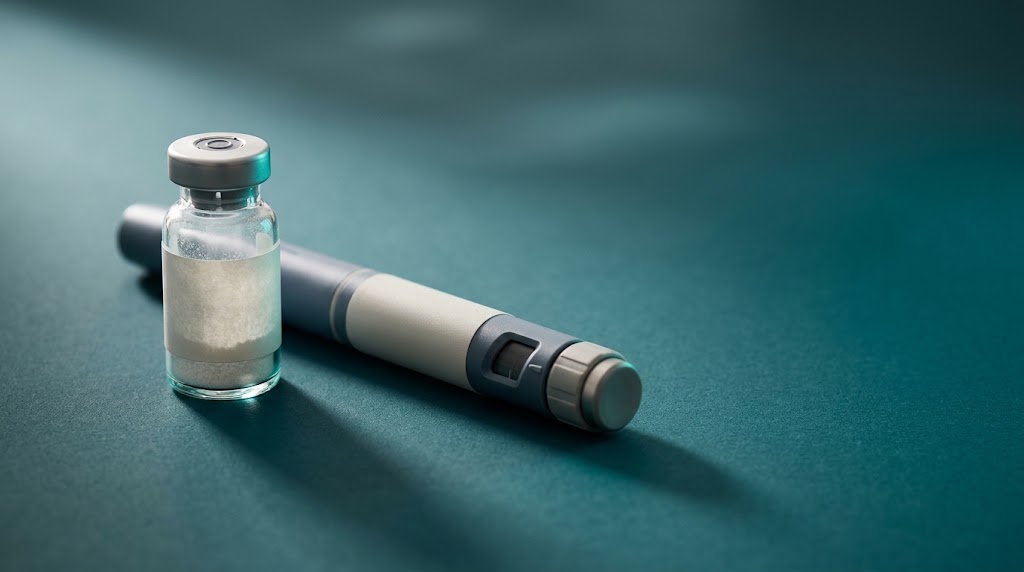
With a vial you get dry powder and mix it yourself: add water, swirl, draw a dose into a syringe. With a pre-filled pen, somebody else did that before shipping, and you do not know when, or what they used.
That matters because the powder is the stable form. Once a peptide is in liquid it starts to break down, and how fast depends on things you cannot see.
That is the trade, and the convenience is real. What is not real is the impression that a pen is a more finished or better regulated product. The approved pens from Novo Nordisk and Lilly are both. These are neither.
What our September capture shows:1
- 4 of 133 tracked sellers list pen products at all
- 2 of those sell pre-filled pens containing a compound; the rest sell empty pens and cartridges you fill yourself
- At one seller, pre-filled pens run 9% to 18% above a vial of the same compound and size
- One seller prices pens at roughly half the market rate for the same milligrams, a different kind of signal
- 0 of the pen listings state a diluent, a pH, a preservative or a date of mixing
Two different things are being sold as "pens"
Separate these before anything else, because they carry completely different risks.
Empty pen hardware. Injector pens and empty cartridges that you fill with your own mixed solution. One seller lists five disposable pens for about $41 and five 3 ml cartridges for about $11. Another sells a dosing pen with cartridges for $20. Nothing is in them. You still mix the powder yourself, and the pen is a delivery device replacing a syringe.
Pre-filled pens. A pen that arrives with the compound already dissolved in liquid: tirzepatide at 20, 30 or 60 mg, semaglutide at 5 or 10 mg, retatrutide at 15, 30 or 60 mg. Somebody mixed it at the other end.
Only the second type raises the stability question, and most of the market is currently the first type. A page telling you "peptide pens are dangerous" without separating them is describing a plastic syringe replacement as a chemical risk.
One thing to know if you are loading your own cartridges: a pen counts volume, not milligrams. A click moves a fixed amount of liquid, so what that click delivers depends entirely on how concentrated your solution is. The same pen, the same click, and twice the strength means twice the dose. Working from the number of clicks somebody else uses, without matching their concentration, is how people end up somewhere they did not intend.
What do pens cost against vials?
Slightly more at one seller, suspiciously less at another.
| Pre-filled pen | Price per mg | Same compound, same size, in a vial | Difference |
|---|---|---|---|
| Tirzepatide 20 mg | $5.18 | $4.75 | 9% more |
| Retatrutide 15 mg | $9.09 | $7.93 | 15% more |
| Semaglutide 10 mg | $10.23 | $9.00 | 14% more |
| Semaglutide 5 mg | $15.28 | $13.00 | 18% more |
| Tesamorelin 10 mg | $8.18 | $7.50 | 9% more |
Medians for the vial column, from in-stock single vials at the same size.1
That premium is what you would expect: a device, an extra step, and a smaller operation doing it. It is also modest enough that cost is not the argument against pens.
For broader context, compare current prices or read our dated cost guide.
The other seller is the interesting one. Its retatrutide pen works out at $1.92 per mg against a market median of $6.80, and its tirzepatide pen at $1.38 against $4.73. Roughly a third of the going rate, for a product that should cost more to produce than a vial. Nothing in the listing explains it.
Why is powder the stable form?
Chemistry, not preference.
Semaglutide is a chain of 31 amino acids. Once it is in liquid, that chain comes apart by several routes, and how fast depends on temperature and on pH, which is how acidic or alkaline the liquid is. A 2025 preformulation study in the Journal of Peptide Science tested it across a range of conditions and found degradation worst between pH 4.5 and 5.5, around the molecule's isoelectric point of 5.4, and concluded that a finished product should be formulated above pH 7.2
Two consequences for anyone holding a pre-filled pen.
The pH of what is inside it determines how fast the contents fall apart, and you have no way to measure it. Bacteriostatic water, the usual mixing liquid, is not adjusted to any particular pH.
And the clock started when it was mixed, not when it arrived. As the storage guide explains, a vial of lyophilised powder is stable for a long time at room temperature; the same compound in solution is on a schedule. The date that matters is one the listing does not give you.
What the approved pens have that these do not
The comparison people make is to Ozempic and Wegovy, so the difference should be stated precisely.
An approved pen contains a formulation with buffers and preservatives, tested for stability, with an in-use period established by that testing: 56 days for Ozempic after first use3; the Wegovy single-dose pen can be kept out of the fridge for up to 28 days before use4, while the Wegovy FlexTouch multi-dose pen lasts up to 56 days after first use4, at defined temperatures. The device is engineered to deliver a fixed dose from that specific concentration.
A grey-market pre-filled pen has none of that behind it. No stability testing you can see, no established in-use period, no preservative you can confirm, and a device that may not have been designed for whatever concentration is inside it.
What you cannot verify with a pen
More than with a vial, and that is the real cost.
| Powder vial | Pre-filled pen | |
|---|---|---|
| Can you inspect the contents? | Yes, before and after mixing: colour, clarity, particles | Not meaningfully. Cartridge windows are small and partly obscured |
| Do you know when it was mixed? | Yes, you did it | No |
| Do you know what it was mixed with? | Yes, you chose the diluent | No |
| Is there a preservative? | You know, because you chose | Not stated on any listing we track |
| Does a certificate of analysis apply? | To the powder, yes, if provided | To the powder before mixing at best, not to what is in the pen now |
| Can you control the concentration? | Yes | No |
The certificate point is the one people miss. A COA tests a batch of powder. Once someone dissolves that powder, the document describes what went in, not what is in the pen after mixing, shipping and sitting in a warehouse.
What does the hardware cost against a syringe?
Roughly ten times more per injection, and that is before anything goes in it.
Among sellers listing supplies, insulin syringes run from about $0.40 each in a ten pack to about $0.57 in a thirty pack.1 The disposable pens in our capture work out at about $8 each, with 3 ml cartridges at about $2. One seller's replacement cartridge pack is $199.
So the delivery method costs about $8 to $10 per pen against well under a dollar for a syringe. Whether that buys you anything depends entirely on why you want the pen.
Pens make the shipping problem worse
No coverage mentions this, and it follows directly from the chemistry.
A vial of freeze-dried powder tolerates a warm delivery van. Powder is stable at room temperature for long periods, which is why almost everything in this market ships as powder in the first place.
A pre-filled pen is a peptide in solution moving through the same supply chain, and degradation in solution is driven by temperature.2 Two days in a hot truck is a different event for a pen than for a vial, and you cannot tell afterwards, because you cannot inspect the contents. Our guide on peptides that arrive warm covers what that looks like with a vial, where at least you can see the powder.
The seller's own storage is the earlier half of the same problem, and it is invisible to you.
The larger the pen, the longer it sits
Look at what is actually being sold.
The pre-filled pens in our capture include tirzepatide at 60 mg and retatrutide at 60 mg. At the doses those compounds are used at, a 60 mg pen is not a month of product. It is many months.
An approved pen holds a few weeks of drug and carries a tested in-use period measured in weeks. A 60 mg pre-filled pen asks a solution of unknown formulation to stay intact for far longer, at whatever temperature your fridge actually runs at, with a rubber seal punctured repeatedly along the way.
Buying a large pre-filled pen is therefore the opposite trade from buying a large vial. A large vial saves money and stays as powder until you mix it. A large pen starts the clock on everything at once.
Approved pen, grey-market pen, powder vial
The three-way comparison, since almost everyone arrives at this question from an approved pen.
| Approved pen (Ozempic, Wegovy, Zepbound) | Grey-market pre-filled pen | Powder vial | |
|---|---|---|---|
| Who mixed it | Manufacturer, under licence | A seller, on an unstated date | You |
| Formulation | Tested, with buffers and preservatives | Unstated | You choose the diluent |
| In-use period | Established by stability testing | None stated | Starts when you mix |
| Device matched to contents | Yes, by design | Unknown | Not applicable |
| Can you inspect it | Not needed | No | Yes, before and after mixing |
| What a COA covers | Not applicable, it is an approved drug | The powder before mixing, at best | The powder you are holding |
| Cost per injection, device only | Included | About $8 | Under $1 for a syringe |
Two of those rows do the work. The approved pen is a tested formulation in a device built for it. The grey-market pen copies the format and none of the testing, which is the whole of the difference.
Three things other pages get wrong
"Pens are more sterile." Nothing supports that. Sterility depends on how the product was filled and handled, and a grey-market filling operation is not a licensed sterile facility. Our guide on reading a COA covers what sterility testing actually looks like.
"A pen is more accurate." A pen is more accurate at delivering the dose it was designed to deliver, from the concentration it was designed for. Put a different concentration in it, or use a pen built for one product with another, and the precision is decorative.
"Pre-filled means pharmaceutical grade." There is no such regulatory category for these products. Pre-filled means somebody else did the mixing.
Who should consider one anyway
Pens solve a real problem for some people, and pretending otherwise is not useful.
If drawing from a vial is difficult, because of tremor, vision, dexterity or squeamishness about needles, a pen removes several steps where mistakes happen. For someone taking the same dose every week from a large vial, that matters.
The version of this with the fewest unknowns is the empty pen loaded with your own solution: you keep control of the diluent, the concentration and the date, and you gain the delivery mechanism. That is a different product from a pre-filled pen and it is priced like hardware.
Common questions
Are pre-filled peptide pens safe?
Unknown, and less verifiable than a vial. The compound is already in solution, so you cannot inspect it properly, you do not know when or with what it was mixed, and no listing we track states a pH, a preservative or a mixing date. The stability of a peptide in solution depends on exactly those things.
Do peptide pens cost more than vials?
At one seller, 9% to 18% more per mg than the same compound in a vial of the same size. At another, roughly a third of the market rate, which is harder to explain than a premium.
How long does a pre-filled peptide pen last?
Nobody can tell you, because the answer depends on the formulation and the date of mixing, and the listings state neither. For comparison, Ozempic has a tested 56-day in-use period; the Wegovy single-dose pen has a 28-day out-of-fridge period before use, while Wegovy FlexTouch has a 56-day in-use period.
Is a peptide pen the same as an Ozempic pen?
No. An approved pen contains a tested formulation with buffers and preservatives, in a device engineered for that concentration, with a stability-tested in-use period. A grey-market pen has none of that documentation behind it.
Can I put my own peptide in an empty pen?
That is what most pen products in this market are for: empty disposable pens and cartridges you load with your own reconstituted solution. It keeps you in control of the diluent, concentration and date, which are the three things a pre-filled pen hides.
What is the difference between a peptide pen and an Ozempic pen?
An Ozempic or Wegovy pen holds a tested formulation with buffers and preservatives, in a device engineered for that exact concentration, with an in-use period established by stability testing. A grey-market pre-filled pen copies the format without any of that behind it.
Should I buy a pre-filled pen or a vial?
A vial keeps you in control of the three things that determine how long the contents last: what it was mixed with, when, and how it was stored since. A pen takes all three out of your hands in exchange for convenience. If the convenience matters to you, an empty pen you load yourself gets you most of it without the unknowns.
Do peptide pens need refrigeration?
Anything already in liquid does, and more urgently than powder does. Degradation in solution is driven by temperature, and with a pen you cannot inspect the contents afterwards to see whether it mattered.
Are pens cheaper than syringes?
No. Insulin syringes run about $0.40 to $0.57 each among sellers listing supplies, and the disposable pens in our capture work out at about $8 each, with cartridges at about $2. The pen is a convenience purchase, not a saving.
Does a certificate of analysis cover a pre-filled pen?
Not really. A COA describes a batch of powder before it was dissolved. It says nothing about what happened during mixing, filling, shipping and storage.
Why would a pen be cheaper than a vial?
It should not be. A pen costs more to produce than a vial of the same powder. One seller in our data prices pens at roughly a third of the market rate per mg, and nothing in the listing explains how.
Are peptide pens more accurate?
Only when the concentration inside matches what the device was built for. Precision in a pen is a property of the pairing, not of the pen.
Sources
- Peptide Decoding vendor price capture, 23 September 2026. peptidedecoding.com/prices. Our own data, counting one priced product at one seller as a listing: 6,495 listings across 133 sellers. Pen products were identified by product title across the full capture including unassigned rows, giving 4 sellers with pen listings, of which 2 sell pre-filled pens containing a compound. Per-mg comparisons use the median price of in-stock single vials of the same compound at the same size, with exact prices, sizes in milligrams and multipacks excluded.
- Malgave A, Akbar S, Tiwari A, Hande S, Joseph A, Malayandi R. Influence of Buffering Capacity, pH, and Temperature on the Stability of Semaglutide: A Preformulation Study. Journal of Peptide Science, 2025. doi:10.1002/psc.70039. Peer-reviewed preformulation study, read via the published abstract. Tested semaglutide stability across pH, buffer strength and temperature using two validated stability-indicating RP-HPLC methods. Found the greatest degradation between pH 4.5 and 5.5, around the isoelectric point of 5.4, and concluded that finished product pH should be above 7.
- Ozempic prescribing information, section 16.2. Manufacturer-approved label: 56 days after first use.
- Wegovy prescribing information, section 16.2. Manufacturer-approved label: single-dose pen up to 28 days out of refrigeration before use; FlexTouch multi-dose pen up to 56 days after first use.
Citing this page. Peptide Decoding. Are Peptide Pens Safe? Pens vs Vials, Compared. Pen and vial pricing from the 23 September 2026 capture of 133 sellers. https://peptidedecoding.com/guides/pens-vs-vials