
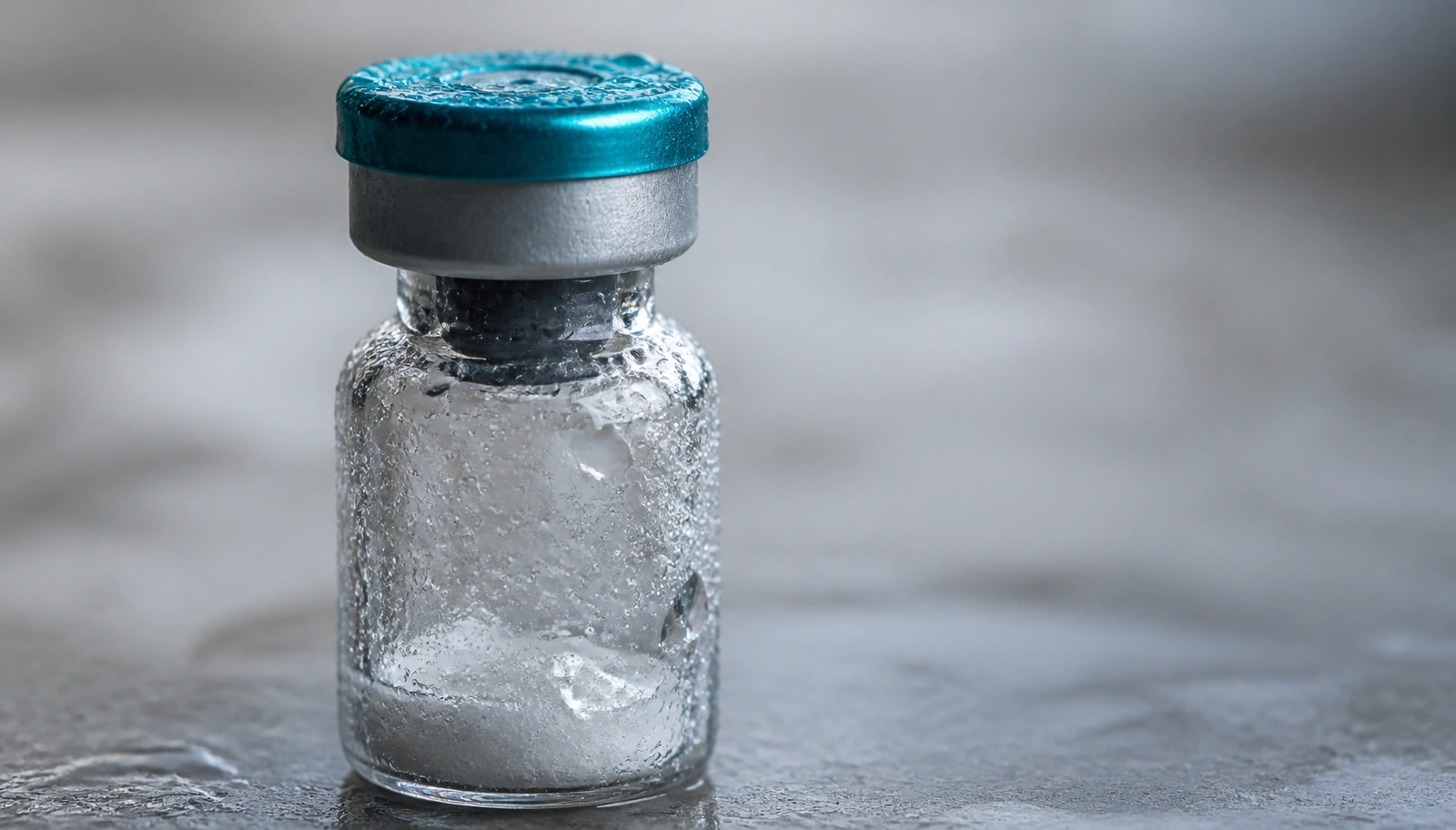
Why dryness is the thing
Nearly every way a peptide falls apart needs water to do it.
The chain gets cut. Certain amino acids change chemically. Things oxidize, molecules clump together, microbes grow. Water is either the ingredient or the medium for every one of those.2
Freeze-drying takes the water out. The bulk of it goes first, then a second drying stage pulls off what clings on, leaving under 1% to 3% moisture behind.1 With the water gone, all of those reactions slow by a factor of hundreds or thousands.2
Powder ships and solution does not for that reason alone.
What the testing actually found
An independent laboratory tested lyophilized BPC-157 under deliberately extreme transport conditions, including temperature swings and high humidity.
Purity fell from roughly 98% to about 96% over 28 days.4
Two points over four weeks, under conditions the study itself describes as far exceeding normal courier shipping. A package that spent two days on a porch has not experienced anything like that test.
The variable that actually matters is not the one people watch
Peak temperature matters more than average temperature. Degradation rates rise sharply with temperature, so a short spell somewhere genuinely hot does more than a long mildly warm journey.2 Figures quoted for how hot a loading dock or delivery van gets are estimates rather than measurements we can source, so treat the principle as the useful part. So the question is less how many warm days and more whether it sat somewhere genuinely hot.
Duration matters more than temperature. A two-day domestic delivery and a fourteen-day parcel held in customs are different stability problems entirely.3 The international shipment stuck in a warehouse for a fortnight is a real concern. The one that sat on your porch over a weekend mostly is not.
And the seal matters more than the box. If the outer packaging was opened or damaged but the vial's own stopper and crimp stayed intact, the powder never met outside air.3 If the seal itself was compromised, humidity can now reach the powder, which is a different situation regardless of how cool the parcel felt.
What if it arrived frozen
Winter has the opposite question, and the answer flips depending on what was in the vial.
| Arrived warm | Arrived frozen | |
|---|---|---|
| Sealed dry powder | Usually fine. Dryness is the protection, and heat draws down a reserve measured in weeks | Usually fine. The water ice crystals would damage is already gone |
| Already in solution | A real question. Every degradation route is open again | Genuinely damaging. Ice crystals drive clumping, and each freeze and thaw repeats it |
Sealed dry powder barely notices freezing.3 The water that ice crystals would damage is already gone, so freezing has very little to work on. A parcel that spent two days below zero with the seal intact is in much the same position as one that spent two days warm.
Anything already in solution is a different matter. Freezing a mixed vial forms ice crystals and concentrates whatever stays liquid around them, and both of those make the peptide clump and lose its shape. Every freeze and thaw does it again.5
So a frozen delivery of powder is usually fine and a frozen delivery of liquid usually is not. That reverses the heat case, where powder tolerates it and solution does not.
The handling advice is the same in both directions: let it reach room temperature before opening, for the condensation reason below.
The trap on the other side
Freeze-dried peptide pulls moisture out of humid air. The word for that is hygroscopic.4
Open a cold vial straight from a chilled shipment into a warm room and water condenses onto the cold glass and the cold powder. Moisture has got in before any diluent went near it.4
It is one of the most commonly skipped steps in peptide handling and one of the most consequential. The fix costs nothing: let a cold vial reach room temperature before you break the seal.
So the shipment that arrived warm carries no condensation risk at all, and the one that arrived cold does. The cold-chain marketing implies the opposite.
If it arrived as liquid, invert everything above
Some compounded prescriptions ship already reconstituted, and a reader holding one of those should not take the reassurance on this page.
Once water is in the vial, every way a peptide falls apart is available again. Solution is fragile where powder is not, and refrigeration stops being a storage preference and becomes the requirement.5
For those shipments, cold chain is not marketing. An ice pack that arrived melted, or a parcel that sat warm for two days, is a real question, not a reflexive worry, and the pharmacy that dispensed it is the right place to ask.
The rest of this page is about sealed dry powder.
If the problem happened at home rather than in transit, our guide on a fridge losing power covers the product-specific storage allowances and what to tell the pharmacy.
When a warm arrival does deserve a second look
Some cases genuinely are not fine. These are them.
Long or delayed international transit. Fourteen days in an uncontrolled warehouse uses far more of a peptide's tolerance than a domestic delivery does.1
Some sequences are more fragile. Peptides built with certain amino acids, methionine, cysteine, tryptophan, asparagine or glutamine, take heat worse even when dry.2 The manufacturer's own stability data is the authority on any specific compound.
A compromised seal, per above.
Visible changes to the cake. Clumping, stickiness, a collapsed or puddled cake, or any color change all suggest moisture got in.4 Our guide on cloudy and undissolved vials covers what those look like and what they mean.
And there is a tell that shows up later. Moisture-damaged powder often dissolves poorly, or produces a cloudy solution when it should be clear.4 So the reconstitution itself is a test of what happened in transit.
A better question than "is it ruined"
Ruined is a yes or no answer, and stability does not work that way. The useful question is how much of the compound's tolerance the incident used up.
A few hours in a hot mailbox plausibly uses up a small percentage of a well-characterized peptide's room-temperature tolerance. That is an estimate rather than a measured figure, and we have not found a published number for it.
So a hot afternoon is not an event that either destroys a vial or leaves it untouched. It draws down a reserve measured in weeks to months, and it takes a few percent.
It also means the incidents add up. One hot delivery is negligible. A hot delivery, then a month on a warm shelf, then a summer road trip, is a different arithmetic, and none of the individual events would have looked like a problem.
And the peak can be measured instead of guessed at. Single-use temperature indicators exist and cost very little. Some pharmacy shipments include one already, so look in the box before assuming nobody measured anything. For repeat orders from the same vendor, adding one to a parcel answers the question this page can only estimate.
What to do when the box arrives
Look at the cake before anything else. A firm white disc or light powder is what you want. Note anything else before you touch it.
Check the seal, not the temperature. Stopper seated, crimp intact, nothing punctured.
If it arrived cold, let it warm up before opening, per the condensation problem above.
If it arrived warm, that alone is not a reason to bin it. Store it as you normally would and judge it at reconstitution.
Photograph anything that looks wrong, keep the lot number, and raise it with the vendor. A vial that arrived damaged is a product problem, and how a seller responds tells you what to expect next order.
What about cold shipping generally
It is sold as a feature, so it deserves a direct answer.
Cold chain shipping is among the most marketed things in this space and among the most misunderstood. Suppliers ship lyophilized peptide at ambient temperature because the dry state is what confers stability, not the ice pack.
That does not make cold shipping pointless. It matters more for oxidation-prone sequences, for long transit, and for anything already in solution.2 It does mean that a supplier charging a premium for ice on a two-day domestic delivery of dry powder is selling reassurance, not protection.
An ice pack also does nothing about a broken seal, which is the failure mode that actually matters.
What this cannot tell you
A stability argument can read as more reassuring than it should, so the limits matter.
Robust is not invulnerable. Long transit, real heat and seal failures do degrade material, and they do it in ways a certificate written on the day of synthesis will never show.2
Degradation is usually invisible. A vial can lose potency with no change to the powder at all. The visible signs in this guide catch moisture damage, which is a subset.
None of this addresses what was in the vial to begin with. A compound that was impure or mislabeled at the factory is a different problem, and our guide on reading a certificate of analysis is the step that comes before this one.
Every number on this page is a general figure. The manufacturer's stability data for your specific compound outranks anything on this page.
Common questions
My package sat outside in the heat. Is it ruined?
Almost certainly not, if it was sealed lyophilized powder. Dry peptide tolerates weeks at room temperature, and an independent stability test on BPC-157 under conditions far harsher than normal shipping found purity falling from about 98% to about 96% over 28 days. A weekend on a porch is not that.
It arrived frozen. Is that worse?
For sealed dry powder, no. Freezing has very little to act on once the water is gone, so a frozen parcel of powder is in much the same position as a warm one. For anything already in solution, freezing is genuinely damaging, because ice crystals drive clumping and unfolding, and every freeze and thaw repeats it. Let a frozen vial warm up before opening either way.
My pharmacy sent it already mixed.
Then this page does not apply to you. Once water is in the vial, all the degradation routes that freeze-drying shut down are open again, and refrigeration is a requirement, not a preference. A melted ice pack on a liquid shipment is a real question for the pharmacy that sent it.
It arrived with a melted ice pack.
The ice pack melting tells you nothing much. Sealed dry powder does not need it, which is why most suppliers ship without one. Check the vial seal and the appearance of the cake instead of the temperature of the packaging.
It arrived cold. Can I open it straight away?
Better not to. Cold glass and cold powder pull water vapor out of warm room air, which introduces moisture before you add any diluent. Let the vial reach room temperature first. This is one of the more commonly skipped steps in peptide handling.
How long can lyophilized powder sit at room temperature?
Weeks to months for most well-characterized compounds, with the exact window depending on the sequence. Peptides containing methionine, tryptophan, cysteine, asparagine or glutamine degrade faster. The manufacturer's stability data for your compound is the real answer.
Does the same apply to a mixed vial?
No, and the difference is large. Once water is in, all the degradation pathways that freeze-drying shut down are open again. A reconstituted vial belongs in the fridge and gets a much shorter clock. Our storage guide covers the two clocks running on a mixed vial.
Should I pay extra for cold shipping?
For sealed dry powder on a short domestic delivery, the stability case for it is thin. It matters more for long or international transit, for oxidation-prone sequences, and for anything shipped already in solution. An ice pack also does nothing about a broken seal, which is the failure that actually matters.
How much damage does one hot day actually do?
A few hours in a hot mailbox plausibly uses up a small percentage of a compound's room-temperature tolerance, though that is an estimate rather than a measured figure. A better frame than ruined or not ruined, and it also means incidents accumulate. One hot delivery is negligible; a hot delivery followed by a warm shelf followed by a summer road trip is a different sum.
How will I know if heat did damage it?
Often you will not, since potency can drop with no visible change. What you can see is moisture damage: a clumped, sticky, collapsed or discolored cake, or powder that dissolves poorly or goes cloudy when it should go clear.
Sources
1: Srivastava et al. Lyophilization: process design, formulation and residual moisture. Pharmaceutical Research 40 (2023). Peer-reviewed review. Describes freezing, primary drying by sublimation and secondary drying by desorption, and the residual moisture of roughly 1 to 3% that remains in the finished cake. 2: Manning, Chou, Murphy, Payne & Katayama, and related work on peptide and protein degradation. Journal of Pharmaceutical Sciences 88(5), 1999. doi:10.1021/js980374e. Peer-reviewed. Sets out hydrolysis, oxidation of methionine and tryptophan, deamidation of asparagine and glutamine, disulfide scrambling and aggregation as the principal degradation routes, all of which require water as reactant or medium, and the temperature dependence of those rates. 3: Chang & Pikal. Mechanisms of protein stabilization in the solid state. Journal of Pharmaceutical Sciences 98(9), 2009. Peer-reviewed review. Explains why the dried solid state confers stability, why molecular mobility rather than temperature alone governs degradation in a dry cake, and why sealed dry solids tolerate excursions that solutions do not. 4: Yoshioka, Aso & Kojima. Effect of water content on molecular mobility and stability of freeze-dried formulations. Pharmaceutical Research 16, 1999. doi:10.1023/A:1018828415520. Peer-reviewed. Shows that absorbed moisture lowers the glass transition temperature of a lyophilized cake and restores the molecular mobility that degradation needs, which is why hygroscopic powder and condensation on a cold vial matter. 5: Bhatnagar, Bogner & Pikal. Protein stability during freezing: separation of stresses and mechanisms of protein stabilization. Drug Development and Industrial Pharmacy 33(4), 2007. Peer-reviewed review. Describes ice crystal formation, freeze concentration of solutes and the unfolding and aggregation that follow each freeze-thaw cycle in solution, which is why a reconstituted vial must not be frozen.