
Bacteriostatic Water vs Sterile Water: One Ingredient, Two Different Products
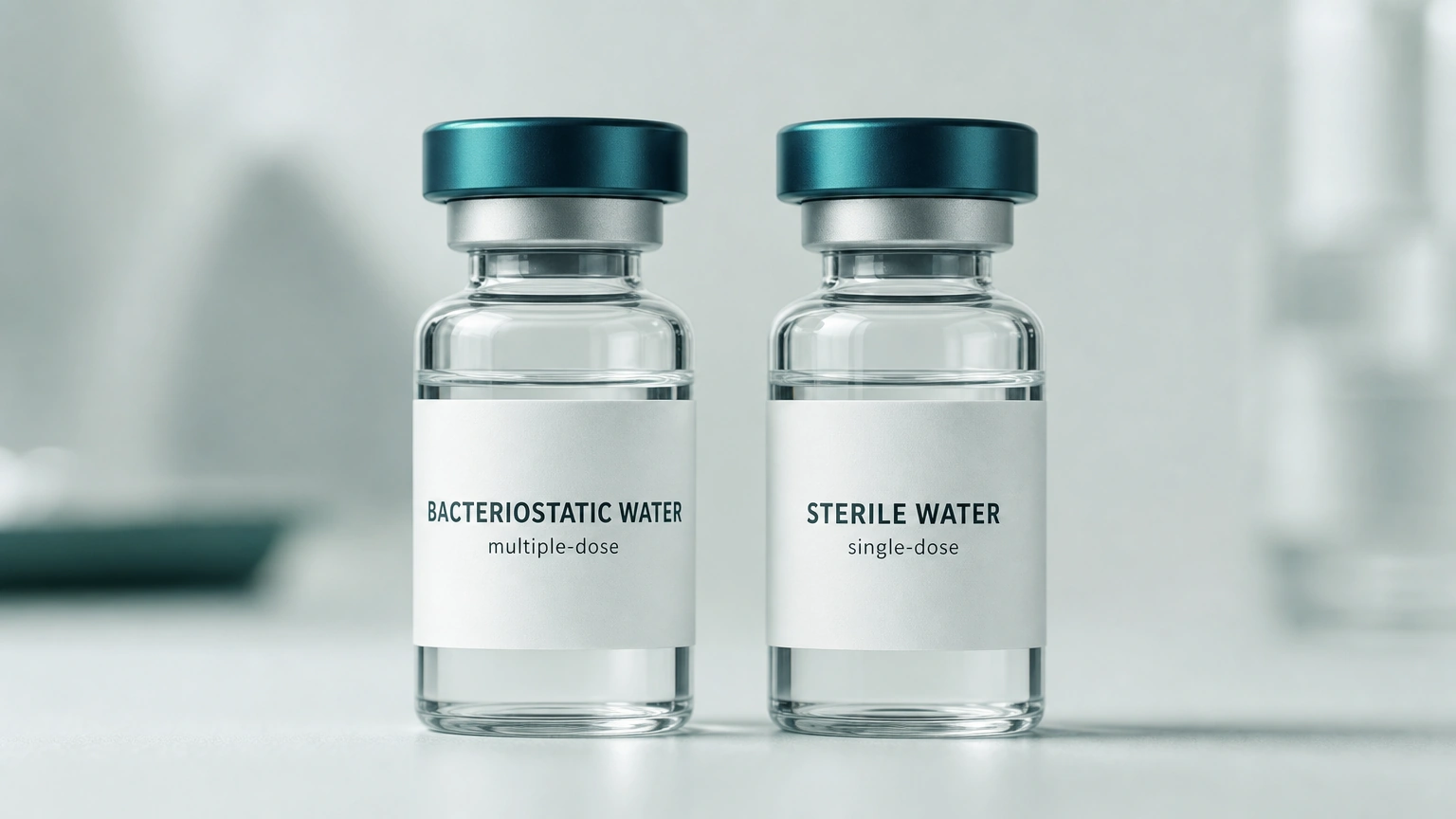
If you only want the short version. They start as the same water. Bacteriostatic water has a preservative added, sterile water does not. That single difference is why one vial can be used for weeks and the other is meant to be used once and thrown away.
If you reconstitute a peptide with sterile water and then draw from it for a month, nothing is stopping bacteria growing in there.
The one ingredient
Bacteriostatic Water for Injection is water for injection with benzyl alcohol added as a preservative.[1]
Sterile Water for Injection is the same water with nothing added. The label puts it plainly: it contains no bacteriostat, no antimicrobial agent and no added buffer, and it is supplied only in single-dose containers.[2] Another version of the label is blunter still, saying that when smaller amounts are required the unused portion should be discarded.[6]
Same starting material. One carries a guard, the other does not.
For what is in a pre-filled pen, and what is not, see the pens-versus-vials comparison.
| Bacteriostatic water | Sterile water | |
|---|---|---|
| Added preservative | Benzyl alcohol, 0.9% or 1.1% | None |
| Container type | Multiple-dose | Single-dose only |
| Re-entry after first puncture | Supported by the label | Not supported; discard the unused portion |
| Leukine after reconstitution | Up to 20 days | Within 6 hours, do not re-enter |
| Suitable for a peptide vial | Yes, this is the intended use | No, not for a vial drawn from over weeks |
| Injected on its own | No, drug diluent use only | No, hemolytic and not isotonic |
| Newborns | Not for use in neonates | The correct choice when preservative-free is required |
| Storage before opening | 20 to 25°C, no refrigeration | 20 to 25°C, no refrigeration |
What the preservative actually does
The word bacteriostatic is precise, and people hear it as something stronger.
Bacteriostatic means it stops bacteria multiplying, not that it kills them.
Bactericidal would mean killing. Benzyl alcohol holds bacteria static between draws. That is enough to keep a vial usable across repeated punctures, and not enough to rescue one that is already contaminated.[1]
So the preservative buys you time. It does not replace cleaning the stopper.
The proof is on an approved drug's label
The clearest demonstration involves neither peptides nor guesswork.
Leukine is an FDA-approved medicine that comes as a freeze-dried powder. Its label tells you to reconstitute it with either sterile water or bacteriostatic water, and then gives you two completely different expiry rules depending on which you chose.
Reconstituted with sterile water, the label says the solution should be given as soon as possible and within six hours. The vial should not be re-entered or reused, and no unused portion should be saved.
Reconstituted with bacteriostatic water, the same powder in the same vial can be stored for up to twenty days.[3]
Six hours against twenty days. Same drug, same vial, same person. The only variable is which water went in.
Nothing about your peptide vial changes that arithmetic.
Why sterile water is the wrong choice for a peptide vial
The mismatch is built in.
A peptide vial is a multi-dose vial by design. You reconstitute it once and draw from it over days or weeks. The preservative exists for exactly that, and sterile water is labeled for the opposite.
Every puncture is an opportunity for something to get in. With bacteriostatic water, whatever arrives is held in check. With sterile water, it has an unlimited food supply and nothing in its way.
The reason people reach for sterile water anyway is usually availability and price. It is easier to find and cheaper, and it looks equivalent on the shelf. A purchasing decision, standing in for a sterility question.
Two strengths, and most articles only mention one
Nearly every source states that bacteriostatic water contains 0.9% benzyl alcohol. The label says 0.9% (9 mg per mL) or 1.1% (11 mg per mL), depending on the product.[1]
Both are on FDA-approved labels. The difference is small in practice. It does mean the number printed on your vial may not match the number in the article you read.
Check the vial in front of you. The habit applies to more than the water.
Neither one goes into you on its own
Almost nobody covers this, and it is the closest thing to a hard rule in the guide.
Both waters are diluents. Neither is meant to be injected by itself.
Water with nothing dissolved in it has no salt content, so it does not match the concentration of your blood. Injected alone, it bursts red blood cells, which the label calls hemolysis.[1]
Both vials are marked for drug diluent use only on the front.[4] Sterile water's warning is the harsher of the two. One label calls it a hemolytic agent due to its hypotonicity and says it is contraindicated for intravenous administration without admixing, and notes that kidney failure caused by released hemoglobin has been reported following hemolysis.[7] Some sterile water vials carry the words NOT ISOTONIC and HEMOLYTIC on the front.[8]
The dissolved peptide is what makes the solution injectable. The water on its own is not a product for injecting.
A trap in the sterile water aisle
Sterile water comes in two formulations that are not interchangeable: one for injection and one for irrigation, which means washing and rinsing.[2]
They look similar and they are not the same product. If you are buying sterile water at all, the label has to say Sterile Water for Injection.
Who should not use bacteriostatic water
The label carries a warning in capitals on the front of the vial: not for use in neonates.[4]
Benzyl alcohol has been linked to serious toxicity in newborns, and where water is needed for a medicine given to a newborn, the label directs that only preservative-free sterile water should be used.[1] This is one of the few situations where sterile water is the correct answer and bacteriostatic water is not.
Pregnancy sits in a different category. Animal reproduction studies have not been done, and the label says bacteriostatic water containing additives should be given to a pregnant woman only if clearly needed.[5] A conversation with a doctor, then, and not a rule.
Benzyl alcohol preparations are also not used for epidural injections or for fluid replacement.[5]
How much benzyl alcohol you are actually getting
The arithmetic is reassuring, and the number gets quoted without it.
Animal studies of small-volume preparations suggest an intravenous dose of up to about 30 mL of 0.9% benzyl alcohol solution can be given to an adult without toxic effects.[1] At 9 mg per mL, that comes to roughly 270 mg of benzyl alcohol.
Reconstituting a peptide vial with 2 mL of bacteriostatic water introduces about 18 mg. You would need fifteen such vials in a day to approach the figure the label discusses, and the water is going under the skin, not into a vein.
The neonate figure is what drives the warning. About 9 mL given to a 6 kg infant is potentially capable of producing blood pressure changes.[1] Body size is doing the work in that figure.
If you already mixed a vial with sterile water
The vial is not automatically ruined, and it is no longer a month-long vial either. Nothing in it is holding bacteria static between draws, so the sensible reading is a short-dated vial rather than a normal one.
Keep it refrigerated, take it through as few punctures as you can, and do not plan a four-week dosing block around it. Sterile water's own label is written for a container used once and discarded.[2] The comparison on the Leukine label, six hours against twenty days, is the fairest illustration of the gap you are working inside.[3]
If the solution turns cloudy, develops particles or looks different from the day you mixed it, that decision is already made for you. Our guide on a cloudy peptide vial covers what those changes mean.
Storage
Store bacteriostatic water at 20 to 25°C, which is ordinary room temperature.[4] It does not need refrigeration before opening.
The 28-day convention comes from the compounding standard for opened multiple-dose vials rather than from the water's own label, which gives a storage temperature and no day count.[9] Our guide on how many times you can puncture a vial works through where that number comes from. It applies to the bacteriostatic water vial itself from the day you first puncture it, and separately to the peptide vial you mixed. Those are two different clocks on two different vials, and our storage guide covers how they interact.
Common questions
What is the actual difference?
One ingredient. Bacteriostatic water has benzyl alcohol added as a preservative. Sterile water has nothing added and is labeled for single use only.
Can I use sterile water to reconstitute a peptide?
You can physically, and the label does not support it for a vial you will re-enter over time. Sterile water is a single-dose product with nothing to hold bacteria in check. A peptide vial punctured twenty or thirty times is exactly the situation the preservative exists for.
Does the preservative kill bacteria?
No, and the word says so. Bacteriostatic means it stops bacteria multiplying. Bactericidal would mean killing them. It holds a vial steady between draws. It cannot sterilise something already contaminated.
Is 0.9% or 1.1% benzyl alcohol correct?
Both. FDA labels list both concentrations depending on the product. Check the vial in front of you.
Can I inject either one on its own?
No. Both are diluents. Water without dissolved solids does not match the salt concentration of blood and can burst red blood cells. Both labels warn about it, and bacteriostatic water is marked for drug diluent use only.
Is the benzyl alcohol a problem?
Not at the amounts involved in reconstituting a peptide vial. Two millilitres carries about 18 mg, against a figure the label discusses of roughly 270 mg intravenously in an adult. The real restriction is newborns, where the label says not to use it at all, and body size is the reason.
I already mixed a vial with sterile water. What now?
Treat it as a short-dated vial rather than a month-long one. There is no preservative in it, so the clock is hours rather than weeks, and every extra puncture adds risk with nothing holding it in check. Keep it refrigerated, use it quickly, and discard it rather than carrying it through a normal dosing month.
How long does an opened bacteriostatic water vial last?
The convention is 28 days from first puncture. That comes from a compounding standard for opened multi-dose vials, not from the bacteriostatic water label, which gives a storage temperature and no day count.
References
- FDA. Bacteriostatic Water for Injection, USP, prescribing information, Hospira/Pfizer, via DailyMed. Regulatory. Sterile, nonpyrogenic water for injection containing 0.9% (9 mg/mL) or 1.1% (11 mg/mL) benzyl alcohol as a bacteriostatic preservative, supplied in a multiple-dose container, pH 5.7. Warns of hemolysis on intravenous administration without a solute; directs preservative-free sterile water for neonates; gives the 30 mL adult and 9 mL 6 kg infant figures from animal studies.
- FDA. Sterile Water for Injection, USP, prescribing information, via DailyMed. Regulatory. Contains no bacteriostat, antimicrobial agent or added buffer, supplied only in single-dose containers to dilute or dissolve drugs for injection. pH 5.0 to 7.0. Warns that intravenous administration without a solute may result in hemolysis.
- Leukine (sargramostim) preparation instructions, as reproduced in a clinical trial protocol at clinicaltrials.gov. Regulatory, via trial protocol. Lyophilised Leukine reconstituted with sterile water should be administered within 6 hours and the vial not re-entered; reconstituted with bacteriostatic water it may be stored up to 20 days.
- Hospira. Bacteriostatic Water for Injection vial label and package insert, via DailyMed. Regulatory. Front-of-vial text reads NOT FOR USE IN NEONATES and FOR DRUG DILUENT USE ONLY. Storage at 20 to 25°C.
- Same as reference 4. States that animal reproduction studies have not been conducted, that the product containing additives should be given to a pregnant woman only if clearly needed, and that preparations containing benzyl alcohol should not be used for fluid replacement or epidural administration.
- Sterile Water for Injection, USP, alternative label, via DailyMed. Regulatory. States the product is intended only for single-dose injection after admixture with an appropriate solute or solution, and that when smaller amounts are required the unused portion should be discarded. pH 5.5 (5.0 to 7.0).
- FDA. Sterile Water for Injection, USP in VIAFLEX plastic container, Baxter. Regulatory. Describes the product as a hemolytic agent due to its hypotonicity, contraindicated for intravenous administration without admixing, and notes that haemoglobin-induced renal failure has been reported following hemolysis.
- Sterile Water for Injection vial labeling, via structured product labeling data. Regulatory. Front-of-vial warnings reading NOT ISOTONIC and HEMOLYTIC, alongside For Drug Diluent Use Only.
- United States Pharmacopeia. General Chapter <797> Pharmaceutical Compounding — Sterile Preparations. Compendial standard. Sets a 28-day beyond-use date for conventionally manufactured multiple-dose vials containing an antimicrobial preservative after initial puncture, unless the manufacturer specifies otherwise. This is the origin of the 28-day convention; the bacteriostatic water label itself gives no day count.
Keep reading
- Are Peptide Pens Safe? Pens vs Vials, Compared
What sellers charge, why the date of mixing matters, and what a powder COA cannot tell you about a pre-filled pen.
- How to Reconstitute a Peptide
Mix peptide powder with bacteriostatic water, step by step.
- How to Store Peptides
Two clocks run on a mixed vial: one for germs, one for the molecule.
- How Many Times Can You Puncture a Vial?
The stopper was tested to four punctures.
- How Much Water Do I Add to a Peptide?
There is no single right amount.
- My Peptide Went Cloudy. Is It Ruined?
One question decides almost everything: when did it go cloudy? Immediately is usually a dissolving problem.
The peptide stuff worth knowing.
Get new guides, tools, compound pages, and important peptide news in your inbox 1–3 times a month. If there’s nothing worth sending, we don’t send one.