
How Many Times Can You Puncture a Vial?
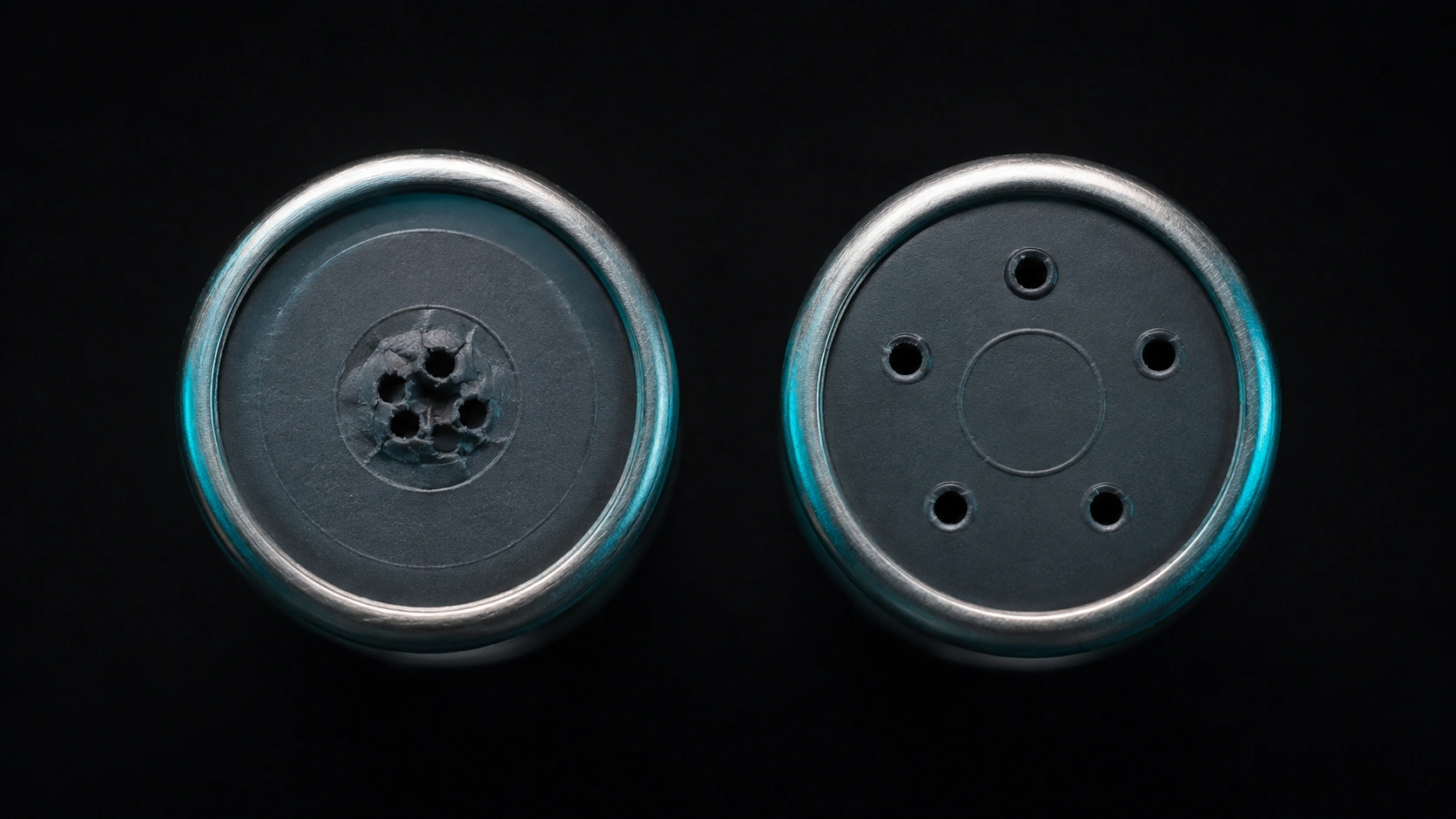
Nobody has counted.
The rubber stopper on a peptide vial is tested before it ships, and the standard test uses four punctures. Someone taking a daily dose from a 10 mg vial will go through that stopper twenty or thirty times.
There is no published number for where a stopper gives out under that kind of use, because nobody has run the experiment. What exists is research on a different problem, and understanding why it does not transfer is more useful than any number somebody made up.
What coring is
Push a needle through rubber and it can punch out a small disc, the way a hole punch takes a circle out of paper. That disc drops into the vial.
Cores are usually too small to see. They are also not sterile in any meaningful sense once they have traveled through the stopper, and they can be drawn into a syringe and injected.
The rate is higher than most people would guess. In a controlled study puncturing propofol vial stoppers 150 times, cores appeared in 26 samples, just over 17%.[1]
That figure comes with a large caveat, and it is the same caveat that runs through this whole subject.
Finer needles do not save you
The obvious assumption is that a thin insulin needle cores less than the thick ones a nurse uses. It seems reasonable. It is also wrong, and the study that shows it is about insulin vials specifically.
Researchers collected insulin cartridges from 30 patients who had been self-injecting and looked at the rubber under a microscope. Coring had occurred in 73% of first injections and 47% of second ones. In the rubber left behind in the cartridge, the rate was 97%.[5]
That last number is the one to hold onto. Almost every cartridge had been cored. Most of the fragments stayed in the cartridge rather than passing through the needle, and the ones that did pass through were the small aggregated pieces rather than the larger needle-shaped cores. So the needle acts as a rough filter, and something still gets through most of the time.
A separate study drawing from vials found that switching to a thinner 23 gauge needle produced three times the coring rate of an 18 gauge, and read the insulin findings as supporting the same conclusion: thinner needles core more.[6]
The proposed mechanism is that a thick needle has a wide, sharp cutting edge that slices cleanly, while a very fine one is more likely to punch and drag, taking a plug with it. The evidence for the pattern is stronger than the evidence for the explanation.
Particle size does drop with needle size. Cores from an 18 gauge needle averaged 77 micrometers across, with the largest at 214. But the same study noted that even the biggest of those would pass easily through a finer needle.[6] Smaller particles, more of them, and still able to travel. If you are not sure what gauge you are using, see how to read an insulin syringe.
What matters more than gauge
Sharp versus blunt. One study found coring in 29% of draws with blunt plastic needles against 4% with sharp bevelled steel.[7] That is a sevenfold difference, larger than any gauge effect in the literature. A needle that has already been through a stopper once is a blunter needle the second time.
Bevel position. Bevel up produces the least fragmentation, bevel down the most, with incidence ranging from zero to 49% across test conditions.[2]
Never reusing a needle to enter the vial. This follows from the sharp-versus-blunt finding and it is the single most controllable factor. A fresh needle for each entry costs pennies.
What the stopper was actually validated for
Under USP chapter 382, the fragmentation test for a stopper intended for repeated entry uses a minimum of four punctures as the default.[3]
Four.
Manufacturers can test to a higher number if the product calls for it, and for a vial sold as research material, nobody specified a number. The stopper met a general standard for repeated entry. It was not qualified for a month of daily use, because that use was not on anyone's list when the vial was made.
The three things that actually change the odds
The research disagrees on plenty and converges on these.
| Factor | Effect | What to do |
|---|---|---|
| Sharp against blunt needle | 4% coring with sharp bevelled steel against 29% with blunt plastic[7] | Fresh needle every entry. The largest effect in the literature |
| Bevel position | Incidence ranged from 0 to 49% across test conditions, largely on this[2] | Bevel up as it enters |
| Puncture spacing | Repeated entry through one point stops the hole resealing[4] | At least 0.75 mm apart, so not the middle every time |
| Needle gauge | A 23 gauge produced three times the coring of an 18 gauge[6] | Not controllable with insulin syringes, and works against you |
Bevel position matters most. Bevel up produces the least fragmentation. Bevel down produces the most, and across test methods the incidence ranged from zero to 49% depending largely on this.[2] The bevel is the angled cutting face at the needle tip, and it should face upward as it enters.
Gauge matters, and not the way people assume. Thinner needles core more often, not less, which is covered above. Insulin syringes sit at the thin end, so this is one of the few factors working against you rather than for you. The fragments they produce are smaller, and smaller fragments still pass through.
Spacing matters, and almost nobody does it. Punctures should be at least 0.75 mm apart.[4] Going through the same hole repeatedly turns a resealing puncture into a channel. Most people aim for the middle of the stopper every time, and that is the wrong habit.
The literature does disagree on one point. Most of it recommends entering at 45 degrees with the bevel up and rotating to 90 as the needle passes through. One study found that an 18 gauge needle at 45 degrees cored more than the same needle at 90.[1] At insulin-syringe gauges this argument is probably academic.
What happens if you inject one
Worth being straight about the state of the evidence here, because it is genuinely mixed.
Particles larger than 6 to 8 micrometers can enter blood vessels.[1] Documented harms from injected particulate include embolism, reduced tissue perfusion, phlebitis, granuloma formation and inflammatory reaction, and rubber exposure has been linked to latex allergy.[7] The insulin cartridge study concluded there is a high possibility that rubber pieces reach subcutaneous tissue, which is the route that matters here.[5] There is a published case of a rubber core from a propofol vial lodging in a 24 gauge catheter and triggering an infusion pump alarm.[7]
Nearly all of that comes from intravenous administration, where a particle goes straight into circulation.
Subcutaneous injection is a different situation, and the honest position is that nobody has studied it. One paper looking at joint injections stated plainly that the clinical relevance of injecting small rubber particles as foreign bodies has not been investigated.[6] A safety review of spinal injections reached the same conclusion: coring happens frequently, and the clinical risk of it is unclear.[8]
So the risk is real enough that hospitals design around it and small enough that nobody has measured it in the route you are using. Both of those are true at once.
None of which tells you what to do, so here is the practical part.
There is nothing to check for on the day, and no test you can run at home. What the documented harms suggest watching for is a lump at an injection site that persists or grows over weeks rather than settling in days, which is what a granuloma looks like, and any site that becomes inflamed well after the injection rather than at the time.
Our guide on when an injection site reaction means stop and get seen covers where the line sits, and the same rules apply whatever caused it.
The honest summary is that this is a reason to use a fresh needle each time and inspect the vial, and not a reason to worry about injections you have already given.
What a failing stopper looks like
The signs are visible if you look, and most people never look.
Visible particles in the solution. Small dark flecks against a light background, or anything drifting when you tilt the vial. Hold it against a dark background under good light.[4] No other check catches as much for as little effort.
A cratered or pitted center. A healthy stopper reseals so completely that punctures are hard to find. A stopper you can see holes in has stopped resealing.
Liquid weeping around the stopper, or a bead of moisture on top after you withdraw. The seal is no longer closing behind the needle.
A stopper that feels soft or gives too easily. Rubber degrades with repeated punctures and with alcohol exposure. Resistance dropping off is the seal getting worse.
Any of those means stop using that vial, and what to do with the vial and the needle afterward is a separate question with two different answers.
The first puncture is not like the others
Reconstituting a vial means drawing bacteriostatic water with one needle and pushing it into the peptide vial with the same one. That needle is usually 18 to 25 gauge, because a 31 gauge insulin needle draws a millilitre of water very slowly.
So a typical vial gets one entry with a wide needle and then twenty or thirty with a fine one. Different needle, different cutting behavior, different coring profile. The heaviest single mechanical event happens at the start, before you have taken a dose.
Two things follow from that. If you are going to be careful about bevel orientation and entry angle on any puncture, that is the one. And a core introduced during reconstitution sits in the vial for every dose afterward, which is an argument for looking at the solution before the first draw rather than after the tenth.
Why the 28-day rule is really about punctures
The 28-day figure people quote comes from a compounding standard for opened multi-dose vials, and it is written as a calendar rule. What it is measuring is not really time.
A vial punctured once and left alone for a month is in a very different state from one punctured thirty times over the same month. The risk accumulates per entry, not per day. Time is a proxy that happens to be easy to write down.
Which means the person doing daily injections runs through the actual risk faster than the calendar suggests, and the person taking something twice a week has more margin than the number implies. The rule cannot know which one you are.
Common questions
How many punctures is too many?
Nobody knows, and anyone giving you a specific number is guessing. The stopper was tested to a minimum of four punctures under the standard that governs it, and daily dosing from one vial goes far past that. Inspect the vial rather than counting.
What is the one thing that helps most?
Using a fresh needle every time you enter the vial. Coring ran 29% with blunt needles against 4% with sharp bevelled ones, a sevenfold gap that beats every other factor in the literature. A needle that has already been through the stopper is a blunt needle.
Do insulin syringes core?
Yes, and more than people assume. Insulin cartridges collected from 30 self-injecting patients showed coring in 73% of first injections, 47% of second ones, and 97% of the rubber remaining in the cartridge. Thinner needles appear to core more often than thick ones, not less, though the fragments that make it through are smaller.
What happens if I inject a core?
Documented harms exist for intravenous injection: embolism, phlebitis, granuloma, inflammatory reaction. Almost nothing has been published on subcutaneous injection specifically, and two separate reviews say plainly that the clinical significance is unclear. Hospitals design around the risk; nobody has quantified it in the route you are using.
Should I worry about injections I have already given?
No. There is nothing to check for on the day and no home test. What the documented harms point to is a lump at a site that persists or grows over weeks instead of settling in days, or a site that becomes inflamed well after the injection. This is a reason to use a fresh needle each time and inspect the vial, not a reason to worry backward.
Does it matter which way the bevel faces?
More than anything else you control. Bevel up produces the least fragmentation and bevel down the most, with incidence ranging from zero to 49% across test conditions depending largely on this.
Should I puncture the same spot every time?
No, and this is the most common mistake. Punctures should be at least 0.75 mm apart. Repeated entry through one point turns a hole that reseals into a channel that does not.
Can I see a core if there is one?
Sometimes. Hold the vial against a dark background under bright light and look for small dark flecks or anything moving as you tilt it. Cores are often too small to see, so a clear-looking vial is not proof of anything.
Does the alcohol swab damage the stopper?
Repeated alcohol exposure degrades rubber over time, which is one reason a stopper softens with use. Swabbing before each entry is still standard practice, because contamination is the larger risk.
References
- The impact of needle size and angle on rubber coring after multiple puncturing of multi-dose propofol vial rubber stoppers. Heliyon, 2022. Experimental study. 18, 20 and 21 gauge needles at 45 and 90 degrees, bevel up, 150 samples. Coring occurred in 26 samples, 17.33%.
- Self-sealing capacity of vial stoppers after multiple needle punctures, Journal of the American Pharmacists Association, 2013;53(1). doi:10.1331/japha.2013.12064, PMID 23636157. Experimental study. Fragmentation incidence varied from 0 to 49% depending on test method. Needles larger than 22 gauge, meaning a higher gauge number and therefore a thinner needle, induced the most fragmentation with bevel down; bevel up induced the least.
- Multi-puncture functional performance test for elastomeric vial stoppers, West Pharmaceutical Services, 2022. Industry technical note. Under USP chapter 382, fragmentation testing must match the intended product's puncture count, with a default minimum of four punctures per stopper for multi-puncture applications.
- Rubber coring of injectable medication vial stoppers: an evaluation of causal factors, Pharmaceutical Technology in Hospital Pharmacy, 2016;1(4). doi:10.1515/pthp-2016-0015. Review. Recommends puncturing at 45 to 60 degrees rotating to a right angle with bevel up, needles of 20 gauge or smaller, punctures at least 0.75 mm apart, and visual inspection of each dose against a dark background under strong light.
- Asakura T, Seino H, Nozaki S, Abe R. Occurrence of coring in insulin vials and possibility of rubber piece contamination by self-injection. Yakugaku Zasshi, 2001;121(6):459-463. DOI 10.1248/yakushi.121.459. PMID 11433780. Experimental study. Insulin cartridges collected from 30 hospitalized self-injecting patients. Coring in 73% of primary injections, 47% of secondary, and 97% of the cartridge remaining preparation. The authors note a high possibility that rubber pieces are injected into subcutaneous tissue.
- Avoiding unconscious injection of vial-derived rubber particles during intra-articular drug administration, 2021. Experimental study. Particles from an 18 gauge needle averaged 77 micrometers with a maximum of 214, and would pass through a finer needle. A 23 gauge aspiration needle produced three times the coring rate. States that the clinical relevance of injecting rubber particles has not been investigated.
- Coring and fragmentation may occur with rubber cap and blunt needles, Anesthesia Patient Safety Foundation, 2021. Review. Coring in 29% of draws with blunt plastic needles against 4% with sharp bevelled steel. Documents a case of near-embolization of a rubber core from a propofol vial, and links rubber fragment exposure to latex allergy.
- Factfinders for patient safety: vial coring, Spine Intervention Society, 2019. Safety review. States that coring happens frequently when drawing through a rubber vial top and that the clinical risk is unclear. Notes that a particle larger than 6 to 8 micrometers injected into a vessel can obstruct it.
Keep reading
- How to Store Peptides
Two clocks run on a mixed vial: one for germs, one for the molecule.
- Bacteriostatic Water vs Sterile Water
They start as the same water.
- How to Reconstitute a Peptide
Mix peptide powder with bacteriostatic water, step by step.
- How to Read a Peptide COA (Certificate of Analysis)
What HPLC purity and mass spectrometry each establish, what purity is actually good enough, why the lot number matters more than the percentage, and the red flags that mean a COA is worthless.
- My Peptide Went Cloudy. Is It Ruined?
One question decides almost everything: when did it go cloudy? Immediately is usually a dissolving problem.
The peptide stuff worth knowing.
Get new guides, tools, compound pages, and important peptide news in your inbox 1–3 times a month. If there’s nothing worth sending, we don’t send one.