
How to Reconstitute a Peptide: A Step-by-Step Guide
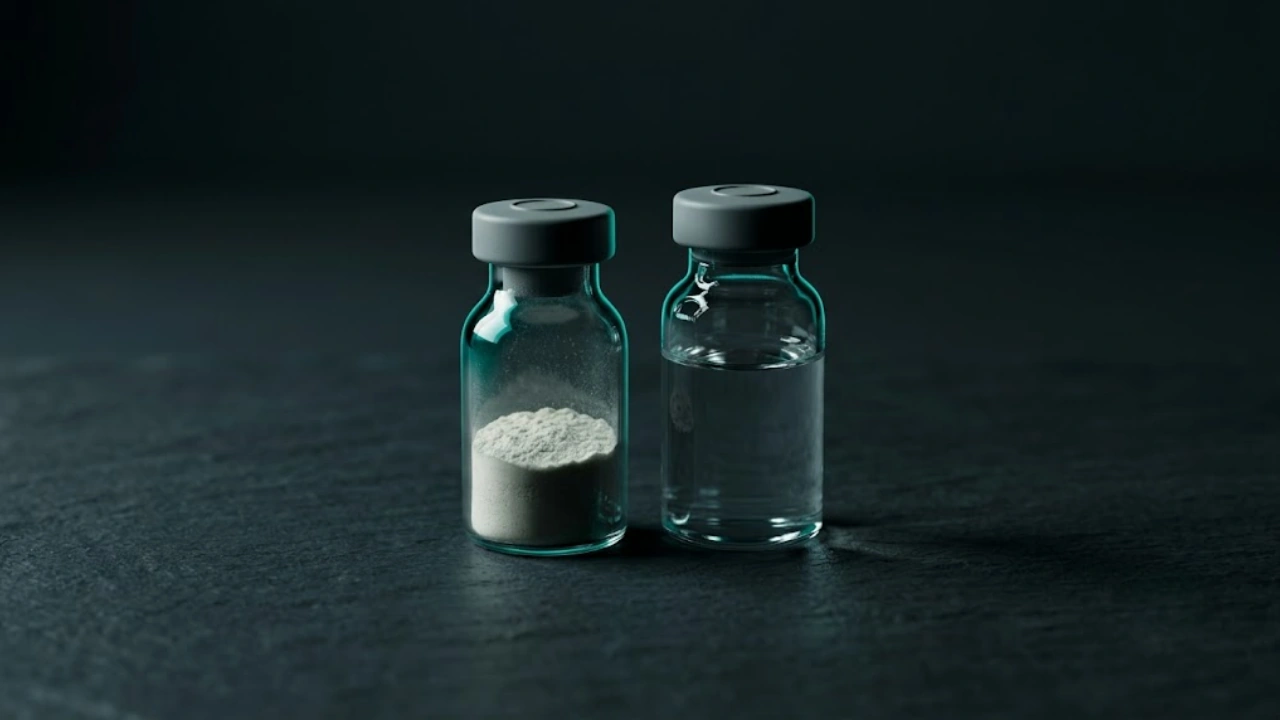
If you have just gotten a vial of peptide powder and have no idea what to do with it, you are in the right place. Reconstitution is the step that turns that dry powder into a liquid you can actually draw into a syringe, and it sounds more technical than it is. Here is the whole thing, plainly.
For what changes if somebody else mixed it, compare pre-filled pens with powder vials.
What does reconstituting a peptide mean?
Peptides ship as a freeze-dried powder because they last far longer dry. Before you can use one, you add a liquid to dissolve it. That is reconstitution. Nothing more complicated than mixing a powder with water, done carefully and cleanly.
What you need
- Your vial of peptide powder.
- Bacteriostatic water. This is sterile water with a tiny amount of preservative that keeps it usable for weeks. It is the standard mixing liquid for almost every peptide.
- An insulin syringe for measuring and drawing your doses.
- Alcohol swabs to wipe the vial tops.
That is it. Some people use a larger syringe to add the water and save the small insulin syringe for dosing, but it is not required.
How do you actually mix it?
- Let both vials, the powder and the water, come to room temperature if they were in the fridge.
- Wipe the rubber top of each vial with an alcohol swab.
- Draw up the amount of bacteriostatic water you have decided to use (more on choosing that amount below).
- Push the needle through the powder vial's top and add the water slowly, letting it run down the inside wall of the glass rather than blasting straight onto the powder.
- Expect the vial to pull. Freeze-dried vials are sealed under vacuum, so the water is drawn in on its own once the needle is through the stopper. Let it pull at its own pace rather than forcing the plunger. If no vacuum is there at all, the seal may have been compromised in transit, which is worth weighing before you use the vial.
- Do not shake it. Swirl the vial gently, or just set it down and let it sit. The powder dissolves on its own within a minute or two. Shaking drives peptide to the air-liquid interface, where it can unfold and aggregate.1
- Check the liquid before you use it. A correctly mixed vial is clear, with no floaters, haze or stringy material. If it stays cloudy after a few minutes of sitting, our guide on a cloudy peptide vial walks through what is worth using and what is not.
- Once the liquid is clear, it is ready. Store it in the fridge.
How much water do you add to a peptide?
This is the question everyone gets stuck on, and here is the answer that unlocks it: there is no single correct amount. The water only changes how concentrated the mix is, not how much peptide you have.
More water makes each drop weaker, so your dose sits at a higher mark on the syringe. Less water makes each drop stronger, so the same dose sits at a lower mark. Neither is right or wrong. You pick the amount that makes your dose easy to measure on the syringe.
That is exactly what our calculator does for you. Enter your vial size and your dose, and it shows you the water options side by side, with the syringe draw for each, and labels the one that is easiest to measure.
Calculating for
Semaglutide
Only injectable compounds are listed; oral, nasal and topical compounds don't need mixing.
Printed on the vial.
iPeptide Decoding does not recommend a dose. Enter the amount your clinician gave you, or pick a value from the reference range to model.
Same dose, different draw. Pick whichever is easiest to measure.
Multi-vendor comparison is a Pro feature.
Daily is 7. Twice weekly is 2.
Your plan for Semaglutide
Is there any exception to bacteriostatic water?
One worth knowing. IGF-1 LR3 is usually mixed with a dilute acetic acid solution instead of bacteriostatic water, and using plain water can degrade it.2 It is the odd one out, so follow that product's own instructions. For essentially everything else, bacteriostatic water is the standard.
How do you know how much to draw?
Peptide doses are drawn with an insulin syringe, which is marked in units. The detail that makes the syringe stop being intimidating is that 100 units simply means 1 mL. Units measure how much liquid you pull in, not how much peptide is in it. Once your vial is mixed, your dose and your water amount decide the exact unit mark to draw to, and the calculator works that out and shows it on a picture of a syringe.
How long does a reconstituted peptide last?
Dry powder keeps for a long time in the freezer. Once you mix a vial, keep it in the fridge, roughly 2 to 8 degrees Celsius, and use it within about a month. Do not freeze a vial that has already been mixed.3 Our guide on how to store peptides covers the details.
Common mistakes to avoid
- Shaking instead of swirling.
- Using the wrong liquid, distilled or tap water instead of bacteriostatic water.
- Blasting the water straight onto the powder instead of down the side.
- Mixing up micrograms and milligrams when you calculate your dose. This is the one worth double-checking every single time, because it is the easiest to get wrong and the most important to get right. Remember, 1 mg equals 1,000 mcg.
- Skipping the alcohol wipe before each draw.
One thing this guide will not do
Tell you how much to take. Reconstitution is just the mechanics of mixing. Your dose is between you and your clinician. On any compound page you will find the commonly referenced range and the evidence behind it, and then you decide the number.
Common questions
What does reconstituting a peptide mean?
Peptides ship as a freeze-dried powder because they last far longer dry. Before you can use one, you add a liquid to dissolve it. That is reconstitution — mixing a powder with water, done carefully and cleanly.
What do you mix a peptide with?
Bacteriostatic water — sterile water with a tiny amount of preservative that keeps it usable for weeks. It is the standard mixing liquid for almost every peptide.
How much water do you add to a peptide?
There is no single correct amount. The water only changes how concentrated the mix is, not how much peptide you have. More water means a higher mark on the syringe, less water a lower mark. Pick the amount that makes your dose easy to measure.
Can you shake a peptide vial?
No. Swirl gently or let it sit. The powder dissolves on its own within a minute or two. Shaking can damage some peptides.
How long does a reconstituted peptide last?
Dry powder keeps for a long time in the freezer. Once mixed, keep the vial in the fridge (roughly 2 to 8 degrees Celsius) and use it within about a month. Do not freeze a vial that has already been mixed.
Which peptide is not mixed with bacteriostatic water?
IGF-1 LR3 is usually mixed with a dilute acetic acid solution instead of bacteriostatic water; plain water can degrade it. For essentially everything else, bacteriostatic water is the standard.
Why does the water get pulled in by itself?
Lyophilized vials are sealed under vacuum, so the vial draws the water in on its own. Let it pull rather than forcing the plunger, and keep the stream running down the glass wall. If nothing is pulled in at all, the vacuum is gone, which can mean the stopper seal has been compromised.
What if the mixed vial looks cloudy?
A correctly mixed vial is clear and free of particles. Cloudiness that does not clear after a few minutes of sitting, visible floaters, or stringy material mean the vial should not be used.
Sources
- Protein Aggregation and Particle Formation: Effects of Formulation, Interfaces, and Drug Product Manufacturing Operations. Journal of Pharmaceutical Sciences, 2011. Peer-reviewed, read at source. Agitation drives protein and peptide molecules to the air-liquid interface, where unfolding and aggregation occur — the mechanism behind the swirl-do-not-shake rule.
- Recombinant human insulin-like growth factor-I (IGF-I): solubility and stability in acidic solution. Peer-reviewed pharmaceutical literature. IGF-I and its analogs are formulated and reconstituted in dilute acid because solubility and stability fall away at neutral pH, which is why IGF-1 LR3 is supplied with an acetic acid diluent rather than bacteriostatic water.
- U.S. Food and Drug Administration — bacteriostatic water for injection labeling and multiple-dose vial guidance. Regulatory. Multiple-dose vials preserved with benzyl alcohol carry a limited in-use period after first puncture and are stored refrigerated; freezing a reconstituted vial is not part of any labeled handling instruction, since freeze-thaw stress damages peptides in solution.
Once your vial is mixed, the next step is figuring out your exact syringe draw and what it costs. That is what the calculator is for. If you are running two compounds, our guide on mixing two peptides in one syringe covers why two barrels is the safer default.
And if you have got this far and the needle part is the problem rather than the mixing, that is common and there is a technique with real evidence behind it. Our guide on injection anxiety covers it.
If you injected before the powder had fully dissolved, the injection-error guide covers what to record and what to watch for now.
Keep reading
- Are Peptide Pens Safe? Pens vs Vials, Compared
What sellers charge, why the date of mixing matters, and what a powder COA cannot tell you about a pre-filled pen.
- How Much Water Do I Add to a Peptide?
There is no single right amount.
- How to Store Peptides
Two clocks run on a mixed vial: one for germs, one for the molecule.
- How to Read an Insulin Syringe
U-100 insulin syringes are the standard measuring tool for peptides.
- Where to Inject, and Why Rotation Matters
The four subcutaneous sites, why the shortest needle is recommended for everyone, and how to rotate properly.
- My Peptide Went Cloudy. Is It Ruined?
One question decides almost everything: when did it go cloudy? Immediately is usually a dissolving problem.
- How to Tell Your Dose Calculation Is Wrong
A calculator gives you an answer whether or not your inputs made sense.
- Can You Mix Two Peptides in One Syringe?
Nobody has tested it for peptides.
The peptide stuff worth knowing.
Get new guides, tools, compound pages, and important peptide news in your inbox 1–3 times a month. If there’s nothing worth sending, we don’t send one.