
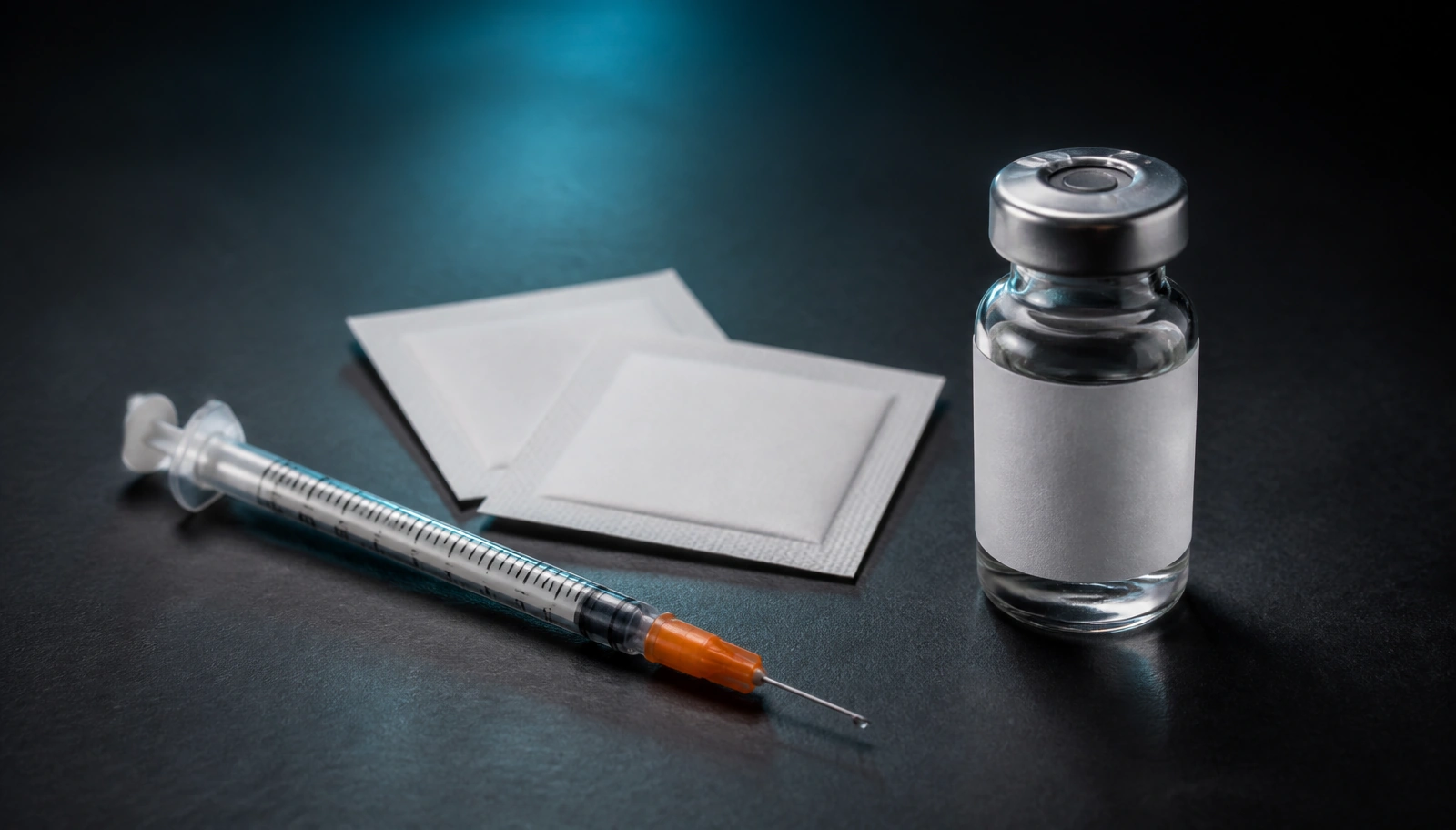
Subcutaneous means into the layer of fat just under the skin, not into muscle and not into a vein. Four areas are used for it: the abdomen, the thigh, the buttock and the upper arm.
Move around inside them. The usual advice is to work in one quadrant for three or four days, then switch, keeping each injection about a centimetre from the last one.
Shorter needles are better. Diabetes care points to the shortest needle available, for everyone, whatever their size.
Almost everyone thinks they rotate well. In a large survey, 98% said they rotated. About a third were doing it wrong.
Nearly all of this evidence comes from insulin, because that is where the research went. A section below sets out what carries over.
When to stop and get it looked at
Redness spreading outward, heat, increasing pain over days, pus, fever, or a red streak moving away from the site. Those are infection signs and they need a clinician, not a change of technique. Our guide on when an injection site reaction means stop and get seen covers the whole picture, including the ten-second test that sorts most of it.
Everything below assumes nothing is currently wrong.
If something went wrong during the injection itself, what happens next depends on whether it went too deep, too shallow, leaked, bled, or may have gone into a vein.
The four areas
Clinical guidance names four sites for subcutaneous injection and infusion: the abdomen, the thigh, the buttock and the upper arm.1
| Area | Where exactly | Notes |
|---|---|---|
| Abdomen | Clear of the navel by a couple of finger-widths, away from ribs and hip bones | Most used |
| Thigh | Front and outer surface | Not the inner thigh |
| Buttock | Upper outer part | Hard to see on yourself |
| Upper arm | Back and outer surface | Hardest to reach without an awkward angle |
The abdomen is the most used, and the usual instruction is to stay a couple of finger-widths clear of the navel and away from the ribs and the hip bones. The thigh means the front and outer surface, not the inner. The buttock means the upper outer part. The upper arm means the back and outer surface, and it is the hardest to reach on yourself without an awkward angle.
Skip anywhere that is bruised, scarred, tattooed over broken skin, inflamed, or lumpy. Injecting into damaged tissue changes how the drug is absorbed, sometimes considerably.1
Needle length, and why shorter wins
The recommendation that surprises people most is that shorter needles are better for everyone.
The FITTER recommendations came out of a workshop of 183 diabetes experts from 54 countries. They state that the shortest available needles are safe, effective and less painful, and should be first choice for every patient group regardless of age, sex or body size.1 The 2025 update says the same, naming 4 mm as the recommended pen needle length whatever a person's age or BMI.2
The reason is what sits underneath. Longer needles increase the chance of reaching muscle, and intramuscular injection changes absorption and hurts more. FITTER advises avoiding it.1 A longer needle does not deliver the drug more thoroughly. It delivers it deeper, which is a different thing and usually the wrong one.
One practical note. On an insulin syringe the needle is fixed to the barrel, so the length is decided when you buy the syringes, and they commonly come in 6 mm, 8 mm and 12.7 mm. Check the box before you order more. Our guide to reading an insulin syringe covers the markings on the barrel, which are a separate thing from the needle length. If you are running two compounds, our guide on whether to combine two compounds in one barrel covers what is known and what is not.
Use a new needle every time. Reuse blunts the tip, and it is associated with pain, bruising and injection site reactions.5
Doing it, in order
Before you start, take the vial out of the fridge and give it a few minutes. Guidance for insulin advises against injecting cold as one of the measures for reducing tissue problems.2 Look at the solution while you wait. If it has gone cloudy or has particles in it, our guide on cloudy vials covers what that means before you go any further.
- Wash your hands. Set out the vial, a new syringe, something clean to press on the site afterward, and your sharps container.
- Pick the site. Somewhere inside the area you are working through this week, at least a centimetre from your last injection, and clear of bruises, lumps, scars or irritated skin.
- Draw the dose. Then hold the syringe needle-up and flick the barrel so any air rises to the top, and push it out until liquid appears at the tip.
- Pinch, if you need to. With the shortest needles most adults do not. A pinch is generally advised for children and for lean adults with little fat under the skin.3 If you pinch, lift the skin between thumb and finger without squeezing hard enough to hurt.
- Insert quickly and fully, straight in at 90 degrees. A 45 degree angle is the alternative taught for people with very little fat under thin skin.3 Do not press the plunger while the needle is going in.
- Release the pinch, then press the plunger slowly and steadily until it stops.3
- Count to ten before pulling the needle out.3 People skip this step, and skipping it is the most common reason a dose leaks back out.
- Press gently with clean gauze as the needle comes out. A spot of blood afterward is normal.3
- Put the whole syringe straight into the sharps container. Do not re-cap it, and do not set it down first.
Rotation, done properly
Rotation is the part most people believe they are doing and are not.
The method in current guidance is to divide the area into quadrants, use one quadrant for three or four days, then move to the next, keeping each individual injection at least a centimetre from the previous one.2 Working around a clock face inside each quadrant is a common way to keep track.
Wandering randomly around the abdomen is not rotation, because random choice clusters. The point of a system is that it removes the choice.
The gap between belief and practice has been measured. In the Australian arm of the international injection technique survey, 98% of people said they rotated, and more than a third were doing it incorrectly. Over half were still using needles longer than recommended, and seven in ten held the needle in for the wrong length of time.4
One adaptation is needed, because that schedule was written for insulin and insulin is injected daily or more often. Someone dosing twice a week, or once, cannot apply a three-day quadrant rule as written.
The principle underneath it still works. Give any individual spot as long as possible before you come back to it, and keep the order fixed so the decision is not made in the moment. A weekly injector moving through four quadrants in order returns to the first one after a month, which is a longer gap than daily insulin users ever get.
Two reasons this matters more than it sounds. Repeated injection into one patch builds up firm, rubbery tissue that absorbs drugs unpredictably, sometimes faster and sometimes barely at all.1 And that tissue often goes numb, so it hurts less, so people keep choosing it. Our guide on injection site reactions covers that trap and the lump itself in detail.
What to do with the needle afterward
Used syringes go into a sharps container, and never loose into household or public bins, recycling, or down the toilet.8 The people that endangers are refuse workers, cleaners, and anyone else in your household.
An FDA-cleared sharps container is the right thing, and they are inexpensive and sold through pharmacies, medical supply companies and online.8 Where one is not available, the FDA describes a heavy-duty plastic household container with a screw-on lid, a laundry detergent bottle being the example it gives, and it should be labeled so nobody mistakes what is inside.8 Stop filling it at about three-quarters.
Disposal itself varies by where you live, and there is no single national rule. Drop-off points can include pharmacies, hospitals, health departments, fire stations and household hazardous waste sites, and mail-back programs exist.8 Some states prohibit household sharps in the trash outright while others permit a sealed container, so the answer comes from your state or county, not from a federal page.9 Our full guide to what to do with the needle afterward takes each of those routes in turn, along with the vial.
If you are stuck by someone else's used needle, wash the area with soap and water or a skin disinfectant and seek medical attention the same day.8
What the evidence actually is
Everything above comes from insulin research. That is where the money and the trials went, and there is no equivalent body of work on injecting research peptides.
Some of it transfers cleanly. Needle length, angle, the ten-second count and the mechanics of tissue trauma are not properties of insulin. They are properties of putting a needle into subcutaneous fat, and they apply to anything injected the same way.
Some of it does not transfer directly. Insulin has a specific fat-building effect that most other compounds lack, which is why lipohypertrophy rates in insulin users run far higher than you should expect elsewhere. Our injection site guide sets out that calibration and the numbers behind it.
And some of it is simply unstudied. Absorption differs between sites for insulin, which is well documented. Whether the same site differences hold for any given peptide has not been tested, so the honest position is that rotating changes where the drug enters and nobody has measured what that does for these compounds specifically.
Three things people argue about
Alcohol swabs
Guidance genuinely disagrees. The Forum for Injection Technique in the UK and published research both report that disinfection before subcutaneous insulin injection is not necessary, and one review states plainly that swabbing clean skin is unnecessary.6 The World Health Organization recommends washing with soap and water instead.6 Other clinical guidance still calls for 60 to 70% isopropyl alcohol.3 What everyone agrees on: visibly dirty skin gets washed, and if you do use alcohol, let it dry completely before the needle goes in.
Aspiration
Pulling back on the plunger to check for blood before injecting is not necessary for subcutaneous or intramuscular injection at the recommended sites, because no large blood vessels are there.7 It also makes the injection more painful.
Needle reuse
Documented skin infections from subcutaneous insulin injection are rare. A 2022 study modeled what happens to skin bacteria during an injection and concluded that carrying colonies into the tissue is unlikely, which explains why reuse has not been linked to infection.5 None of that is an argument for reusing needles. The case against reuse is pain, bruising, injection site reactions and tissue damage.5
What reading about it cannot teach
Which site suits a particular compound, because that comparison has not been made for these drugs.
Whether your technique is correct, since reading about a ten-second count and performing one are different skills. A pharmacist or nurse will watch you do it, and many will do that without much ceremony.
And if the difficulty is not technique at all but the needle itself, our guide on injection anxiety covers what actually helps, including the one technique with real evidence behind it.
Anything about dose. Where to put it and how much to put in are separate questions, and our guides on dose calculation and reading a syringe cover the second one.
Common questions
Does it matter which site I use?
For insulin, absorption differs by site and it matters. For research peptides, nobody has run that comparison, so the practical answer is to pick sites you can reach and reuse them in a system.
How far apart should injections be?
At least a centimetre from the last one, with the working area changed every three or four days.2
Do I need to pinch the skin?
With the shortest needles, most adults do not. A pinch is generally advised for lean adults and children.3 If a site feels like it has very little padding, pinch it.
Why does the dose leak back out?
Usually because the needle came out too soon. Counting to ten before withdrawing is what prevents it.3
There is a small air bubble in the syringe. Is that dangerous?
The fear comes from air embolism, which involves a large volume of air entering a vein directly. A subcutaneous injection puts a small volume into the fat under the skin, which is a different route. The practical problem with air is accuracy, since air in the barrel takes up space that should hold liquid, so you get less drug than you measured. Flick the bubbles to the top and push them out before you inject.
What do I do with the used syringe?
It goes straight into a sharps container without being re-capped. Loose needles must never go into household bins, recycling or the toilet.8 Where you take the full container depends on your state.
Is it normal to bleed a little?
Yes. Blood at the site after the needle comes out is not serious.3 Press on it with clean gauze.
Can I inject into the same spot if it is the only one that does not hurt?
A site that stopped hurting is the one to stop using. Tissue injected repeatedly often loses sensation, which is why it feels easier, and it absorbs unpredictably. Our injection site guide explains the full picture.
Does it hurt less with a shorter needle?
The evidence says yes. Shorter needles are described as less painful with higher acceptance and comparable outcomes.1
Sources
- Frid AH, Kreugel G, Grassi G, et al. New Insulin Delivery Recommendations. Mayo Clinic Proceedings 2016;91(9):1231-1255. Peer-reviewed expert recommendations, abstract and key sections read at source. Written and vetted by 183 diabetes experts from 54 countries at the FITTER workshop in Rome, 2015. States that the shortest needles, being 4 mm pen and 6 mm syringe needles, are safe, effective and less painful and should be first-line in all patient categories; that intramuscular injections should be avoided; that lipohypertrophy is a frequent complication which distorts absorption, that injections should not be given into these lesions, and that correct site rotation helps prevent them. Names the abdomen, thigh, buttock and upper arm as the recommended injection and infusion sites.
- Advance Insulin Injection Technique and Education With FITTER Forward Expert Recommendations. Mayo Clinic Proceedings, April 2025. Peer-reviewed expert recommendations, abstract read at source, authored by 16 diabetes specialists from 13 countries meeting in 2023 and 2024. Recommends 4 mm as the needle length for all individuals regardless of age or BMI, with 5 mm as a backup and lengths above 5 mm not recommended for any population. For lipodystrophy prevention, recommends dividing the body into quadrants, rotating the injection quadrant every three to four days, and keeping each injection at least 1 cm from previous sites, alongside avoiding cold insulin and not reusing needles. The quadrant and 1 cm details were read in a detailed conference summary of the paper rather than in the full text, which sits behind a paywall.
- Subcutaneous injection procedure as described in patient instruction materials within published clinical trial protocols, and in clinical best-practice guidance for injectable medicines. Trial protocol documents hosted at clinicaltrials.gov and a pharmacy clinical guide, read via search results. Consistent across sources: insert at 90 degrees, with 45 degrees taught for people with little subcutaneous fat on thin skin; release the pinched skin after the needle is fully inserted; press the plunger slowly and steadily; count 10 seconds before withdrawing; apply gauze with gentle pressure as the needle is removed; blood at the site afterwards is not serious. The same clinical guide recommends skin disinfection with 60 to 70% isopropyl alcohol or ethanol, which conflicts with the sources at reference 6 and is reported as a disagreement in the guide.
- Australian arm of the international injection technique survey, reported in FITTER educational materials. Manufacturer-published educational material summarising survey findings, read via search result. Reports that 98% of respondents claimed to perform site rotation while over a third, 37%, performed it incorrectly; that over half, 51%, were still using needles longer than the recommended 4 mm; and that seven in ten left the needle in the skin for an incorrect length of time. The publisher manufactures pen needles, which is a commercial interest in the finding that people use the wrong ones. The underlying survey is the same international injection technique study that informed the 2016 recommendations, and the figures were not verified against the survey publications themselves.
- Injection site microflora in persons with diabetes: why needle reuse is not associated with increased infections? 2022. Peer-reviewed study, abstract read at source. Sampled 50 people with diabetes and 50 controls, and analysed used pen injectors and needles collected from home and hospital use. Most needles and cartridges, 95% and 86% respectively, contained no biological signal. A mathematical model indicated that penetrating bacterial colonies during subcutaneous injection is unlikely, which the authors offer as an explanation for the lack of documented skin infections from subcutaneous insulin injection. The paper separately describes needle reuse as a primary cause of pain, bruising, clogging, injection site reactions and associated lipodystrophy.
- Is skin disinfection before subcutaneous injection necessary? The reasoning of Certified Nurses in Infection Control in Japan. PLOS One 2021. Peer-reviewed qualitative study, abstract and introduction read at source. States that nurses continue to disinfect skin before subcutaneous injection despite evidence that disinfection is not necessary, citing the Forum for Injection Technique UK and Tandon et al. Notes that the WHO toolkit recommends washing the skin with soap and running water, and that swabbing clean skin before an injection is unnecessary while visibly soiled skin must be washed.
- CDC. Vaccine Administration, Immunization Best Practices. Government clinical guidance, read at source. States that aspiration before injection, meaning pulling back on the syringe plunger after needle insertion and before injecting, is not necessary because no large blood vessels are present at the recommended injection sites, and that a procedure including aspiration may be more painful. The guidance is written for vaccines; the anatomical reasoning applies to the same sites.
- FDA. Safely Using Sharps (Needles and Syringes) at Home, at Work and on Travel and Best Way to Get Rid of Used Needles and Other Sharps. Government guidance, read at source. States that loose sharps must never be placed in household or public trash or recycling bins or flushed, because this endangers waste and sewage workers, cleaners, household members and children. Used sharps should go immediately into a sharps disposal container. FDA-cleared containers are available through pharmacies, medical supply companies, health care providers and online, and are made of puncture-resistant plastic with leak-resistant sides and a tight-fitting puncture-resistant lid. Where an FDA-cleared container is not available, a heavy-duty plastic household container such as a laundry detergent container may be used. Disposal methods vary by locality and may include drop-off at doctors' offices, hospitals, pharmacies, health departments, medical waste facilities, police or fire stations, and household hazardous waste collection sites. For needlestick injury from another person's used needle, wash the area immediately with soap and water or a skin disinfectant and seek immediate medical attention. The three-quarters fill guidance and the labelling advice appear in state health department materials restating FDA container standards.
- State-level variation in household sharps disposal rules. Secondary sources, read via search results, including a state guide published in 2026 and a California sanitary district notice. Rules differ by state: California and Massachusetts prohibit home-generated sharps in household trash, while other states permit disposal in a sealed approved container, and some have no specific rule for home users. California's prohibition is at Section 118286 of the Health and Safety Code. The FDA sets container standards but does not regulate what a household does with its own used needles, which is why the answer is a state or county one. No single authoritative national list was verified at source, so the guide directs readers to their own state or county rather than naming states.