
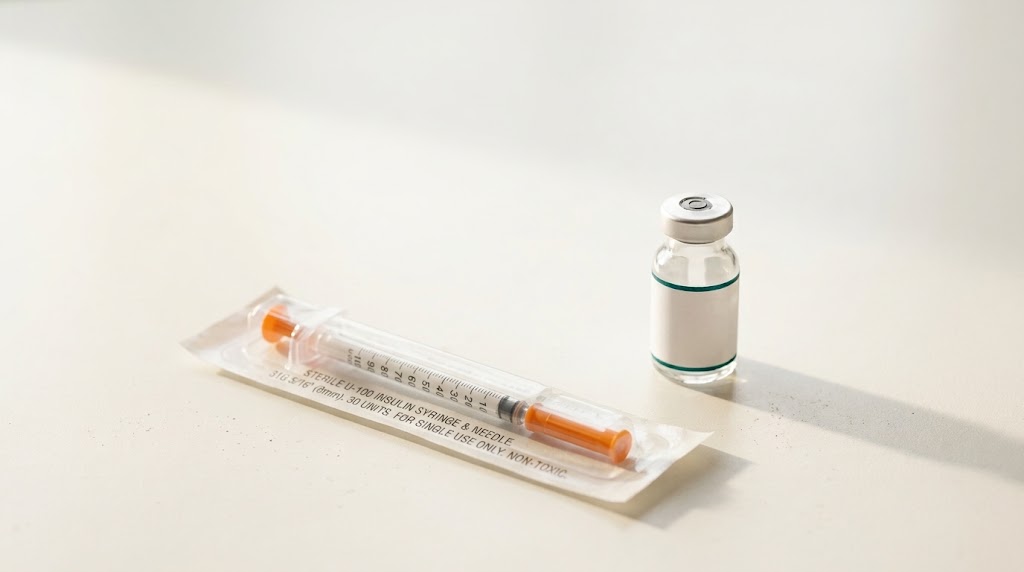
Putting off an injection. Sitting with the syringe in your hand for twenty minutes. Quietly abandoning a protocol because the needle part turned out to be harder than expected.
All of it is common. Between 20 and 30% of adults have significant needle fear.[^1]
It is also one of the few fears with a physical signature you can measure. Two different things get called needle anxiety, and one of them does not respond to the usual advice.
Are you afraid of the needle, or of what is in it?
Some people reading this are not afraid of needles at all.
They are afraid of injecting something they bought from a website into their own body, which is a different thing entirely and not a phobia. It is a reasonable response to a reasonable uncertainty, and the techniques below will not touch it, because there is nothing irrational to work on.
If that is closer to your situation, the useful reading is elsewhere. Our guide on reading a COA explains what would actually tell you what is in the vial, our guide on vetting a vendor covers what can be checked before buying, and our guide on why most peptides have no human evidence deals with the compound itself.
Hesitation that gets worse the more you learn about a product is information, not anxiety.
The rest of what follows is about needles.
The two kinds of needle fear
Anxiety
The one people expect. Racing heart, dread building through the day, avoidance, the syringe sitting on the counter, and blood pressure and heart rate both rising with it.
The vasovagal response
Different, and the common one here. Blood pressure and heart rate rise briefly and then plunge at the moment of the needle. That is what produces the lightheadedness, the nausea, the greying vision and, at the far end, fainting.
Needle fear is unusual among phobias in producing that response at all, which most others do not.[^2]
The standard advice for anxiety makes the vasovagal response worse. Relaxing, breathing slowly, letting your muscles go loose: all of that lowers blood pressure, which is the direction it is already dropping.
Check this against your own experience. Many people who faint report no conscious fear of the needle itself, but a considerable fear of the fainting.[^2] If that describes you, the thing you are avoiding is not the injection.
Applied tension: the technique that works
The evidence-backed technique for the fainting response is to deliberately raise your blood pressure rather than calm it.
Tense large muscle groups. Arms, legs, torso. Hold for fifteen to twenty seconds until you feel warmth in your face, release for twenty or thirty seconds, and repeat. Do it for a few minutes before the injection and keep going during it.
A systematic review of randomised trials found applied tension reduced fainting compared with exposure alone. The benefit held immediately after treatment and at one-year follow-up.[^3] That durability is unusual for a behavioural technique, and it is the best evidence available here.
Two practical notes. Do not tense the limb you are about to inject, and stay seated or lying down until it passes if you feel it coming anyway.
What helps if you do not faint
Different problem, different tools, and these have less evidence behind them than applied tension does.
Cold
An ice pack or cold spray on the site for a minute beforehand reduces the sensation. Of the physical interventions, this one has the most support behind it.[^4]
Not watching
Looking away is not weakness, it removes the visual trigger that drives a lot of the response.
Topical anaesthetic
Numbing cream applied 30 to 45 minutes before, available without prescription. For somebody genuinely stuck, it can be what gets the first few injections done.
A shorter needle
Our injection guide covers why the shortest needle is recommended for everyone, and a shorter needle is also less frightening to look at.
Same time, same place
Deliberation is the enemy here. A fixed routine removes the twenty minutes of building up to it, which is usually worse than the injection.
Somebody there the first few times
Not to do it for you, just to be present.
Getting through the first injection
Most abandonment happens here, and the gap between what people expect and what actually happens is widest on the first attempt.
Set everything out before you begin. Vial, syringe, alcohol wipe, sharps container, all within reach. Fumbling with packaging while holding a drawn syringe is what turns two minutes into twenty.
Sit down somewhere you can stay sitting. Not standing at a bathroom sink, which is the worst possible place to discover you faint.
Use the abdomen. It is the least sensitive of the subcutaneous sites, the easiest to see, and the easiest to pinch, and our injection guide covers the rest of them for when you start rotating.
And expect the minute before to be worse than the injection, which is the usual order and useful to know in advance.
Why you feel faint after injecting
The ten minutes after catch people out, because they were braced for the needle and not for what follows.
Lightheadedness, slight nausea, feeling clammy or shaky. If that arrives within a minute or two of injecting, it is almost always the vasovagal reflex resolving rather than anything to do with the compound.
Sit down and stay down until it passes, which usually takes a few minutes. Lying down with your legs raised is better still. Do not go and stand up to prove you are fine, which is how people end up on the floor.
Our guide on when an injection site reaction means stop and get seen covers what a genuine reaction looks like and which symptoms mean something different. Timing is usually the clue.
Does a subcutaneous injection actually hurt?
A subcutaneous injection with a short fine needle into fat is among the least painful injections there is. The brain reliably overestimates it, and the gap between expected and actual is largest on the first attempt.
That does not mean it is nothing, and some compounds sting regardless of technique, and our guide on injection site reactions covers the difference between ordinary soreness and something that needs attention.
How someone else can actually help
Most people who want to help do it wrong, kindly.
Watching intently makes it worse. So does asking whether you are ready, repeatedly, which restarts the countdown every time. So does offering to do it for you, which sounds generous and removes the thing you are trying to build.
What actually helps is being in the room and visibly uninterested. Nearby, doing something else, available if you feel faint and otherwise not part of it.
If you do want somebody to do the injection itself, that is a fine arrangement and worth agreeing in advance rather than at the moment, which is when it tends to be proposed.
When to get it treated properly
Needle fear is badly underdiagnosed in adults, largely because people are embarrassed by it and it rarely comes up unless somebody asks.[^1]
It is also treatable, with a good evidence base. Exposure-based cognitive behavioural therapy works for specific phobias, and needle phobia is among the more responsive ones, usually over a handful of sessions.
If injections are part of your medical care, and particularly if fear is causing you to skip or delay them, raise it with a doctor as the recognised condition it is.
Is it alright to just stop?
Almost nothing written about injection anxiety says this, and it belongs on a site about compounds that are mostly unproven.
If you cannot face injecting a research peptide that has no completed human trial behind it, stopping is a completely reasonable decision. Our guide on why most peptides have no human evidence covers what you would be giving up, which for most compounds is a possibility and not a benefit.
That calculation is different for prescribed medication. Insulin, a GLP-1 for diabetes, fertility treatment: those have evidence behind them, and there the fear is worth treating instead of accommodating. Raise it with the prescriber, since alternatives sometimes exist.
But nobody should white-knuckle their way through daily injections of something unstudied because quitting feels like failure. None of this is a test you can pass.
Where this stops being useful
Whether your particular reaction is vasovagal or anxiety, which is worth discussing with a clinician if it is severe.
Anything about a diagnosed phobia, which has proper treatment available.
Whether to continue, which depends on what you are injecting and why.
Common questions
Is it normal to be scared of injecting yourself?
Between 20 and 30% of adults have significant needle fear, and it is higher in younger adults and in women. It is common, underdiagnosed, and rarely mentioned because people find it embarrassing.
Why do I feel faint when I inject?
That is a vasovagal response: blood pressure and heart rate drop sharply at the moment of the needle. It is a genuine physical reflex and not a state of mind, and needle fear is one of the few phobias that produces it.
Should I relax before injecting?
Not if you are prone to fainting. Relaxation lowers blood pressure, which is what is already falling. Tensing your muscles deliberately is the evidence-backed approach.
What is applied tension?
Tensing large muscle groups for fifteen to twenty seconds, releasing for twenty or thirty, repeated for a few minutes before and during the injection. A systematic review found it reduced fainting compared with exposure alone, and the effect held at one year.
Does numbing cream work?
Topical anaesthetic applied 30 to 45 minutes beforehand reduces the sensation and is available without prescription. It can be what gets somebody through the first few injections.
Does it get easier?
For most people, yes, and the first attempt is where the gap between expected and actual pain is widest. Where it is not improving, exposure-based therapy has a good evidence base and takes a handful of sessions.
I am not scared of needles, I am scared of what is in the vial
That is a different thing and not a phobia. It is a reasonable response to real uncertainty, and no relaxation technique addresses it. Our guides on reading a COA and on vetting a vendor are the relevant reading.
I feel faint after injecting, not during
Sit down and stay down for a few minutes, with your legs raised if you can. Arriving within a minute or two of the injection, that is almost always the vasovagal reflex rather than the compound.
How can my partner help?
By being nearby and uninterested. Watching intently, asking repeatedly whether you are ready, and offering to take over all make it harder, however kindly meant.
Should I just give up?
If you are injecting a research peptide with no completed human trial, that is a reasonable decision and not a failure. If it is prescribed medication with evidence behind it, treating the fear is the better route, and the prescriber may have alternatives.
Sources
[^1]: Interventions for adults with needle fear: prevalence and treatment. Frontiers in Psychiatry, 2025. Peer-reviewed. Reports that fear of needles affects approximately 20 to 30% of adults, with higher rates in younger adults and in women, and that prevalence is higher in chronic disease cohorts. Records that needle fear remains underdiagnosed and undertreated in adults, with avoidance driven partly by embarrassment.
[^2]: Vasovagal response in blood-injection-injury phobia. The characteristic physiological sequence, an initial rise in blood pressure and heart rate followed by a sharp drop at the moment of the procedure, is described consistently across clinical sources, as is the observation that many people who faint report fearing the fainting rather than the needle. Blood-injection-injury phobia is distinctive among specific phobias in producing a vasovagal response.
[^3]: Interventions for Individuals With High Levels of Needle Fear: Systematic Review of Randomized Controlled Trials and Quasi-Randomized Controlled Trials. Clinical Journal of Pain, 2015. Peer-reviewed systematic review. Applied tension showed benefit on fainting post-treatment and at one-year follow-up compared with exposure alone; the review notes these findings rested on a single trial with twenty participants. Records lifetime prevalence of blood-injection-injury phobia at approximately 3% to 4.5%, rising to around 10% when high needle fear without formal diagnosis is included.
[^4]: Cold, topical anaesthesia and distraction for injection-related pain and anxiety. Reported across clinical and patient-facing sources with a weaker evidence base than applied tension. Cold application and topical anaesthetic are the two physical interventions with reasonable support; distraction and avoiding visual exposure are commonly recommended with less formal evidence.