
Call 999 or 911 now
These are emergencies, not injection site questions, and they usually arrive within minutes to an hour of injecting.[^3]
Trouble breathing or noisy breathing.
Swelling of the face, lips, tongue or throat.
A rash spreading across the body, not staying at the site.
Feeling faint, or a sense that something is badly wrong.
This is anaphylaxis, it can worsen in minutes, and it is treated as an emergency regardless of how the injection site itself looks.[^3]
If the problem happened during the injection rather than developing afterward, the injection-error guide covers bleeding, leakage, accidental muscle injection, a possible vein hit, and a repeated dose.
Get seen today
Not an emergency, and not something to sleep on either. Any one of these is enough on its own.
Red streaks running from the site toward your armpit or groin. Thin red lines tracking away from the injection, following the path of your lymph vessels. This is lymphangitis and it means an infection is moving.[^4] Same day, without exception.
A fever above 38°C or 100.4°F within a day or two of injecting, especially with chills or feeling generally unwell.[^5] A local reaction does not make you feel ill. Feeling ill means something has become systemic.
Pus, or any discharge from the site.[^5]
A lump that feels soft or spongy when you press it, with tight shiny skin over it and sometimes a pale or yellow center. That is an abscess, it will not resolve on its own the way an ordinary reaction does, and it usually needs draining.[^2]
Redness that keeps expanding past about two inches from the site, particularly with warmth and increasing pain.[^5]
Pain that is getting worse after the first 48 hours instead of settling.[^2]
If you are diabetic, immunosuppressed, or have circulation problems, the threshold for all of the above drops. Get seen sooner.[^6]
The marker line
The single most useful thing you can do at home, and it takes ten seconds.
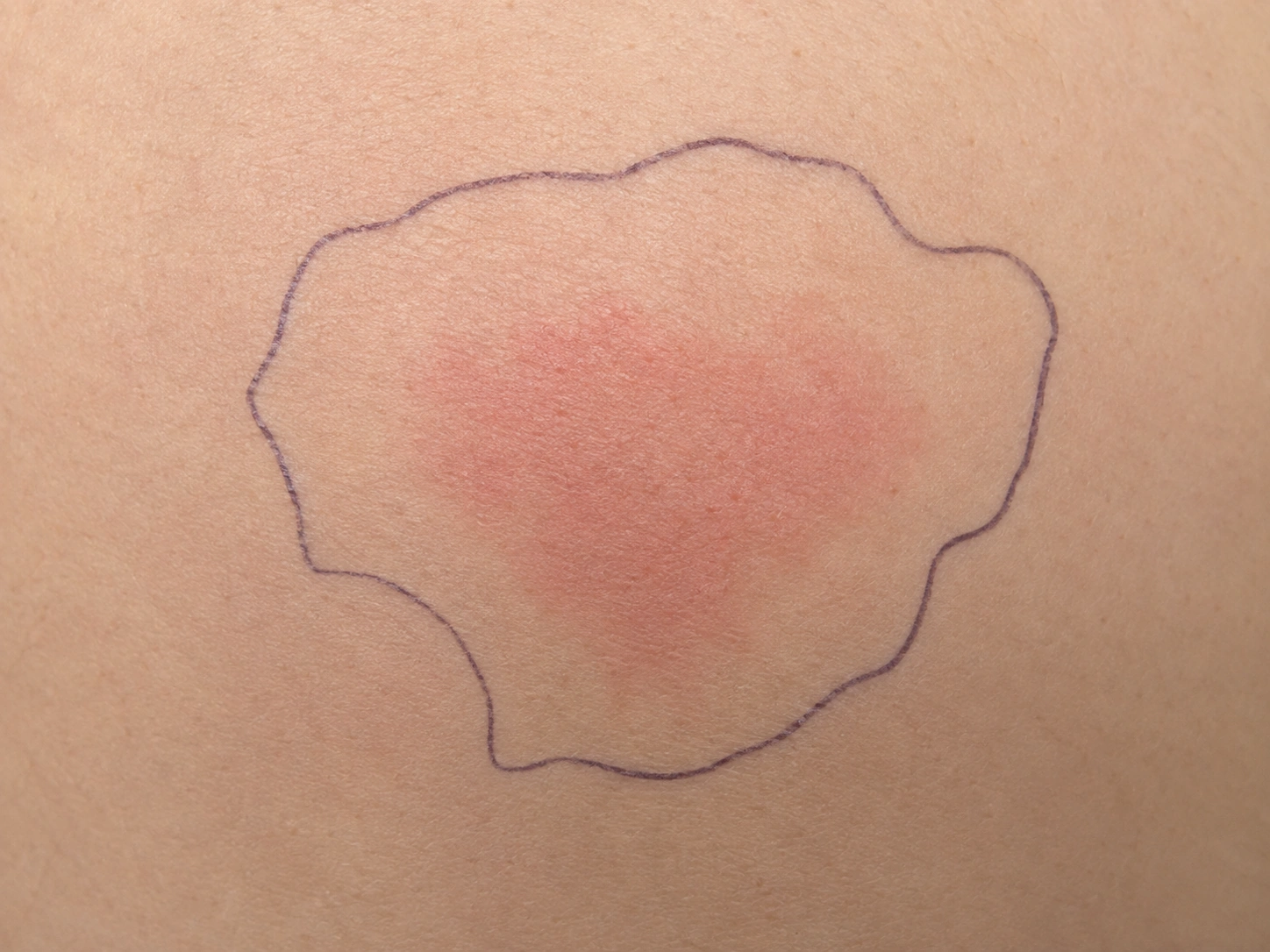
Draw a line around the edge of the redness with a pen. Write the time next to it.
Clinicians do exactly this when assessing a possible skin infection, for the same reason: redness is hard to judge by memory and easy to judge against a line.[^6] Check it a few hours later, and again the next morning.
Inside the line and fading means it is behaving normally.
Creeping past the line, especially with more pain and warmth than yesterday, means the get-seen-today list above applies.
A photograph in the same light, at the same distance, does a similar job less precisely.
What normal actually looks like
Most of what frightens people is normal, and the numbers are more reassuring than the internet suggests.
The timeline. Changes appear within a few hours, peak at 24 to 48 hours, and resolve within about a week.[^1] Milder reactions clear inside 48 to 72 hours.[^7]
The size can be alarming and still be normal. In studies of a routine childhood booster, between 19% and 33% of children developed redness or swelling of 50 millimetres or more, roughly two inches, and 1% to 2% had swelling extending from shoulder to elbow.[^1] Those were not infections. Nearly all resolved on their own.
The tenderness fades as it grows, which is the test at the top of this page.[^1]
You feel fine. Systemic symptoms are infrequent with a large local reaction. Someone with a spreading local reaction who feels entirely well is describing a different situation from someone with a spreading local reaction and a fever.[^1]
A firm lump is expected. A small hard bump under the skin after injecting is an ordinary finding and not in itself a sign of anything.[^3] What matters is whether it is hard or soft, and whether it is growing.
For scale: among people who inject regularly, roughly 42% report redness, swelling or tenderness at some point, while about 7% develop an actual abscess or open wound.[^2]
Why peptides in particular
A general injection page will not cover either of these.
Injection site reactions are the most common side effect of subcutaneous peptide use, reported in roughly 5% to 30% of users depending on the compound.[^5]
And some of that is histamine, not irritation. Several growth hormone releasing peptides, GHRP-2 and GHRP-6 particularly and ipamorelin less so, trigger histamine release directly.[^5] That produces a fast itchy welt that arrives within minutes and settles within hours, which is a different thing from the redness and swelling this page is about. Our guide on why a peptide injection itches or welts covers that side.
The distinguishing feature is speed. Histamine is minutes. Inflammation is hours. Infection is days.
The long-standing lump, and the trap inside it
A firm lump that has been there for weeks, does not hurt, and is not red or warm is usually something else entirely.
Lipohypertrophy is a build-up of fat and scar tissue from injecting the same patch of skin repeatedly. It feels firm or rubbery, can range from pea-sized to fist-sized, and the skin over it feels thickened.[^9] It is not an infection and it is not dangerous in itself.
Three features separate it from the situations higher up this page. Not hot or warm. Not red or unusually bruised. Not noticeably painful.[^10] Any of those three appearing in a long-standing lump changes the picture.
Lipohypertrophic tissue often goes numb, and a numb spot hurts less to inject into. So people gravitate toward it, which makes it worse.[^11]
The spot that stopped hurting is the spot to stop using.
It also changes how the drug is absorbed. Injecting into lumpy or scarred tissue gives unpredictable uptake, sometimes faster, sometimes barely at all.[^12] Some people on GLP-1 drugs report a plateau breaking simply from moving to fresh tissue, which is a change in absorption and not much else.
Switching from damaged tissue back to healthy tissue means the same dose absorbs better. In insulin practice that carries a documented hypoglycaemia risk, serious enough that patients are told to reduce the dose when they change sites.[^13] The general principle carries: a dose that felt mild from a lumpy site may not feel mild from a fresh one.
Some calibration. Lipohypertrophy is common with insulin, affecting up to 64% of people who inject it.[^9] It is milder and less common with other injectables, because insulin has a specific fat-building effect most other compounds lack.[^14] So it is a real thing to know about, and the insulin numbers do not transfer directly.
Two other lumps that are neither infection nor lipohypertrophy. A sterile abscess is a pocket of inflammatory fluid with no bacteria in it, which feels like a lump without being infected.[^15] A granuloma is a small nodule formed when immune cells wall off something they treat as foreign, and it can appear weeks or months after repeated injections.[^15] Both are questions for a clinician, not emergencies.
The pattern that means stop before the next dose
Different from everything above, and easy to miss because each individual reaction looks manageable.
If reactions are arriving faster and hitting harder with each successive injection, that escalation suggests an immune response building, not simple irritation, and it warrants an evaluation before the next scheduled dose.[^8]
Dose one produces a small red patch on day two. Dose three produces a bigger one within hours. Dose five arrives in minutes. That trajectory is the finding, and no single injection in it would have prompted a phone call.
Also on the stop list: swelling that persists beyond about seven days, which can indicate a granuloma instead of an ordinary reaction.[^5]
What to bring to the appointment
What you bring changes what the visit is worth.
Say what you actually injected. Telling a clinician you injected something bought online under a research-use label is uncomfortable, and that discomfort is the main reason people delay going at all. It is also the single most useful thing you can tell them. Somebody assessing a possible skin infection wants to know what went under the skin, whether it was sterile, and where it came from. Withholding it does not make the reaction go away and it does make the assessment worse. Why an incomplete list matters goes further than one appointment.
The specifics they will want. What compound, what dose, when, how many previous doses, and whether this has happened before. Whether it came from a pharmacy with a prescription or from a website. Whether the vial was reconstituted with bacteriostatic water and how long ago.
The lot number, if you have the vial. If more than one person reports a problem from the same lot, that number is how it gets connected.
Photographs with times. A site photographed at four hours, twelve hours and twenty-four hours tells a story that a single look in a consulting room cannot.
And your marker line, which is why the pen matters.
What this page cannot do
Being straight about the limits, because a triage list can read as more certain than it is.
Nobody can assess an injection site from a description, and forum photographs are worse than useless, since phone cameras and kitchen lighting change what redness looks like.
Cellulitis and a large local reaction genuinely look alike. That confusion is documented in the clinical literature, which is why the medical advice is to watch the trajectory, not the appearance.[^1] The tenderness direction and the marker line exist because a snapshot cannot tell you.
A normal-looking site does not rule out a contamination problem. If the vial was compromised, the injection site is not where you would necessarily see it first.
And a threshold in a list is not a rule about you. Two inches, 38 degrees and 48 hours are guides from clinical sources. Someone whose site sits just inside all three and who feels wrong about it should still call. Nobody has ever regretted a phone call about this.
Common questions
How do I tell an infection from a normal reaction?
Watch the pain direction. A normal reaction gets bigger while hurting less, because tenderness peaks in the first few hours and fades as swelling grows. An infection gets bigger while hurting more, and adds warmth, fever or discharge. Draw a line around the redness with a pen and check it in a few hours.
Is a hard lump under the skin normal?
Usually. A firm bump after injecting is an ordinary finding. The one to worry about is soft and spongy under pressure with tight shiny skin over it, which suggests an abscess and needs medical attention, not waiting.
My injection site is red and warm. Should I worry?
Not on its own, particularly in the first 24 to 48 hours. It becomes a same-day question when the redness keeps expanding past about two inches, the pain increases after 48 hours, you develop a fever, or red streaks appear.
How long should a reaction last?
Most peak at 24 to 48 hours and resolve within a week, with milder ones clearing in 48 to 72 hours. Anything still swollen after about seven days should be looked at.
Can an injection site reaction be big and still be fine?
Yes, and bigger than most people expect. In studies of a routine booster, up to a third of children had redness or swelling of two inches or more, and a small number had swelling from shoulder to elbow. Almost none were infections. Size alone is not the signal; trajectory and how you feel are.
What if it itches and welts immediately?
More likely histamine than infection, and common with some growth hormone releasing peptides. It arrives within minutes and settles within hours. Our guide on why a peptide injection itches or welts covers it.
Each injection seems to react worse than the last.
That escalation is itself the finding, and it suggests an immune response building, not simple irritation, and it warrants an evaluation before the next dose, even though no single reaction in the sequence looked serious.
I have a firm lump that has been there for weeks but does not hurt.
More likely lipohypertrophy, a build-up of fat and scar tissue from injecting the same area repeatedly, than anything infectious. It should not be hot, red or painful; if it is any of those, that changes the picture. It usually fades over weeks to months once you stop using that spot.
The same spot hurts less than the others, so I keep using it.
You have found the trap. Lipohypertrophic tissue often goes numb, which makes it the comfortable choice and makes the problem worse. The spot that stopped hurting is the spot to stop using. It also absorbs unpredictably, so the dose you think you are getting may not be the dose arriving.
Do I have to tell a doctor I bought it online?
Yes, and it is the most useful thing you can tell them. Someone assessing a possible skin infection needs to know what went under the skin, whether it was sterile and where it came from. The conversation is uncomfortable and the assessment is worse without it.
Should I put heat or cold on it?
A cool compress is the standard first response for an ordinary inflammatory reaction. Anything still not settling, or anything on the get-seen-today list, is a question for a clinician, not a compress.
Sources
[^1]: Vaccination site reaction or bacterial cellulitis? Paediatrics and Child Health, via PubMed Central. Clinical review. Between 19.3% and 33% of children developed a large local reaction of 50 mm or more after a preschool booster, with 1% to 2% showing extensive limb swelling. Inflammatory changes appear within a few hours, peak at 24 to 48 hours and resolve within one week. Tenderness is greatest in the first few hours and subsides as the reaction enlarges. Systemic symptoms including fever are infrequent. States that injection-related bacterial cellulitis is vanishingly rare while large inflammatory reactions are relatively common. [^2]: What does an infected injection site look like?, April 2026. Consumer clinical summary. Describes the inverted pain pattern in infection, expanding redness over hours or days, heat radiating from the site, and pain worsening after the first 48 hours. Abscess presents as a raised lump that feels soft or spongy under pressure, with tight shiny skin and sometimes a pale or yellow centre, and does not resolve on its own. Reports that among people who inject regularly, about 42% experience redness, swelling or tenderness at some point and roughly 7% develop an abscess or open wound. [^3]: Injection site reactions: symptoms, treatment and prevention, GoodRx, 2025. Consumer medical reference. Anaphylaxis symptoms including trouble breathing and swelling of the face, lips or tongue require emergency care. Allergic reactions typically develop within minutes to hours of injection. A lump under the skin after injecting is a normal and expected reaction. [^4]: Red streaks on skin: lymphangitis, April 2026. Clinical summary. Thin red streaks travelling from a wound toward the lymph nodes indicate lymphangitis and warrant immediate evaluation. [^5]: Peptide injection site reactions: causes, prevention and when to worry, March 2026. Industry clinical summary. Injection site reactions affect approximately 5% to 30% of subcutaneous peptide users; onset typically 30 minutes to 4 hours with resolution in 24 to 72 hours. Histamine release is described for GHRP-2 and GHRP-6, less so ipamorelin. Escalation criteria given as spreading redness beyond 5 cm, red streaking, fever above 38°C within 24 to 48 hours, purulent drainage, and swelling persisting beyond 7 days as a possible granuloma. [^6]: Cellulitis, StatPearls, NCBI Bookshelf, December 2025. Clinical reference. The affected area should be inspected and outlined with a marker to monitor progression, and palpated to assess for fluctuance indicating a developing abscess. Lists diabetes, venous insufficiency and peripheral vascular disease among risk factors. [^7]: Injection site reactions: redness and swelling, February 2026. Industry reference. Mild reactions typically peak within four to eight hours, begin fading within 24 hours and resolve within 48 to 72 hours. Reactions persisting beyond 72 hours or progressively worsening warrant investigation. [^9]: Cleveland Clinic. Lipohypertrophy, 2025. Clinical reference. A lump of fatty tissue under the skin caused by repeated injections in the same place, feeling lumpy, firm or rubbery and sometimes numb. Affects as many as 64% of people with diabetes who inject insulin. Affects absorption, so the drug may be taken up faster or slower than expected. [^10]: Lipohypertrophy, Healthline. Consumer medical reference. States that areas of lipohypertrophy should not be hot or warm to the touch, should not show redness or unusual bruising, and should not be noticeably painful, and that any of these suggests infection or injury requiring prompt assessment. Lumps commonly resolve over weeks to months once the area is avoided. [^11]: Gluteal injection site complications, February 2026. Clinical summary. Notes that lipohypertrophic areas can become numb, which paradoxically leads people to prefer them for future injections because they feel less painful, worsening the condition. [^12]: Peptide injection sites, March 2026, and Peptide injection sites: SubQ vs IM, February 2026. Industry guides. Injecting into lumpy or scarred tissue produces unpredictable uptake, with some doses absorbing quickly and others barely at all. Reports of GLP-1 plateaus breaking on a change of site are attributed to improved absorption. [^13]: Understanding lipohypertrophy, October 2024. Patient education. States that moving an insulin injection from an area with lipohypertrophy to unaffected tissue carries a high risk of hypoglycaemia, and that the dose should be reduced and monitoring increased when changing sites. [^14]: Lipohypertrophy, citing Bolognia. Reference. Notes that injection site hypertrophy is much rarer and milder with hormones and medications that lack insulin's specific ability to stimulate fat cell growth. [^15]: Peptide injection site lump: causes and next steps, May 2026. Clinical summary. Defines a sterile abscess as a non-infected collection of inflammatory fluid that feels firm but contains no pus, and a granuloma as a nodule forming when immune cells wall off a substance treated as foreign, potentially weeks or months after repeated injections. [^8]: Injection site reactions: what is common and what deserves a call, June 2026. Clinical guidance. Describes escalation across successive doses, where reactions arrive faster and hit harder each time, as suggesting an immune-mediated mechanism rather than simple irritation, warranting evaluation before the next scheduled dose.