
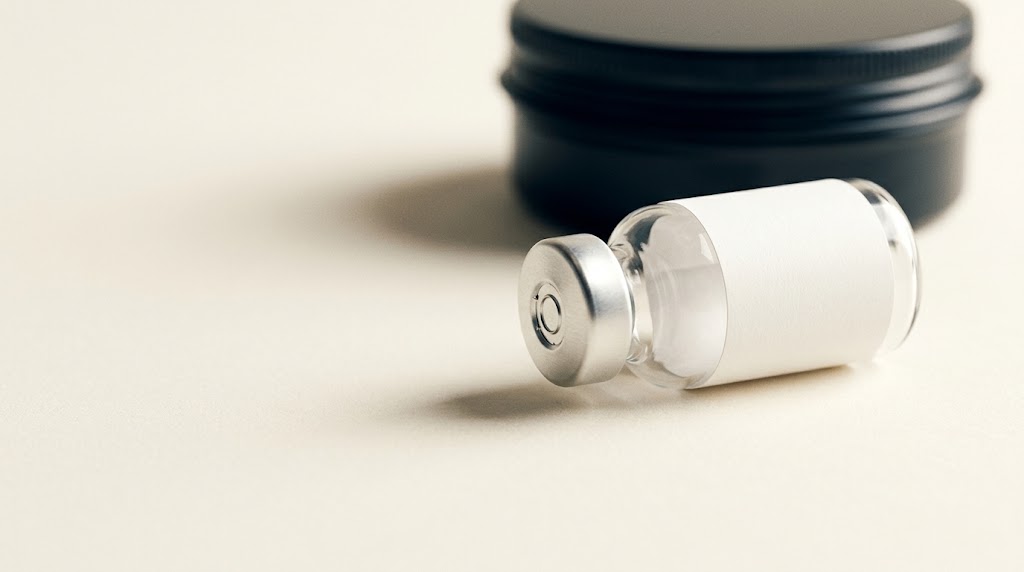
Getting rid of the needle and getting rid of the vial are different problems, and only one has a proper answer.
The needle is a settled question. There is an established system, it works the same whatever was in the syringe, and nobody involved in it asks.
The vial is less settled, and the standard advice was written for pill bottles, not for a few millilitres of reconstituted liquid.
How to dispose of used needles and syringes
Everything sharp goes into a hard-sided container immediately after use. Needle, syringe, the lot, without recapping, which our guide on injecting it wrong covers as the commonest route to sticking yourself.
An FDA-cleared sharps container is the right thing and costs a few pounds from a pharmacy or online. If you do not have one, the accepted substitute is a heavy-duty plastic household container with a tight-fitting lid, and a laundry detergent bottle is the example given in most official guidance.[^1]
What does not work: a drinks bottle, a takeaway container, anything a needle can push through, and anything with a lid that pops rather than screws.
Stop at the fill line. FDA-cleared containers are marked with a line showing when they should be considered full, which removes the guesswork.[^1] For an improvised container the rule of thumb is about three quarters. Either way, one filled to the top cannot be closed safely and gets handled by somebody who has no idea what is inside.
Where to take a full sharps container
Close it, tape the lid if the container suggests it, and then the answer depends on where you live.
Some places accept a sealed sharps container in household waste. Many do not, and putting one in the wrong bin is the failure that actually hurts somebody.
The routes that generally exist are these. Drop-off boxes at pharmacies, hospitals, clinics and sometimes fire stations. Household hazardous waste collection sites. Mail-back programmes, where you post the sealed container back in prepaid packaging. And in some areas, a collection service that comes to you.
In the United States, SafeNeedleDisposal.org lists the rules and options state by state, which is the quickest way to find out what applies to you. Elsewhere, the local council or health authority website is the equivalent.
Nobody asks what was in the syringe. A pharmacy drop-off box, a hazardous waste site and a mail-back programme all take sharps because sharps are the hazard. Of everything in this subject, this is where being on an unapproved compound changes nothing at all.
What if there is nowhere near you?
Common in rural areas, and common anywhere without a kiosk network. The routes listed so far all assume one exists.
Mail-back programmes are the answer that works from anywhere with a postal service. You buy a container that comes with prepaid return packaging, fill it, seal it, and post it. Typically somewhere between twenty and sixty depending on size, which is the real cost of this problem when geography rules out everything free.
Two routes worth trying before you pay. A GP surgery or a dialysis unit will sometimes take a sealed container even when they do not advertise it, and a call costs nothing. And some pharmacy chains run collection at a subset of branches and not all of them, so a central no does not always mean the branch will refuse.
What is not an answer is keeping it indefinitely. A full container in a cupboard is a problem deferred, and it grows.
Our guide on storing peptides covers keeping what you are still using, and this covers the other end of the same shelf.
What to do with a backlog of loose needles
This is where a lot of people are when they finally look any of it up.
Six months of daily injections into a jar, a shoebox, or a drawer. No container, no plan, and a growing reluctance to think about it. Anybody running more than one compound gets there faster, for the reasons our guide on running multiple peptides sets out.
The fix is the ongoing one, done more carefully. Get a hard-sided container with a screw lid and tip the sharps in instead of picking them out, because a hand going into a container of loose needles is exactly the injury this is all designed to prevent. Tip, do not sort, and stop when the new container is three-quarters full instead of forcing everything into one.
Then take it through any of the routes above. Nobody counts them and nobody asks how long you have had them.
Disposing of them without anyone noticing
The advice to remove the label is about identity theft. That is rarely why people ask.
Plenty of readers would rather a housemate, a partner or a parent did not find vials in a bin. That is a different concern from identity theft and an entirely reasonable one. It is also why disposal gets deferred until it turns into a jar of loose needles.
What helps is ordinary packaging, not concealment. A sealed bag inside a lidded container, going out with general waste, is both the correct route and unremarkable to look at. The sharps container is the more visible object, and that one has an explanation available to anybody who asks, because people use them for insulin, fertility treatment and a dozen other things.
How to dispose of peptide vials
Here the standard advice starts to fit badly.
The official process for unwanted medication starts with a take-back programme. If none is available, the guidance is to mix the medicine with something unappealing like coffee grounds or cat litter, seal it in a bag or container, and put it in household waste with any personal details removed.[^2]
That process was designed for tablets. It translates badly.
An empty vial
The easy case. A few residual drops, label removed or blacked out, household waste. Small glass vials are usually rejected by kerbside recycling regardless of the glass, because municipal sorting cannot handle items that size.[^3]
A vial with solution still in it
The awkward one. The mix-with-coffee-grounds method assumes a solid. For a small volume of liquid the practical equivalent is to absorb it, which is what the coffee grounds are doing in the first place, then seal and bin it.
A vial of unreconstituted powder
This behaves like the tablet case the guidance was written for, and the same method applies.
Can you flush peptides?
The FDA maintains a short flush list, and the criteria for being on it are specific. A medicine qualifies if it is sought after for misuse or abuse and if a single dose could kill somebody who took it inappropriately.[^2] Fentanyl patches are the standard example.
No peptide meets either test, so none is on the list.
So the answer is the ordinary one. Bin it properly, and keep it out of the sink and the toilet.
Will a take-back programme accept peptide vials?
Probably, and the question is more interesting than it looks.
Drug take-back kiosks, DEA collection events and pharmacy return schemes exist for prescription and over-the-counter medication. Nobody inspects what goes into the box.
What they accept is more specific than people assume, and it has changed.
Sharps are never accepted at drug take-back
Every DEA announcement says so, consistently and across more than a decade.[^4] That is what the separate sharps system above exists for, and it is why the two halves of this page have two different answers.
Liquids depend on the programme
DEA's own position has moved. Its 2022 announcement excluded liquids outright. Its 2024 announcement said liquid products should be sealed in their original container, which is an acceptance with a condition attached.[^4] State programmes vary again: Colorado's accepts liquid medications in small amounts in original non-leaking containers.[^5]
Empty containers are often excluded outright
Colorado's programme lists them among items it cannot accept.[^5] An empty vial goes in household waste, which is where this page already sends it.
So the practical position. A vial of unreconstituted powder is uncontroversial. A vial with solution in it depends on the programme and on whether it is sealed. An empty vial is not what these programmes are for, and the needle never goes there under any circumstances.
What you cannot rely on is a pharmacist accepting it over the counter if you ask. A research-labelled product is not something they have a process for, and asking may produce an awkward conversation instead of a solution.
If the point is getting rid of it safely, the anonymous kiosk is the path of least friction. If you would rather not think about it, the household waste route is legitimate for everything except the sharps.
Travelling with sharps
Two different situations, routinely confused.
Going somewhere
That means carrying unused needles, which our guide on travelling with peptides covers, and which is generally straightforward.
Coming back
You may have used sharps and no container. A travel-sized sharps container solves it, costs very little, and is worth packing for the same reason you packed the syringes.
What you should not do is improvise with a hotel bin or leave loose sharps in checked luggage. Housekeeping staff and baggage handlers are exactly the people the disposal rules exist to protect.
Why the rules exist
Worth stating, because the rules sound fussy until you know what they are for.
Loose needles in general waste injure the people who handle it. Refuse collectors, sorting facility workers and cleaners get needlestick injuries from household bins, and the person who threw the needle away is never the person who gets hurt.
Hence the hard-sided container and the separate route. The rule protects somebody downstream of you.
Where this stops being useful
The rules where you live, which are local and genuinely vary.
What any specific facility will accept, which is worth a phone call and not an assumption.
Anything about quantities beyond personal use, which is a different waste category with different rules.
Common questions
Can I put needles in the bin?
Not loose, anywhere. Used sharps go in a hard-sided container with a tight lid, and whether the sealed container can then go in household waste depends on where you live.
What if I do not have a sharps container?
A heavy-duty plastic household container with a screw lid is the accepted substitute, and a laundry detergent bottle is the standard example. A drinks bottle will not do, and nor will anything a needle can push through.
How full can it get?
About three quarters. A container filled to the top cannot be closed safely and gets handled by somebody who does not know what is inside.
Where do I take a full container?
Pharmacy or hospital drop-off boxes, household hazardous waste sites, mail-back programmes, and in some areas a collection service. SafeNeedleDisposal.org lists options by state in the US.
Will anyone ask what I was injecting?
No. Sharps disposal handles the hazard and not the contents, and this is the one part of the subject where an unapproved compound makes no difference.
How do I get rid of an unused vial?
Empty vials go in household waste with the label removed. A vial with liquid still in it should be absorbed into something like coffee grounds or cat litter, sealed, and binned. Unreconstituted powder follows the same route.
There is nowhere near me that takes sharps. What now?
Mail-back programmes work from anywhere with a postal service, and a container with prepaid return costs roughly twenty to sixty depending on size. Before paying, try a GP surgery or dialysis unit, and check individual pharmacy branches as well as the chain's central answer.
I have six months of needles in a jar. What do I do?
Get a hard-sided container with a screw lid and tip them in instead of picking them out, because reaching into loose needles is the injury the whole system exists to prevent. Fill to three quarters, use more than one container if needed, and take them through any of the normal routes.
What if I do not want anyone finding them?
A sealed bag inside a lidded container going out with general waste is both the correct route and unremarkable to look at. A sharps container is the more visible item, and it has an ordinary explanation, since people use them for insulin and fertility treatment among other things.
Can I flush it?
No. The FDA flush list is short and specific and no peptide appears on it.
Can I recycle the glass?
Usually not through kerbside collection, because municipal sorting cannot handle items that small, whatever the glass is made of.
Sources
[^1]: FDA. Sharps Disposal Containers. FDA consumer guidance, read at source. Used sharps should be placed immediately in an FDA-cleared sharps disposal container. Where one is not available, a heavy-duty plastic household container with a tight-fitting, puncture-resistant lid is the recommended substitute, with a laundry detergent bottle given as the standard example. The FDA notes that FDA-cleared containers are made from rigid plastic and come marked with a line indicating when the container should be considered full, and that they are available in travel sizes. Sharps should never be placed loose in household waste or recycling, nor flushed.
[^2]: FDA. Drug Disposal: FDA's Flush List for Certain Medicines and Dispose "Non-Flush List" Medicine in Trash. FDA consumer guidance, read at source. Drug take-back programmes, including DEA-authorised collection sites and the DEA National Take Back Day held twice yearly, are the preferred route. Where no take-back is available, most medicines should be removed from their container, mixed with an unpalatable substance such as dirt, used coffee grounds or cat litter, sealed in a bag or container and placed in household waste, with personal information removed from the original label. The flush list criteria are that a medicine is sought after for its misuse or abuse potential and that it can result in death from one dose if taken inappropriately, with fentanyl patches given as the example. No peptide meets either criterion and none appears on the list, which should be confirmed against the current version at each review.
[^3]: Kerbside recycling of small glass vials. Reported in waste management and pharmacy sources. Municipal sorting systems frequently reject items of that size regardless of material, and local rules vary. A local authority or waste management source should be cited, and the claim is framed as usually rather than always in the body text for that reason.
[^4]: DEA National Prescription Drug Take Back Day announcements. DEA press releases, read via search result. The 2024 announcement states that DEA and its partners will collect tablets, capsules, patches and other forms of prescription drugs, that syringes, sharps and illicit drugs will not be collected, and that liquid products such as cough syrup should be sealed in their original container. The 2022 announcement states that liquids including intravenous solutions, syringes and other sharps, and illicit drugs will not be accepted. The exclusion of sharps is consistent across every announcement located, spanning 2014 to 2024. The position on liquids changed between 2022 and 2024, which the body text states rather than presenting one year's rule as fixed. Take Back Day is held twice yearly; permanent DEA-authorised collection sites and pharmacy drop boxes operate year-round and may apply their own rules.
[^5]: Colorado Department of Public Health and Environment. Medication and sharps takeback: acceptable vs non-acceptable items. State programme documentation, read via search result. Cited as an example of a state-level programme with published item rules, not as a national standard. Accepts prescription and over-the-counter medications including liquid medications in small amounts in original non-leaking containers, and unused drug injection cartridges where the needle is still protected. Cannot accept needles, syringes and other sharps, medical tools and supplies, or empty containers. Rules of this kind are set programme by programme, which is the point the body text makes; this is one published example and not a rule that applies elsewhere.