
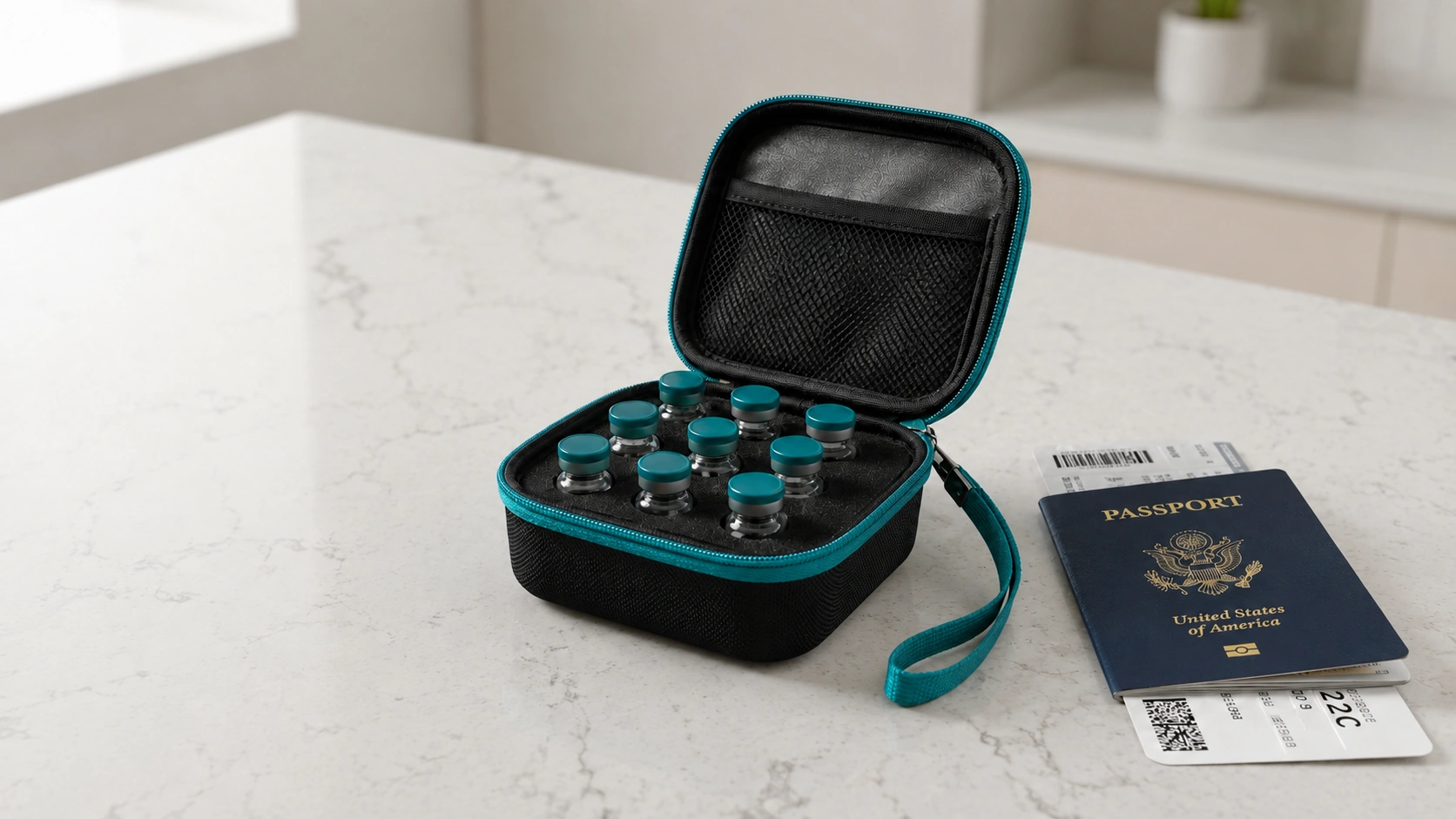
The rules for flying with liquids and needles are generous. No size limit, cold packs fine, syringes fine, no prescription needed.
Every one of them is written about medicine. A vial that says research use only is not medicine, and that gap is what this page is about.
Flying inside the US is mostly a practical problem. Crossing a border is a legal one.
What TSA actually allows
The rules as written are more permissive than most people expect.
Liquid medication is exempt from the 3.4 ounce limit. TSA's own wording: you may bring medically necessary liquids, medications and creams in excess of 3.4 ounces in your carry-on bag, and you remove them to be screened separately.1 There is no quart bag requirement and no fixed cap. The standard is a reasonable quantity for your trip.2
You have to declare them. Tell the officer at the start of screening and put the items in a separate bin.2 That step is the trade for the exemption. Most confiscation stories trace back to somebody not doing this and triggering a bag search instead.
Syringes and needles are allowed in carry-on, when you are carrying the medication they go with.3 The medication is what makes the needles admissible. Needles on their own are a harder conversation.
Cold packs are allowed, and the detail is unusually favorable. Ordinary frozen items must be completely solid at screening or they fall under the liquid rules. TSA's gel ice packs page states that medically necessary gel packs in reasonable quantities are allowed regardless of their physical state, melted or slushy.4
One wrinkle, because TSA's own pages are not consistent on this. A separate TSA travel tips sheet says cooling accessories must be completely solid, and that if they are partially frozen or slushy they are screened the same way as other medically necessary liquids.14 Read together, a slushy medical gel pack is still permitted and gets inspected as a liquid instead of waved through as a solid. Either way it needs declaring.
No prescription label is legally required. TSA does not require original pharmacy containers. Every source that deals with this also says the same next thing: bring them anyway, because unlabelled containers invite questions and secondary screening.5
X-rays do not harm medications. If you would prefer they were not scanned, you can ask for a visual inspection, and you have to ask before screening starts.6
A genuinely accommodating set of rules. Now the part they were not written for.
The exemption is for medication
Every rule above turns on the phrase medically necessary.
A prescribed medicine from a pharmacy fits that description without any effort. It has a label with your name on it, a prescriber, and a container that says what is inside.
A vial labeled research use only, not for human consumption, fits none of it. There is no prescription, no pharmacy label, and the label itself says the contents are not intended for a person. TSA's own wording ties the exemption to medically necessary liquids and to transporting medication.12 Claiming a medical exemption for something whose own labeling denies medical use puts you in an awkward position if anyone reads the vial.
Every travel guide skips this, because they are all written about medication and they assume you have a prescription.
So there are two situations, and they are not the same.
If your peptide came from a compounding pharmacy with a prescription in your name, you are an ordinary traveler carrying an ordinary prescription. Everything above applies to you directly. Keep the pharmacy label on it.
If your vial is research-labelled, none of the medical exemption was written for your situation, and the rest of this page is about that.
| Prescribed from a pharmacy | Research-labelled vial | |
|---|---|---|
| Over the 3.4 oz liquid limit | Yes, as medically necessary | The exemption was not written for it |
| Syringes in carry-on | Yes, with the medication | The medication is what makes them admissible |
| Cold packs, even slushy | Yes, as medically necessary | Same gap as the liquids exemption |
| Prescription label needed | Not legally, and bring it anyway | There is none to bring |
| Crossing a border | Still depends on the destination | Importation of an unapproved drug |
Domestic flying
TSA screens for threats to the aircraft. Peptide vials are not that, and TSA is not a drug enforcement agency.
In practice, small volumes of clear liquid in labeled vials attract very little attention at a domestic checkpoint. The realistic outcomes are that nothing happens, or that a bag gets searched and an officer asks what something is.
Two practical points matter more than any of the rules.
Carry-on, not checked. The one unambiguous instruction in this guide, and it has nothing to do with security. Cargo holds swing through temperatures no peptide label permits, including below freezing on long flights. A checked bag can also be delayed by days. Everything you have read about protecting a vial from heat and freeze cycles argues for keeping it with you.
Reconstituted vials are the awkward ones. Dry powder is stable, small, and looks like nothing. A mixed vial needs to stay cool for the whole journey and is a liquid for screening purposes. Where the trip allows it, traveling with unmixed powder and reconstituting at the other end removes most of the problem.
If somebody asks what it is
Answer honestly. Lying to a federal officer is a far worse problem than anything in your bag, and it converts a routine question into a serious one.
The accurate description is what the vial says: a research chemical, in powder or solution, being carried personally. If it came from a pharmacy with your name on it, say that and show the label, and the conversation is usually over.
TSA's mandate is threats to the aircraft. An officer who asks about a vial is establishing what it is, not deciding whether you should have it. If a question goes beyond that, it stops being a screening matter, and that is a different conversation from the one this page can prepare you for.
The car is where things actually get damaged
Most travel is not flying, and the numbers on a parked car are worse than the numbers on a cargo hold.
A car parked on a 72°F sunny day reached 117°F inside within an hour in one study, and cracking the windows changed almost nothing.8 Weather service tracking on a day in the low 90s found the interior hit 100°F in half an hour, 110°F within an hour, and passed 120°F after two.9 A closed car in direct sun can exceed 140°F.10
Set that against the storage standard. Most labels specify 68 to 77°F, and the widest excursion the pharmacopoeia allows is 104°F for no more than 24 hours.11 A car on a mild day passes that ceiling in under an hour.
The glove box and the trunk are worse than the cabin, so a cooler belongs on a seat.12
When you leave the car, the vials leave with you. A quick stop for lunch is the most common way this goes wrong, because nobody thinks of an hour as long.
And winter runs the same logic backward. A vial left in a car overnight in freezing weather has had a freeze cycle, which does its own damage and is not undone by warming back up.
Keeping it cold
This matters if you are carrying mixed vials, or a compound that needs refrigeration even as powder.
An insulated case with a gel pack handles most journeys. Keep the pack from touching the vials directly, because contact freezing does the same damage as a freezer.12
Airline crews can sometimes hold something in a galley fridge or provide ice. It is an ask, and they can say no. Ice cubes melt into water, which is a liquid, so a sealed bag matters.
For long or multi-leg trips, count total time out of refrigeration. Whether the gel pack is still cold matters less. A vial that spends fourteen hours at cabin temperature has had a meaningful excursion whether or not the gel pack survived.
Hotel fridges are often not fridges
Many minibar units are thermoelectric coolers, not compressor refrigerators. They hold roughly 15 to 20°C below whatever the room is, which works in a cool room and fails in a warm one.13 A minibar in a 26°C room may never get below 6 to 11°C, and it will not tell you.
Two practical responses. Call ahead and ask whether the room has an actual refrigerator, which is a normal request and usually easy to accommodate.12 Or ask the front desk to store it in the kitchen or staff fridge, which is standard practice for guests carrying medication.
If neither is available, a cool dark drawer beats a minibar that cannot hold temperature, and the total-time-out-of-refrigeration question applies for the length of the stay.
Sharps
Unused needles travel with the medication they belong to.3 Used ones need a sharps container, and travel-sized ones are sold in most pharmacies.6
Do not improvise this with a bottle. A container that opens in a bag is a problem for whoever handles it next, and airline crews are not required to take a used needle from you.
Coming home with used sharps is the other half of the same trip, and it has its own routes.
Crossing a border is a different question
Everything above concerns airport security. Customs is a separate agency asking a separate question, and this is where flying with research peptides stops being a practical matter. Carrying peptides through an airport and importing them by post are different questions with different processes.
Bringing an unapproved drug into a country is importation. Our guide on what "research use only" actually means covers the US side, where a personal importation policy exists and research peptides do not meet its conditions.
Going the other way is riskier and less predictable. A compound sold openly online in the US may be prescription-only or prohibited elsewhere, and a US prescription generally carries no weight at a foreign border. Several countries require an import permit obtained weeks in advance even for ordinary prescribed medicines. Japan's yakkan shomei and the UAE's health ministry permits are the commonly cited examples, and the lead time runs to four to six weeks.7
So check the destination, not the departure point. The rules that matter are the ones where you land.
And a research label does not help at customs the way it helps a seller online. The phrase exists to describe intent for a domestic regulator. A customs officer is asking what the substance is and whether you may bring it in.
If a trip is short, leaving the vials at home is the answer that has no downside.
Common questions
Can I fly with peptides?
Domestically, in a carry-on, the problem is practical more than it is a security matter. TSA screens for threats to aircraft. The rules that make liquids and needles easy to carry are written about prescribed medication, so how cleanly they apply depends on whether yours came from a pharmacy.
Carry-on or checked bag?
Carry-on, and the reason is temperature. Cargo holds reach temperatures no peptide label permits, including below freezing, and checked bags get delayed.
Do I need a doctor's note?
TSA does not require one, and does not require original pharmacy containers either. If you have a prescription and a pharmacy label, bring both, because they turn a conversation into a formality.
Are ice packs allowed?
Yes, and the rule is more generous than for ordinary frozen items. Medically necessary ice packs are permitted even partially melted or slushy, while non-medical frozen items must be completely solid at screening.
Are syringes allowed?
In carry-on, yes, when accompanied by the medication they are for. Used needles need a proper sharps container.
Should I declare them?
If you are invoking the medical liquid exemption, declaring is not optional, and skipping it is what turns a routine screening into a bag search. Take the items out and tell the officer at the start.
What do I say if an officer asks what it is?
Answer honestly. The accurate description is what the vial says, a research chemical being carried personally, and if it came from a pharmacy with your name on it, show the label. TSA screens for threats to the aircraft, so an officer asking about a vial is establishing what it is rather than deciding whether you should have it.
Can I leave peptides in the car while I run in somewhere?
The numbers say no. A car parked on a 72°F day reached 117°F inside within an hour in one study, and the widest storage excursion most labels allow is 104°F for up to 24 hours. The glove box and trunk are hotter than the cabin. Take them with you.
Will the hotel minibar keep them cold enough?
Often not. Many are thermoelectric coolers that hold about 15 to 20°C below room temperature, so a warm room means a warm minibar. Call ahead about a real refrigerator, or ask the front desk to use the kitchen fridge.
What about flying internationally?
Customs asks a different question from security, and the answer depends entirely on the destination. Some countries require import permits obtained four to six weeks ahead even for ordinary prescriptions, and a US prescription usually carries no weight abroad. For a short trip, leaving them at home avoids the question.
Should I travel with mixed or unmixed vials?
Unmixed where the trip allows it. Dry powder is far more stable, is not a liquid for screening purposes, and does not need to stay cold for the whole journey.
Sources
- TSA. I am traveling with medication, are there any requirements I should be aware of? Regulatory. States that medically necessary liquids, medications and creams in excess of 3.4 ounces or 100 millilitres may be brought in a carry-on bag, and must be removed to be screened separately.
- TSA. Medications (liquid). Regulatory. Larger amounts of medically necessary liquids, gels and aerosols are permitted in reasonable quantities for the trip, and must be declared to officers at the checkpoint for inspection.
- TSA carry-on rules 2026, August 2026. Travel guidance citing TSA. Syringes and needles are allowed when carrying the injectable medication they accompany, and ice packs to keep it cold are permitted.
- TSA. Gel ice packs. Regulatory. Frozen liquid items are allowed when frozen solid at screening; if partially melted, slushy, or with liquid at the bottom of the container they must meet 3-1-1 requirements. Medically necessary gel ice packs in reasonable quantities are allowed regardless of their physical state of matter, melted or slushy, and must be notified to the officer for inspection.
- TSA liquid exceptions 2026, July 2026. Travel guidance citing TSA. A prescription label is not legally required, and original pharmacy-labelled containers significantly reduce the chance of additional screening or questions.
- TSA medication rules: flying with prescriptions, 2026. Travel guidance citing TSA. X-ray screening does not affect medications; a visual inspection may be requested before screening begins. Used sharps must be stored in an approved sharps container, sold in travel sizes by most pharmacies.
- The complete guide to traveling with medication in 2026, March 2026. Travel guidance. Notes that Japan, the UAE and several Southeast Asian countries have stricter rules than travellers expect, and that import permits such as Japan's yakkan shomei and UAE Ministry of Health approval should be applied for four to six weeks before departure.
- Pediatrics study of vehicle interior temperatures, as reported in Left medication in a hot car? Read this before you toss it, July 2026. A parked car on a 72°F sunny day reached 117°F inside within an hour, and cracked windows changed almost nothing. Standard storage on most labels is 68 to 77°F, and the widest USP excursion allowance caps at 104°F for no more than 24 hours.
- National Weather Service vehicle temperature tracking, as reported in What happens if you leave medicine in the car?, March 2026. Outside air in the low 90s produced an interior of 100°F at 30 minutes, 110°F at one hour, and above 120°F at two hours. Opening the windows afterwards dropped it only to 112°F.
- How to travel with medication that needs refrigeration, 2026. States that a closed car parked in sun can exceed 60 to 70°C, roughly 140 to 158°F, within tens of minutes, and that portable and minibar-style thermoelectric coolers typically cool to only 15 to 20°C below ambient temperature.
- Same as reference 8. The USP excursion allowance and standard label storage range.
- Temperature tips for safe and effective medication storage, Baystate Health. Advises never leaving medication in a hot or cold car, never in the trunk, keeping it in the cabin, and calling ahead to confirm a hotel or rental has a refrigerator.
- Same as reference 10. The thermoelectric cooler limitation.
- TSA. Travel tips factsheet. Regulatory. States that ice packs, frozen gel packs and other accessories required to cool medically necessary liquids must be completely solid at the checkpoint, and that if partially frozen or slushy they are subject to the same screening as other medically necessary liquids. This sits in tension with the gel ice packs page at reference 4, and the two are reconciled in the text.