
Retatrutide_Dosage, benefits & legal status
Also known as LY3437943, reta, triple G, GLP-3, GLP-3 retatrutide, R-30, R30, R20, R5, triple agonist, ratatouille, triple-G, GLP-3R, GLP-3 (RT), Reta GLP-3, Trinity-X, EZP-3P, R-10, GLP-3 (RTA), LP3-R, EP-3 R, AMP-3P, GLP3-Reta, GLP-3 AL (R), RETA-3, TA-R, GLP-3 R, GLP-3 RT, GLP-3 RTA, RETA-10, RETA-20, IP3-RT, PRL-3 RT, IPP-3 RT
An experimental weekly shot with some of the biggest weight-loss numbers yet in trials.
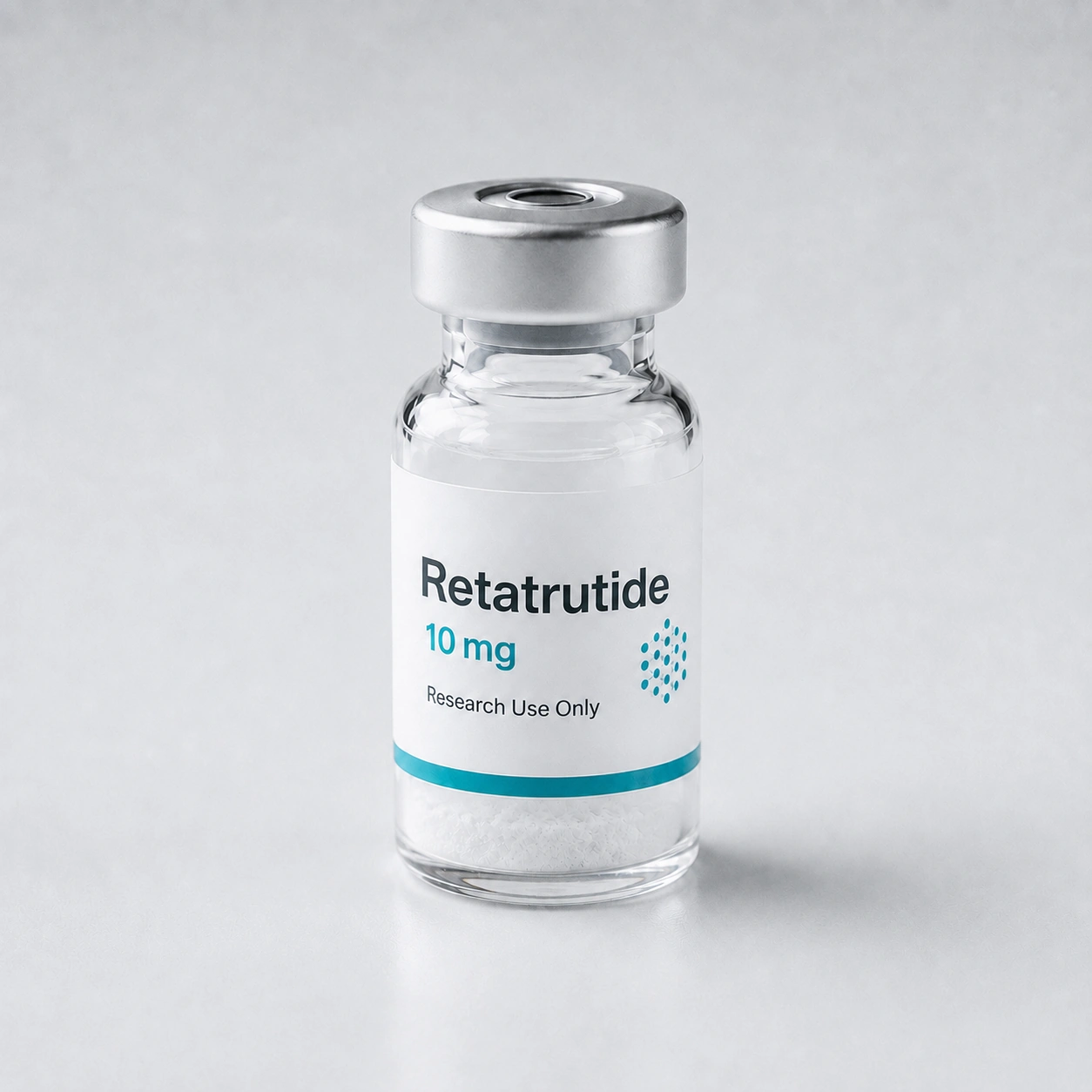
Common vial size is what vendors typically sell, not a recommendation. Enter your own vial in the calculator.
What is Retatrutide?
Plain language first. The technical label stays, but it never stands alone.Overview
It copies three of your natural 'I'm full' and fat-burning signals together, which is why it drives some of the largest weight-loss numbers seen in trials. It is still experimental.
Retatrutide is a triple agonist that switches on three hormone receptors at once: GLP-1, GIP, and glucagon.
What it's used for
People follow it for very large weight loss, around a quarter to nearly a third of body weight in trials. It acts on three appetite and metabolism pathways at once.
How does Retatrutide work?
What it does in the body, and where.Retatrutide adds a third target, glucagon, to the two tirzepatide already hits. Glucagon is the interesting one, because it does something the others do not.
- 01GLP-1 and GIP reduce how much you eatThe same appetite and stomach-emptying effects as the approved drugs in this family.
- 02Glucagon raises how much you burnIt pushes your body to spend more energy at rest, rather than only taking in less. That is a different lever from the other two.
- 03More receptors has meant more weight loss, and more side effectsTrial figures are the largest in this class so far, but it is investigational, so nobody yet knows how it behaves over years.

What else is it used for?
Each group carries its own evidence level.Approved means regulators have cleared it for that purpose. Investigational means it is in trials. Early research means it is being studied and is not established.
Trial result: 28.3% (stayed on treatment) · 25.0% (everyone randomised). The first figure describes people who stayed on treatment and the second counts everyone who started. Our write-up of the published trial explains why both figures exist.
Weight loss
Investigational- Human trialIn a 48-week mid-stage trial, average weight loss reached 24.2% on the top dose against 2.1% on placebo.
- Human trial83% of people on the top dose lost at least 15% of their body weight, and a quarter lost more than 30%.
- Human trialIn a late-stage trial reported in December 2025, average loss was 28.7% at 68 weeks, the largest late-stage weight-loss result reported so far.
- Human trialIn a second late-stage trial reported in May 2026, loss was roughly 25 to 28% at 80 weeks, with a subgroup reaching about 30% at two years.
Liver fat and joint pain
Investigational- Human trialFat in the liver dropped by 82.4% on average at 24 weeks, against essentially no change on placebo.
- Human trial86% of people reached a normal liver-fat level by 24 weeks, rising to 93% by 48 weeks.
- Human trialKnee osteoarthritis pain scores fell by up to 75.8%.
The published record
Papers and trials about Retatrutide
Searched: Retatrutide, LY3437943, triple agonist, GLP-3R, Reta GLP-3, Trinity-X, LP3-R, GLP3-Reta.
Left out: reta (vendor listing code, appears in no journal); triple G (vendor listing code, appears in no journal); GLP-3 (vendor listing code, appears in no journal); GLP-3 retatrutide (vendor listing code, appears in no journal); R-30 (vendor listing code, appears in no journal); R30 (vendor listing code, appears in no journal); R20 (vendor listing code, appears in no journal); R5 (vendor listing code, appears in no journal); ratatouille (vendor listing code, appears in no journal); triple-G (vendor listing code, appears in no journal); GLP-3 (RT) (vendor listing code, appears in no journal); EZP-3P (vendor listing code, appears in no journal); R-10 (vendor listing code, appears in no journal); GLP-3 (RTA) (vendor listing code, appears in no journal); EP-3 R (vendor listing code, appears in no journal); AMP-3P (vendor listing code, appears in no journal); GLP-3 RT Research Peptide for Sale (vendor listing code, appears in no journal).
167 papers tagged human · 44 not reviews or lab · 11 clinical trial publications
34 registered trials · 2 with posted results
Furthest stage reached: Phase 3, completed, no results posted
Counted from Europe PMC indexing, not read by a person; a human tag can land on reviews, commentary or lab papers; clinical trial publications is the narrower count.
At a glance
Four things to know about Retatrutide
Evidence
Investigational
Category
Weight loss and metabolic
Common vial
10 mg
Half-life
About 6 days
How much, and do you cycle it?
The range, and whether you take breaks.1 up to 12 mg per dose (start low, increase slowly), weekly. Not cycled in the trials Trial dose
Given continuously for the whole study period: TRIUMPH-1, 80 weeks with an extension to 104. The dose is stepped up at the start, which is a ramp rather than a cycle, and no trial in this class built in a planned break.
About 6 daysTrial protocol
Not yet traced to a primary source.
You can compare this against the whole library to see where it sits.
How do I dose and price it?
Enter your vial and your dose. Pick a mix. We show the draw and the cost.The vial holds a fixed amount of drug. Adding more water does not make more drug, it just spreads it thinner, so you draw a bigger number on the syringe for the same dose.
Choose your mix
Measuring the water1 mL = one full 100-unit syringe.
Retatrutide starts at $24.99 across 166 vendors, typically $3.20 – $11.33 per mg.
653 listings, last read Oct 24, 2026. Shipping and card fees are not included.
How do you store it?
Before mixing, and after.Dry powder in the freezer or fridge. Once mixed, fridge, and use within about a month.
Unmixed lyophilized Retatrutide keeps for a long time cold. Once you add water the clock starts: most reconstituted vials hold up for roughly 28 to 30 days at fridge temperature. Keep it out of light, and do not freeze it after mixing.
What are the side effects and cautions?
Known cautions and warnings for this compound.Vials sold as "GLP-3" are retatrutide. There is no hormone called GLP-3. The name was invented by counting receptors: semaglutide hits one, tirzepatide hits two, retatrutide hits three, so sellers numbered them. The numbering is not real biology, and GLP-2 is already the name of a different intestinal hormone that has nothing to do with weight loss. Look for the word retatrutide or the code LY3437943, which is what appears in the scientific and regulatory record. Codes like R5, R20 and R30 refer to the milligrams in the vial, not the dose.
Solubility, computed: 27% charged residues, 40% hydrophobic. Water usually sufficient.
A first-pass rule from peptide manufacturers' guidance. It does not account for disulfide bridges, salt form or how the powder was dried, and it predicts what should be easy rather than what will happen in your vial.
Who should avoid it
- Not legally available outside clinical trials, so no prescriber is assessing whether it suits you
- Pregnancy, or trying to become pregnant
Stop and get help
- Severe stomach pain that spreads to your back
- Vomiting badly enough that you cannot keep fluids down
- Signs of an allergic reaction
Common effects
- Nausea, vomiting, and diarrhea, which increase at higher doses
- Odd skin sensations such as tingling or numbness, reported in trials
- Urinary tract infections
- A mild temporary rise in heart rate
Read what dehydration on it actually feels like and when to get help.
Where this page says nothing is established, that means nobody has studied it, not that a compound is safe.
Is Retatrutide approved?
And where the numbers on this page come from.No. Retatrutide is not approved anywhere and is currently in company-run clinical trials. There is no legal route to obtain it outside a trial.
- Approval statusInvestigational
- RouteUnder the skin (subcutaneous)
- Checked3 October 2026
- DoseFrom published clinical trials. Not approved by a regulator for this dose.
- Vial sizeFrom what vendors typically list; not a recommendation.
- SourcesDrugs.com, retatrutide development historyAJMC, TRIUMPH-1 phase 3 resultsPhase 2 trial, New England Journal of Medicine, 2023Liver fat substudy, Nature Medicine, 2024Retatrutide entry, WHO International Nonproprietary Names / ClinicalTrials.govEli Lilly, statement on retatrutide black-market enforcement
What has happened recently
Not approved in any country. Lilly has said it plans to file for FDA approval in the first quarter of 2027, pushed back from an earlier timeline while manufacturing and quality data are assembled. On August 12, 2026, Lilly filed six federal lawsuits against US sellers of black-market retatrutide, naming Aesthetic Envy Cosmetic Centers, Astra, Legendary Peptides, Striker Pharmacy, Texas Peptides and Lone Star Peptide. Four of the six were filed in Texas. The company also said it had referred more than 200 individuals and entities to the FDA, the Department of Justice, state attorneys general and licensing boards, and reported more than 14,000 listings across over 100 countries. Alongside the filings it asked payment processors, credit card companies, e-commerce platforms and shipping carriers to cut sellers off. The FDA has stated that selling unapproved retatrutide to consumers is illegal and that it cannot lawfully be compounded. A "research use only" label does not change that. Lilly said on July 23, 2026 that it plans to submit retatrutide to the FDA in the first quarter of 2027. A submission is not an approval. Standard review runs about ten to twelve months from acceptance, so a decision falls in late 2027 or 2028 and a prescription in a pharmacy realistically in 2028. The application type is itself disputed: the FDA has determined retatrutide is a drug rather than a biologic, and that question is before the Seventh Circuit.
What regulators say
From official documentsEnforcement naming this compound
Vendor product named as an unapproved new drug (Royal Peptides, August 2026)
This is a finding about one seller's vial, not about the compound or any approved product containing it.
Read the letter
You can compare this against the whole library, or read how to check a seller.
More on Retatrutide
- Retatrutide prices
- Retatrutide vs TirzepatideRetatrutide's 28.3 percent is being set against tirzepatide's 22.5 percent. Different trials, different lengths, and no trial yet comparing the two directly.
- Why Am I So Dehydrated on Retatrutide?Why eating less can leave you short of fluid, the warning signs to watch for, and what the approved GLP-1 labels say about kidney risk.
- Retatrutide Skin Sensitivity: Is It Normal?Dysesthesia hit 12.5% at 12 mg against 0.9% on placebo in the published phase 3 trial, and 20.9% in the knee trial. Why your skin looks normal, and what to say.
- Does Retatrutide Make You Not Care About Anything?Nobody knows, and that means something different here. The mechanism is real, the weight loss is a competing explanation, and no surveillance data exists.
- When Will Retatrutide Be FDA Approved?Lilly named the filing window in an SEC filing. Filing is not approval, the trials are done, and a prescription is realistically 2028 rather than next year.
- Is It Safe to Buy Retatrutide Online?What independent tests of online retatrutide found, how careful buyers check a vial, what it costs and where the law stands.
- Has Anyone Died From Retatrutide? What the Two FDA Reports Actually SayTwo unverified FDA reports describe deaths after people used products sold as retatrutide. Nobody has established what was in the vials, and the controlled trials show no cardiac excess.
- A Counterfeit Retatrutide Vial Put a Patient in the hospital. The Test Record Shows Where the Risk SitsAustralia's regulator traced a torn oesophagus to a vial that contained semaglutide, not retatrutide. Nearly 4,000 blind tests of online vials say the failures cluster in one channel.
- Retatrutide + cagrilintide: untested swapCagriSema is the one stack tested properly, and it ran the two compounds roughly even. This blend runs 83 to 17, with a different GLP-1.
- Retatrutide + tesamorelin: the overlapTesamorelin is added for visceral fat, which retatrutide already reduces substantially. A liver fat substudy found retatrutide cutting it by over 80%.
- Retatrutide + AOD-9604: one failed in 2007AOD-9604 missed its primary endpoint at every dose in a 536-person trial and development was abandoned. Retatrutide has five positive Phase 3 trials.
- Retatrutide + MOTS-c + TesamorelinThree compounds at three stages of proof, pushing blood sugar in three directions. Only one of them carries the evidence on this page.
- Tirzepatide + retatrutide: the label says noSold premixed in one vial. The FDA label for tirzepatide says not to combine it with any GLP-1 receptor agonist, and retatrutide is one.
- Retatrutide + SLU-PP-332: zero and fiveOne half has five Phase 3 trials. The other has no human trial of any kind and is not a peptide. Anti-doping labs are already building tests for it.
- Retatrutide + GHK-Cu: loose skinPeople add GHK-Cu because they are losing weight fast and worried about loose skin. No trial has tested the pair, and the structural problem is elastin.
What else is like Retatrutide?
Others in GLP-1 agonists, side by side.If you're weighing Retatrutide, it's worth reading Tirzepatide, Semaglutide, and Mazdutide in the same class.
An experimental weekly shot with some of the biggest weight-loss numbers yet in trials.
- Dose
- 1 up to 12 mg per dose (start low, increase slowly)
- How often
- Weekly
The drug in Mounjaro and Zepbound: a weekly shot for major weight loss and blood sugar.
- Dose
- 2.5 up to 15 mg per week (start low, increase slowly)
- How often
- Weekly
The drug in Ozempic and Wegovy: a weekly shot that curbs hunger for steady weight loss.
- Dose
- 0.25 up to 2.4 mg per week (start low, increase slowly)
- How often
- Weekly
An experimental weekly weight-loss shot (approved in China) that also helps blood sugar and cholesterol.
- Dose
- 2 up to 9 mg per dose (start low, increase slowly)
- How often
- Weekly
Also sold in a blend: Retatrutide + Cagrilintide blend
Compared with
One head-to-head trial, three pivotal trials, and why their headline weight-loss figures are not directly comparable.
Read comparison →One receptor, then two, then three, and the numbers climb with them. Only two of the three steps have a head to head behind them.
Read comparison →Retatrutide's 28.3 percent is being set against tirzepatide's 22.5 percent. Different trials, different lengths, and no trial yet comparing the two directly.
Read comparison →Guides for this compound
- How to Reconstitute a Peptide
Mix peptide powder with bacteriostatic water, step by step.
- How to Read an Insulin Syringe
Read the units, convert to millilitres, and draw the exact dose.
- mcg vs mg: The Peptide Dosing Mistake to Avoid
Your vial says mg and your protocol says mcg. Here is the conversion and how to check it.
- When Will Retatrutide Be FDA Approved and Available?
What Lilly plans to file in Q1 2027, the review clock, and the drug-or-biologic dispute.
- Is It Safe to Buy Retatrutide Online?
What independent tests of online vials found, and how careful buyers check before using one.
- Why Does My Peptide Injection Itch or Welt
Injection-site irritation, a histamine reaction, or a true allergy, and how to tell them apart.
Sources
- Drugs.com, retatrutide development history(2026)Development timeline confirming it remains unapproved.
- AJMC, TRIUMPH-1 phase 3 results(2026)TRIUMPH-1 phase 3, 2,339 participants over 80 weeks.
- Phase 2 trial, New England Journal of Medicine, 2023
- Liver fat substudy, Nature Medicine, 2024
- Retatrutide entry, WHO International Nonproprietary Names / ClinicalTrials.gov(2026)The compound is registered as retatrutide, development code LY3437943. No trial or regulatory document uses the term GLP-3.
- Eli Lilly, statement on retatrutide black-market enforcement(2026)Six lawsuits filed 12 August 2026 against US compounding pharmacies, medical spas and online sellers. Over 200 entities referred to regulators, over 14,000 listings reported across more than 100 countries.
Beyond these, 288 records are indexed. Browse the records