
Tirzepatide_Dosage, benefits & legal status
Also known as Mounjaro, Zepbound, LY3298176, GLP-2 TZ, GLP2-T, GLP-2 T, tirz, EZP-2P, GLP-2 (TRZ), GLP-2T Peptide, GLP-1 T, SP-2TZ, EP-2 T, Tirz GLP-2, TIRZ-GLP2, AMP-2P, GLP-2 (TR), GLP-2 AL (T), DA-T, GLP-2 TRZ, TIRZ-30, TIRZ-60, TIRZ-120, IP2-TZ, IP2 TRZ, PRL-2 TRZ, IPP-2 TRZ
The drug in Mounjaro and Zepbound: a weekly shot for major weight loss and blood sugar.
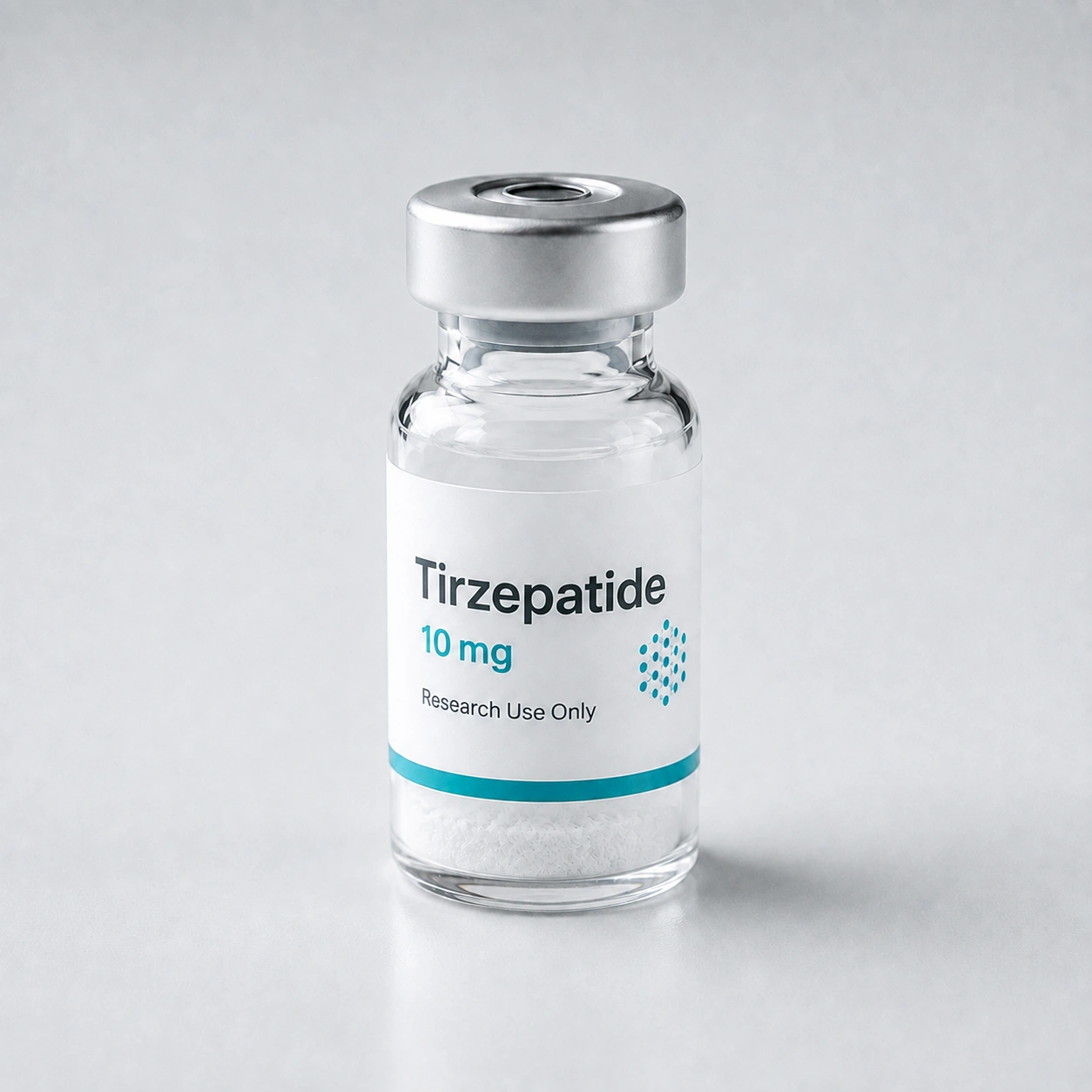
Common vial size is what vendors typically sell, not a recommendation. Enter your own vial in the calculator.
What is Tirzepatide?
Plain language first. The technical label stays, but it never stands alone.Overview
It works on two of your body's appetite-and-blood-sugar signals together, which tends to produce more weight loss than drugs that hit only one. It is the active drug in Mounjaro and Zepbound.
Tirzepatide is a dual agonist that activates two gut-hormone receptors at once, GLP-1 and GIP.
What it's used for
People use it for major weight loss and better blood sugar. It works on two gut-hormone signals at once to reduce hunger, and tends to produce larger losses than older options.
After treatment stops, see what the regain studies measured.
How does Tirzepatide work?
What it does in the body, and where.Tirzepatide is one molecule that fits two different receptors, GLP-1 and GIP. Adding the second target is what separates it from semaglutide.
- 01It activates GLP-1, as semaglutide doesSlower stomach emptying, quieter appetite signaling, steadier blood sugar after meals.
- 02It also activates GIPA second gut hormone that appears to improve how well your body handles fat and sugar, and may soften the nausea from the GLP-1 side.
- 03The two together do more than either aloneTrials have consistently produced larger weight loss than GLP-1 drugs on their own, at the cost of more gut side effects for some people.

What else is it used for?
Each group carries its own evidence level.Approved means regulators have cleared it for that purpose. Investigational means it is in trials. Early research means it is being studied and is not established.
Trial result: 22.5% (stayed on treatment) · 20.9% (everyone randomised). The first figure describes people who stayed on treatment and the second counts everyone who started, which is why published figures for the same trial differ.
Weight loss
FDA-approved- Human trialIn a 72-week trial, average weight loss was 15.0% on 5 mg, 19.5% on 10 mg, and 20.9% on 15 mg, against about 3.1% on placebo.
- Human trialAmong people who took it as directed, losses reached 16.0%, 21.4%, and 22.5%.
- Human trial63% of people on the top dose lost at least a fifth of their body weight, and more than a third lost at least a quarter.
- Human trialFat mass fell about three times more than lean mass, so most of what was lost was fat rather than muscle.
Diabetes and blood sugar
FDA-approved- Human trial95% of people who had prediabetes returned to normal blood sugar across the doses.
- RegulatoryApproved as Mounjaro in 2022 for type 2 diabetes and as Zepbound in 2023 for obesity.
Our male fertility guide covers why tirzepatide has no reproductive evidence.
The published record
Papers and trials about Tirzepatide
Searched: Tirzepatide, Mounjaro, Zepbound, LY3298176, GLP2-T, GLP-2T Peptide, Tirz GLP-2, TIRZ-GLP2.
Left out: GLP-2 TZ (vendor listing code, appears in no journal); GLP-2 T (vendor listing code, appears in no journal); tirz (vendor listing code, appears in no journal); EZP-2P (vendor listing code, appears in no journal); GLP-2 (TRZ) (vendor listing code, appears in no journal); GLP-1 T (vendor listing code, appears in no journal); SP-2TZ (vendor listing code, appears in no journal); EP-2 T (vendor listing code, appears in no journal); GLP-2 TZ Research Peptide for Sale (vendor listing code, appears in no journal); AMP-2P (vendor listing code, appears in no journal).
358 papers tagged human · 176 not reviews or lab · 62 clinical trial publications
308 registered trials · 16 with posted results
Furthest stage reached: Approved in the US
Compare this against the whole library →
Indicated as an adjunct to diet and exercise to improve glycemic control in adults and pediatric patients 10 years of age and older with type 2 diabetes mellitus; to reduce the risk of major adverse cardiovascular events in adults with type 2 diabetes mellitus who are at high risk for these eventsRegulatorsCounted from Europe PMC indexing, not read by a person; a human tag can land on reviews, commentary or lab papers; clinical trial publications is the narrower count. 502 papers and 100 trials indexed in detail.
At a glance
Four things to know about Tirzepatide
Evidence
FDA-approved
Category
Weight loss and metabolic
Common vial
10 mg
Half-life
About 5 days
How much, and do you cycle it?
The range, and whether you take breaks.2.5 up to 15 mg per week (start low, increase slowly), weekly. Not cycled Human study
Taken continuously. In SURMOUNT-4, people who kept taking it lost a further 5.5 percent over the following year while those switched to placebo gained 14 percent back. Stopping is the thing that undoes it.
Source: Aronne et al., SURMOUNT-4: tirzepatide withdrawal (JAMA 2024)
About 5 daysFDA label
The label states an elimination half-life of approximately 5 days, which is what enables once-weekly dosing. The overdosage section repeats the figure.
Source: Mounjaro label section 12.3, Reference ID 5716211, revised 12/2025
You can compare this against the whole library to see where it sits.
How do I dose and price it?
Enter your vial and your dose. Pick a mix. We show the draw and the cost.The vial holds a fixed amount of drug. Adding more water does not make more drug, it just spreads it thinner, so you draw a bigger number on the syringe for the same dose.
Choose your mix
Measuring the water1 mL = one full 100-unit syringe.
Tirzepatide starts at $17.00 across 154 vendors, typically $2.10 – $9.00 per mg.
569 listings, last read Oct 24, 2026. Shipping and card fees are not included.
How do you store it?
Before mixing, and after.Fridge before first use. Room temperature is fine once in use.
Sealed pens live in the fridge. Once you start a pen it can stay at room temperature for the in-use window on the label (often about 4 to 6 weeks depending on the product). Keep it out of light, do not freeze it, and toss it if it has been frozen or left hot.
What are the side effects and cautions?
Known cautions and warnings for this compound.Vials sold as "GLP-2" or "GLP-2 TZ" are tirzepatide. That naming borrows a real name: GLP-2 is a separate gut hormone whose actual approved drug is teduglutide, for short bowel syndrome, and it has nothing to do with weight loss. The seller's "2" is counting receptors, not naming a hormone. Check the label for tirzepatide or the code LY3298176.
Solubility, computed: 18% charged residues, 49% hydrophobic. Base may help.
A first-pass rule from peptide manufacturers' guidance. It does not account for disulfide bridges, salt form or how the powder was dried, and it predicts what should be easy rather than what will happen in your vial.
Who should avoid it
- A personal or family history of medullary thyroid cancer, or the genetic condition MEN 2
- Pregnancy, or trying to become pregnant
- A history of pancreatitis, which needs a conversation with your doctor first
- Severe stomach-emptying problems (gastroparesis)
Stop and get help
- Severe stomach pain that spreads to your back
- A lump or swelling in your neck, hoarseness, or trouble swallowing
- Vomiting badly enough that you cannot keep fluids down
- Sudden changes in your vision
- Signs of an allergic reaction such as face or throat swelling or trouble breathing
Common effects
- Nausea, worst in the first weeks and after each dose increase
- Diarrhea, constipation, and vomiting
- Tiredness
- Reduced appetite to the point of forgetting to eat
- Injection-site redness
Where this page says nothing is established, that means nobody has studied it, not that a compound is safe.
Is Tirzepatide approved?
And where the numbers on this page come from.Yes. Tirzepatide is FDA approved and available on prescription in the United States.
- Approval statusFDA-approved
- RouteUnder the skin (subcutaneous)
- Checked14 August 2026
- DoseFrom the drug label. The manufacturer tested this range and a regulator reviewed it.
- Vial sizeFrom what vendors typically list; not a recommendation.
- Sources
What has happened recently
In January 2026 the FDA asked that the warning about suicidal thoughts and behavior be removed from the obesity versions of this drug family after a review found no increased risk. Labels were updated in February 2026.
What regulators say
From official documentsIndicated in combination with a reduced-calorie diet and increased physical activity to reduce excess body weight and maintain weight reduction long term in adults with obesity or adults with overweight in the presence of at least one weight-related comorbid condition; to treat moderate to severe obstructive sleep apnea in adults with obesity
Initial US approval 2022. Label revised 4/2026; DailyMed updated April 22, 2026.
Checked 12 September 2026FDA via DailyMed: Zepbound (tirzepatide) injection, prescribing information, DailyMed, revised April 2026Indicated as an adjunct to diet and exercise to improve glycemic control in adults and pediatric patients 10 years of age and older with type 2 diabetes mellitus; to reduce the risk of major adverse cardiovascular events in adults with type 2 diabetes mellitus who are at high risk for these events
Checked 12 September 2026FDA via DailyMed: Mounjaro (tirzepatide) injection, prescribing information, DailyMed
Enforcement naming this compound
Vendor product named as an unapproved new drug (Royal Peptides, August 2026)
The vendor's product, not the approved Mounjaro or Zepbound This is a finding about one seller's vial, not about the compound or any approved product containing it.
Read the letter
You can compare this against the whole library, or read how to check a seller.
What else is like Tirzepatide?
Others in GLP-1 agonists, side by side.If you're weighing Tirzepatide, it's worth reading Semaglutide, Mazdutide, and Survodutide in the same class.
The drug in Mounjaro and Zepbound: a weekly shot for major weight loss and blood sugar.
- Dose
- 2.5 up to 15 mg per week (start low, increase slowly)
- How often
- Weekly
The drug in Ozempic and Wegovy: a weekly shot that curbs hunger for steady weight loss.
- Dose
- 0.25 up to 2.4 mg per week (start low, increase slowly)
- How often
- Weekly
An experimental weekly weight-loss shot (approved in China) that also helps blood sugar and cholesterol.
- Dose
- 2 up to 9 mg per dose (start low, increase slowly)
- How often
- Weekly
An experimental weekly shot for weight loss and fatty-liver disease.
- Dose
- 2.4 up to 6 mg per week (start low, increase slowly)
- How often
- Weekly
Compared with
One head-to-head trial, three pivotal trials, and why their headline weight-loss figures are not directly comparable.
Read comparison →One receptor, then two, then three, and the numbers climb with them. Only two of the three steps have a head to head behind them.
Read comparison →Tirzepatide won the head-to-head at 20.2 percent against 13.7. The 47 percent figure everyone quotes is relative; the absolute gap is 6.5 points, from an open-label trial.
Read comparison →Retatrutide's 28.3 percent is being set against tirzepatide's 22.5 percent. Different trials, different lengths, and no trial yet comparing the two directly.
Read comparison →Guides for this compound
- How to Reconstitute a Peptide
Mix peptide powder with bacteriostatic water, step by step.
- How to Read an Insulin Syringe
Read the units, convert to millilitres, and draw the exact dose.
- mcg vs mg: The Peptide Dosing Mistake to Avoid
Your vial says mg and your protocol says mcg. Here is the conversion and how to check it.
- Does Tirzepatide Make Birth Control Less Effective? What the Label Says
What the tirzepatide label says about oral contraceptives, the four-week window after starting and after each dose increase, and why semaglutide's label differs.
- Do GLP-1 Drugs Affect Sperm, Testosterone or Male Fertility? What Has Actually Been Measured
Two 2026 reviews counted 10 studies and 639 men. One randomized trial measured semen in 25 men. No study has recorded a pregnancy. What the evidence shows.
Sources
- American Academy of Sleep Medicine, FDA approval for sleep apnea(2024)First approval of a drug in this family for obstructive sleep apnea.
- Eli Lilly, SURMOUNT-OSA sleep apnea results(2024)SURMOUNT-OSA trial, with up to 51.5% of participants meeting criteria for disease resolution.
- FDA, removal of the suicidal-ideation warning (Jan 2026)(2026)FDA asked for the suicidal-ideation warning to be removed after a review found no increased risk.
- SURMOUNT-1 results, Eli Lilly / NEJM, 2022
Beyond these, 602 records are indexed. Browse the records