Liraglutide
The one that started this. Approved for diabetes in 2010 and for weight management in 2014, making it the first GLP-1 drug approved for obesity. A daily injection, and the only one of the four available as a generic.

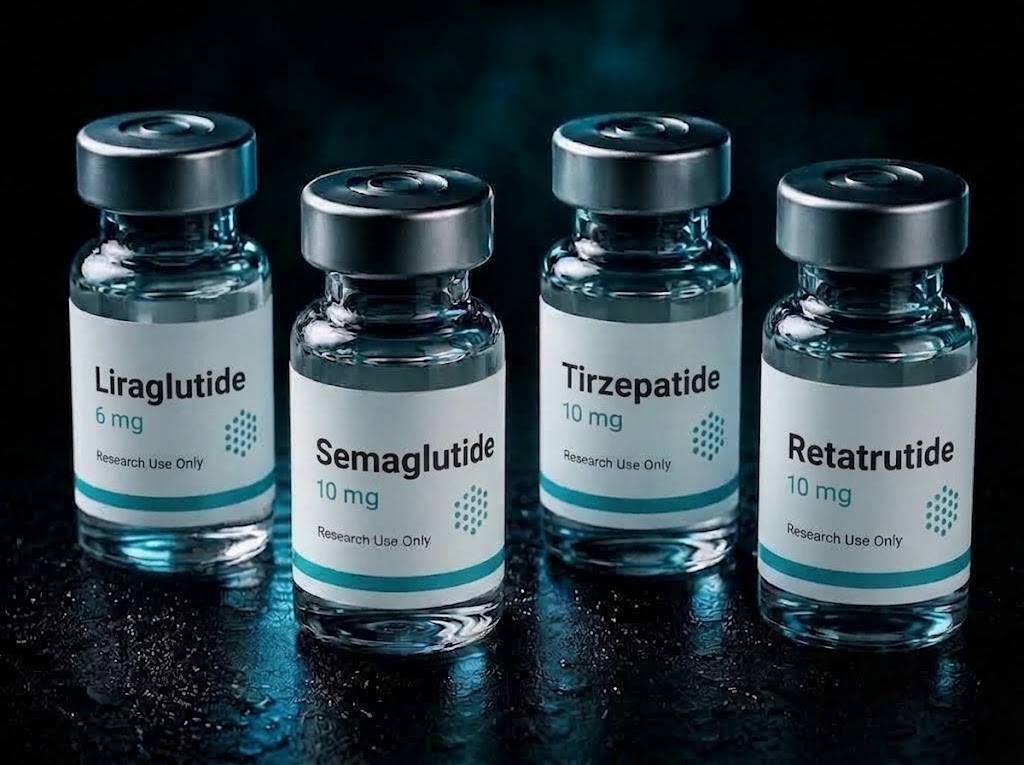
Each one adds something. The evidence gets thinner as you climb.
Average weight loss runs from about 6 percent on liraglutide to about 28 on retatrutide, with semaglutide and tirzepatide between them. These four form a ladder of one receptor, one receptor dosed weekly instead of daily, two receptors, then three. Two of the three steps up that ladder have been tested in a direct head to head trial. The top step has not, and its number comes from a press release.
| Liraglutide | Semaglutide | Tirzepatide | Retatrutide | |
|---|---|---|---|---|
| Receptors | GLP-1 | GLP-1 | GLP-1, GIP | GLP-1, GIP, glucagon |
| Dosing | Daily | Weekly | Weekly | Weekly |
| FDA approved | Yes, 2010 and 2014 [1] | Yes [2] | Yes [3] | No [4] |
| Weight loss | 6.4 to 8 percent [1][5] | 13.7 to 15.8 percent [2][5][6] | 20.2 to 22.5 percent [3][6] | 28.3 percent [4] |
| Head to head behind that number | Yes, against semaglutide [5] | Yes, against both neighbours [5][6] | Yes, against semaglutide [6] | No [4] |
| Generic available | Yes, since 2024 [1] | No | No | Not approved |
Footnote: The figures come from different trials of different lengths. Section 02 explains which comparisons are real.
The one that started this. Approved for diabetes in 2010 and for weight management in 2014, making it the first GLP-1 drug approved for obesity. A daily injection, and the only one of the four available as a generic.
The same receptor as liraglutide, engineered to last a week instead of a day. That change alone roughly doubled the weight loss, and it is the most instructive result here.
Adds GIP, a second gut hormone receptor. Beat semaglutide in a direct trial.
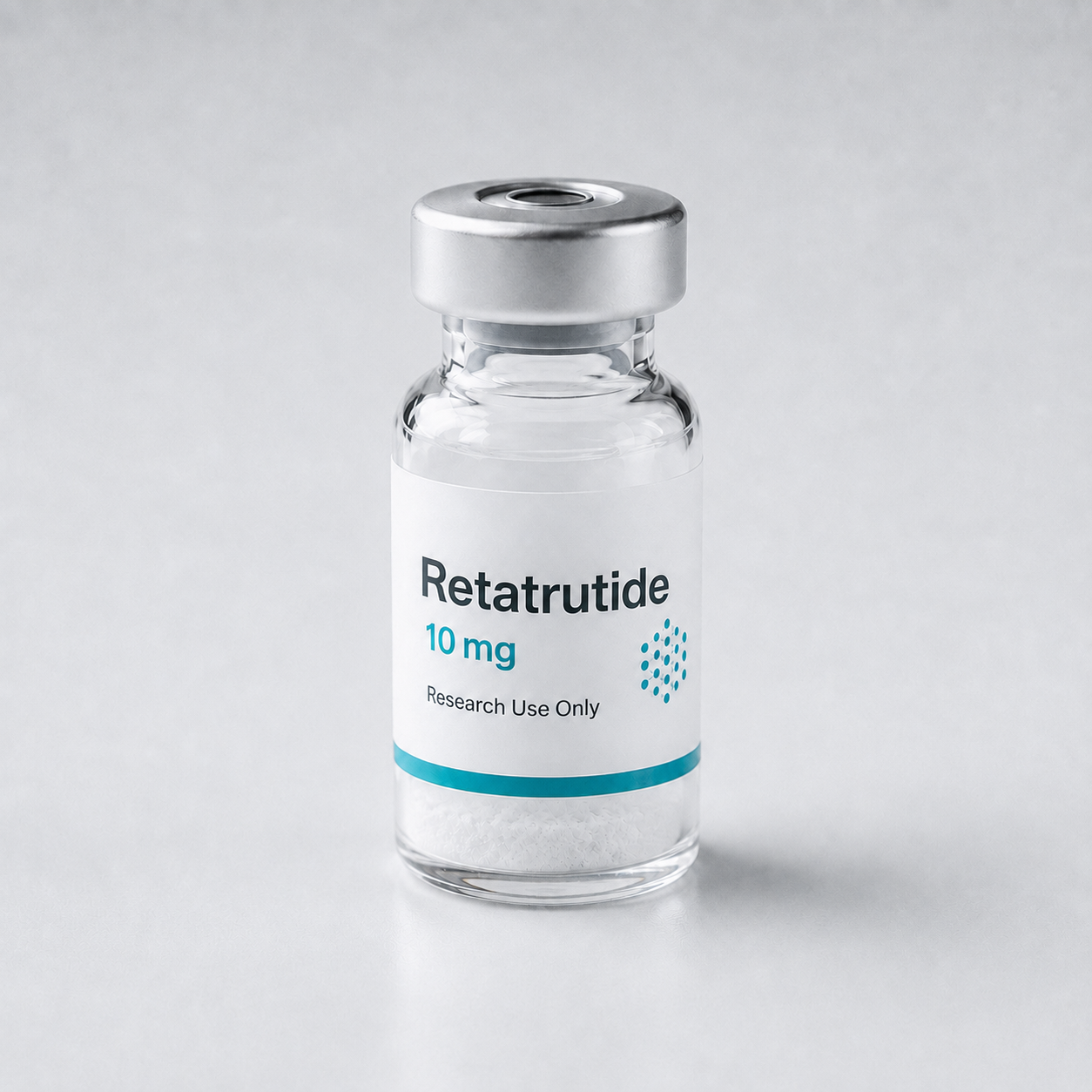
Adds glucagon, raising energy expenditure instead of only reducing intake. The largest weight loss figure any obesity drug has reported, and the only one here without an approval or a published pivotal trial.
Deck: Start here if you have only heard the brand names.
When you eat, your gut releases hormones that tell your body food has arrived. One of them is GLP-1. It slows your stomach emptying, prompts insulin release when blood sugar rises, and acts on the parts of your brain that govern appetite. The practical effect is that you feel full sooner and stay full longer.
All four of these drugs are copies of that hormone, modified so they last far longer than the real thing, which survives only a couple of minutes.
Two of them add a second or third hormone. Tirzepatide also copies GIP, another gut hormone. Retatrutide adds glucagon, raising the rate at which your body burns energy instead of only reducing what goes in.
The brand names, because they cause more confusion than anything else here.
| Molecule | For diabetes | For weight |
|---|---|---|
| Liraglutide | Victoza | Saxenda |
| Semaglutide | Ozempic | Wegovy |
| Tirzepatide | Mounjaro | Zepbound |
| Retatrutide | None | None |
Each pair is the same molecule at a different dose with a different approved use. Ozempic and Wegovy are both semaglutide. Mounjaro and Zepbound are both tirzepatide.
What to expect, roughly. Average weight loss runs from about 6 percent on the oldest of the four to about 28 percent on the newest, over roughly a year to eighteen months. Those are averages, and individual results vary widely in every one of these trials.
What all four have in common is nausea, and it is not a minor footnote. Gastrointestinal effects are the dominant side effect across every trial of every one of these compounds, they are worst while the dose is being increased, and they are the most common reason people stop.
Deck: Four steps up. Two of them have been tested directly.
Four rungs climbing left to right or bottom to top, each labelled with its compound, receptor count and weight loss figure:
Liraglutide · 1 receptor · daily · about 6 to 8 percent Semaglutide · 1 receptor · weekly · about 14 to 16 percent Tirzepatide · 2 receptors · weekly · about 20 to 22 percent Retatrutide · 3 receptors · weekly · about 28 percent
Between each pair of rungs, mark whether a direct head to head trial exists:
Liraglutide to semaglutide: tested, STEP 8 Semaglutide to tirzepatide: tested, SURMOUNT-5 Tirzepatide to retatrutide: not tested
The third gap must look visibly different from the first two. That absence is the argument of the page.
The first step is the surprising one. Liraglutide and semaglutide act on the same receptor. The difference between them is that semaglutide lasts a week and liraglutide lasts a day.
In STEP 8, a direct head to head over 68 weeks, semaglutide produced 15.8 percent weight loss against liraglutide's 6.4. [5] Same receptor, roughly two and a half times the result, from a change in how long the drug stays in circulation.
That is worth sitting with before reading anything about receptor counts. The largest single jump on this ladder came from duration, not from adding a target.
The second step was also tested. SURMOUNT-5 put tirzepatide against semaglutide over 72 weeks: 20.2 percent against 13.7. [6] Adding the GIP receptor produced a real gain, and a smaller one than the jump before it.
Both tested steps were open-label. STEP 8 and SURMOUNT-5 were each run without blinding, so participants and investigators knew which drug was being given. [5][6] In trials measuring an outcome responsive to effort and expectation, that is a real limitation, and it applies to both comparisons this page relies on rather than only one.
The third step has not been tested. Retatrutide's 28.3 percent comes from TRIUMPH-1, the Phase 3, announced by press release in May 2026 with no peer reviewed publication following. Its Phase 2 trial is published, in the New England Journal of Medicine in 2023, and the Phase 3 result that everyone quotes is not. [4] It has never been compared against tirzepatide, or against anything else, in a randomised trial.
So the ladder is solid for two steps and speculative for the third.
One detail from STEP 8 is worth separating out. Gastrointestinal side effects were reported by 84.1 percent on semaglutide and 82.7 percent on liraglutide, a gap of under two points. [5] The two drugs made people feel almost exactly as unwell as each other.
Discontinuation was not close. 13.5 percent left the semaglutide arm and 27.6 percent left the liraglutide arm, roughly double. [5]
Same side effect burden, less than half the weight loss, twice the dropout. That is a useful thing to know about how people actually make this decision, and it is not about tolerability.
Deck: Every figure here comes from a different trial, and some compounds have two.
Across the coverage of these four, the same compound gets different numbers depending on which page you land on. There are three reasons, and none of them is anyone being dishonest.
Different trials, different lengths, different people. SCALE ran 56 weeks. STEP 1 ran 68. SURMOUNT-1 ran 72. TRIUMPH-1 ran 80. A drug studied for 80 weeks has more time to produce weight loss than one studied for 56, and comparing the endpoints directly hands the longer trial an advantage unrelated to the drug.
Head to head figures differ from solo-trial figures. Liraglutide produced 8.0 percent in its own SCALE trial and 6.4 percent when measured against semaglutide in STEP 8. [1][5] Semaglutide produced 14.9 percent in STEP 1, 15.8 in STEP 8 and 13.7 in SURMOUNT-5. [2][5][6] All four figures are real. Head to head numbers are the more reliable ones, because the comparison group went through the same trial.
One trial can even report two different figures. SURMOUNT-1 gives tirzepatide as 22.5 percent on one measure and 20.9 on another. The two differ only in how each handles people who stopped treatment. [3] Most coverage picks one without saying which.
What that means for reading this page. Where a head to head figure exists, this page uses it. Where one does not, it says so.
| Liraglutide | Semaglutide | Tirzepatide | Retatrutide | |
|---|---|---|---|---|
| Brands | Victoza, Saxenda | Ozempic, Wegovy, Rybelsus | Mounjaro, Zepbound | None |
| Receptors | GLP-1 | GLP-1 | GLP-1, GIP | GLP-1, GIP, glucagon |
| Dosing | Once daily | Once weekly, or a daily tablet | Once weekly | Once weekly |
| First approved | 2010 for diabetes [1] | 2017 for diabetes [2] | 2022 for diabetes [3] | Not approved [4] |
| Approved for weight | 2014, the first ever [1] | 2021 [2] | 2023 [3] | No [4] |
| Own pivotal trial | SCALE, 8.0 percent at 56 weeks [1] | STEP 1, 14.9 percent at 68 weeks [2] | SURMOUNT-1, 22.5 percent at 72 weeks [3] | TRIUMPH-1, 28.3 percent at 80 weeks [4] |
| Published | Yes, NEJM 2015 [1] | Yes, NEJM 2021 [2] | Yes, NEJM 2022 [3] | No. Press release only [4] |
| Cardiovascular trial | LEADER, 13 percent MACE reduction [1] | SELECT, 20 percent MACE reduction [7] | SURPASS-CVOT, non-inferior to another GLP-1 [8] | None |
| Oral form | No | Yes | No | No |
| Generic | Yes, since 2024 [1] | No | No | Not applicable |
| Boxed warning | Thyroid C-cell tumours [9] | Thyroid C-cell tumours [9] | Thyroid C-cell tumours [9] | Expected if approved |
Deck: Sixteen years from the first approval to the newest unpublished result.
2009 and January 2010 · Liraglutide The EMA approves liraglutide, and the FDA follows in January 2010 as Victoza, for type 2 diabetes. It is the first of this family to reach the market. [1]
December 2014 · Liraglutide The FDA approves it again as Saxenda, at a higher dose, for chronic weight management. This is the first GLP-1 drug approved for obesity, and the modern obesity drug market begins here. [1]
2015 · Liraglutide Pi-Sunyer publishes the SCALE Obesity and Prediabetes trial in the New England Journal of Medicine. 3,731 adults, 56 weeks, 8.0 percent weight loss against 2.6 on placebo, with 33.1 percent losing 10 percent or more. [1]
2016 · Liraglutide LEADER reports a 13 percent reduction in major cardiovascular events in patients with type 2 diabetes at high cardiovascular risk. [1]
2017 and 2021 · Semaglutide Semaglutide is approved for diabetes as Ozempic, then for weight management as Wegovy after STEP 1 reports 14.9 percent at 68 weeks. Same receptor as liraglutide, dosed weekly instead of daily. [2]
2022 · Liraglutide and Semaglutide STEP 8, the head to head. 68 weeks, adults without diabetes, semaglutide 2.4 mg weekly against liraglutide 3.0 mg daily. Semaglutide 15.8 percent, liraglutide 6.4 percent. [5]
2022 and 2023 · Tirzepatide Tirzepatide is approved for diabetes as Mounjaro, then for weight management as Zepbound. SURMOUNT-1 reports 22.5 percent at 72 weeks on one measure and 20.9 on another. [3]
2023 · Semaglutide SELECT reports a 20 percent reduction in major cardiovascular events against placebo, in 17,604 adults with existing heart disease and obesity but no diabetes. [7]
2024 · Liraglutide Generic liraglutide becomes available. The first drug in this family to lose patent protection, and the only one of the four you can currently buy as a generic. [1]
May 2025 · Semaglutide and Tirzepatide SURMOUNT-5, the second head to head. 751 adults, 72 weeks, open label. Tirzepatide 20.2 percent against semaglutide 13.7. Published in the New England Journal of Medicine. [6]
2025 · Tirzepatide SURPASS-CVOT reports tirzepatide non-inferior to dulaglutide, another GLP-1 drug, in patients with diabetes and established heart disease. That establishes safety, not benefit against placebo. [8]
21 May 2026 · Retatrutide TRIUMPH-1 topline results are announced by press release. 28.3 percent at 80 weeks. No peer reviewed publication has followed, and reported enrolment, dose levels and discontinuation rates vary across coverage. [4]
Today Three approved, one not. Two head to head trials exist, covering the first two steps of the ladder.
The biggest jump on this ladder came from changing the dosing schedule.
Liraglutide and semaglutide act on the same receptor. The only meaningful difference between them is that one lasts a day and the other lasts a week. In a direct trial, that produced 6.4 percent against 15.8. [5]
Adding a second receptor is the entire premise of tirzepatide, and it produced a smaller gain than that: 13.7 to 20.2 in SURMOUNT-5. [6]
So the story people tell about this category, that each drug works better because it hits more targets, does not survive its own evidence. The largest single improvement came from duration, not from receptor count.
The top of the ladder is where the evidence runs out. Retatrutide's 28.3 percent has never been compared against tirzepatide, and it comes from a press release, not a published trial. Secondary sources cannot even agree on the enrolment, the dose levels or the discontinuation rate, because there is no methods section to settle them. [4]
The ladder holds for three rungs and turns speculative at the fourth.
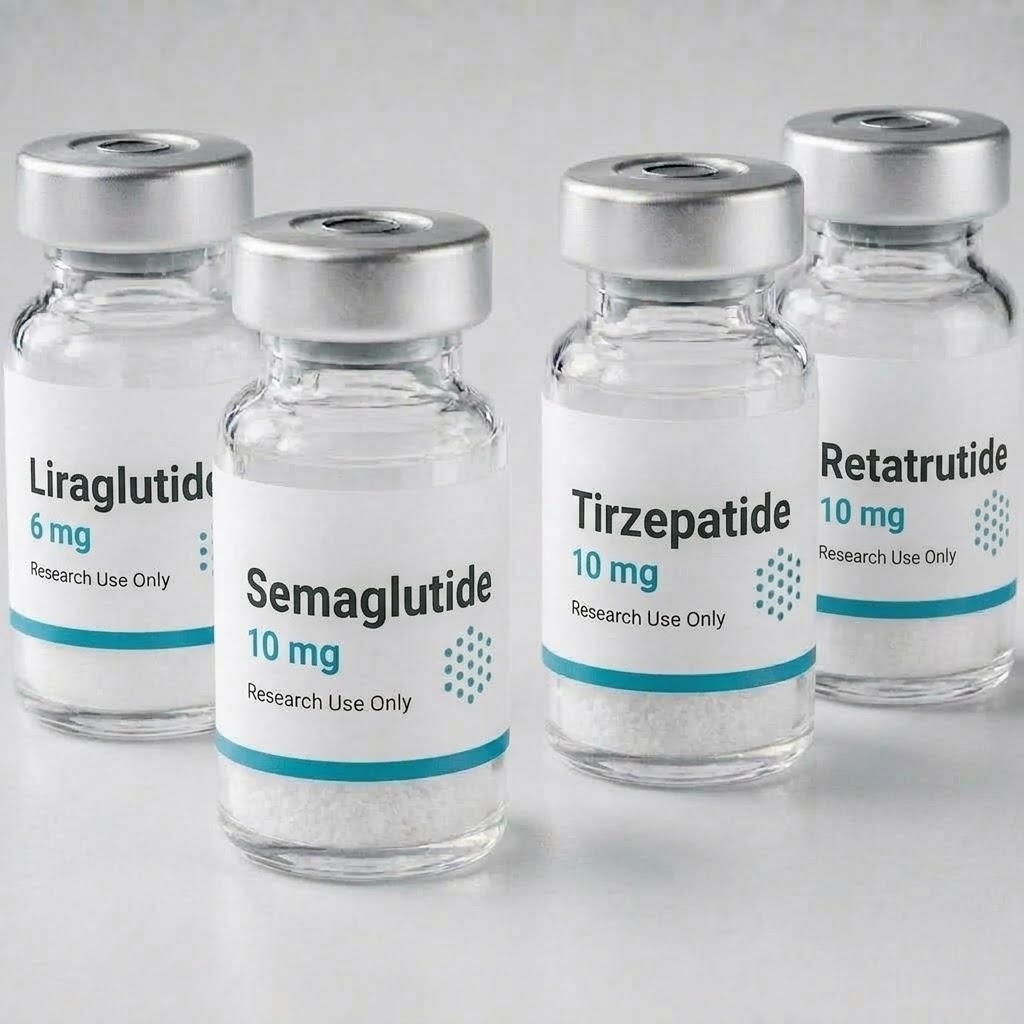
Deck: One shared mechanism, then two additions.
What all four share. Every one of these activates the GLP-1 receptor. GLP-1 is released by your gut after eating, and it slows stomach emptying, prompts insulin release when blood sugar is high, and acts on appetite centres in the brain. That shared mechanism does most of the work in all four drugs.
Liraglutide to semaglutide: duration, not mechanism. Both are modified copies of GLP-1 carrying a fatty acid that binds albumin and slows clearance. Semaglutide's modification is more effective, taking it from about a day to about a week.
Weekly dosing means more consistent receptor occupancy and fewer peaks and troughs, and it removes six injections a week. Whether the benefit comes from the pharmacology or from people simply taking it more reliably has not been separated.
Tirzepatide adds GIP. A second gut hormone receptor. GIP appears to add to appetite suppression and to improve how the body handles fat and glucose, and it may reduce the nausea that comes with GLP-1 activation, allowing higher effective dosing.
Retatrutide adds glucagon. Usually discussed as the hormone that raises blood sugar, glucagon also increases energy expenditure and fat breakdown. So retatrutide works on both sides of the equation, reducing intake and raising output, where the other three work mainly on intake.
Why the gains get smaller as you climb. The three receptors overlap. All of them affect appetite, and GLP-1 does most of that work on its own. Each addition contributes a slice instead of a separate mechanism, and that is why receptor count and weight loss do not scale together.
That is the same pattern seen when amylin was added to GLP-1, where the combination came in well below the sum of the two alone.
Deck: What separates the four.
Shared: all four activate GLP-1 · all four are injected · all four produce dose-dependent gastrointestinal effects · three carry the same boxed warning and the fourth would · none is approved for cosmetic or general wellness use
| Liraglutide | Semaglutide | Tirzepatide | Retatrutide | |
|---|---|---|---|---|
| Receptors | 1 | 1 | 2 | 3 |
| Dosing | Daily | Weekly | Weekly | Weekly |
| Head to head result | 6.4 percent [5] | 13.7 to 15.8 percent [5][6] | 20.2 percent [6] | None exists [4] |
| Approved | Yes, twice | Yes, three products | Yes, two products | No |
| Published pivotal trial | Yes [1] | Yes [2] | Yes [3] | No [4] |
| Cardiovascular benefit shown | 13 percent, in diabetes [1] | 20 percent, in obesity [7] | Non-inferiority only [8] | Untested |
| Oral option | No | Yes | No | No |
| Generic | Yes [1] | No | No | No |
| Distinctive effect | None beyond the class | None beyond the class | None beyond the class | Dysesthesia [4] |
Summary compiled from published trials, FDA labelling and company announcements.
Deck: Prices as of mid-2026, and they move faster than anything else on this page.
Retail list prices are high and almost nobody pays them: roughly 1,349 dollars a month for Wegovy and 1,086 for Zepbound.[12]
What most people pay depends on which of four routes they are on.
| Route | Liraglutide | Semaglutide | Tirzepatide | Retatrutide |
|---|---|---|---|---|
| Generic | Available since 2024 [1] | None | None | Not approved |
| Lowest in-stock research listing we track | $51.00 | $10.00 | $4.00 | $32.48 |
| Insurance plus savings card | Varies | As low as 25 dollars [12] | As low as 25 dollars [12] | Not applicable |
| Manufacturer direct, self-pay | Not applicable | About 349 a month, or 149 to 299 for the pill [12] | 299 to 449 by dose [12] | Not applicable |
| Retail list | Lower, as a generic | About 1,349 [12] | About 1,086 [12] | Not applicable |
Liraglutide is the only one with a generic, available since 2024, and that is the single most practical difference between these four for anyone paying out of pocket.[1] It also produces the least weight loss of the four, so the trade is explicit instead of hidden.
Between semaglutide and tirzepatide the gap is smaller than it looks. At manufacturer self-pay prices the difference at maintenance doses is roughly 100 dollars a month, far less than the retail figures suggest. Both companies cut direct prices repeatedly during 2025 and 2026 while competing with each other.[12]
Retatrutide has no price at all, because it has no approved product. What is sold under that name is a research chemical.
Treat every figure here as perishable. These moved several times in the eighteen months before this was written. Check the manufacturer's own pharmacy before relying on any number, including these.
Deck: Four gaps, and the first is the top of the ladder.
Nobody has compared retatrutide against tirzepatide. The entire case for the third receptor rests on comparing a press release against a published trial of a different length in a different population. [3][4]
Nobody has separated duration from pharmacology. Semaglutide beat liraglutide by a wide margin, and the drugs differ in how long they last and in how often a person has to remember an injection. No trial has isolated which of those produced the result. [5]
Nobody has published the fat and lean tissue split at these levels. At 20 to 28 percent weight loss, what came off matters a great deal, and it is a secondary outcome in every one of these programmes.
Nobody has compared them on outcomes, either. Liraglutide, semaglutide and tirzepatide each have their own cardiovascular trial, and the three answer different questions in different populations. [1][7][8] No trial has put any two of them against each other on events.
Deck: Four questions, and weight loss is only one of them.
Will you inject daily or weekly? Liraglutide is a daily injection and the other three are weekly. Semaglutide also comes as a tablet. For a lot of people that settles it before any evidence enters the conversation.
What are you paying? Liraglutide is the only one available as a generic.[1] If cost is the binding constraint, it is the answer, and it produces the least weight loss of the four.
What are you actually treating? These are not interchangeable across indications. Semaglutide has the strongest cardiovascular evidence, from a trial in people with heart disease and obesity but no diabetes.[7] Tirzepatide has an additional approval for obstructive sleep apnoea. Liraglutide has paediatric approvals the others do not.
How settled do you need the evidence to be? Three of these have published pivotal trials and approvals. Retatrutide has a press release.[4] That is a genuine difference in kind, not in degree.
Deck: One boxed warning across the class, and one compound with no label at all.
Register header: 4 fields · 16 entries · Compiled from FDA labelling, published trials and US market conditions
01 · On the label · The same boxed warning for all three approved (red) The strongest warning the FDA issues, applied across the class.
02 · Reported · Across the trials (teal) Gastrointestinal effects dominate for all four, and are dose dependent.
03 · Unsettled · Retatrutide's figures do not agree (amber) These conflict across sources because TRIUMPH-1 is unpublished.
04 · Supply · What you are actually buying (amber) Three approved products, one research chemical, and a compounded market that has closed.
The boxed warning deserves context in both directions. It exists because rodents given GLP-1 drugs developed thyroid C-cell tumours in a dose-dependent way, and rodents carry far more of the relevant receptors on those cells than people do. Whether it happens in humans is unknown, and no confirmed cases have come out of the trial programmes. [9]
It also carries a hard contraindication, and a prescriber is meant to ask about your family's thyroid history before writing any of them.
Retatrutide is in the same class and will very likely carry the same warning if approved. Anyone buying it now as a research chemical gets no boxed warning, no contraindication check and nobody asking about thyroid cancer in the family.
Deck: Short section. None of these is a performance drug.
None of the four appears on the 2026 WADA Prohibited List.
Weight class sports are where this could matter, since rapid weight loss has obvious competitive relevance, and WADA states that absence from the list does not mean a substance is permitted.
The larger risk is the same as everywhere else here. A research chemical bought online can contain something the label never mentioned, and that has produced positive tests for compounds athletes never intended to take.
If you compete under a testing body, ask that body directly.
Deck: Three approved, one not, and one of the three has a generic.
Liraglutide is approved twice and available as a generic. The FDA approved it as Victoza for type 2 diabetes in January 2010 and as Saxenda for chronic weight management in December 2014, making it the first GLP-1 drug approved for obesity. Generic versions became available in 2024. [1]
That generic status is the single most practical difference here, and it appears in almost no comparison of these compounds.
Semaglutide is approved three times over. As Ozempic for diabetes, Wegovy for weight management, and Rybelsus in tablet form, with an oral version approved for weight loss more recently. [2]
Tirzepatide is approved twice. As Mounjaro for diabetes and Zepbound for weight management, with an additional approval for obstructive sleep apnoea in adults with obesity. [3]
Retatrutide is not approved anywhere. It is investigational. Sources disagree on whether an application has been filed, and approval estimates in circulation run from late 2026 to 2028. [4] Every vial sold under that name is a research chemical.
The compounded market has also closed. The FDA declared the tirzepatide shortage resolved in October 2024 with enforcement discretion ending in early 2025, and in April 2026 proposed removing semaglutide from the 503B bulk list. [10] Millions of people used compounded versions during the shortage years, and none of those were the approved products.
Retatrutide reports the highest figure at 28.3 percent, and it is the only one of the four with no approval and no published pivotal trial.[4] Among the approved three, tirzepatide is highest at 20.2 percent, measured against semaglutide's 13.7 in a direct head to head.[6] Liraglutide is lowest at 6.4 percent, also measured directly against semaglutide.[5]
Semaglutide produced roughly two and a half times the weight loss in a direct trial: 15.8 percent against 6.4 over 68 weeks.[5] Both act on the same receptor. The difference is that semaglutide is dosed weekly and liraglutide daily. That makes it the clearest evidence here that duration matters more than receptor count.
No, and the evidence points the other way. The largest jump on this ladder came from changing liraglutide to semaglutide, and both are single-receptor drugs.[5] Adding a second receptor produced a smaller gain than that.[6] The receptors overlap, so each addition contributes a slice instead of a separate mechanism.
Nausea, vomiting, diarrhoea and constipation dominate across all four, are dose dependent, and are worst while the dose is being increased.[1][2][3][4] Hair loss appears among common adverse events on the approved labels and rarely in coverage.[9] All three approved compounds carry a boxed warning for thyroid C-cell tumours based on rodent studies, with a hard contraindication for a personal or family history of medullary thyroid carcinoma or MEN 2.[9] Retatrutide additionally reports dysesthesia, meaning altered skin sensation, which the other three do not.[4]
Yes, across this class. Weight regain after discontinuation has been documented for these drugs, and no trial has compared the four on what happens after stopping. That is one of the larger unanswered questions about the whole category.
No trial has studied switching, and people do it constantly. The head to head trials randomised people who had been on neither drug, so they say nothing about what happens when you change.[5][6] Dose titration starts again from the bottom with the new compound, and switching is a prescriber's decision.
No. In the one trial that measured it directly, gastrointestinal side effects were reported by 84.1 percent on semaglutide and 82.7 percent on liraglutide, which is effectively the same.[5] What differed was how many people stayed: 13.5 percent left the semaglutide arm against 27.6 percent on liraglutide. Same burden, better result, so more people stuck with it.
No trial has compared them directly. Across separate trials the gap is large: tirzepatide produced 20.2 percent in a head to head against semaglutide, and liraglutide produced 6.4 percent in a head to head against the same drug.[5][6] That is an indirect comparison through a shared comparator, which is more informative than comparing solo trials and less reliable than testing the two against each other.
Its reported number is higher, at 28.3 percent against semaglutide's 13.7 to 15.8, and the two have never been compared.[2][4][5][6] Retatrutide also has no approval and no published pivotal trial, so the comparison sets a press release against published work.
Weight loss begins within weeks and continues for most of a year in every one of these trials. The pivotal studies ran 56 weeks for liraglutide, 68 for semaglutide, 72 for tirzepatide and 80 for retatrutide, and the curves were still descending at the end in most of them.[1][2][3][4] Dose escalation takes the first several weeks in all four, and that is when side effects are worst.
Unknown at these levels, and it matters more the higher up the ladder you go. The split between fat and lean tissue is a secondary outcome in every one of these programmes and it is not the headline figure in any of them.
Liraglutide, because it is the only one of the four available as a generic, since 2024.[1] The other three are brand-only, and retatrutide has no approved product at all. Manufacturer self-pay programmes have narrowed the gap for semaglutide and tirzepatide considerably, so check current pricing before assuming.
Because the figures come from different trials of different lengths, and because head to head trials report different numbers than solo trials. Liraglutide is 8.0 percent in its own trial and 6.4 against semaglutide.[1][5] Semaglutide is 14.9, 15.8 and 13.7 depending on the trial.[2][5][6] All are real, and head to head figures are the more reliable ones.
No. The comparison everyone is making sets a press release against a published trial of a different length in a different population.[3][4] No randomised trial has put them against each other.
The three approved ones do, for thyroid C-cell tumours based on rodent studies, with a hard contraindication for a personal or family history of medullary thyroid carcinoma or MEN 2.[9] Retatrutide is in the same class and would very likely carry it too.
Semaglutide, at present. SELECT showed a 20 percent reduction in major cardiovascular events against placebo in people with obesity and no diabetes.[7] Liraglutide's LEADER trial showed 13 percent in a diabetes population.[1] Tirzepatide's trial showed non-inferiority against another GLP-1 drug, not benefit against placebo.[8] Retatrutide has none.
Not for everyone. It produces less weight loss than the newer three, and it has the longest real-world safety record of the family, cardiovascular outcome data, paediatric approvals, and generic availability. Daily dosing is the trade.
[1] Liraglutide. FDA approval as VICTOZA for type 2 diabetes, January 2010, following EMA approval in 2009. FDA approval as SAXENDA for chronic weight management, December 2014, the first GLP-1 receptor agonist approved for obesity. Pi-Sunyer X, Astrup A, Fujioka K, Greenway F, Halpern A, Krempf M, et al. A randomized, controlled trial of 3.0 mg of liraglutide in weight management. N Engl J Med. 2015 Jul 2;373(1):11-22. DOI 10.1056/NEJMoa1411892. PMID 26132939. SCALE Obesity and Prediabetes: 3,731 adults randomised 2:1, 2,487 to liraglutide and 1,244 to placebo, 78.7 percent women, 56 weeks. 8.0 percent weight loss against 2.6 percent on placebo, with 33.1 percent achieving 10 percent or more. Serious adverse events 6.2 percent against 5.0 percent. LEADER cardiovascular outcomes trial: 13 percent reduction in major adverse cardiovascular events in patients with type 2 diabetes at high cardiovascular risk. More than 11,000 subjects across 52 completed trials, with more than 7,500 exposed for up to three years. Generic liraglutide became available in 2024. SCALE CITATION VERIFIED AGAINST NEJM AND PUBMED. LEADER AND REGULATORY DATES VIA SECONDARY SOURCES. CONFIRM THE GENERIC AVAILABILITY DATE BEFORE PUBLISHING, since it underpins a headline claim.
[2] Semaglutide. FDA approval as OZEMPIC for type 2 diabetes 2017, WEGOVY for chronic weight management 2021, RYBELSUS oral for diabetes. Wilding JPH, Batterham RL, Calanna S, et al. Once-weekly semaglutide in adults with overweight or obesity. N Engl J Med. 2021 Mar 18;384(11):989-1002. DOI 10.1056/NEJMoa2032183. STEP 1: 68 weeks, 14.9 percent weight loss. PEER REVIEWED TRIAL, CITATION VERIFIED AGAINST NEJM.
[3] Tirzepatide. FDA approval as MOUNJARO for type 2 diabetes 2022 and ZEPBOUND for chronic weight management 2023. Jastreboff AM, Aronne LJ, Ahmad NN, et al. Tirzepatide once weekly for the treatment of obesity. N Engl J Med. 2022;387(3):205-216. PMID 35658024. SURMOUNT-1: 2,539 adults, 72 weeks, 22.5 percent on the efficacy estimand and 20.9 percent on the treatment-regimen estimand at 15 mg. The two figures differ in how each handles participants who stopped treatment, and both are correct. PEER REVIEWED TRIAL, ABSTRACT READ.
[4] Retatrutide. The Phase 2 trial is published: Jastreboff AM, et al. Triple-hormone-receptor agonist retatrutide for obesity: a phase 2 trial. N Engl J Med. 2023 Aug 10;389(6):514-526. DOI 10.1056/NEJMoa2301972. The Phase 3 is not. Eli Lilly, TRIUMPH-1 topline results announced 21 May 2026. 28.3 percent mean weight loss at the top dose over 80 weeks. No peer reviewed publication had appeared at the time of writing. Secondary sources report enrolment as both 2,026 and 2,339, the middle dose as both 8 mg and 9 mg, the lowest dose result as both 16.1 and 19.0 percent, and discontinuation for adverse events between single digits and 14.1 percent. Dysesthesia, meaning altered skin sensation, is reported in the retatrutide programme and not for semaglutide or tirzepatide. Heart rate rose about 3 to 4 beats per minute at the top dose. Not approved in any country; sources disagree on whether an FDA application has been filed. VERIFY EVERY FIGURE AGAINST THE PUBLISHED PAPER WHEN IT APPEARS.
[5] Rubino DM, Greenway FL, Khalid U, O'Neil PM, Rosenstock J, Sørrig R, Wadden TA, Wizert A, Garvey WT; STEP 8 Investigators. Effect of weekly subcutaneous semaglutide vs daily liraglutide on body weight in adults with overweight or obesity without diabetes: the STEP 8 randomized clinical trial. JAMA. 2022 Jan 11;327(2):138-150. DOI 10.1001/jama.2021.23619. PMID 35015037. Trial NCT04074161.
Phase 3b, randomised, open-label, 68 weeks, 19 US sites. Randomised 3:1:3:1 to semaglutide 2.4 mg weekly (n=126) or matching placebo, or liraglutide 3.0 mg daily (n=127) or matching placebo, with placebo groups pooled (n=85). Semaglutide used a 16-week dose escalation and liraglutide a 4-week escalation.
Mean weight change: semaglutide 15.8 percent against liraglutide 6.4 percent, difference 9.4 percentage points, 95% CI 12.0 to 6.8, p less than 0.001. Pooled placebo 1.9 percent. Absolute weight loss 15.3 kg against 6.8 kg. Waist circumference 13.2 cm against 6.6 cm.
Reaching 10 percent loss: 70.9 against 25.6 percent, odds ratio 6.3. Reaching 15 percent: 55.6 against 12.0, odds ratio 7.9. Reaching 20 percent: 38.5 against 6.0, odds ratio 8.2.
Gastrointestinal adverse events were reported by 84.1 percent on semaglutide and 82.7 percent on liraglutide, a difference of under two points. Discontinuation for any reason was 13.5 percent on semaglutide and 27.6 percent on liraglutide.
PEER REVIEWED HEAD TO HEAD TRIAL, ABSTRACT AND RESULTS TABLE READ. NOTE THE OPEN-LABEL DESIGN, which is the same limitation SURMOUNT-5 carries.
[6] Aronne LJ, et al. Tirzepatide as compared with semaglutide for the treatment of obesity. N Engl J Med. Published May 2025. SURMOUNT-5. Head to head, open label, 751 adults with obesity and without diabetes, 72 weeks, maximum tolerated dose in both arms. Tirzepatide 20.2 percent against semaglutide 13.7 percent, p less than 0.001, and superior on all five key secondary endpoints. The open-label design is a real limitation in a trial measuring an outcome responsive to effort and expectation. PEER REVIEWED. CONFIRM VOLUME AND PAGES.
[7] Lincoff AM, et al. Semaglutide and cardiovascular outcomes in obesity without diabetes. N Engl J Med. 2023. SELECT. 17,604 adults with pre-existing cardiovascular disease, BMI 27 or above, no diabetes. 20 percent reduction in major adverse cardiovascular events, hazard ratio 0.80. Absolute reduction 1.5 percentage points, from 8.0 percent to 6.5, number needed to treat 67. PEER REVIEWED. CONFIRM VOLUME AND PAGES.
[8] SURPASS-CVOT. 13,299 adults with type 2 diabetes and established atherosclerotic cardiovascular disease, tirzepatide against dulaglutide as active comparator. Non-inferior for three-point MACE, directionally favouring tirzepatide without meeting superiority. The comparator was another GLP-1 drug with its own cardiovascular approval, not placebo, so the trial establishes safety, not benefit against no treatment. CONFIRM FULL CITATION AND FINAL FIGURES.
[9] SAXENDA, VICTOZA, WEGOVY, OZEMPIC, MOUNJARO and ZEPBOUND prescribing information. Novo Nordisk and Eli Lilly. FDA labels. All carry a boxed warning for risk of thyroid C-cell tumours, based on rodent studies showing dose-dependent tumours at clinically relevant exposures. Whether they occur in humans is unknown. All are contraindicated with a personal or family history of medullary thyroid carcinoma or multiple endocrine neoplasia syndrome type 2. Labelled warnings include pancreatitis and gallbladder disease. Hair loss appears among common adverse events. CONFIRM CURRENT LABEL WORDING, SINCE INDICATIONS HAVE BEEN ADDED OVER TIME.
[10] Compounding status. FDA declared the tirzepatide shortage resolved 2 October 2024, with enforcement discretion for large-scale compounding ending approximately February to March 2025. In April 2026 the agency proposed removing semaglutide from the 503B bulk drug substances list, which would end large-scale compounding of semaglutide once finalised. CONFIRM CURRENT STATUS, SINCE THIS IS AN ACTIVE REGULATORY PROCESS.
[11] Janvier S, Cheyns K, Canfyn M, Goscinny S, De Spiegeleer B, Vanhee C, Deconinck E. Impurity profiling of the most frequently encountered falsified polypeptide drugs on the Belgian market. Talanta. 2018;188:795-807. DOI 10.1016/j.talanta.2018.06.023. PEER REVIEWED ANALYTICAL STUDY.
[12] Manufacturer direct pricing, as of mid-2026. LillyDirect self-pay for Zepbound: 299 dollars a month at 2.5 mg, 399 at 5 mg, 449 at 7.5 through 15 mg. NovoCare Pharmacy self-pay for Wegovy injection: about 349 a month for doses up to 2.4 mg. Oral Wegovy launched January 2026 at 149 to 299 a month. Retail list prices approximately 1,349 for Wegovy and 1,086 for Zepbound. With commercial insurance and a manufacturer savings card, both can fall to about 25 a month; savings cards are generally unavailable to Medicare, Medicaid, VA and TRICARE beneficiaries. Generic liraglutide pricing is not included here because we have not verified a current figure. These prices moved repeatedly during 2025 and 2026 and should be checked against the manufacturers' own pharmacies before use.
What Europe PMC and ClinicalTrials.gov hold for each, on the same rule.
Liraglutide has 600 records, Semaglutide 604, Tirzepatide 503 and Retatrutide 261. 165, 192, 124 and 40 original human studies, 514, 760, 292 and 34 registered trials, respectively.
Semaglutide: FDA via DailyMed: Indicated as an adjunct to diet and exercise to improve glycemic control in adults with type 2 diabetes mellitus; to reduce the risk of major adverse cardiovascular events in adults with type 2 diabetes and established cardiovascular disease; to reduce the risk of sustained eGFR decline, end-stage kidney disease and cardiovascular death in adults with type 2 diabetes and chronic kidney disease · FDA via DailyMed: Indicated as an adjunct to diet and exercise to improve glycemic control in adults with type 2 diabetes mellitus; to reduce the risk of major adverse cardiovascular events in adults with type 2 diabetes who are at high risk for these events · FDA via DailyMed: Indicated in combination with a reduced calorie diet and increased physical activity to reduce the risk of major adverse cardiovascular events in adults with established cardiovascular disease and either obesity or overweight; to reduce excess body weight and maintain weight reduction long term in adults and pediatric patients aged 12 years and older with obesity and adults with overweight with at least one weight-related comorbid condition; for the treatment of noncirrhotic metabolic dysfunction-associated steatohepatitis (MASH) with moderate to advanced liver fibrosis
Tirzepatide: FDA via DailyMed: Indicated as an adjunct to diet and exercise to improve glycemic control in adults and pediatric patients 10 years of age and older with type 2 diabetes mellitus; to reduce the risk of major adverse cardiovascular events in adults with type 2 diabetes mellitus who are at high risk for these events · FDA via DailyMed: Indicated in combination with a reduced-calorie diet and increased physical activity to reduce excess body weight and maintain weight reduction long term in adults with obesity or adults with overweight in the presence of at least one weight-related comorbid condition; to treat moderate to severe obstructive sleep apnea in adults with obesity
The published recordLiraglutide
6,179
Papers and trials about Liraglutide
333 papers with human data · 165 original studies
514 registered trials · 28 with posted results
Counted from Europe PMC indexing, not read by a person; human includes reviews and cell work, original studies exclude both. 500 papers and 100 trials indexed in detail.
The published recordSemaglutide
6,422
Papers and trials about Semaglutide
354 papers with human data · 192 original studies
760 registered trials · 9 with posted results
Indicated as an adjunct to diet and exercise to improve glycemic control in adults with type 2 diabetes mellitus; to reduce the risk of major adverse cardiovascular events in adults with type 2 diabetes and established cardiovascular disease; to reduce the risk of sustained eGFR decline, end-stage kidney disease and cardiovascular death in adults with type 2 diabetes and chronic kidney diseaseRegulatorsCounted from Europe PMC indexing, not read by a person; human includes reviews and cell work, original studies exclude both. 504 papers and 100 trials indexed in detail.
The published recordTirzepatide
2,863
Papers and trials about Tirzepatide
268 papers with human data · 124 original studies
292 registered trials · 10 with posted results
Indicated as an adjunct to diet and exercise to improve glycemic control in adults and pediatric patients 10 years of age and older with type 2 diabetes mellitus; to reduce the risk of major adverse cardiovascular events in adults with type 2 diabetes mellitus who are at high risk for these eventsRegulatorsCounted from Europe PMC indexing, not read by a person; human includes reviews and cell work, original studies exclude both. 403 papers and 100 trials indexed in detail.
The published recordRetatrutide
261
Papers and trials about Retatrutide
154 papers with human data · 40 original studies
34 registered trials · 2 with posted results
Counted from Europe PMC indexing, not read by a person; human includes reviews and cell work, original studies exclude both.