
Cagrilintide vs Semaglutide
REDEFINE 1 tested cagrilintide alone, semaglutide alone, both together and placebo, in the same 3,417 people over the same 68 weeks. Semaglutide produced more weight loss than cagrilintide, 16.1 percent against 11.8, and the combination reached 22.7 percent, which lands above either one and below the two added together.
- Weight loss
- Two different hunger signals
- A genuine head to head
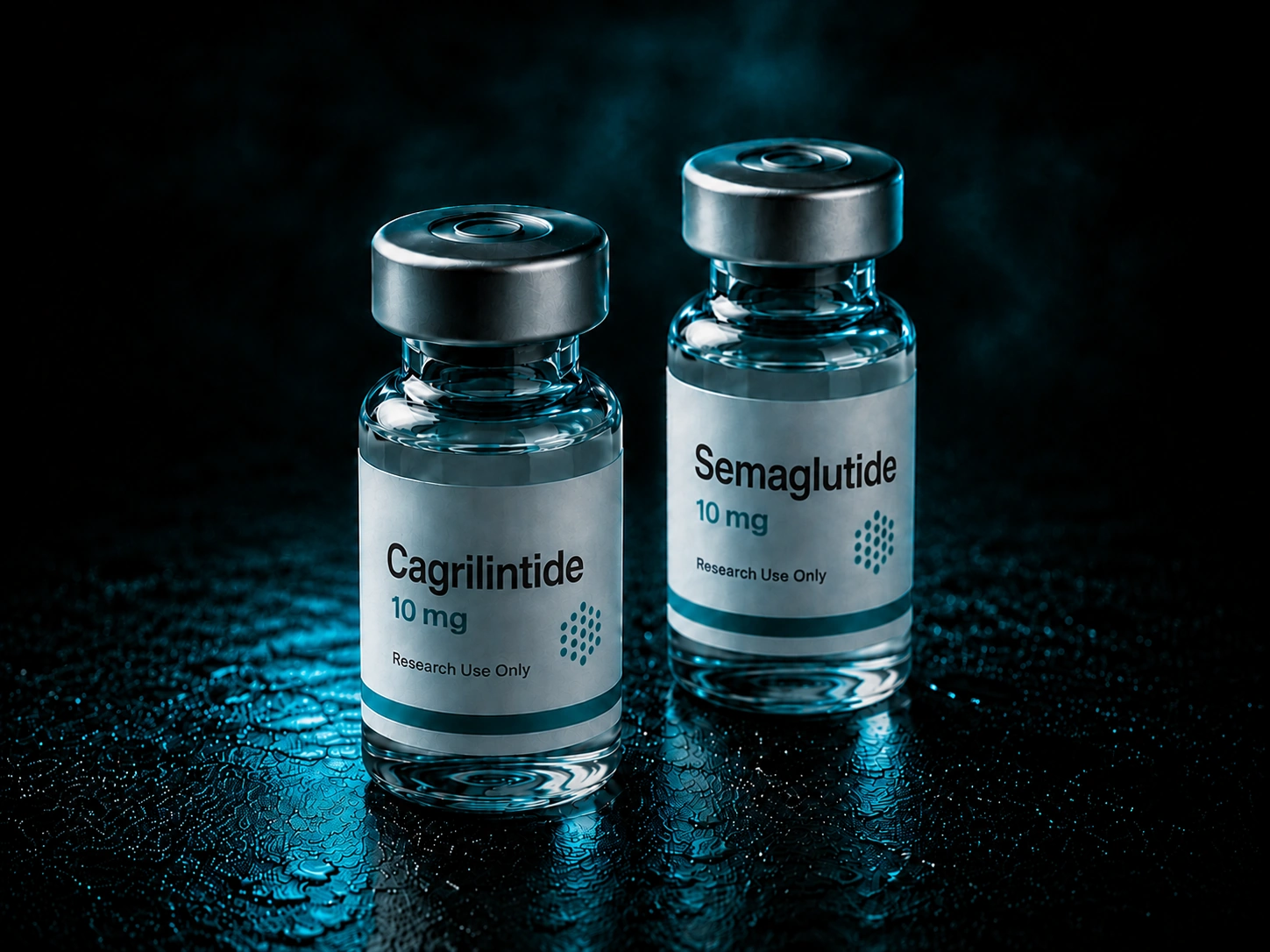
Has anyone actually compared them head to head?
Two different hunger signals, and the trial tested them in the same room.
| Attribute | Cagrilintide | Semaglutide |
|---|---|---|
| Copies | Amylin, a fullness hormone | GLP-1, a gut hormone |
| Dosing | Once weekly | Once weekly |
| FDA status | Not approved [6] | Approved, as Ozempic, Wegovy and Rybelsus |
| Weight loss in REDEFINE 1 | 11.8 percent [1] | 16.1 percent [1] |
| Injection site reactions | 17 percent [5] | 2.6 percent [5] |
| Discontinued for side effects | About 6 percent on the combination, against 3.7 on placebo [8] | Same trial, same figure |
| Tested against each other | Yes, in the same trial [1] | Yes, in the same trial [1] |
Both figures come from the same 68 week trial in the same population.
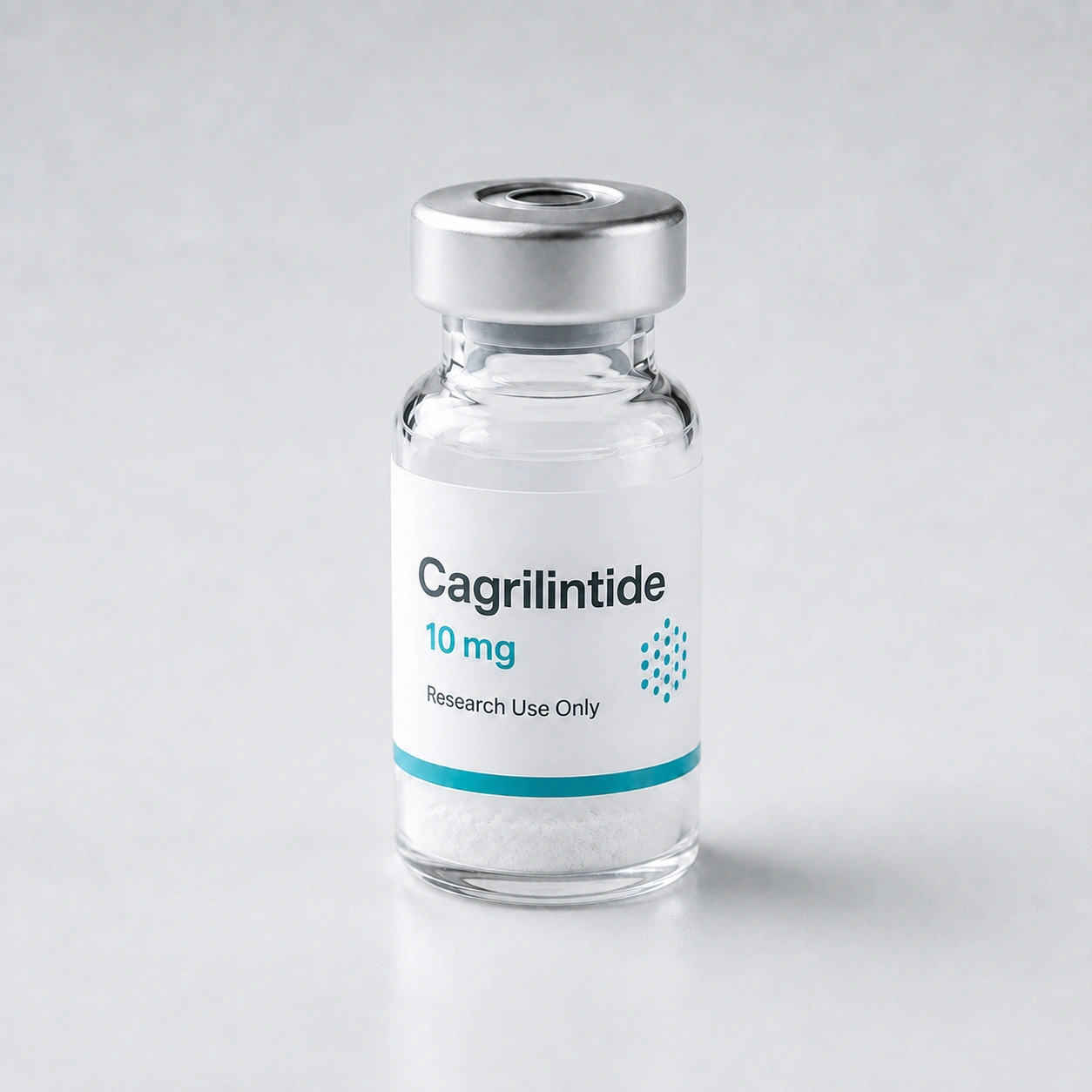
Cagrilintide
A long-acting copy of amylin, a hormone your pancreas releases alongside insulin when you eat. Amylin slows the stomach and tells the brain you have had enough. In plain terms: it works on feeling full, not on wanting less.
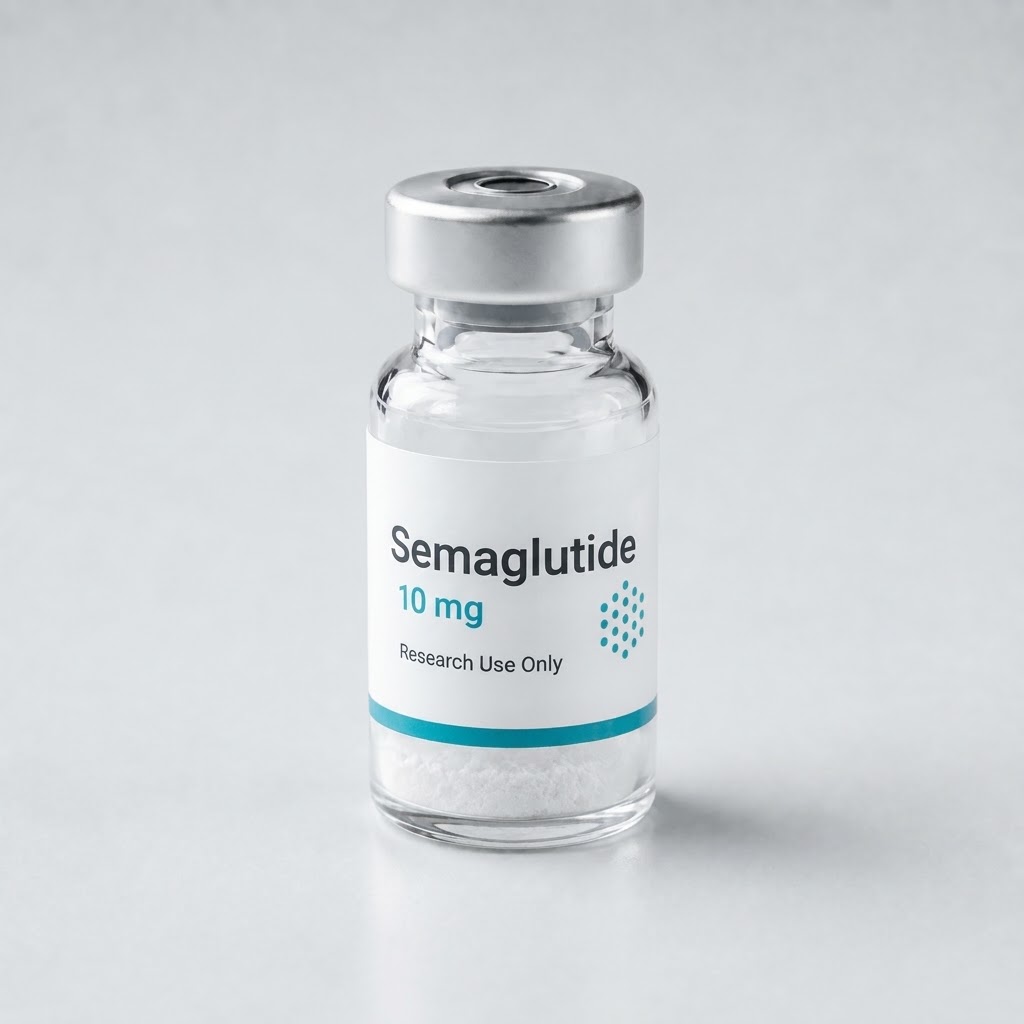
Semaglutide
A long-acting copy of GLP-1, a hormone your gut releases after eating. It slows stomach emptying, steadies blood sugar and reduces appetite. In plain terms: the current standard, with approvals for diabetes and for weight management.
What did the head-to-head trial find?
| Arm | Weight loss at 68 weeks |
|---|---|
| Cagrilintide and semaglutide together | 22.7 percent |
| Semaglutide alone | 16.1 percent |
| Cagrilintide alone | 11.8 percent |
| Placebo | 2.3 percent |
Semaglutide beat cagrilintide by 4.3 percentage points, in the same people, at the same time. Most peptide comparisons are stitched together from separate trials with a conclusion drawn across the gap. REDEFINE 1 randomized 3,417 adults with obesity or overweight, without diabetes, into four groups over the same 68 weeks at the same sites. [1]
Two things stop it being the whole story. Add the two single-drug results together and you get 27.9, and the combination reached 22.7, so the effect is additive but not fully so. And the order flips depending on who is being treated: in an earlier Phase 2 trial in people with type 2 diabetes, cagrilintide alone produced 8.1 percent against semaglutide's 5.1 over 32 weeks. [4]
One thing this comparison does not tell you. It says semaglutide beat cagrilintide, not that GLP-1 beats amylin. Eli Lilly's amylin analog eloralintide produced up to 20.1 percent on its own at 48 weeks in Phase 2, against 0.4 percent on placebo, which is above semaglutide's 16.1 percent from a different trial. [11] The claim the trial supports is narrower: semaglutide beat this amylin analog.
How do they compare, side by side?
How do they compare, side by side?
| Attribute | Cagrilintide | Semaglutide |
|---|---|---|
| Also called | AM833 | Ozempic, Wegovy, Rybelsus |
| Copies | Amylin | GLP-1 |
| Receptor | Amylin receptors, in the brainstem | GLP-1 receptor |
| Main effect | Fullness and slowed stomach emptying | Appetite reduction and slowed stomach emptying |
| Half-life | About 7 days | About 7 days |
| Dosing | Once weekly | Once weekly, or daily as a tablet |
| Approved | No, anywhere [6] | Yes, for diabetes and weight management |
| REDEFINE 1 result | 11.8 percent at 68 weeks [1] | 16.1 percent at 68 weeks [1] |
| In type 2 diabetes | 8.1 percent at 32 weeks [4] | 5.1 percent at 32 weeks [4] |
| Injection site reactions | 17 percent [5] | 2.6 percent [5] |
| Own Phase 3 program | RENEW, beginning [5] | Complete, across STEP and SUSTAIN |
| Predecessor | Pramlintide, approved 2005 | Liraglutide, approved 2010 and 2014 |
What does the evidence actually show?
Does combining them add up?
Pramlintide is approved
The first amylin analog. Native amylin clumps together and cannot be formulated, so pramlintide swaps three amino acids to keep it soluble. It has to be injected two or three times a day before meals, and produces roughly 2 to 3 percent weight loss in type 2 diabetes. [7]
The engineering fix
Novo Nordisk attaches a fatty acid to an amylin analog, the same trick used to make semaglutide long acting. The molecule binds albumin, the half-life stretches to about seven days, and weekly dosing becomes possible. Roughly five times the weight loss of pramlintide, on about one twenty-first of the injections. [7]
Amylin alone beat a GLP-1 drug
A dose-finding trial tests 0.3 to 4.5 milligrams weekly. The top dose produces about 10.8 percent weight loss at 26 weeks, against 3.0 percent on placebo and 9.0 percent on liraglutide. That result is what justified the Phase 3 program. [3]
The order reverses in diabetes
Frias and colleagues test the combination in adults with type 2 diabetes and obesity over 32 weeks. CagriSema reaches 15.6 percent, cagrilintide alone 8.1 and semaglutide alone 5.1. HbA1c falls 2.2 points on the combination, 1.8 on semaglutide and 0.9 on cagrilintide. [4]
REDEFINE 1 headline, and a 72 billion dollar day
Novo's head of development had told an earnings call the combination could reach 25 percent. It came in at 22.7, having met its primary endpoint and beaten both single drugs and placebo by roughly 20 points.
Shares fell around 20 percent, taking about 72 billion dollars off the company's value in a day. Analysts described the forecast as an unforced error, and shareholders later brought fraud claims over it. [9]
REDEFINE 1 is published
3,417 adults, mean starting weight 106.9 kilograms, four arms, 68 weeks. Combination 22.7 percent, semaglutide 16.1, cagrilintide 11.8, placebo 2.3. About 60 percent on the combination lost 20 percent or more and 23.1 percent lost 30 percent or more. Half of them, 50.7 percent, came out with a BMI in the non-obese range, against 10.2 percent on placebo. [1][8]
Gastrointestinal effects occurred in 79.6 percent against 39.9 on placebo, and about 6 percent stopped because of side effects against 3.7 on placebo. Investigators could hold people at a lower dose, and only about 57 percent reached the top dose. [8]
The monotherapy arm, and RENEW
The monotherapy arm is presented separately at a diabetes congress, the first late-stage data for cagrilintide on its own, and a dedicated Phase 3 program called RENEW is announced. [5]
Eloralintide clears semaglutide's number
Eli Lilly's amylin analog reports Phase 2 results. Weight loss of 9.5 to 20.1 percent across doses at 48 weeks, against 0.4 percent on placebo. The top dose beat semaglutide's 16.1 percent from REDEFINE 1, from a separate trial. It moves to Phase 3. [11]
REDEFINE 4 misses non-inferiority
An open-label head-to-head against tirzepatide. CagriSema produced about 23 percent weight loss at 84 weeks against 25.5 percent for tirzepatide, and did not meet its non-inferiority endpoint. Shares fell about 15 percent again. [10]
Petrelintide, on tolerability
Zealand Pharma and Roche report 10.7 percent at 42 weeks in 493 adults, against 1.7 percent on placebo. Analysts were unimpressed by the weight loss. The tolerability was the story: vomiting in 3 percent against 6.2 percent on placebo, and no more discontinuations at the top dose than on placebo. [12]
Where this leaves them
Semaglutide is approved and widely prescribed. Cagrilintide is not approved anywhere, and the combination is under review.
The most useful thing about this comparison is that it exists at all. Retatrutide's 28.3 percent gets set against tirzepatide's 22.5 from a separate trial of a different length. Here a straightforward question has a straightforward answer, out of one study, one population, one stretch of 68 weeks. One finding complicates it: in people with type 2 diabetes the order flipped. That was a shorter and much smaller trial, so it settles nothing on its own, and it is enough to say the answer probably depends on who is being treated. The fixed combination of these two compounds was later put against tirzepatide directly, and our report on what REDEFINE 4 found covers that result and why the filing is unaffected.
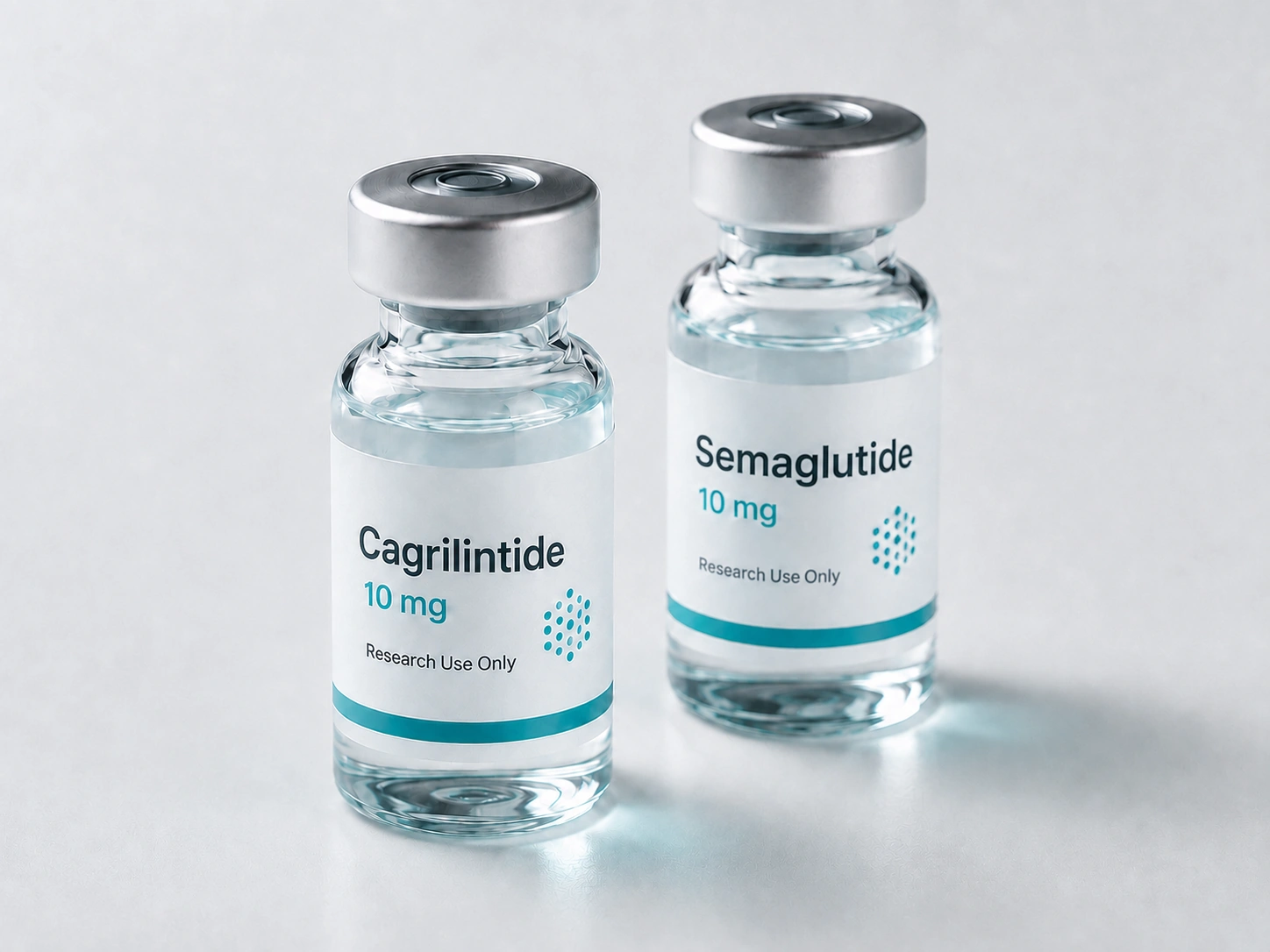
How does each one work?
Cagrilintide
It copies amylin, which your pancreas releases alongside insulin in roughly fixed proportion. Amylin slows stomach emptying and acts on the brainstem to produce fullness. It is closer to a satiety signal than an appetite suppressant, though the practical difference between those is smaller than it sounds.
The engineering is where this gets interesting. Native amylin will not stay in solution, so it cannot be made into a drug directly. Pramlintide solved that in 2005 with three amino acid swaps, and needed two or three injections a day for modest results. Cagrilintide adds a fatty acid, the same approach that made semaglutide weekly, and gets roughly five times the weight loss on a fraction of the injections. [7]
The advance was in delivery, not in biology. Amylin had been a plausible target for twenty years and a difficult one to package.
Semaglutide
It copies GLP-1, the hormone your gut releases after you eat. It slows the stomach, prompts insulin release when blood sugar is high, and acts on appetite centers in the brain. It is a modified version with a fatty acid attached so it binds albumin and lasts about a week.
Why the combination is less than the sum: both slow the stomach, and both act on brain circuits governing intake. Two drugs pulling partly the same lever gain less together than their separate results imply. That is what REDEFINE 1 found. [1]
What does the evidence actually show?
Eloralintide, from Eli Lilly.A selective amylin receptor agonist. Phase 2 produced between 9.5 and 20.1 percent weight loss across doses at 48 weeks, against 0.4 percent on placebo. It went to Phase 3 in December 2025 and is currently the strongest published amylin monotherapy result. [11]
Petrelintide, from Zealand Pharma and Roche.10.7 percent at 42 weeks in 493 adults. Analysts were disappointed by the number, and the tolerability is what stands out: vomiting in 3 percent against 6.2 percent on placebo, and no more people leaving at the top dose than on placebo. [12] For a class where four out of five people report gastrointestinal effects, that is meaningful.
Amycretin, from Novo Nordisk.Instead of combining two drugs it puts GLP-1 and amylin activity into one molecule, in both oral and injectable forms. It is behind the others in development and it is the more elegant version of the CagriSema idea. [13]
Pramlintide, approved since 2005.It is in this list to show the distance traveled: two or three injections a day for roughly 2 to 3 percent weight loss. [7] Cagrilintide is the amylin analog furthest through development, and it is not the best one on the numbers published so far. Reading REDEFINE 1 as amylin underperforming GLP-1 generalizes from the weakest member of a class.
What has nobody answered?
What has nobody answered?
Cagrilintide has never had its own Phase 3 program.Everything known about it as a standalone drug comes from one arm of a trial designed to test the combination, plus an earlier dose-finding study. The dedicated program, RENEW, is only starting. [5]
Nobody knows how much of the weight is fat.REDEFINE 1 reported weight, and the split between fat and lean tissue is the question that matters at losses of this size. It is not the headline figure in the coverage.
The injection site problem has no explanation yet.Reactions occurred in 17 percent on cagrilintide against 2.6 percent on semaglutide, and analysts attributed the combination's rate primarily to the cagrilintide component. [5] Why is not established, and neither is whether a different formulation fixes it.
The amylin analogs have never met in a trial.Eloralintide, petrelintide and cagrilintide have only cross-trial numbers between them, with different lengths and populations. [11][12] And neither compound on this page has finished cardiovascular outcome data: semaglutide's is further along than most of the class and still incomplete, cagrilintide has none.
What are the side effects, and what are you buying?
What are the side effects, and what is approved?
Semaglutide's boxed warning
The strongest warning the FDA issues, and it applies to the whole class.
- Risk of thyroid C-cell tumors. Rodents developed dose-dependent tumors at clinically relevant exposures [8]boxed
- Contraindicated with a personal or family history of medullary thyroid carcinoma, or with MEN 2 [8]contraindicated
- Pancreatitis and gallbladder disease, both reported in trials [8]label
- Whether it causes these tumors in humans is unknown, and no confirmed cases have emergedunknown
From REDEFINE 1
Gastrointestinal effects dominate, as they do across the class.
- Gastrointestinal events in 79.6 percent on the combination against 39.9 on placebo [1]measured
- Nausea, vomiting, diarrhea and constipation, worst during dose escalation [1]measured
- Injection site reactions in 17 percent on cagrilintide against 2.6 percent on semaglutide [5]distinctive
- About 6 percent stopped because of side effects, against 3.7 on placebo [8]measured
Cagrilintide specifically
Nobody has run these studies. That is different from a clean result.
- Cagrilintide in a dedicated Phase 3 program, only now startingnot studied
- The fat and lean tissue split at these levels of weight lossnot studied
- Why the injection site reactions happen, and whether formulation fixes themnot studied
- Any cardiovascular outcome data for cagrilintidenot studied
What you are actually buying
One has three approved products. The other has none.
- Semaglutide is dispensed on prescription as Ozempic, Wegovy or Rybelsusrx only
- Cagrilintide is not approved anywhere, so anything sold under that name is a research chemical [6]research use
- Testing of seized peptides found purity between 5 and 75 percent, plus arsenic and lead [14]analysis
- One US lab reported problems in almost 30 percent of samples, including bacteria [15]testing
*Where this page says nothing is established, it means nobody has studied it. It does not mean a compound is safe.
The boxed warning deserves a moment in both directions. It exists because rodents given GLP-1 drugs developed thyroid C-cell tumors in a dose-dependent way, and rodents carry far more of the relevant receptors on those cells than people do. Whether it happens in humans is unknown, and no confirmed cases have come out of the trial programs. [8] Cagrilintide is a different mechanism and does not obviously inherit that particular question. What it does inherit is everything else about being unapproved: no label, no verified dose, no manufacturing standard, and nobody watching. Our guide on reading a certificate of analysis covers what to look for in a research vial.
Are they banned in sport, and are they FDA approved?
What is the regulatory position?
Sport. Neither cagrilintide nor semaglutide is named on the 2026 WADA Prohibited List. Weight class sports are where this could matter, since rapid weight loss has obvious competitive relevance, and WADA states that absence from the list does not mean a substance is permitted. The larger risk for an athlete is the same as everywhere else here: an unapproved compound bought online can contain something the label never mentioned. If you compete under a testing body, ask that body directly.
Semaglutide is approved three times over. As Ozempic for type 2 diabetes, as Wegovy for chronic weight management, and as Rybelsus in tablet form. All are manufactured products dispensed on prescription, with labels, contraindications and post-approval monitoring.
Cagrilintide is not approved anywhere. Not on its own and not in the combination. CagriSema has been submitted for review, and cagrilintide as a standalone drug is only now entering its own dedicated Phase 3 program. [5][6] Approval for a combination product would not automatically make cagrilintide available on its own, since regulators approve products, not molecules. Every vial sold under that name today is a research chemical, with no label and no verified contents.
Questions people ask
Which one produces more weight loss?
Semaglutide, in adults with obesity and without diabetes. 16.1 percent against 11.8 over 68 weeks in the same trial. In people with type 2 diabetes an earlier and shorter trial found the opposite order.
Is the combination better than either alone?
Yes, and by less than adding them together suggests. 22.7 percent against 16.1 for semaglutide alone and 11.8 for cagrilintide alone. The two mechanisms overlap, and both slow the stomach.
Is cagrilintide FDA approved?
No, not anywhere, alone or in combination. The combination is under review and cagrilintide's own Phase 3 program is only starting.
What is the difference between amylin and GLP-1?
Amylin comes from the pancreas alongside insulin and produces fullness. GLP-1 comes from the gut after eating and reduces appetite. Both slow stomach emptying. That is where they overlap.
Does this mean amylin drugs are weaker than GLP-1?
No, and REDEFINE 1 does not support that reading. Lilly's amylin analog eloralintide produced up to 20.1 percent on its own in Phase 2, above semaglutide's 16.1 in the same comparison. Different trials, so treat it carefully. What the trial showed is that semaglutide beat this amylin analog.
Why do so many people get injection site reactions on cagrilintide?
Nobody has explained it. Reactions occurred in 17 percent on cagrilintide against 2.6 percent on semaglutide, and analysts attributed the combination's rate mainly to the cagrilintide component.
How is cagrilintide different from pramlintide?
Same target, different engineering. Pramlintide needs two or three injections a day and produces about 2 to 3 percent weight loss. Cagrilintide has a fatty acid attached that stretches its half-life to about a week, and produces around 11 percent.
Why did people call the CagriSema result disappointing?
Because Novo's head of development had publicly forecast 25 percent and the trial produced 22.7. The trial met its primary endpoint and beat both single drugs. Shares still fell around 20 percent, taking roughly 72 billion dollars off the company's value.
Has CagriSema been compared to tirzepatide?
Yes, in REDEFINE 4 in 2026, open-label. It produced about 23 percent at 84 weeks against tirzepatide's 25.5 percent and did not meet non-inferiority.
Can I buy cagrilintide legally?
Not as an approved medicine, because there is no approved product anywhere. What is sold online is a research chemical.
What this page is built on
- 01Coadministered cagrilintide and semaglutide in adults with overweight or obesity: the REDEFINE 1 randomized trial. N Engl J Med. Published 22 June 2025. PMID 40544433. Trial NCT05567796. Human Phase 3a. 3,417 adults with obesity or overweight plus at least one comorbidity, without type 2 diabetes. Trial product estimand at week 68: CagriSema 22.7 percent, semaglutide 16.1, cagrilintide 11.8, placebo 2.3. Treatment policy estimand: CagriSema 20.4 percent. Gastrointestinal adverse events 79.6 percent against 39.9 on placebo.
- 02REDEFINE 2. Human Phase 3 in 1,206 adults with overweight or obesity and type 2 diabetes. CagriSema produced 13.7 percent weight loss at 68 weeks against 3.4 on placebo, and 73.5 percent reached HbA1c of 6.5 or below against 15.9 percent.
- 03Cagrilintide dose-finding trial. Human multicenter, randomized, placebo and active controlled. Doses 0.3 to 4.5 mg weekly. The 4.5 mg dose produced about 10.8 percent weight loss at 26 weeks against 3.0 percent on placebo and 9.0 percent on liraglutide 3.0 mg.
- 04Frias JP, et al. Cagrilintide plus semaglutide in adults with type 2 diabetes and overweight or obesity. 2023. Human Phase 2, 32 weeks. CagriSema 15.6 percent weight loss, cagrilintide alone 8.1, semaglutide alone 5.1. Note the reversed order between the two single agents relative to REDEFINE 1.
- 05Cagrilintide monotherapy sub-analysis presented at the European Association for the Study of Diabetes congress, 2025. First late-stage standalone data for cagrilintide. 11.8 percent weight loss at 68 weeks against 2.3 on placebo. Injection site reactions in 17 percent on cagrilintide against 2.6 percent on semaglutide. A dedicated Phase 3 program, RENEW, was announced.
- 06Regulatory status. Cagrilintide is not approved in any country, alone or in combination. CagriSema has been submitted for FDA review. Semaglutide is approved as Ozempic, Wegovy and Rybelsus.
- 07Pramlintide and the amylin engineering problem. Pramlintide, approved 2005, uses three amino acid substitutions to keep amylin soluble and requires two to three daily injections before meals for roughly 2 to 3 percent weight loss. Cagrilintide uses fatty acid acylation for albumin binding and a seven day half-life.
- 08Semaglutide prescribing information, Wegovy and Ozempic. Novo Nordisk. FDA labels. Boxed warning for risk of thyroid C-cell tumors, based on rodent studies. Contraindicated with a personal or family history of medullary thyroid carcinoma or with MEN 2. Warnings include pancreatitis and gallbladder disease.
- 09Market response to REDEFINE 1, December 2024. Novo Nordisk's head of development had publicly forecast about 25 percent ahead of the readout. The trial produced 22.7 percent and met its primary endpoint. Shares fell approximately 20 percent, removing roughly 72 billion dollars of market value. Context rather than clinical evidence.
- 10REDEFINE 4, February 2026. Open-label Phase 3 head-to-head against tirzepatide. CagriSema produced about 23 percent weight loss at 84 weeks against 25.5 percent for tirzepatide, and did not meet its non-inferiority endpoint.
- 11Eloralintide Phase 2 results, Eli Lilly, December 2025. Human Phase 2, 48 weeks. Weight loss of 9.5 to 20.1 percent across doses against 0.4 percent on placebo. Advanced to Phase 3. Currently the strongest published amylin monotherapy result.
- 12Petrelintide ZUPREME-1 Phase 2, Zealand Pharma and Roche, March 2026. Human Phase 2, 493 adults, 42 weeks. 10.7 percent mean weight loss at the top dose against 1.7 percent on placebo. Vomiting in 3 percent against 6.2 percent on placebo.
- 13Amycretin, Novo Nordisk. A single molecule activating both GLP-1 and amylin receptors, in oral and injectable forms. Phase 1b/2a data reported, advancing toward Phase 3.
- 14Janvier S, Cheyns K, Canfyn M, Goscinny S, De Spiegeleer B, Vanhee C, Deconinck E. Impurity profiling of the most frequently encountered falsified polypeptide drugs on the Belgian market. Talanta. 2018;188:795-807. Peer-reviewed analytical study. Purity 5 to 75 percent, plus arsenic and lead.
- 15NBC Washington. Lab finds problems in 30% of peptide vials tested. December 2024. News report of commercial laboratory testing, not peer reviewed.