
Retatrutide vs Tirzepatide
Tirzepatide is approved and hits two receptors. Retatrutide adds a third and produced the largest weight loss result any obesity drug has reported, 28.3 percent at 80 weeks. That figure comes from a trial against placebo, published in September 2026. The comparison everyone is drawing sits between two separate trials of different lengths. And retatrutide is not approved anywhere.
- Weight loss
- One is approved
- No head to head trial exists
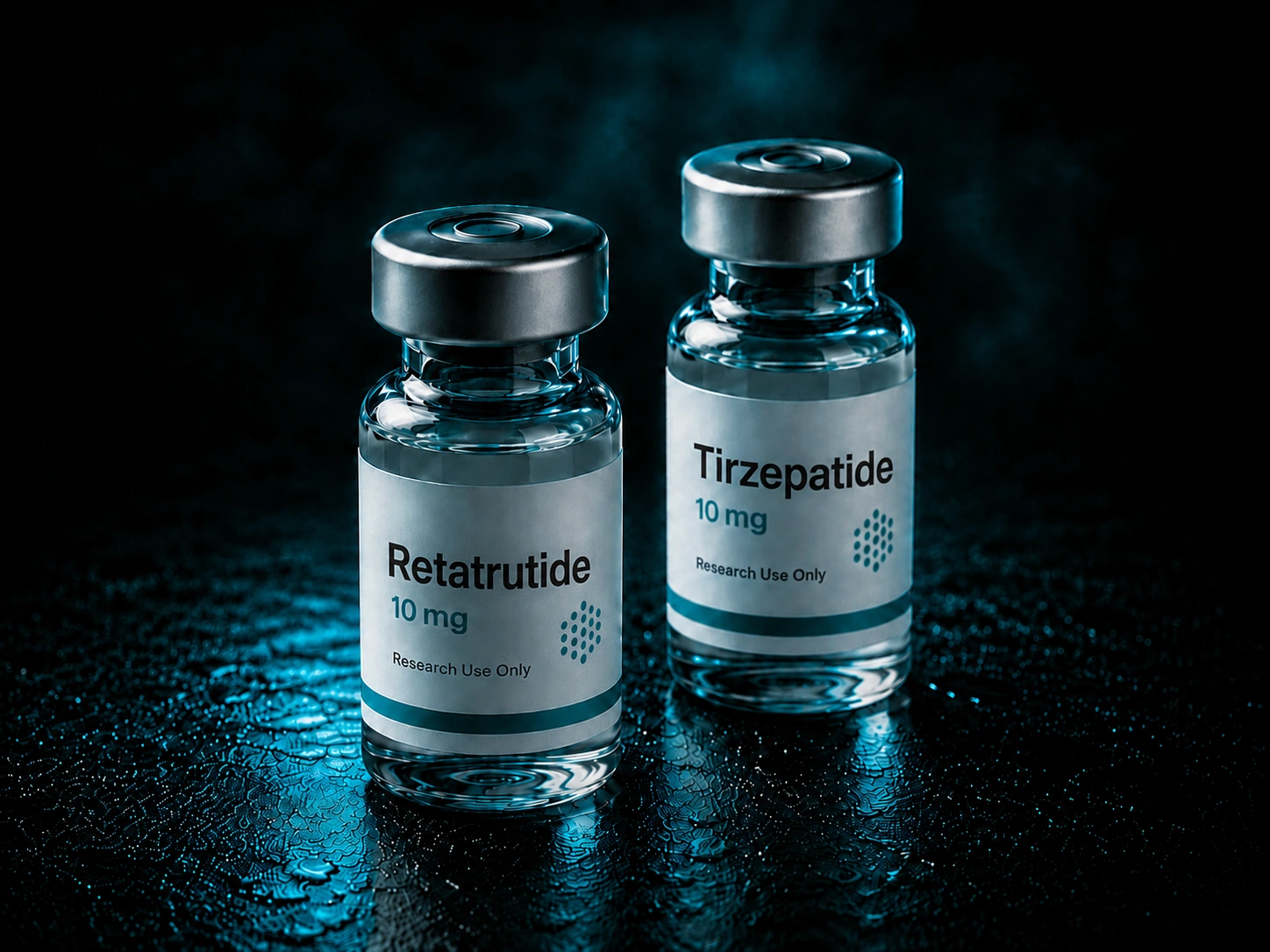
Have these two ever been tested against each other?
One has a label and a paper. The other has a bigger number and neither.
| Attribute | Retatrutide | Tirzepatide |
|---|---|---|
| Receptors | Three: GLP-1, GIP, glucagon | Two: GLP-1, GIP |
| FDA status | Not approved [6] | Approved, as Mounjaro and Zepbound |
| Headline weight loss | 28.3 percent at 80 weeks [1] | 22.5 percent at 72 weeks [4] |
| Evidence type | Placebo-controlled Phase 3, NEJM 2026 [1] | Placebo-controlled Phase 3, NEJM 2022 [4] |
| Head to head trials | None [2] | None [2] |
| Boxed warning | None, because there is no label | Yes, for thyroid C-cell tumors [9] |
| How people get it | Research chemical | Prescription |
The two headline figures come from separate trials of different lengths.
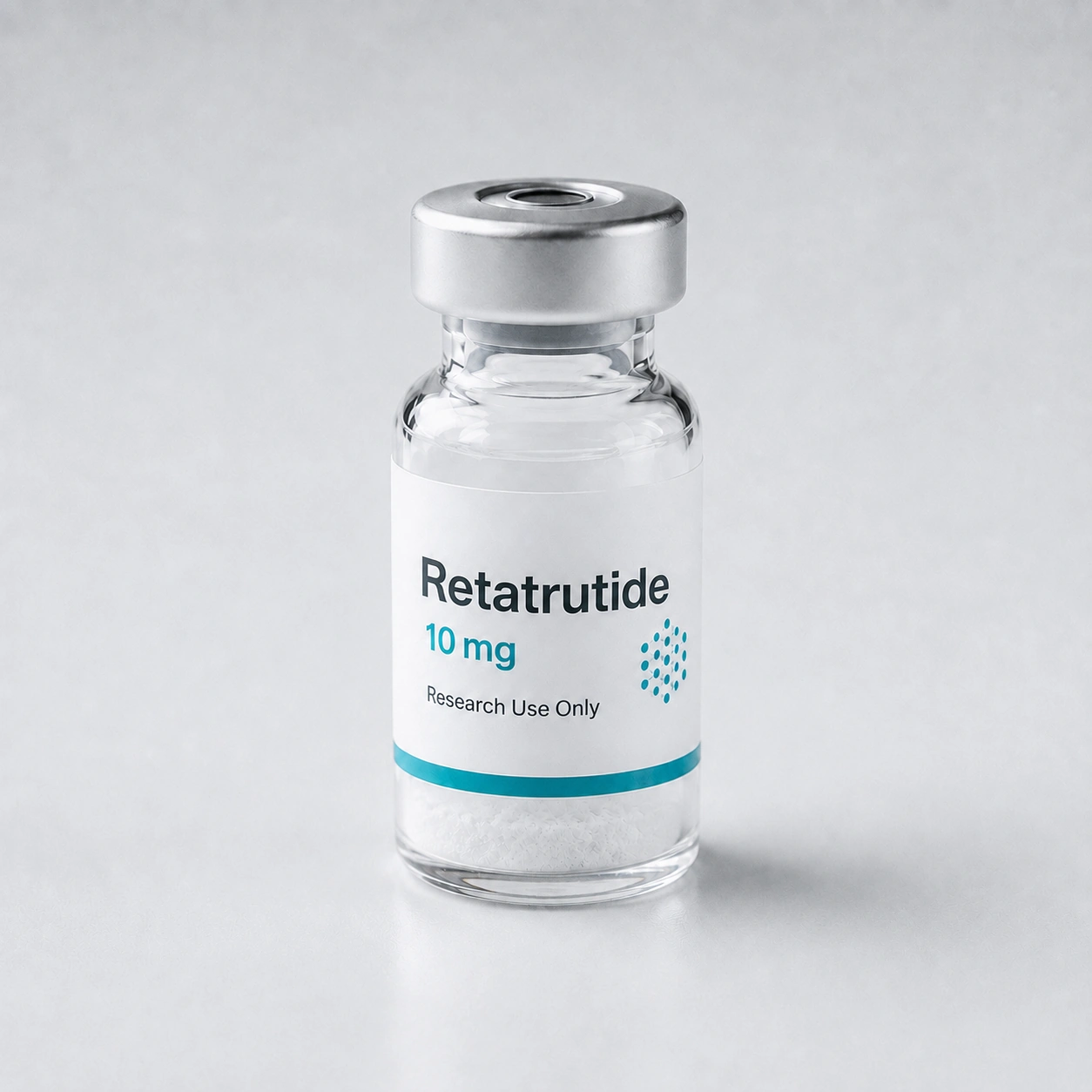
Retatrutide
A synthetic peptide that activates three hormone receptors at once: GLP-1 and GIP, which reduce appetite and steady blood sugar, plus glucagon, which raises the rate at which your body burns energy. In plain terms: the drug that adds a third lever to the two tirzepatide already pulls.
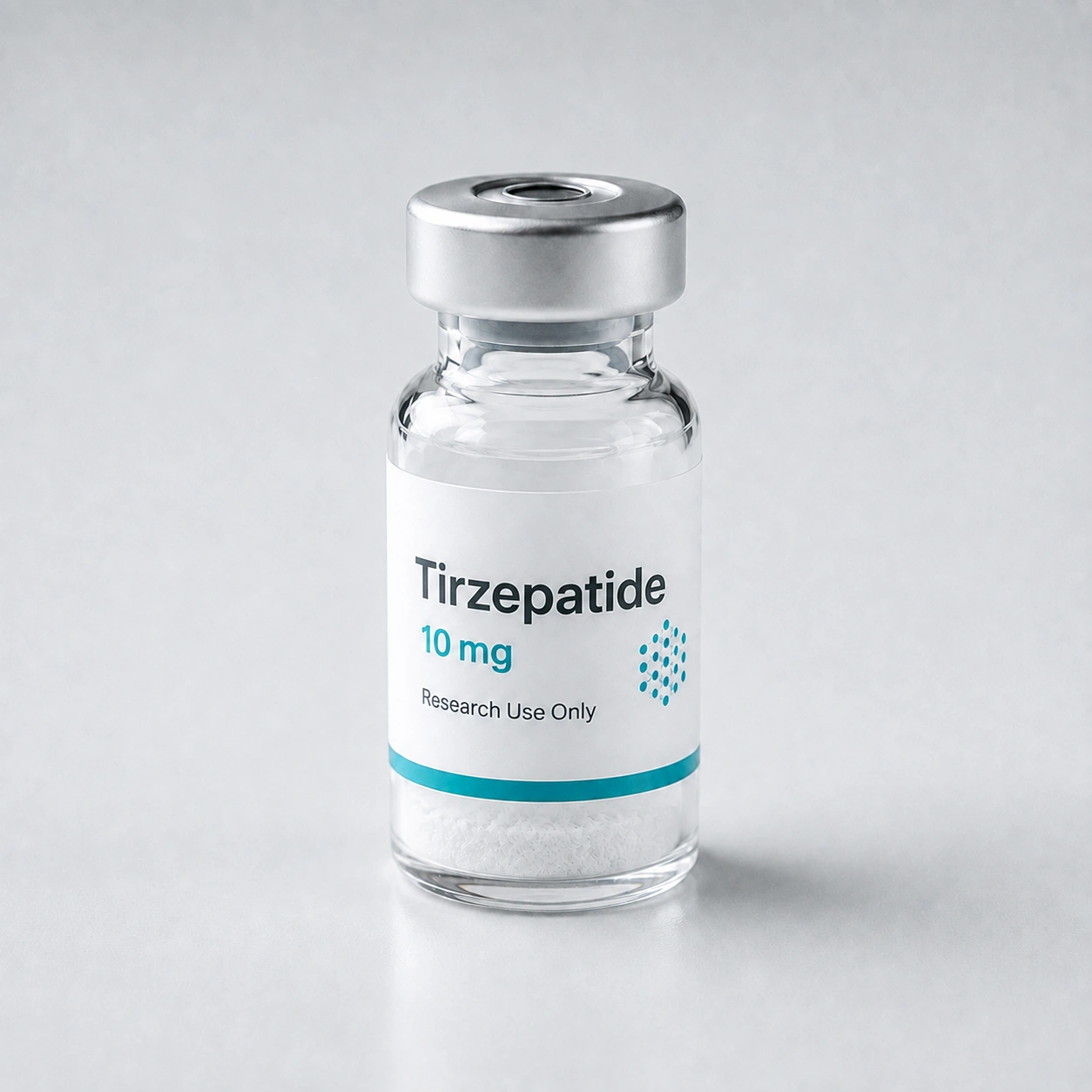
Tirzepatide
A synthetic peptide activating GLP-1 and GIP. Approved as Mounjaro for type 2 diabetes and as Zepbound for weight management. In plain terms: the current benchmark, with a full published trial program and a label.
Does the comparison everyone is making actually exist?
The figure traveling around is 28.3 against 22.5. It looks like a head to head result and it is not. Retatrutide's 28.3 percent comes from TRIUMPH-1, running 80 weeks in adults with obesity and at least one weight-related condition, without diabetes. [1] Tirzepatide's 22.5 percent comes from SURMOUNT-1, running 72 weeks in a similar but separately recruited population. [4] Different trials, eight weeks apart in duration, different sites, different years, different people.
There are two numbers for tirzepatide, both correct. SURMOUNT-1 reports 20.9 percent and 22.5 percent from the same data. The difference is how each treats people who stopped taking the drug. One counts everyone as randomized, the other reflects the effect among those still taking it. Whichever number a comparison uses shifts the gap by a point and a half, and most pages pick one without saying which.
The numbers now have a paper behind them. TRIUMPH-1 was announced by press release on 21 May 2026 and published in full in September 2026. That settles the figures coverage disagreed on: 2,339 participants, doses of 4, 9 and 12 milligrams, 19.0 percent at the lowest dose, and discontinuation for adverse events of 4.1 to 11.3 percent by dose. [1] What it does not settle is the comparison, because the trial was against placebo.
How do they compare, side by side?
How do they compare, side by side?
| Attribute | Retatrutide | Tirzepatide |
|---|---|---|
| Also called | LY3437943 | Mounjaro, Zepbound, LY3298176 |
| Receptors | GLP-1, GIP, glucagon | GLP-1, GIP |
| Dosing | Once weekly, subcutaneous | Once weekly, subcutaneous |
| Approved | No, anywhere | Yes, for type 2 diabetes and weight management |
| Pivotal trial | TRIUMPH-1, 80 weeks [1] | SURMOUNT-1, 72 weeks [4] |
| Headline result | 28.3 percent at the top dose [1] | 22.5 percent at 15 mg, or 20.9 percent depending on the estimand [4] |
| Published | Yes, New England Journal of Medicine, September 2026 [1] | Yes, New England Journal of Medicine, PMID 35658024 [4] |
| Nausea | About 41 percent at the top dose against about 8 percent on placebo [1] | Reported, dose dependent |
| Discontinuation | Reported between about 6 and 14 percent, sources conflict [1] | About 6 percent in SURMOUNT-1 [4] |
| A distinctive effect | Dysesthesia, altered skin sensation [3] | Not reported |
| Heart rate | Up about 3 to 4 beats per minute at the top dose [1] | Small increase reported |
| Boxed warning | None yet, because there is no label | Thyroid C-cell tumors [9] |
| Hard contraindications | None published | Personal or family history of MTC, or MEN 2 [9] |
| Dose range | Reported as 4, 8 or 9, and 12 mg [1] | 2.5 to 15 mg, titrated upward [9] |
| How people obtain it | Research chemical, sold online | Prescription, and compounded in some settings |
What does the evidence actually show?
Why is the most quoted number in obesity medicine still not a head to head?
SURMOUNT-1 is published
72 weeks, adults with obesity and without diabetes, published in the New England Journal of Medicine. The 15 milligram dose produced 22.5 percent weight loss by one measure and 20.9 percent by another, both against placebo. Discontinuation for adverse events was about 6 percent. [4]
Approved twice
The FDA approves tirzepatide as Mounjaro for type 2 diabetes and as Zepbound for chronic weight management. It becomes the benchmark every later drug is measured against.
Phase 2 results
Weight loss beyond anything a dual agonist had produced, prompting the Phase 3 program. Gastrointestinal effects dominate, and nausea reaches about 45 percent at higher doses during escalation. [5]
TRIUMPH-4
28.7 percent weight loss at 68 weeks in adults with obesity and knee osteoarthritis. [1]
TRANSCEND-T2D-1
In type 2 diabetes: HbA1c down 1.7 to 2.0 percentage points and weight down 11.5 to 16.8 percent. Less weight loss than in the obesity trials, which is the usual pattern when these drugs are tested in diabetes. [1]
TRIUMPH-1, by press release
28.3 percent mean weight loss at the top dose over 80 weeks. All doses met their primary and key secondary endpoints. Around 45 percent of top dose participants lost 30 percent or more of their body weight. [1]
TRIUMPH-1, in print
The full results are published in the New England Journal of Medicine. The trial compared retatrutide with placebo, not with tirzepatide. [1]
Where this leaves them
Tirzepatide is prescribed. Retatrutide is not approved, Lilly plans to file for approval in early 2027, and it is being sold online as a research chemical in the meantime.
None of this means the result is wrong. Lilly has run three positive Phase 3 readouts and the effect size is consistent across them. It means the number is being treated as more settled than it currently is, and that the comparison against tirzepatide is being drawn between a published trial and a summary.
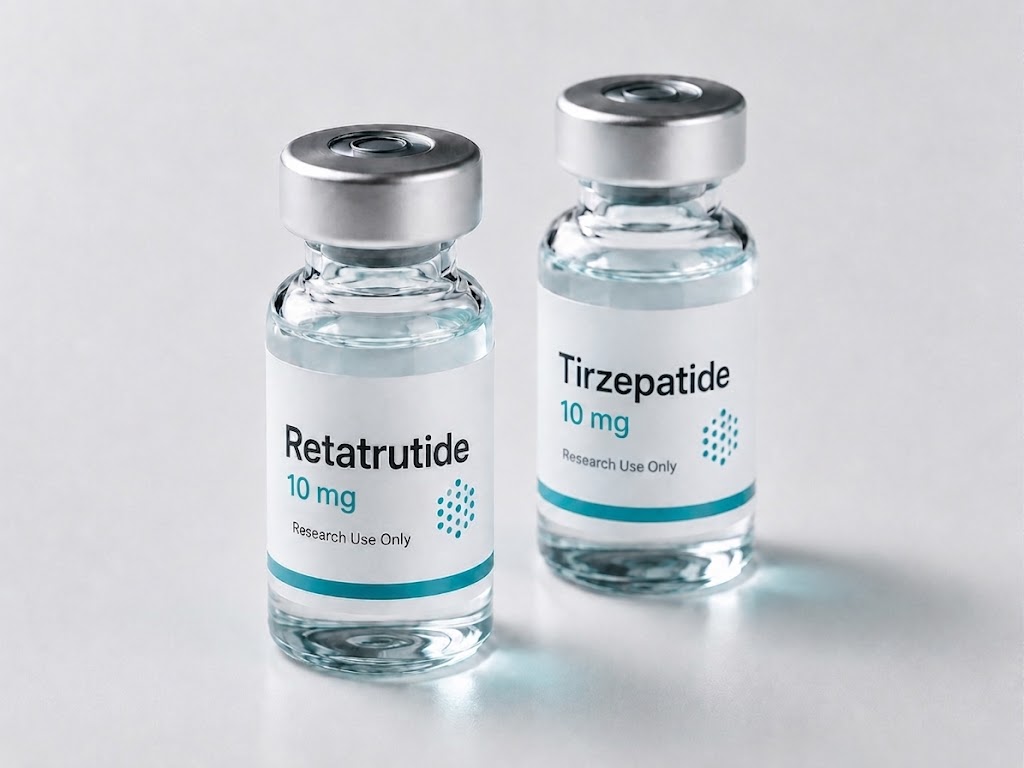
How do two receptors reduce what goes in while a third raises what goes out?
Retatrutide
It adds a third target, the glucagon receptor. Glucagon is usually discussed as the hormone that raises blood sugar, and it also increases energy expenditure and the breakdown of fat. So retatrutide works on intake and on output at the same time, and the extra weight loss is thought to come from that second half.
Adding a glucagon receptor agonist to a drug for metabolic disease is not obviously a good idea, since glucagon raises blood sugar. The reasoning is that the GLP-1 and GIP components more than offset it, and the diabetes trial supports that, with HbA1c falling substantially. [1]
It may also explain the side effects. The heart rate increase of roughly 3 to 4 beats per minute at the top dose is attributed to glucagon receptor activation. So is the drug's most distinctive finding: dysesthesia, meaning altered or unpleasant skin sensation. Neither semaglutide nor tirzepatide reports this. [3]
Tirzepatide
It activates GLP-1 and GIP receptors. GLP-1 slows stomach emptying and reduces appetite, and GIP appears to add to that while helping with how the body handles glucose and fat.
Working together, they mostly reduce how much you eat. So the two drugs are not doing more and less of the same thing. Tirzepatide works mainly on intake.
The third receptor is the entire difference between them, and it is the one part of retatrutide that has no long published track record behind it.
What has nobody answered?
Which four gaps has nobody answered?
Nobody has compared them.No randomized trial has put retatrutide against tirzepatide or against semaglutide. [2] Every comparison in circulation, including the one in this page's title, is built from separate trials with different lengths, sites and participants.
The head to head has not reported.TRIUMPH-5 is registered to compare retatrutide with tirzepatide directly. Until it reports, every comparison on this page is between separate trials.
The split between fat and muscle is unreported.The split between fat and lean tissue at the top dose is not reported in the published trial, nor in Lilly's results announcements. For a drug producing losses of this size, that is not a detail.
Nobody knows whether retatrutide will carry the same boxed warning.It targets the same receptors as tirzepatide, so the thyroid question applies to it too, and the answer will come with the label, not before it. [9] Neither compound has finished cardiovascular outcome data either. Weight is a measurement, not an outcome.
What are the side effects, and what are you buying?
Which has a label, and which has a trial paper and an online market?
Tirzepatide's boxed warning
The strongest warning the FDA issues, and it is on the approved drug.
- Risk of thyroid C-cell tumors. In rats, dose-dependent and duration-dependent at clinically relevant exposures [9]boxed
- Contraindicated with a personal or family history of medullary thyroid carcinoma, or with MEN 2 [9]contraindicated
- Acute pancreatitis and acute gallbladder disease, both reported in trials [9]label
- Whether it causes these tumors in humans is unknownunknown
From the trials
Gastrointestinal effects dominate for both, and are dose dependent.
- Nausea, about 41 percent at retatrutide's top dose against about 8 percent on placebo [1]measured
- Vomiting, diarrhea, constipation and abdominal pain, most pronounced during escalation [5][9]measured
- Hair loss, listed among tirzepatide's common adverse events and rarely mentioned in coverage [9]label
- Dysesthesia, in up to 12.5 percent on retatrutide against 0.9 percent on placebo [3]distinctive
Numbers that now agree
Coverage disagreed on these until the full TRIUMPH-1 results were released.
- Enrollment: 2,339 adults, randomized equally to 4 mg, 9 mg, 12 mg or placebo [1]confirmed
- Doses: 4, 9 and 12 mg. The 8 mg figure in some coverage was a Phase 2 dose [1]confirmed
- Lowest dose: 19.0 percent at 4 mg, or 17.6 percent counting everyone randomized [1]confirmed
- Discontinuation for adverse events: 4.1, 6.9 and 11.3 percent by dose, against 4.9 percent on placebo [1]confirmed
What you are actually buying
This is the sharpest practical difference on the page.
- Tirzepatide is dispensed on prescription as Mounjaro or Zepboundrx only
- Retatrutide is not approved anywhere and what is sold online is a research chemical [6]research use
- Testing of seized peptides found purity between 5 and 75 percent, plus arsenic and lead [7]analysis
- One US lab reported problems in almost 30 percent of samples, including bacteria [8]testing
For what independent tests found in retatrutide sold online, see the retatrutide buying guide.
*Where this page says nothing is established, it means nobody has studied it. It does not mean a compound is safe.
The boxed warning needs context in both directions. It exists because rats given tirzepatide developed thyroid C-cell tumors in a dose-dependent way, and rodents are unusually susceptible here, carrying far more GLP-1 receptors on those cells than humans do. Across the SURMOUNT program, more than 5,000 people treated for up to 72 weeks produced no confirmed cases of medullary thyroid carcinoma. [9] So the warning is real, animal-derived, and so far unmatched by any human case. Retatrutide is in the same class, and if it is approved it will very likely carry the same warning. Nobody buying it as a research chemical today gets a boxed warning, a contraindication check or a prescriber asking about thyroid cancer in the family. Our guide on reading a certificate of analysis covers what to look for in a research vial.
Are they banned in sport, and are they FDA approved?
Which is approved twice, and which is not approved at all?
Sport. Neither retatrutide nor tirzepatide is named on the 2026 WADA Prohibited List. Weight class sports are the place this could matter, since rapid weight loss has obvious competitive relevance, and WADA states that absence from the list does not mean a substance is permitted. The larger risk for an athlete is the same as everywhere else in this library: an unapproved drug bought online can contain something the label never mentioned. If you compete under a testing body, ask that body directly.
Tirzepatide is approved. As Mounjaro for type 2 diabetes and as Zepbound for chronic weight management in adults meeting the criteria. Both are manufactured products dispensed on prescription, with labels, monitoring guidance and a system watching for problems after approval.
Retatrutide is not approved anywhere. It is investigational. Sources disagree on where the application stands, with some reporting a filing in June 2026 and others saying no filing date has been announced, so treat any specific approval timeline as an estimate. Estimates in circulation run from late 2026 to 2028. [6] Every vial sold under that name is a research chemical, with no label, no verified dose, no manufacturing standard and nobody monitoring outcomes. That gap is larger than any number in the trials.
Questions people ask
Is retatrutide better than tirzepatide?
Its headline number is larger, 28.3 percent against 22.5. Those come from separate trials of different lengths in separately recruited populations, and nobody has compared the two directly. Suggestive, then, but not a result.
Is retatrutide FDA approved?
No, not anywhere. It is investigational, and Lilly has said it plans to file for approval in the first quarter of 2027.
Why do different sites give different retatrutide numbers?
Mostly because coverage ran ahead of the full results, and because Lilly reports two sets of figures. Assuming everyone stayed on treatment, the top dose produced 28.3 percent. Counting everyone randomized, it was 25.0 percent. The full TRIUMPH-1 results are now published, so the trial's own figures settle the rest.
What does the third receptor actually do?
Glucagon increases energy expenditure and fat breakdown. GLP-1 and GIP mostly reduce how much you eat. So retatrutide works on both sides of the equation and tirzepatide works mainly on one.
Is dysesthesia a real concern?
It is a real reported finding, meaning altered or unpleasant skin sensation. In TRIUMPH-1 it affected 5.1 to 12.5 percent of participants depending on dose, against 0.9 percent on placebo, and most cases were mild to moderate and resolved during treatment. The Wegovy label lists it too, at a much lower rate.
Can I get retatrutide legally?
Not as an approved medicine, because there is no approved product. What is sold online is a research chemical with no label and no verified contents.
Does tirzepatide cause thyroid cancer?
Its label carries a boxed warning because rats developed thyroid C-cell tumors in a dose-dependent way. Whether it does the same in humans is unknown, and more than 5,000 people across the SURMOUNT trials produced no confirmed cases over up to 72 weeks. Rodents carry far more of the relevant receptors on those cells than people do. It is contraindicated with a personal or family history of medullary thyroid carcinoma or with MEN 2.
Will retatrutide carry the same warning?
Probably, since it acts on the same receptors, and the answer will arrive with its label. Anyone buying it now as a research chemical is taking a same-class drug with no label, no contraindication check and nobody asking about their family's thyroid history.
How much of the weight loss is fat?
Not reported in the published trial, nor in Lilly's results announcements. The split between fat and lean mass is the number to look for in any supplementary analysis or later publication.
What this page is built on
- 01TRIUMPH-1, NCT05929066. Topline results announced by Eli Lilly and Company, 21 May 2026; full results published in the New England Journal of Medicine, September 2026. Phase 3, 80 weeks, 2,339 adults with obesity or overweight plus at least one weight-related condition, without diabetes, randomized equally to retatrutide 4 mg, 9 mg or 12 mg or placebo. Mean weight loss 19.0, 25.9 and 28.3 percent by dose against 2.2 percent on placebo on the efficacy estimand, and 17.6, 23.7 and 25.0 percent against 3.9 percent on the treatment-regimen estimand. Discontinuation for adverse events 4.1, 6.9 and 11.3 percent against 4.9 percent. Figures as reported in the published trial: Jastreboff AM, Kaplan LM, Davies MJ, et al. Retatrutide, a Triple Hormone Receptor Agonist, for Treatment of Obesity. New England Journal of Medicine, published online 29 September 2026. DOI 10.1056/NEJMoa2604169. Body composition: the published paper and its supplementary appendix do not report a fat and lean mass split; the only body-shape measure reported is waist circumference. The full text was read from a copy hosted outside the journal's own site, and the journal's own summary also does not mention body composition.
- 02Absence of head to head data. Retatrutide has not been compared against tirzepatide or semaglutide in any randomized trial. All published comparisons are cross-trial, with different durations, populations and primary endpoints.
- 03Dysesthesia in the retatrutide program. Jastreboff AM, Kaplan LM, Davies MJ, et al. Retatrutide, a Triple Hormone Receptor Agonist, for Treatment of Obesity. N Engl J Med, published online 29 September 2026. DOI 10.1056/NEJMoa2604169. TRIUMPH-1. In TRIUMPH-1, 5.1, 12.3 and 12.5 percent by dose against 0.9 percent on placebo, generally mild to moderate, with most cases resolving during treatment. In TRIUMPH-4, 8.8 percent at 9 mg and 20.9 percent at 12 mg against 0.7 percent on placebo; that is a Lilly topline figure, not yet a published one. The Wegovy label lists dysesthesia among adverse reactions at a much lower rate.
- 04Jastreboff AM, Aronne LJ, Ahmad NN, et al. Tirzepatide once weekly for the treatment of obesity. N Engl J Med. 2022;387(3):205-216. PMID 35658024. SURMOUNT-1. Human Phase 3, 72 weeks. The 15 mg dose produced 22.5 percent weight loss on the efficacy estimand and 20.9 percent on the treatment-regimen estimand. Discontinuation for adverse events about 6 percent. The two figures differ in how they handle participants who stopped treatment, and both are correct.
- 05Retatrutide Phase 2 results, 2023. Human Phase 2. Gastrointestinal effects dominant and dose dependent, with nausea up to about 45 percent at higher doses during escalation.
- 06Retatrutide regulatory status. Not approved in any country at the time of writing. Sources disagree on whether an FDA application has been filed, with some reporting a June 2026 filing and others stating no filing date has been announced. Approval estimates in circulation range from late 2026 to 2028.
- 07Janvier S, Cheyns K, Canfyn M, Goscinny S, De Spiegeleer B, Vanhee C, Deconinck E. Impurity profiling of the most frequently encountered falsified polypeptide drugs on the Belgian market. Talanta. 2018;188:795-807. Peer-reviewed analytical study. Purity 5 to 75 percent, plus arsenic and lead.
- 08NBC Washington. Lab finds problems in 30% of peptide vials tested. December 2024. News report of commercial laboratory testing, not peer reviewed.
- 09ZEPBOUND (tirzepatide) injection prescribing information. Initial US approval 2022. Eli Lilly. FDA label. Boxed warning: risk of thyroid C-cell tumors. Contraindicated in patients with a personal or family history of MTC or with MEN 2. Warnings include acute pancreatitis and acute gallbladder disease. Doses of 2.5 to 15 mg, titrated upward. Across the SURMOUNT program, more than 5,000 participants treated for up to 72 weeks produced no confirmed cases of MTC.