
GLP-1 agonists
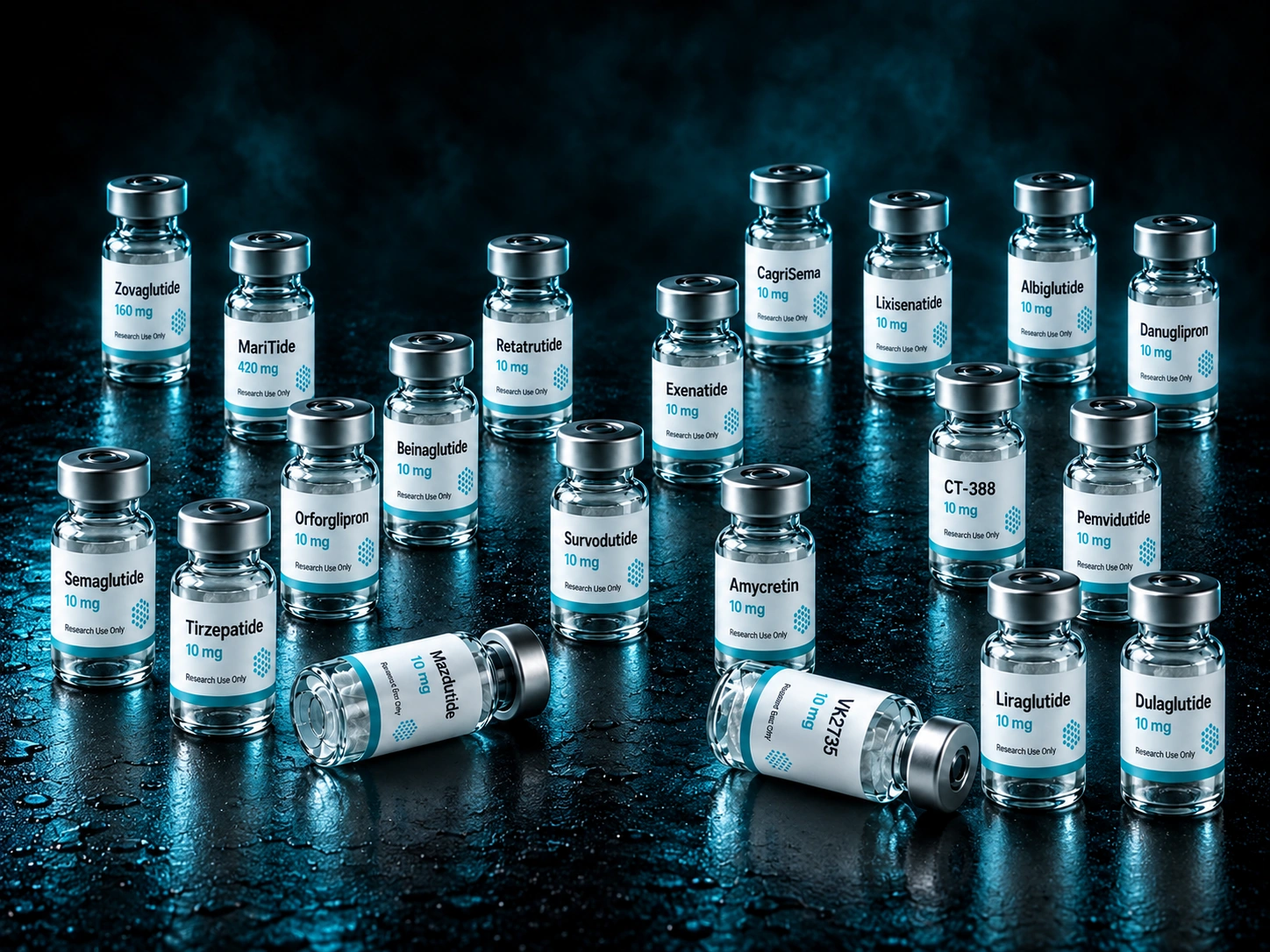
Twenty compounds, one receptor. Eight are FDA approved. Most of the figures cited for the rest come from trial protocols, not drug labels. That distinction is what this page is built on.
- GLP-1 receptor
- 8 approved · 9 in trials · 3 discontinued
- Weight loss and metabolic
Do more receptors mean more weight loss — and more side effects?
Every compound in this class works by binding the GLP-1 receptor. What separates them is what else they bind, and whether a regulator has reviewed the dose.
Semaglutide
One receptor. A lab-made copy of GLP-1, a hormone your gut releases after eating. The drug in Ozempic and Wegovy. More human evidence behind it than anything else in the class.
Retatrutide
Three receptors: GLP-1, GIP, and glucagon. The trial numbers are the largest published in this class. The drug has no legal route outside a clinical trial.
What does each added receptor change about what the drug can do?
Adding GIP shifts fat metabolism. Adding glucagon pushes the body to burn more energy alongside eating less. The weight loss figures in trials have followed each addition upward.
agonists
Semaglutide · Liraglutide · Lixisenatide · Albiglutide · Exenatide · Orforglipron · Dulaglutide · Beinaglutide · Zovaglutide
agonists
Tirzepatide · VK2735 · CT-388
Also GLP-1 + glucagon: Survodutide · Pemvidutide · Mazdutide
agonists
Retatrutide
How do they compare, side by side?
Where does each dose come from?
| Compound | Receptors | Status | Dose | Dose source | Route | Cycling |
|---|---|---|---|---|---|---|
| SemaglutideOzempic / Wegovy | GLP-1 | FDA approved | 0.25 up to 2.4 mg/wk | FDA label | Injection weekly or pill | Not cycled[3] |
| TirzepatideMounjaro / Zepbound | GLP-1, GIP | FDA approved | 2.5 up to 15 mg/wk | FDA label | Injection weekly | Not cycled[4] |
| LiraglutideSaxenda / Victoza | GLP-1 | FDA approved | 0.6 up to 3 mg/day | FDA label | Injection daily | Not cycled[5] |
| DulaglutideTrulicity | GLP-1 | FDA approved | 0.75 up to 4.5 mg/wk | FDA label | Injection weekly | Continuous[6] |
| ExenatideByetta / Bydureon | GLP-1 | FDA approved | 2 mg/wk (weekly form) | FDA label | Injection weekly | Continuous[7] |
| OrforglipronFoundayo | GLP-1 | FDA approved | 0.8 up to 17.2 mg/day | FDA label | Pill, daily | Not cycled[8] |
| Retatrutide | GLP-1, GIP, glucagon | Investigational | 1 up to 12 mg/wk | Trial dose | Injection weekly | Not cycled in trials[2] |
| Survodutide | GLP-1, glucagon | Investigational | 2.4 up to 6 mg/wk | Trial dose | Injection weekly | Not cycled in trials |
| Mazdutide | GLP-1, glucagon | Investigational | 2 up to 9 mg/wk | Trial dose | Injection weekly | Not cycled in trials |
| Amycretin | GLP-1, amylin | Investigational | 0.3 up to 60 mg/wk | Trial dose | Injection or pill | Not cycled in trials |
| VK2735 | GLP-1, GIP | Investigational | 2.5 up to 15 mg/wk | Trial dose | Injection or pill | Not cycled in trials |
| CagriSema | GLP-1 + amylin | Investigational | 2.4 mg/wk | Trial dose | Injection weekly | Not cycled in trials |
| MariTide | GLP-1, GIP (antibody conjugate) | Investigational | 140 up to 420 mg/mo | Trial dose | Injection monthly | Not cycled in trials |
| CT-388 | GLP-1, GIP | Investigational | 4 up to 24 mg/wk | Trial dose | Injection weekly | Not cycled in trials |
| Pemvidutide | GLP-1, glucagon | Investigational | 1.2 up to 2.4 mg/wk | Trial dose | Injection weekly | Not cycled in trials |
| Zovaglutide | GLP-1 | Investigational | 80 up to 160 mg/mo | Trial dose | Injection monthly | Not cycled in trials |
| Beinaglutide | GLP-1 | China clinical use | Per Chinese label | Clinical use | Injection 3x daily | Per prescription |
| LixisenatideAdlyxin (withdrawn) | GLP-1 | Discontinued | Per label | FDA label | Injection daily | Per prescription |
| AlbiglutideTanzeum (withdrawn) | GLP-1 | Discontinued | Per label | FDA label | Injection weekly | Per prescription |
| DanuglipronPfizer, dev. stopped | GLP-1 | Discontinued | 40 up to 200 mg/dose | Trial dose | Pill, daily | No schedule. Development stopped April 2025.[9] |
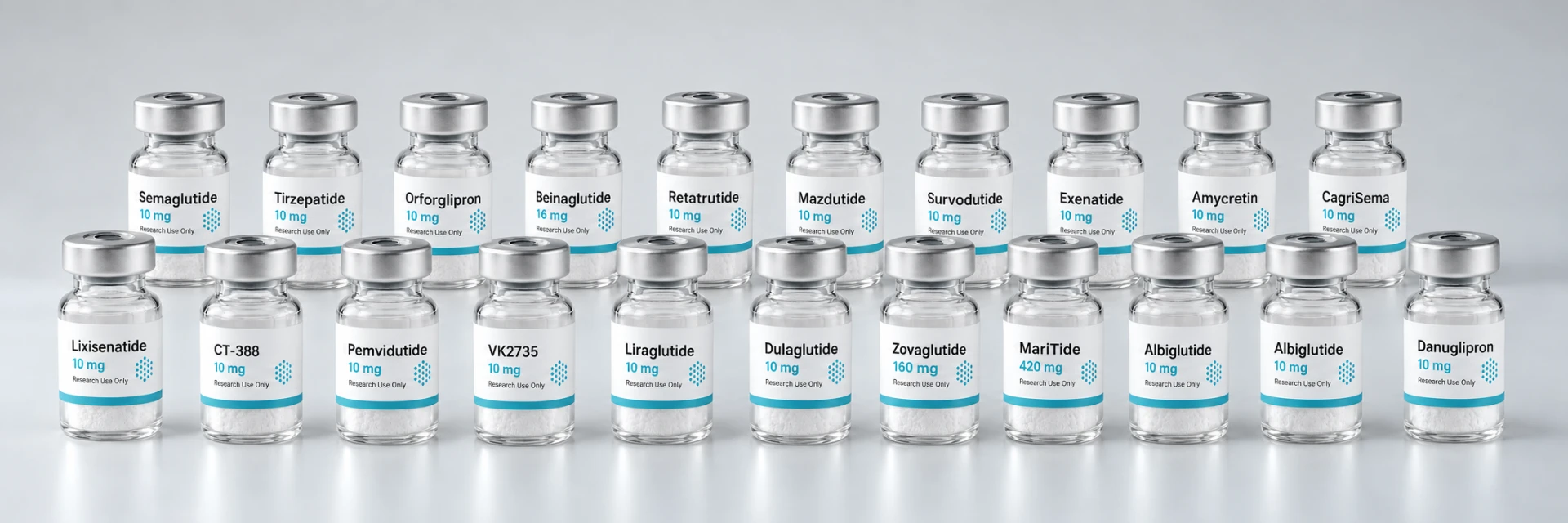
A trial dose is what researchers chose to test. It is not what a regulator reviewed and judged safe for general use. Of the twenty compounds above, only six have a dose that comes from a label.
What does the evidence actually show?
Why were they all approved for diabetes first?
Exenatide clears the FDA
First GLP-1 agonist approved in the US. Indicated for type 2 diabetes, twice daily injection. Weight loss was a secondary finding, not the purpose.
Liraglutide approved for obesity
First approval in the class specifically for weight management, at 3 mg daily. Average loss around 8%. Raised expectations without meeting them for most people.
Semaglutide at 2.4 mg — STEP 1
Average weight loss of 14.9% against 2.4% on placebo at 68 weeks in 1,961 adults. [3] The number reset expectations for the class.
Tirzepatide — SURMOUNT-1
Average weight loss around 21% at the 15 mg dose, versus semaglutide's 15%. Two receptors instead of one. [4]
SURMOUNT-5: head to head
Tirzepatide against semaglutide directly in 751 adults over 72 weeks. Tirzepatide 20.2% versus semaglutide 13.7%. [1] The first real comparative figure in this class.
Danuglipron development stopped
Pfizer stopped development after liver enzyme elevations appeared at higher doses in a Phase 2 trial. A commercial withdrawal and a safety discontinuation are different things. This is a safety discontinuation. [9]
Orforglipron — first true GLP-1 pill
Foundayo, a small molecule that survives digestion without the empty-stomach requirement of oral semaglutide. Starting price $25 per month with insurance. Average loss around 27 lb at the highest dose. Less than the injectables, no needle. [8]
Retatrutide TRIUMPH-1 Phase 3
2,339 participants, 80 weeks. 28.3% average at the 12 mg dose, assuming everyone stayed on treatment, or 25.0% counting everyone. 45.3% lost 30% or more of body weight. [2] Eli Lilly plans to file for FDA approval in Q1 2027. No legal route to buy today.
What are the key differences?
Which five distinctions matter?
Six of the twenty compounds have a dose that comes from an FDA label. The other fourteen have only trial protocols, written for specific populations under clinical supervision. A trial dose is not prescribing guidance.
Semaglutide acts on one receptor. Tirzepatide acts on two, adding GIP. Retatrutide acts on three, adding glucagon. Each addition has moved the weight loss figure in trials, and each has added side effects alongside it. [1][2]
The two approved pills, oral semaglutide and orforglipron, produce less weight loss than the top-dose injectables. Orforglipron can be taken any time of day. Oral semaglutide requires an empty stomach and a 30-minute wait. That is not a minor difference for most people.
Albiglutide and lixisenatide were withdrawn by their manufacturers when better drugs made them uncompetitive. Danuglipron was stopped because of a liver signal. Those are different kinds of exits and they mean different things about what caused them. [9]
In the STEP 1 extension, participants regained about two thirds of what they had lost within a year of stopping semaglutide. Tirzepatide showed the same pattern. The researchers concluded that ongoing treatment appears to be required to maintain the result. That applies to every compound in this table. [11]
What are the side effects, and what are you buying?
What does the class share, and what does the real-world data add?
Shared across the class
What the trials miss
- Nearly 4% of side-effect reporters described reproductive symptoms including irregular and heavy bleeding [12]
- 13% described psychiatric symptoms, most commonly anxiety at 4.2% and depression at 2.8% [12]
- Semaglutide nausea 39.4%; tirzepatide nausea 28.6% — tirzepatide sits easier in self-reports [12]
- The lean mass problem: ~1/3 of weight lost on semaglutide was lean mass, not fat [10]
Buying reality
- Retatrutide, survodutide, and the other trial-stage drugs have no legal route to purchase
- Vials labeled GLP-3 contain retatrutide under a different name
- Vials labeled GLP-4 are not a fourth drug in this family: what GLP-4 actually refers to
- Lilly filed six federal lawsuits against retatrutide sellers on 12 August 2026 [13]
- Approved compounds (sema, tirz) can be compounded during shortage — confirm current shortage status before assuming
What do people actually search for?
Which GLP-1 produces the most weight loss?
In published trials, retatrutide at around 28% at the top dose, assuming everyone stayed on treatment, followed by tirzepatide at around 21%, then semaglutide at around 15%. Retatrutide is investigational and has no legal route. Those figures come from a clinical trial, not from general use. [1][2][3]
What is the difference between Ozempic and Wegovy?
Same drug, semaglutide, different doses and different approved uses. Ozempic goes up to 2 mg weekly, approved for type 2 diabetes. Wegovy goes to 2.4 mg weekly, approved for obesity. The molecule is identical.
Is there a GLP-1 pill?
Two. Oral semaglutide (Rybelsus) requires an empty stomach with minimal water and a 30-minute wait before eating. Orforglipron (Foundayo), approved April 2026, can be taken any time of day. Both produce less weight loss than the injectables.
Why was danuglipron discontinued?
Pfizer stopped development in April 2025 after liver enzyme elevations appeared at higher doses in a Phase 2 trial. That is a safety discontinuation, not a commercial withdrawal like albiglutide and lixisenatide. [9]
Do you regain the weight if you stop?
Most people do. In the STEP 1 extension, participants regained about two thirds of what they had lost within a year of stopping semaglutide. Tirzepatide showed the same pattern. The researchers concluded that ongoing treatment appears to be required to maintain the result. [11]
What is GLP-3?
There is no hormone called GLP-3. GLP-2 is already the name of a real gut hormone used for a bowel condition. Vials sold as GLP-3 contain retatrutide. The numbering came from sellers counting receptors: one, two, three, and labeling accordingly.
Why do trial doses not equal label doses?
A trial dose is what researchers chose to test in a specific population under supervision, often starting very low and stepping up to find limits. It is not what a regulator reviewed and approved for general use. Of the twenty compounds on this page, only six have a label dose.
Is beinaglutide the same as native GLP-1?
It is a version of native GLP-1 used clinically in China. It requires injection three times daily before meals because native GLP-1 has a very short half-life, minutes rather than hours. The modifications that extend half-life in semaglutide and other long-acting agents are absent.
Are any of these banned in sport?
Not at this time. Semaglutide and tirzepatide are on the WADA 2026 Monitoring Program, meaning WADA is collecting data on their use in athlete samples. None of the GLP-1 agonists are on the prohibited list as of 2026. This may change.
References
- 01Aronne LJ, et al. Tirzepatide as compared with semaglutide for the treatment of obesity (SURMOUNT-5). New England Journal of Medicine, May 2025. DOI 10.1056/NEJMoa2416394. Human trial, head to head, 751 adults, 72 weeks. Tirzepatide 20.2% average weight loss against semaglutide 13.7%.
- 02TRIUMPH-1 Phase 3 results. Announced by Eli Lilly and Company, 21 May 2026; published in the New England Journal of Medicine, September 2026. Retatrutide in 2,339 participants over 80 weeks. 28.3% at 12 mg assuming everyone stayed on treatment; 25.0% counting everyone randomized. 45.3% lost 30% or more of body weight on the same assumption.
- 03FDA prescribing information for Ozempic (semaglutide injection) and Wegovy (semaglutide injection). NDA 209637 and NDA 215256. Regulatory documents. Retrieve current labels from DailyMed; label revisions change document URLs.
- 04Jastreboff AM, et al. Tirzepatide once weekly for the treatment of obesity (SURMOUNT-1). New England Journal of Medicine, 2022;387:205-216. DOI 10.1056/NEJMoa2206038. Human trial. Average weight loss approximately 21% at 15 mg against placebo over 72 weeks.
- 05FDA prescribing information for Saxenda (liraglutide 3 mg) and Victoza (liraglutide 1.2 mg and 1.8 mg). Regulatory documents.
- 06FDA prescribing information for Trulicity (dulaglutide). Regulatory document.
- 07FDA prescribing information for Byetta (exenatide twice daily) and Bydureon (exenatide extended-release). Regulatory documents.
- 08Eli Lilly and Company. FDA approves Foundayo (orforglipron). Press release, 1 April 2026. Regulatory announcement. Starting dose 0.8 mg daily, escalating across six steps at 30-day intervals to a maximum of 17.2 mg.
- 09Pfizer Inc. Pfizer reports Phase 2b study results for danuglipron. Press release, April 2025. Company release. Development discontinued after liver enzyme elevations appeared at higher doses. ALT and AST elevations described as dose-dependent.
- 10Regeneron Pharmaceuticals. Complete 26-week Phase 2 COURAGE results. 2025. Human trial measuring body composition. Approximately one third of weight lost on semaglutide alone identified as lean mass.
- 11Wilding JPH, Batterham RL, Davies M, et al. Weight regain and cardiometabolic effects after withdrawal of semaglutide: the STEP 1 trial extension. Diabetes, Obesity and Metabolism, 2022;24:1553-1564. Human trial extension. Participants regained approximately two-thirds of lost weight within one year of stopping.
- 12Sehgal NKR, Tronieri JS, Ungar L, Guntuku SC. Self-reported side effects of semaglutide and tirzepatide in online communities. Nature Health, 2026. DOI 10.1038/s44360-026-00108-y. Observational, self-reported. 410,198 posts, 67,008 users, 29,000 reporting side effects.
- 13Eli Lilly and Company. Statement on illegal retatrutide sales, 12 August 2026. Company release. Six federal lawsuits filed, 200-plus referrals to FDA and DOJ.