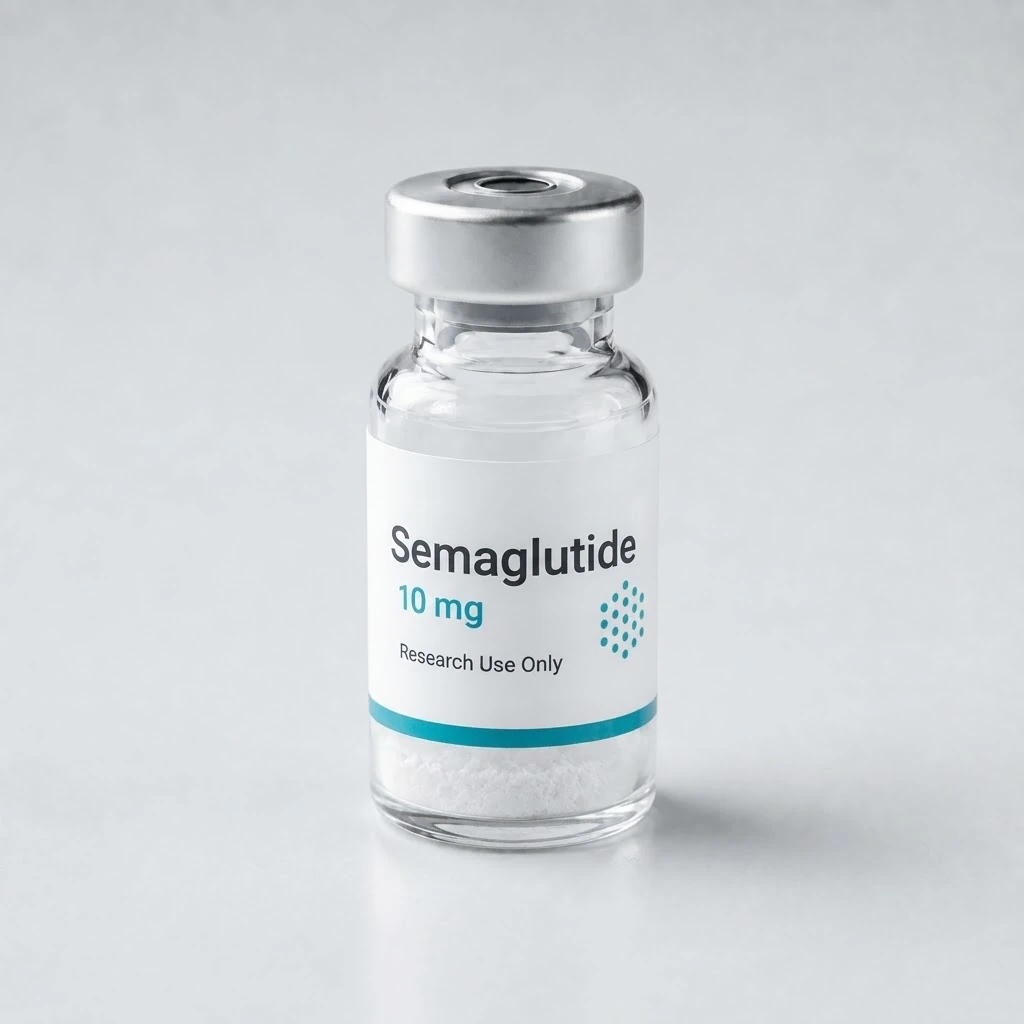
GLP-1 · Approved
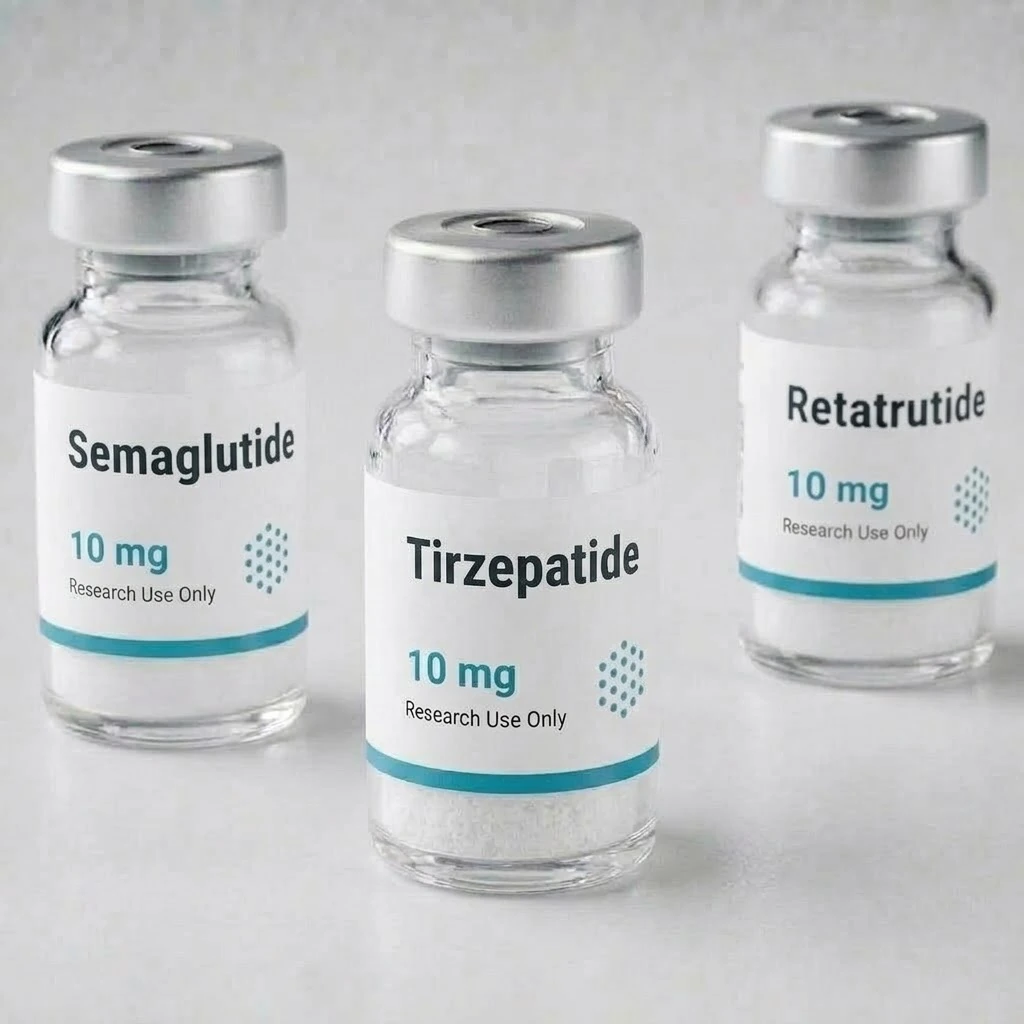
Semaglutide
The oldest of the three, with the longest human record. Approved for diabetes, weight and cardiovascular risk.

Two of these three have been compared head to head. The third has only ever been compared with placebo.
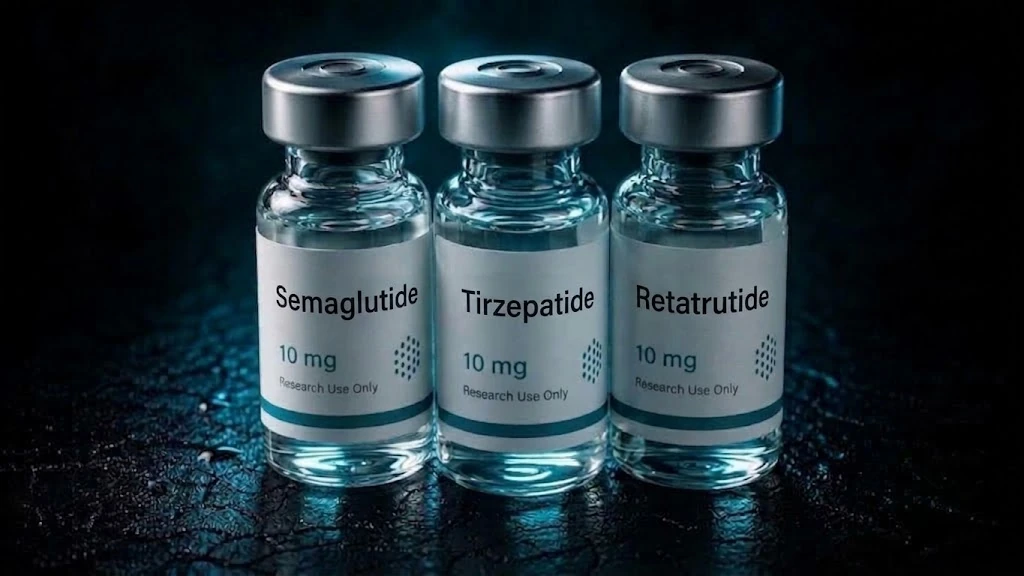
Tirzepatide beat semaglutide by 6.5 percentage points in SURMOUNT-5, the only head-to-head trial among the three. Retatrutide's larger number has never been tested against either drug. The figures people line up, roughly 15, 22.5 and 28.3 percent, come from STEP 1, SURMOUNT-1 and TRIUMPH-1, three trials of different lengths that do not use the same statistical convention.
The oldest of the three, with the longest human record. Approved for diabetes, weight and cardiovascular risk.
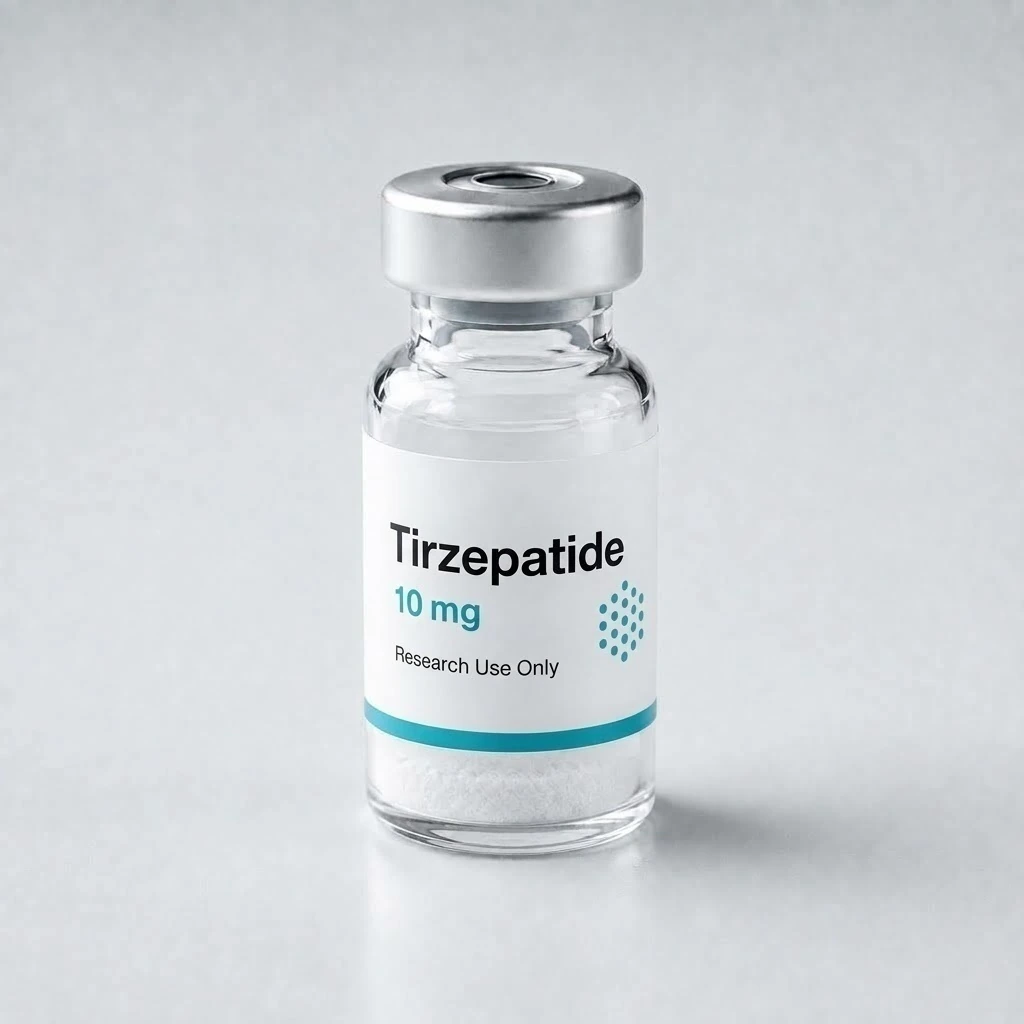
The only one tested head to head against another drug here. It beat semaglutide by 6.5 points in SURMOUNT-5.
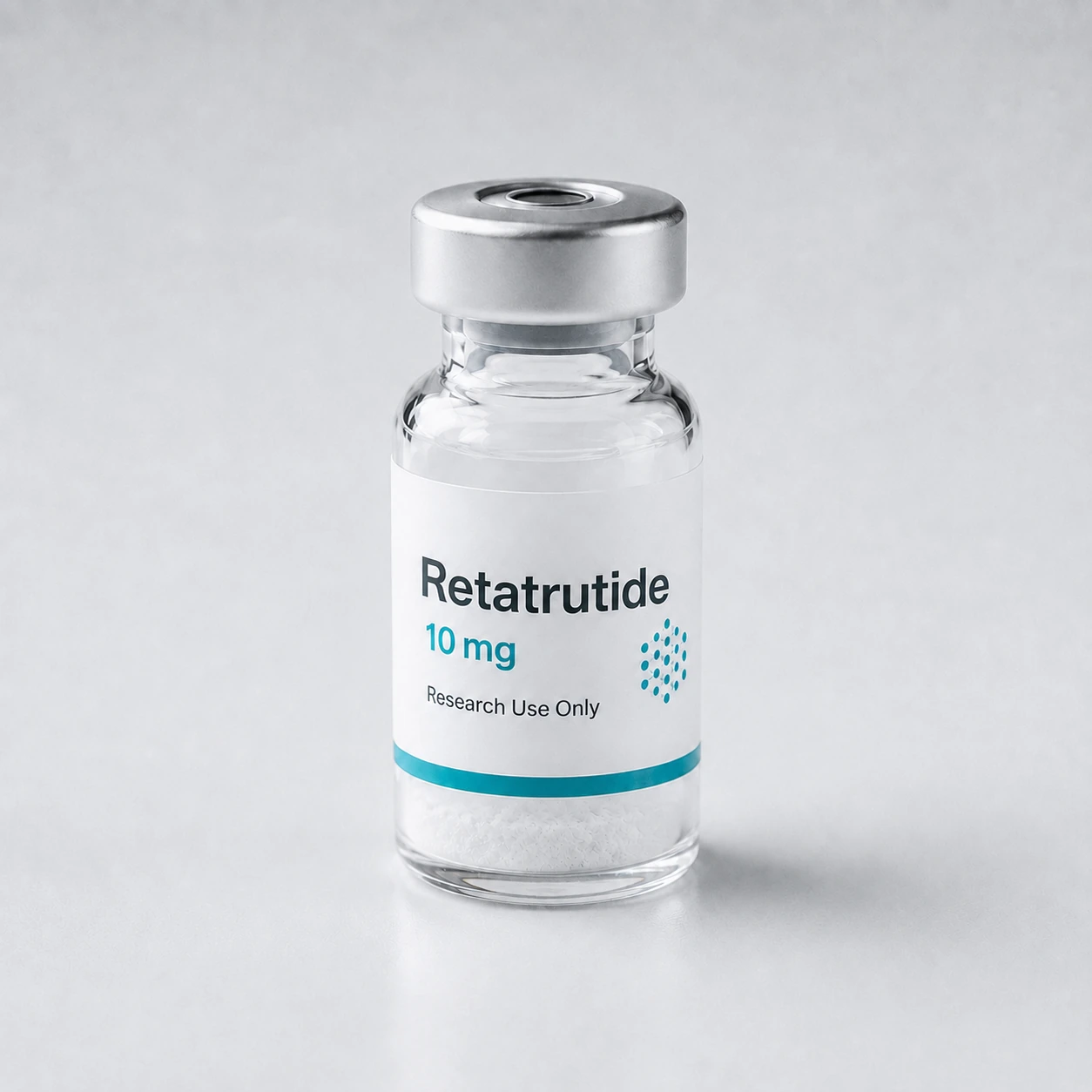
The largest weight-loss number of the three, from a trial against placebo only. Never tested against either drug.
| Semaglutide | Tirzepatide | Retatrutide | |
|---|---|---|---|
| Receptors | GLP-1 | GIP + GLP-1 | GIP + GLP-1 + glucagon |
| Approved for weight loss | Yes, Wegovy | Yes, Zepbound | No. Nowhere |
| Pivotal trial | STEP 1, 68 weeks 1 | SURMOUNT-1, 72 weeks 2 | TRIUMPH-1, 80 weeks 4 |
| Participants | 1,961 1 | 2,539 2 | 2,339 4 |
| Headline loss | 14.9% 1 | 22.5% 3 | 28.3% 7 |
| Which estimand that is | Counts everyone | Assumes everyone stayed on | Assumes everyone stayed on |
| Tested against another drug? | Yes, lost to tirzepatide 5 | Yes, beat semaglutide 5 | Never |
| Median vendor price per mg | $8.00 | $4.75 | $7.33 |
| At its own trial dose | $19 per week | $71 per week | $88 per week |
| Vendors we track selling it | 85 | 94 | 111 |
Price figures are from our 5 October 2026 capture of 158 vendors and move constantly. 13
Retatrutide, on the raw numbers, and the raw numbers are the problem.
At the top dose in each pivotal trial, semaglutide 2.4 mg produced 14.9 percent weight loss over 68 weeks, tirzepatide 15 mg produced 22.5 percent over 72 weeks, and retatrutide 12 mg produced 28.3 percent over 80 weeks. 137 That is the ladder everyone quotes, and the ranking is almost certainly right in direction.
The size of each step is where it falls apart. Those three figures are not the same measurement. Two of them assume every participant stayed on the drug for the whole trial, and one of them counts everybody who started including the people who quit. Lining them up side by side compares a best case against an average.
STEP 1, SURMOUNT-1 and TRIUMPH-1. 3 trials, 3 durations, 2 incompatible conventions.
When the three are put on the same footing, the gap between semaglutide and tirzepatide narrows from 7.6 points to somewhere between 5.3 and 6.0. 13 The gap between tirzepatide and retatrutide moves even more, from 5.8 points down to as little as 3.3, or up to 6.0, depending on which defensible method you pick. 347
One of those two gaps has been measured in a randomized trial. The other has not.
No, and the reason is a word most coverage never prints: estimand.
A large obesity trial reports its result more than once, because there is more than one honest question to ask. One question is what the drug does to someone who takes it as directed for the full trial. The other is what happens on average to everyone handed a prescription, including the people who stop because the nausea is intolerable. Both are legitimate. They give different numbers, and the second is always smaller.
The trouble is that Novo Nordisk and Eli Lilly use different names for the same two ideas.
| What is being estimated | Novo Nordisk calls it | Eli Lilly calls it |
|---|---|---|
| Effect if everyone had stayed on the drug | Trial product estimand 1 | Efficacy estimand 3 |
| Effect counting everyone who started | Treatment policy estimand 1 | Treatment-regimen estimand 3 |
Lilly's own definition of the efficacy estimand is that it "represents efficacy prior to discontinuation of study drug," and of the treatment-regimen estimand that it "represents the estimated average treatment effect regardless of treatment discontinuation." 3 Novo's two estimands in STEP 1 answer those same two questions under the other pair of names. 1
Novo and Lilly. 2 sponsors, 2 vocabularies, 1 number quoted out of each.
Here is what each drug looks like under each convention, at its top dose in its own pivotal trial.
| Semaglutide 2.4 mg, 68 wk | Tirzepatide 15 mg, 72 wk | Retatrutide 12 mg, 80 wk | |
|---|---|---|---|
| Assuming everyone stayed on drug | 16.9% 1 | 22.5% 3 | 28.3% 7 |
| Its placebo arm | 2.4% 1 | 2.4% 3 | 2.2% 7 |
| Counting everyone who started | 14.9% 1 | 20.9% 3 | 25.0% 4 |
| Its placebo arm | 2.4% 1 | 3.1% 3 | 3.9% 4 |
Now read the numbers people actually quote. The familiar trio is STEP 1's 14.9, SURMOUNT-1's 22.5 and TRIUMPH-1's 28.3. The first comes from the bottom half of that table and the other two come from the top half. The comparison takes semaglutide's average-including-quitters and sets it against tirzepatide's and retatrutide's if-everyone-stayed.
Put all three on "assuming everyone stayed on drug" and the ladder reads 16.9, 22.5 and 28.3. 137 Put all three on "counting everyone who started" and it reads 14.9, 20.9 and 25.0. 134 Both are defensible. Neither is the trio in circulation.
Subtract each trial's own placebo arm and the picture shifts again, because the placebo arms are not identical. STEP 1's placebo group lost 2.4 percent, SURMOUNT-1's lost 3.1 percent and TRIUMPH-1's lost 3.9 percent on the counting-everyone basis. 134 A 1.5 point spread across three placebo groups is not noise to be ignored. It is the thing a placebo arm exists to subtract.
| Placebo-adjusted, counting everyone who started | |
|---|---|
| Semaglutide | 12.5 points 1 |
| Tirzepatide | 17.8 points 3 |
| Retatrutide | 21.1 points 4 |
That is the most honest single ranking on this page, and it is still a comparison of three separate trials.
Tirzepatide won SURMOUNT-5 by 6.5 percentage points, and this is the only pairing among the three where that sentence can be written at all.
SURMOUNT-5 randomized 751 adults with obesity and without diabetes to tirzepatide or semaglutide for 72 weeks, each at the maximum dose the participant tolerated. 5 Tirzepatide reached 20.2 percent weight loss against semaglutide's 13.7 percent, with p below 0.001. 5 Waist circumference fell 18.4 cm against 13.0 cm. 5 Published in the New England Journal of Medicine in 2025, it remains the only randomized head-to-head trial of two of these three drugs.
SURMOUNT-5. 751 adults, 72 weeks, 6.5 points, and 1 design flaw worth knowing.
The flaw is that SURMOUNT-5 was open-label. Everyone knew which drug they were taking. In a trial whose primary endpoint is body weight and where both arms require participants to keep taking an injection through months of gastrointestinal side effects, knowing you are on the newer drug that the headlines favor is not a trivial thing. It is the single biggest reason to hold this result a little loosely.
And here is the part worth sitting with. Comparing STEP 1 against SURMOUNT-1 four different ways gives a semaglutide-to-tirzepatide gap of 5.3, 5.6, 5.6 and 6.0 points. 13 SURMOUNT-5 then measured it at 6.5. 5 The cross-trial estimates came within about a point of the measured answer.
That cuts two ways, and the page is not going to pretend otherwise. It is modest evidence that careful cross-trial comparison of drugs in this class can land close to the truth. It is also a sample of one, and we only know it landed close because somebody spent the money to run the trial. The mixed-estimand figure of 7.6 points that circulates widely overstated SURMOUNT-5's measured gap by 17 percent, so even here the sloppy version was the one that missed.
Nobody has run the blinded version. Nobody has run anything at all involving retatrutide and an active comparator.
The method nearly doubles it, from 3.3 points to 6.0 points, and no trial exists to settle which is right.
TRIUMPH-1 published in the New England Journal of Medicine on 29 September 2026, so retatrutide's Phase 3 is no longer a press release. 4 TRIUMPH-1 randomized 2,339 adults with obesity and without diabetes across 131 sites in 11 countries to 4, 9 or 12 mg weekly or placebo for 80 weeks. 4 That is a real trial with a real methods section, and the result is large.
What it is not is a comparison with tirzepatide. Here is the tirzepatide-to-retatrutide gap by four defensible routes.
| Method | Gap |
|---|---|
| As usually quoted, 22.5 vs 28.3 | 5.8 points |
| Both on counting-everyone, 20.9 vs 25.0 | 4.1 points |
| Placebo-adjusted, assuming-everyone-stayed | 6.0 points |
| Placebo-adjusted, counting-everyone | 3.3 points |
A tirzepatide-to-retatrutide gap ranging from 3.3 to 6.0 points depending on bookkeeping is not a settled finding. For the semaglutide-to-tirzepatide pair the equivalent spread was 5.3 to 6.0, a much tighter range, and SURMOUNT-5 existed to check it against. For this pair the spread is wider and there is nothing to check it against.
SURMOUNT-1 against TRIUMPH-1. 1 gap, 4 defensible methods, 2.7 points of disagreement.
Two more things make this pairing harder to read than the other one.
TRIUMPH-1 ran 8 weeks longer than SURMOUNT-1 and 12 weeks longer than STEP 1. 124 A crude correction, dividing each drug's placebo-adjusted loss by its trial length, puts semaglutide at 1.8 points per 10 weeks, tirzepatide at 2.5 and retatrutide at 2.6. 134 On that arithmetic tirzepatide and retatrutide are near-identical and most of the gap is the extra time. That arithmetic is also wrong in a specific direction, because weight loss in these trials flattens rather than continuing in a straight line, so the later weeks contribute less than the early ones and dividing by weeks penalizes the longest trial. Treat it as a reason for caution, not as a result.
TRIUMPH-1 also enrolled a heavier group. Mean BMI was about 40, against 37.9 in STEP 1 and 38.0 in SURMOUNT-1. 124 Heavier starting populations tend to post larger percentage losses. All three trials excluded participants with diabetes, so that particular confound is absent. 124
Semaglutide copies one gut hormone, tirzepatide copies two, and retatrutide copies two and adds a third signal that works in the opposite direction.
Semaglutide is a GLP-1 receptor agonist. GLP-1 is released from the gut after eating and it slows stomach emptying, increases insulin release when glucose is high, and acts on appetite centers in the brain. 10
Tirzepatide hits GLP-1 and also GIP, a second gut hormone. The GIP contribution is the part of this class that is least settled mechanistically, because GIP receptor agonism and GIP receptor blockade have both been argued to help with weight. Tirzepatide's results establish that the combination works without settling why. 11
Retatrutide adds glucagon receptor agonism to those two. This is the interesting one, because glucagon's familiar job is raising blood sugar, which sounds like the wrong direction entirely. The proposed benefit is that glucagon receptor activity raises energy expenditure and acts on liver fat, so the two incretin receptors reduce what goes in while the third raises what goes out. 6
Wegovy 1 receptor, Zepbound 2, retatrutide 3, with the 3rd pulling the other way.
The receptor count is also why the ladder is intuitively appealing and why that appeal should be resisted. More receptors producing more weight loss is a tidy story, and the one place it was tested directly, SURMOUNT-5, it held. 5 But receptor count is not a dose and it is not a mechanism of action in a person. Nothing guarantees the pattern keeps going, and a fourth receptor would not be expected to add another six points simply because the first three did.
Gastrointestinal effects in all three, rising with dose, and one effect that only retatrutide reports.
| At the top dose | Semaglutide 2.4 mg 1 | Tirzepatide 15 mg 3 | Retatrutide 12 mg |
|---|---|---|---|
| Nausea | 44.2% | 31.0% | about 41% 7 |
| Diarrhea | 31.5% | 23.0% | not published by percentage |
| Vomiting | 24.8% | 12.2% | not published by percentage |
| Constipation | 23.4% | 11.7% | not published by percentage |
| Stopped for adverse events | 7.0% | 6.2% | 11.2% 4 |
| Its placebo arm stopped | 3.1% | 2.6% | 4.6% 4 |
Two things stand out.
Semaglutide's nausea rate is the highest in that table, at 44.2 percent against tirzepatide's 31.0 percent, and semaglutide is the drug with the smallest weight loss of the three. 13 The side effect burden does not line up neatly with the benefit. Anyone assuming the gentlest drug is the weakest one has it backwards here.
Retatrutide's discontinuation rate is the outlier. 11.2 percent of participants on 12 mg stopped for adverse events, against 6.2 percent on tirzepatide 15 mg and 7.0 percent on semaglutide 2.4 mg. 134 Retatrutide's 11.2 percent, roughly one in nine, is also the mechanism by which the two estimands pull apart, which is why its two figures sit 3.3 points apart while semaglutide's sit 2.0 points apart. 147
In TRIUMPH-1, 11.2% stopped on retatrutide, against 6.2% and 7.0% on the approved two.
Retatrutide also reports dysesthesia, altered skin sensation, at 5.1 to 12.5 percent across its dose arms against 0.9 percent on placebo. 7 The Wegovy and Zepbound labels do not list it at comparable rates. 1011 Whether it is a glucagon receptor effect is not established.
All three sit in a class carrying a boxed warning for thyroid C-cell tumors, based on rodent findings. 1011 In January 2026 the FDA asked for the warning about suicidal thoughts and behavior to be removed from the obesity versions of this drug family after a review found no increased risk, and labels were updated in February 2026.
Market snapshot · October 5, 2026
Semaglutide is the most expensive of the three per milligram and by far the cheapest per week, because STEP 1 dosed it at 2.4 mg against tirzepatide's 15 mg in SURMOUNT-1 and retatrutide's 12 mg in TRIUMPH-1. 124
This is the part most comparisons get wrong by never doing the arithmetic. Our 5 October 2026 capture covers 158 vendors. 13
| Median price per mg | Dose in its pivotal trial | Cost per week at that dose | |
|---|---|---|---|
| Semaglutide | $8.00 (dearest) | 2.4 mg 1 | $19 (cheapest) |
| Tirzepatide | $4.75 (cheapest) | 15 mg 2 | $71 |
| Retatrutide | $7.33 | 12 mg 4 | $88 (dearest) |
The per-milligram ranking and the per-week ranking are exact opposites for the two ends. Tirzepatide is the cheapest of the three by the milligram and the second most expensive by the week. Semaglutide is the dearest by the milligram and roughly a quarter of retatrutide's weekly cost, because it is dosed at a fifth of the milligrams.
In our 2026 capture, $8.00 per mg buys the cheapest week and $4.75 per mg the second dearest.
Price per milligram is the number almost every vendor page leads with, and on its own it tells you close to nothing about what a protocol costs. A drug's milligram count is a property of its potency, not of its value.
Spreads within each compound are enormous. Semaglutide ranges from $1.00 to $112.79 per mg across 124 clean single-vial listings, tirzepatide from $0.07 to $95.00 across 226, and retatrutide from $1.45 to $76.00 across 258. 13 A hundredfold spread inside one compound is not a market pricing quality. Nothing in a price tells you what is in the vial.
For comparison, the approved products through official channels run on a completely different scale, with manufacturer self-pay programs in the few hundred dollars per month and retail list prices around $1,000 to $1,350 per month. 12 Those are regulated products with an identified manufacturer. The figures in the table above are research chemicals sold by vendors with no such accountability.
Market snapshot · October 5, 2026
Retatrutide, the only one of the three not approved anywhere, has the widest gray-market supply of the three.
| Listings | Vendors | Alias codes in our library | |
|---|---|---|---|
| Semaglutide | 180 | 85 | 17 |
| Tirzepatide | 285 | 94 | 27 |
| Retatrutide | 345 | 111 | 34 |
Retatrutide carries the most listings, the most vendors and twice as many alias codes as semaglutide. 13 Of the 158 vendors in the capture, 120 sell at least one of the three and 71 sell all three. 13 17 sell retatrutide and neither of the others, and 34 sell retatrutide but not semaglutide. 13
In our 2026 capture, 111 vendors sell the 1 drug no regulator has approved.
The alias lists are the most telling part. Retatrutide's 34 alias codes include GLP-3, triple G, Trinity-X, RETA-10 and ratatouille. 13 "GLP-3" is not a real receptor designation and there is no such hormone. "Ratatouille" is a phonetic dodge. These are not scientific synonyms or trade names, they are search-and-filter evasion codes, and the volume of them is a measure of how much pressure the sellers are under.
That pressure is real. On 12 August 2026 Lilly filed six federal lawsuits against US sellers of black-market retatrutide. Lilly has said it plans to file for FDA approval in the first quarter of 2027, pushed back from an earlier timeline while manufacturing and quality data are assembled.
What is in the vials is the open question. A 2018 analysis of seized peptide products found purity ranging from 5 to 75 percent. 14 That study was not of these three compounds, and we are not going to claim it was. It is the best published measurement available of what unregulated peptide supply chains actually deliver, and the direction of the finding is the relevant part.
Anything sold under these names outside a pharmacy was not made in the facility that supplied any trial on this page. The trial results describe a characterised molecule at a known dose. They do not transfer to a vial of unknown content.
Two of the three are approved for weight loss. The third is not approved for anything, anywhere.
| Weight loss | Type 2 diabetes | Cardiovascular | |
|---|---|---|---|
| Semaglutide | Wegovy 10 | Ozempic | Yes, in people with obesity and established cardiovascular disease 8 |
| Tirzepatide | Zepbound 11 | Mounjaro | Non-inferior to dulaglutide in SURPASS-CVOT 9 |
| Retatrutide | No | No | No trial powered for it 4 |
Semaglutide has the strongest cardiovascular evidence of the three. SELECT randomized 17,604 adults and found a 20 percent relative reduction in major adverse cardiovascular events. 8 Tirzepatide's SURPASS-CVOT compared it with dulaglutide, an active comparator rather than placebo, across 13,299 adults with diabetes. 9
Retatrutide has nothing here. TRIUMPH-1 reported that pancreatitis and major adverse cardiovascular events were uncommon, with too few events for firm conclusions, and the trial was not powered for cardiovascular safety. 4 That is the correct way to report it and it means the question is open rather than answered favorably.
Wegovy and Zepbound carry 2 approvals each. Retatrutide carries 0.
All three are prohibited at all times in sport under the World Anti-Doping Agency code's S4 category covering metabolic modulators, which applies regardless of a drug's approval status.
Four questions, and the first one is the whole page.
Nobody has compared retatrutide with anything but placebo. Every retatrutide-versus-tirzepatide number in circulation is an inference across trials, and that inference ranges from 3.3 to 6.0 points depending on method. 34 A head-to-head would settle it. None has been run, and Lilly has no commercial reason to run one against its own tirzepatide.
Nobody has run a blinded head-to-head of any pair. SURMOUNT-5 is open-label. 5 It is the best evidence in this comparison and its design is the weakest part of it.
Nobody has published how much of the loss is fat. None of the three pivotal trials reported body composition as a primary endpoint. 124 At TRIUMPH-1's 25 percent total body weight loss, the question of what fraction is lean mass stops being academic, and for retatrutide there is no published answer. 4
Nobody knows what happens after the trial ends. The STEP 1 extension found substantial weight regain after semaglutide was withdrawn. 1 No equivalent withdrawal data exists for retatrutide. TRIUMPH-1's 80-week result says nothing about year five. 4
Retatrutide produced a larger number in its own trial. The two have never been compared directly, and the estimated gap ranges from 3.3 to 6.0 percentage points depending on the method used. 34
Retatrutide, at 28.3 percent over 80 weeks. 7 That figure assumes every participant stayed on the drug, and 11.2 percent did not. 4
No. SURMOUNT-5 compared them directly and tirzepatide won by 6.5 percentage points. 5
No. It is not approved in any country. Lilly has said it plans to file for FDA approval in the first quarter of 2027.
Because each trial reports two results, and most coverage picks one without saying which. Retatrutide's two figures are 28.3 and 25.0 percent, and both are correct. 47
It is the specific question a trial result answers. One estimand asks what the drug does to people who keep taking it. The other asks what happens on average to everyone who starts, including those who stop. 3
The one counting everyone who started is closer to what happens in practice, because people do stop. Just make sure all the numbers you are comparing use the same one.
The 47 percent figure is SURMOUNT-5's 6.5 point absolute difference expressed as a proportion of semaglutide's result. Both describe SURMOUNT-5 accurately. 5 The absolute figure is the more useful one.
Its trial dose is 2.4 mg a week against tirzepatide's 15 mg and retatrutide's 12 mg. 124 At $8.00 per mg that works out to about $19 a week. 13
Glucagon receptor activity is proposed to raise energy expenditure and act on liver fat, so it works in the opposite direction to the other two. 6 Its specific contribution has not been isolated in a trial.
Our library records 34 alias codes for it, including GLP-3 and ratatouille. 13 They are search-evasion codes used by sellers, not scientific synonyms. There is no GLP-3 receptor.
Dysesthesia was reported in 5.1 to 12.5 percent of retatrutide participants against 0.9 percent on placebo. 7 The Wegovy and Zepbound labels do not list it at comparable rates. 1011
No. 68, 72 and 80 weeks respectively, with retatrutide's the longest. 124
Semaglutide. SELECT found a 20 percent relative reduction in major cardiovascular events across 17,604 adults. 8 Retatrutide has no trial powered for it. 4
No. What is sold online was not made in the facility that supplied any trial on this page, and a 2018 analysis of seized peptide products found purity ranging from 5 to 75 percent. 14
Yes, all three, at all times, under the WADA code's S4 metabolic modulators category. Approval status makes no difference.
What Europe PMC and ClinicalTrials.gov hold for each, on the same rule.
Semaglutide has 604 records, Tirzepatide 602 and Retatrutide 288. 189, 176 and 44 original human studies, 795, 308 and 34 registered trials, respectively.
Semaglutide: FDA via DailyMed: Indicated as an adjunct to diet and exercise to improve glycemic control in adults with type 2 diabetes mellitus; to reduce the risk of major adverse cardiovascular events in adults with type 2 diabetes and established cardiovascular disease; to reduce the risk of sustained eGFR decline, end-stage kidney disease and cardiovascular death in adults with type 2 diabetes and chronic kidney disease · FDA via DailyMed: Indicated as an adjunct to diet and exercise to improve glycemic control in adults with type 2 diabetes mellitus; to reduce the risk of major adverse cardiovascular events in adults with type 2 diabetes who are at high risk for these events · FDA via DailyMed: Indicated in combination with a reduced calorie diet and increased physical activity to reduce the risk of major adverse cardiovascular events in adults with established cardiovascular disease and either obesity or overweight; to reduce excess body weight and maintain weight reduction long term in adults and pediatric patients aged 12 years and older with obesity and adults with overweight with at least one weight-related comorbid condition; for the treatment of noncirrhotic metabolic dysfunction-associated steatohepatitis (MASH) with moderate to advanced liver fibrosis
Tirzepatide: FDA via DailyMed: Indicated as an adjunct to diet and exercise to improve glycemic control in adults and pediatric patients 10 years of age and older with type 2 diabetes mellitus; to reduce the risk of major adverse cardiovascular events in adults with type 2 diabetes mellitus who are at high risk for these events · FDA via DailyMed: Indicated in combination with a reduced-calorie diet and increased physical activity to reduce excess body weight and maintain weight reduction long term in adults with obesity or adults with overweight in the presence of at least one weight-related comorbid condition; to treat moderate to severe obstructive sleep apnea in adults with obesity
The published recordSemaglutide
Papers and trials about Semaglutide
Searched: Semaglutide, Ozempic, Wegovy, Rybelsus.
Left out: GLP-1 SM (vendor listing code, appears in no journal); GLP-1 S (vendor listing code, appears in no journal); GLP-1 (S) (vendor listing code, appears in no journal); sema (vendor listing code, appears in no journal); EZP-1P (vendor listing code, appears in no journal); GLP-1 SG (vendor listing code, appears in no journal); EP-1 S (vendor listing code, appears in no journal).
355 papers tagged human · 189 not reviews or lab · 79 clinical trial publications
795 registered trials · 10 with posted results
Compare this against the whole library →
Indicated as an adjunct to diet and exercise to improve glycemic control in adults with type 2 diabetes mellitus; to reduce the risk of major adverse cardiovascular events in adults with type 2 diabetes and established cardiovascular disease; to reduce the risk of sustained eGFR decline, end-stage kidney disease and cardiovascular death in adults with type 2 diabetes and chronic kidney diseaseRegulatorsCounted from Europe PMC indexing, not read by a person; a human tag can land on reviews, commentary or lab papers; clinical trial publications is the narrower count. 504 papers and 100 trials indexed in detail.
The published recordTirzepatide
Papers and trials about Tirzepatide
Searched: Tirzepatide, Mounjaro, Zepbound, LY3298176, GLP2-T, GLP-2T Peptide, Tirz GLP-2, TIRZ-GLP2.
Left out: GLP-2 TZ (vendor listing code, appears in no journal); GLP-2 T (vendor listing code, appears in no journal); tirz (vendor listing code, appears in no journal); EZP-2P (vendor listing code, appears in no journal); GLP-2 (TRZ) (vendor listing code, appears in no journal); GLP-1 T (vendor listing code, appears in no journal); SP-2TZ (vendor listing code, appears in no journal); EP-2 T (vendor listing code, appears in no journal); GLP-2 TZ Research Peptide for Sale (vendor listing code, appears in no journal); AMP-2P (vendor listing code, appears in no journal).
358 papers tagged human · 176 not reviews or lab · 62 clinical trial publications
308 registered trials · 16 with posted results
Compare this against the whole library →
Indicated as an adjunct to diet and exercise to improve glycemic control in adults and pediatric patients 10 years of age and older with type 2 diabetes mellitus; to reduce the risk of major adverse cardiovascular events in adults with type 2 diabetes mellitus who are at high risk for these eventsRegulatorsCounted from Europe PMC indexing, not read by a person; a human tag can land on reviews, commentary or lab papers; clinical trial publications is the narrower count. 502 papers and 100 trials indexed in detail.
The published recordRetatrutide
Papers and trials about Retatrutide
Searched: Retatrutide, LY3437943, triple agonist, GLP-3R, Reta GLP-3, Trinity-X, LP3-R, GLP3-Reta.
Left out: reta (vendor listing code, appears in no journal); triple G (vendor listing code, appears in no journal); GLP-3 (vendor listing code, appears in no journal); GLP-3 retatrutide (vendor listing code, appears in no journal); R-30 (vendor listing code, appears in no journal); R30 (vendor listing code, appears in no journal); R20 (vendor listing code, appears in no journal); R5 (vendor listing code, appears in no journal); ratatouille (vendor listing code, appears in no journal); triple-G (vendor listing code, appears in no journal); GLP-3 (RT) (vendor listing code, appears in no journal); EZP-3P (vendor listing code, appears in no journal); R-10 (vendor listing code, appears in no journal); GLP-3 (RTA) (vendor listing code, appears in no journal); EP-3 R (vendor listing code, appears in no journal); AMP-3P (vendor listing code, appears in no journal); GLP-3 RT Research Peptide for Sale (vendor listing code, appears in no journal).
167 papers tagged human · 44 not reviews or lab · 11 clinical trial publications
34 registered trials · 2 with posted results
Counted from Europe PMC indexing, not read by a person; a human tag can land on reviews, commentary or lab papers; clinical trial publications is the narrower count.