
All comparisons
Epitalon vs MOTS-c
Two longevity peptides, and two different ways of having no human evidence. Epitalon's celebrated human data belongs to Epithalamin, a bovine pineal extract, not to the synthetic peptide people inject. MOTS-c has no human data at all, and it is something your body already makes, with levels rising when you exercise.
- Longevity
- Neither FDA approved
- No human trials of either
Published August 16, 2026 · Updated October 11, 2026
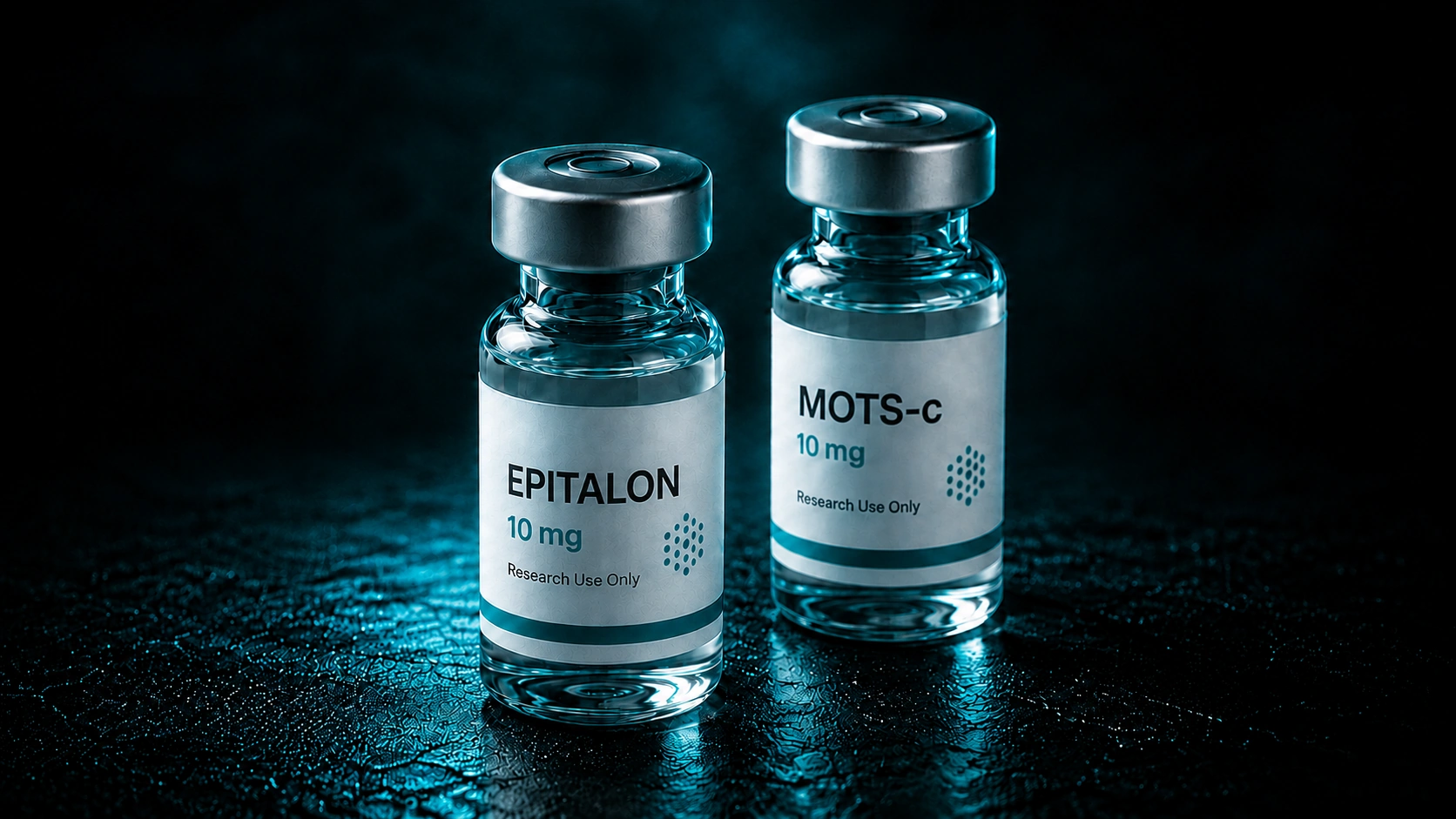
The short answer
Has either one been tested in a person?
Epitalon's famous human evidence is about a different substance. MOTS-c has no human evidence at all, and your body already makes it.
| Attribute | Epitalon | MOTS-c |
|---|---|---|
| Length | 4 amino acids | 16 amino acids |
| Where it comes from | Synthetic, from a pineal extract | Encoded in your mitochondrial DNA [5] |
| Made in your body | The parent extract is, in tiny amounts | Yes, and exercise raises it [6] |
| Human trials | None of this compound [2] | None [5] |
| Best evidence | Human cell culture [1][3] | Mouse studies and human cells [5][7] |
| FDA status | Not approved. Recommended for compounding July 2026 [8] | Not approved. Recommended for compounding July 2026 [8] |
Both were reviewed by the FDA's advisory committee in July 2026. A recommendation is not approval.
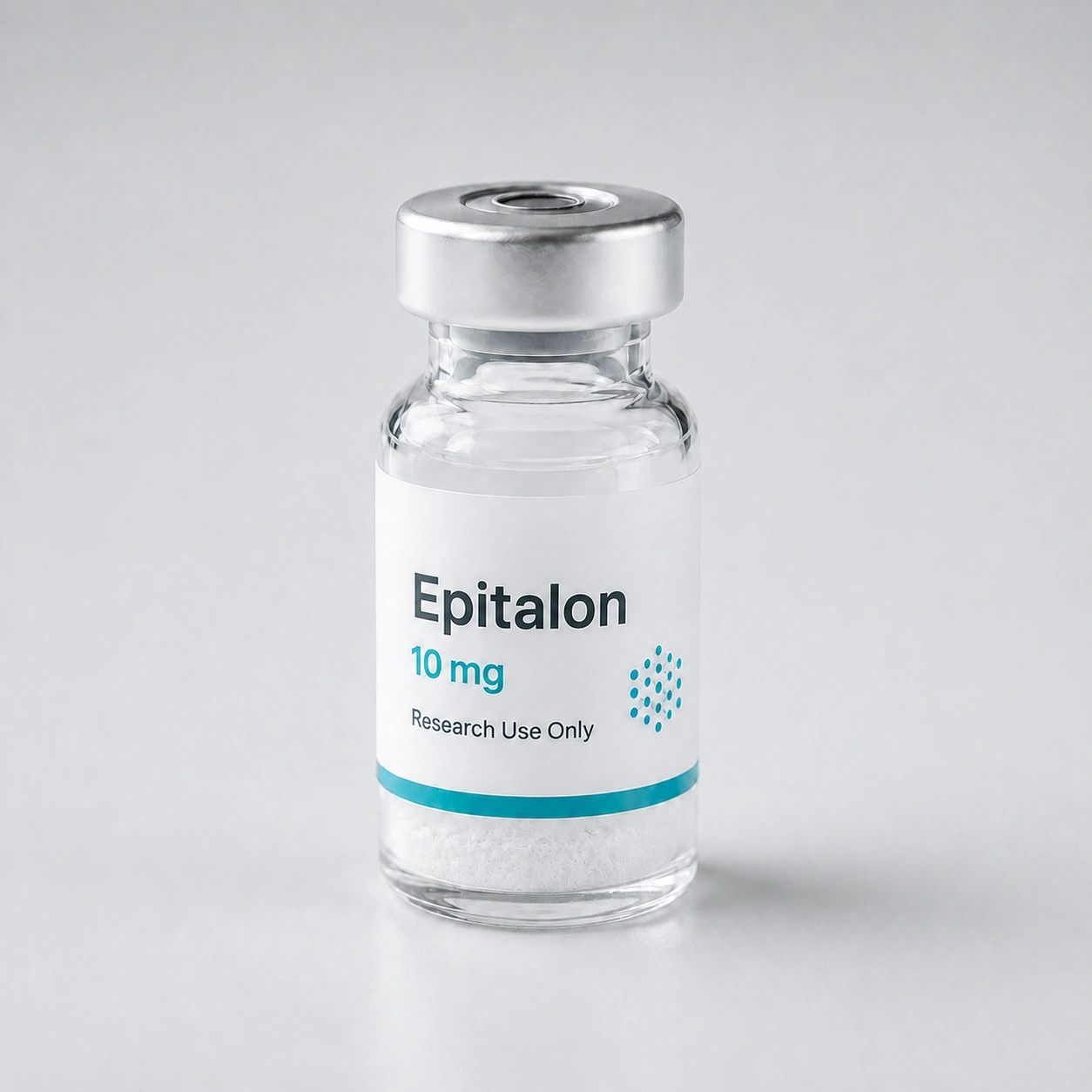
Telomeres · Pineal · Synthetic
Epitalon
Four amino acids, Ala-Glu-Asp-Gly, also written AEDG. It was identified as the active piece of Epithalamin, an extract made from the pineal glands of cattle. A short synthetic peptide studied for whether it can switch telomerase back on, the enzyme that maintains the protective caps on your chromosomes.
Length4 amino acids
OriginSynthetic, from a bovine extract
Human trialsNone of this compound
Independent replication2025, in cell culture
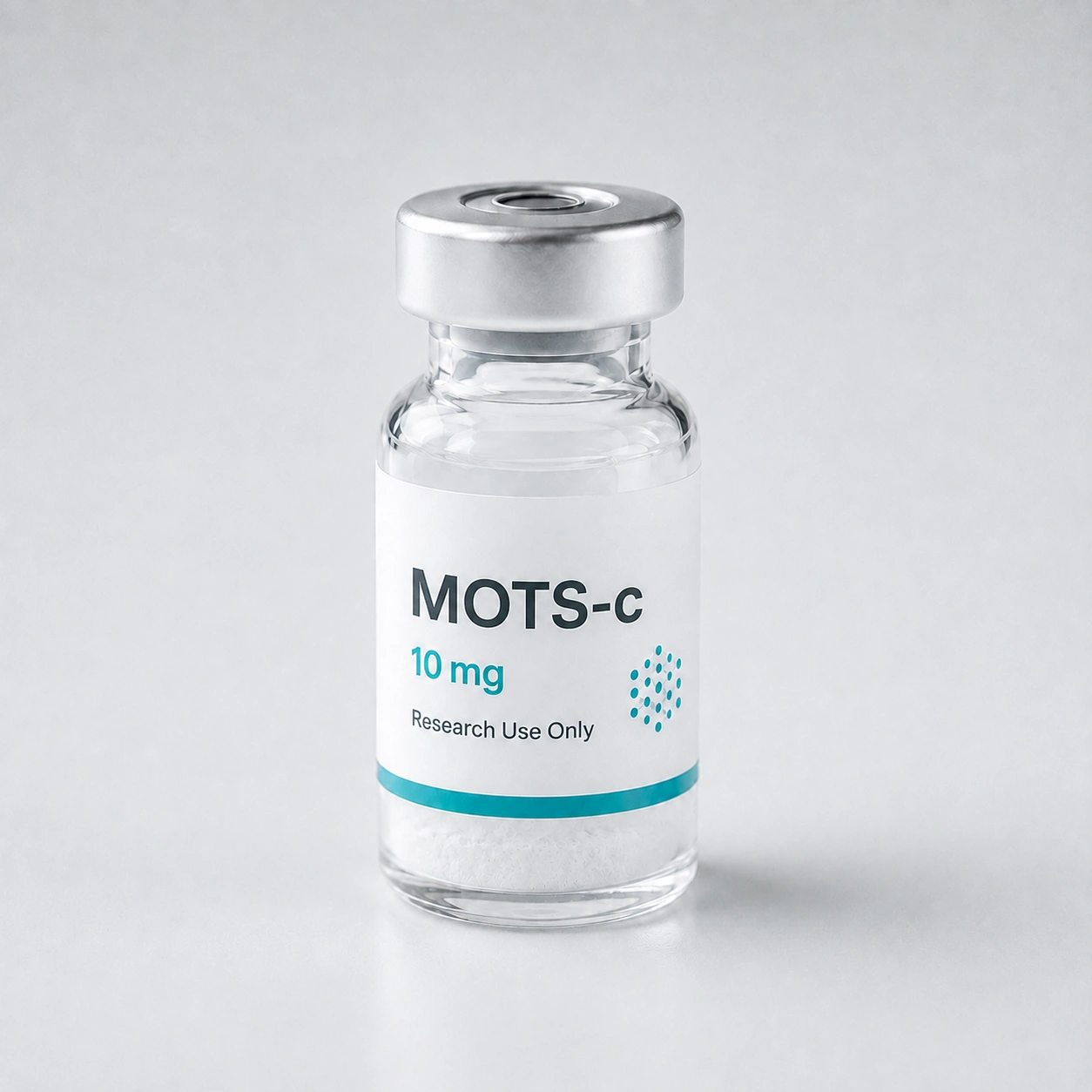
Mitochondria · Metabolism · Endogenous
MOTS-c
Sixteen amino acids, encoded not in the DNA in your cell nucleus but in the separate small genome inside your mitochondria. A signal your own mitochondria send out, studied for how it affects metabolism and muscle, and it rises naturally when you exercise.
Length16 amino acids
OriginYour own mitochondrial DNA
Human trialsNone
Rises with exerciseYes
What is actually known
Why has neither been tested in people?
This is the whole page, so it goes here rather than at the end.
Epitalon's problem is a substitution. You will see references to large human studies showing improved survival and cardiovascular markers in elderly subjects. Those studies exist. They used Epithalamin, the bovine pineal extract, in Russian clinical work going back to the 1970s. Epitalon is a synthetic tetrapeptide identified as the active constituent within that extract. Related, and not the same thing. An extract contains many components, and the human results belong to the extract as a whole. They cannot be transferred to the isolated fragment without testing the fragment, which nobody has done. [2] If that shape sounds familiar, it is the same problem as TB-500, where the human trials used a 43 amino acid protein and the product sold is a 7 amino acid piece of it. Our Epitalon sleep guide covers the three human studies, and what they measured.
MOTS-c's problem is simpler. There are no human trials of any kind. What exists is mouse work, cell culture including human cells in a dish, and observational findings that levels change with exercise and age. [5][6][7] Nobody has given it to a person in a published study.
And there is a genetic story about MOTS-c that gets told backward. You will read that Japanese centenarians carry a mitochondrial variant producing a more active form of MOTS-c, and that this explains their longevity. The variant is real. It is called m.1382A>C, it swaps one amino acid at position 14, and it is largely restricted to East Asian populations. Fuku and colleagues noticed it in Japanese people with exceptional lifespan and proposed a link. [12] What happened next is the part that gets dropped. The swap makes MOTS-c less effective, not more, and specifically a weaker insulin sensitiser. A meta-analysis across three Japanese cohorts, more than 27,000 people in total, found that carrying it significantly raised the rate of type 2 diabetes in men. [13] So the variant enriched in long-lived Japanese populations produces a weaker version of the peptide. Whatever the connection between MOTS-c and longevity turns out to be, the claim that centenarians have more active MOTS-c is not it.
And a third thing worth sitting with. Your body already makes MOTS-c, and exercise raises it. [6] That is presented as a selling point, and it also raises an obvious question nobody has answered: if the level rises when you train, what does injecting more of it add, and at what level does more stop helping? No study has looked.
Epitalon4 amino acids, synthetic, isolated from a bovine extract
Ala
Glu
Asp
Gly
MOTS-c16 amino acids, encoded in your own mitochondrial DNA
01
02
03
04
05
06
07
08
09
10
11
12
13
14
15
16
One is a fragment of an animal extract. One is written into your own mitochondria.
Different origins entirely. One was isolated from cow pineal glands. One is read off a genome inside your cells.
Different absences. Epitalon has human data belonging to something else. MOTS-c has none at all.
Only one is endogenous. You make MOTS-c. You do not make Epitalon.
What does the evidence actually show?
What does the evidence actually show?
0
Published human trials of either compound
22
Years between Epitalon's original cell culture finding and its first independent replication, which was also in cell culture
7 to 5
The advisory committee margin that recommended each for compounding, which is not approval
1970s
Epithalamin
Russian clinical work on the extract
Researchers run clinical work on Epithalamin, an extract of bovine pineal glands, in elderly subjects, reporting effects on survival and markers of aging over follow-up windows of six to twelve years. This is the human evidence people cite for Epitalon, and it is not Epitalon. [2][11]
2003
Epitalon
Telomerase in a dish
Khavinson, Bondarev and Butyugov report that Epitalon applied to human fetal fibroblasts induced hTERT, the catalytic part of telomerase, restored measurable telomerase activity and elongated telomeres. [1]
- no fold-change figures
- no confidence intervals
- no p-values
2003
Epitalon
Anisimov mouse work
Anisimov and colleagues report effects on lifespan and spontaneous tumor incidence in mice. [4]
2004
Epitalon
Ten more divisions
A follow-up in the same journal reports treated fibroblast cultures reaching 44 passages against 34 in untreated controls, roughly ten extra divisions past the point where control cells stopped. Still cell culture. [1]
2015
MOTS-c
Discovery paper
Lee, Cohen and colleagues describe MOTS-c, a peptide encoded within mitochondrial 12S rRNA and detectable in tissue and in circulation. It raises AICAR more than twentyfold and activates AMPK. In mice it prevented weight gain and insulin resistance on a high fat diet. [5]
2015
MOTS-c
The longevity hypothesis
Fuku and colleagues publish a hypothesis paper in Aging Cell, noting that a mitochondrial variant called m.1382A>C is found in Japanese people with exceptional lifespan and is specific to Northeast Asian populations. The title ends in a question mark, and the paper says further research is needed to work out what the variant actually does. [12]
2021
MOTS-c
Exercise-induced
Reynolds and colleagues publish in Nature Communications, describing MOTS-c as an exercise-induced regulator of age-related physical decline and muscle maintenance. Levels rise with exercise. [6]
2025
Epitalon
The first independent replication
A group at Brunel University London, with no connection to Khavinson, publishes in Biogerontology, examining Epitalon in normal breast epithelial cells, fibroblasts and cancer cell lines. Twenty-two years after the original finding, and still in cell culture. [3]
2025
MOTS-c
Work continues in cells and animals
Including reports on pancreatic islet cells and on muscle wasting in human skeletal muscle cells in a dish. [7]
2023–26
Both
Through the 503A process
Both compounds pass through the FDA's 503A bulk substances process, placed in Category 2 and later removed after nominations were withdrawn. [8]
Jul 2026
Both
Advisory committee vote
The FDA's advisory committee reviews both and recommends both for the compounding list. Epitalon at 7 votes to 5, MOTS-c at 7 to 5 with two abstentions. The committee went against its own FDA scientists, who had advised against all seven peptides heard. [8]
Today
Both
Still no human trial
No published human trial of either compound exists.
The most cited human evidence for Epitalon is about a different substance. An extract is a mixture, and isolating one component and assuming it carries the whole effect is a hypothesis, not a finding. [2] MOTS-c has the cleaner story and the emptier file: no human trials at all, and no ambiguity about whose data belongs to what.
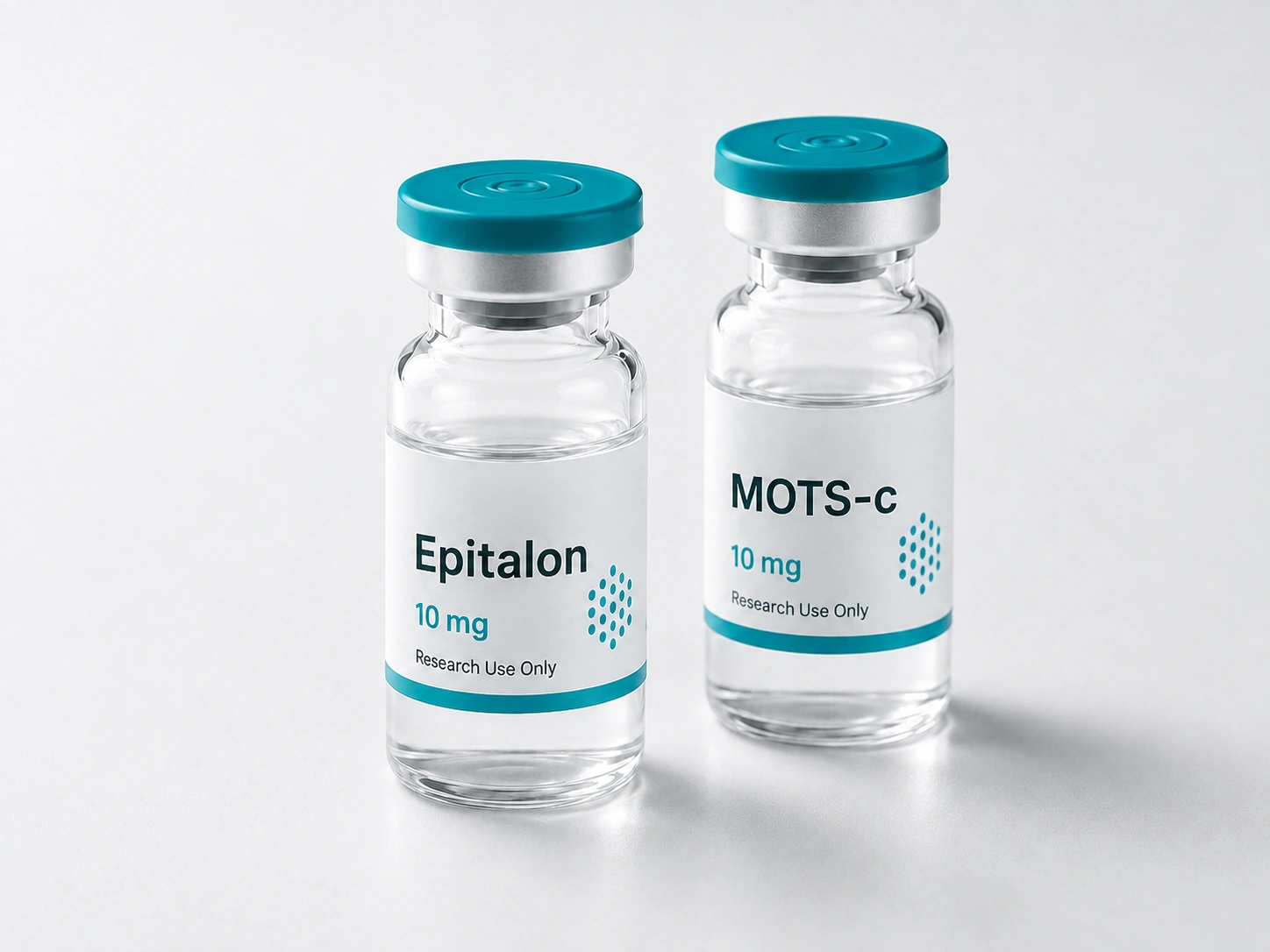
How do they compare, side by side?
How do they compare, side by side?
| Attribute | Epitalon | MOTS-c |
|---|---|---|
| Full name | Epithalon, AEDG, Ala-Glu-Asp-Gly | Mitochondrial open reading frame of the 12S rRNA type-c |
| Length | 4 amino acids | 16 amino acids |
| Discovered by | Vladimir Khavinson's group, St Petersburg | Changhan Lee and Pinchas Cohen's group |
| Where it comes from | Isolated from Epithalamin, a bovine pineal extract | Encoded in mitochondrial DNA [5] |
| Present in your body | Not as such. The parent extract's components are | Yes, circulating and in tissue [5] |
| Changes with exercise | No known relationship | Rises with exercise [6] |
| Proposed mechanism | Switches telomerase back on, lengthening telomeres [1] | Activates AMPK, a cellular energy sensor, partly by raising AICAR more than twentyfold [5] |
| Human trials of the compound | None [2] | None |
| Human evidence that exists | Cell culture only [1][3] | Human cells in culture, plus population genetics on a variant [7][12][13] |
| Independent replication | Yes, 2025, in cell culture [3] | Multiple groups, in animals and cells |
| Animal evidence | Mice, flies, rats, monkeys | Mice, extensively |
| FDA status | Not approved [8] | Not approved [8] |
| July 2026 advisory vote | Recommended [8] | Recommended [8] |
Mechanism
How does each one work?
Two plausible mechanisms, both demonstrated somewhere other than a living person.
Epitalon
Your chromosomes have protective caps called telomeres that shorten each time a cell divides. When they get short enough, the cell stops dividing. An enzyme called telomerase can rebuild them, and in most adult cells it is switched off or barely active.
Epitalon is proposed to switch it back on. The 2003 work found that adding it to human fetal fibroblasts induced hTERT, restored telomerase activity and lengthened telomeres, and the 2004 follow-up found treated cultures divided about ten more times than controls. [1] The 2025 Brunel replication supports the basic finding. [3]
Two things about that. All of it is cells in a dish. And there is a reason telomerase is switched off in adult cells: unrestricted division is what cancer cells do. Any compound proposed to reactivate it carries that question with it. [4]
MOTS-c
Your mitochondria have their own small genome, separate from the DNA in the cell nucleus. MOTS-c is written into that genome, and it appears to act as a signal from mitochondria to the rest of the cell about energy status.
It works partly by raising a molecule called AICAR more than twentyfold, which activates AMPK, the sensor that tells a cell it needs to make energy rather than store it. In mice, that translated into resistance to weight gain and insulin resistance on a high fat diet. [5]
The interesting part is that this is not a foreign signal. Exercise raises MOTS-c on its own, and levels appear to fall with age. [6] So the argument for injecting it is a replacement argument rather than an enhancement one, and nobody has tested whether topping up a signal your body is already adjusting does what the model predicts.
Mechanism summaries compiled from published cell and animal work. Neither mechanism has been demonstrated in a living person.
What are the key differences?
What actually separates them?
Shared: sold for longevity · injected · no published human trial · not FDA approved · both recommended by the advisory committee in July 2026
Epitalon
Size4 amino acids
OriginSynthetic, isolated from a bovine pineal extract
In your body naturallyNo
TargetTelomerase and telomere length
Best evidenceHuman cells in culture
Independent replicationOnce, in 2025, in cells
The evidence problemHuman data belongs to the parent extract
Specific cautionTelomerase activation and cancer history
MOTS-c
Size16 amino acids
OriginEncoded in your own mitochondrial DNA
In your body naturallyYes, and exercise raises it
TargetAMPK and cellular energy signaling
Best evidenceMice, plus human cells in culture
Independent replicationMultiple groups, in animals
The evidence problemNo human data at all
Specific cautionNobody knows what supraphysiological levels do
Summary compiled from published research and regulatory records.
What has nobody answered?
What has nobody answered?
Nobody has given either one to a person in a published study.Not for longevity, not for metabolism, not for anything. Everything written about either compound in humans is extrapolation from cells, from animals, or in Epitalon's case from a different substance.
Nobody has tested the isolated Epitalon peptide in people.The human longevity findings belong to Epithalamin. Testing whether one component of an extract reproduces the whole extract's effect is a specific study that has never been run. [2]
Nobody knows what extra MOTS-c does.Your body makes it, exercise raises it, and levels fall with age. That is the argument for supplementing. It is also a reason to want a dose-response study, because a signal your body regulates is a signal that presumably has a range where it works and a range where it does not. Nobody has looked. [6]
Every dosing protocol you will find is invented.Epitalon circulates as 5 to 10 milligrams daily for ten to twenty days, cycled every four to six months. MOTS-c circulates as 5 to 10 milligrams once or twice weekly for eight to twelve weeks. Neither traces to a published human study, because there are none. The mouse work used 5 milligrams per kilogram per day into the abdominal cavity, which is a different dose by a different route in a different species. [5]
And nobody has run either one long enough to matter.These are compounds sold for aging, which is a decades-long process. The longest human exposure to either is whatever individuals have done to themselves, unmeasured.
What are the side effects, and what are you buying?
What are the side effects?
01Reported
What has been described
Nearly all of this comes from animals and cells rather than people.
- Both described as well tolerated in animal workanimal
- Injection site reactions, reported by users rather than measuredanecdote
- No pattern of serious effects documented for eitherno signal
- No pattern has been documented because nobody has been watchingcaveat
02Unstudied
Nobody has looked
Nobody has run these studies. That is different from a clean result.
- Either compound in a person, in any published trialno data
- Any dose-response relationship, in anyoneno data
- Long-term use, which is the entire proposition being soldno data
- Whether raising MOTS-c above what exercise produces does anythingno data
03Specific
Cautions worth naming
One for each compound, and they are different in kind.
- Telomerase activation is treated as a reason for caution with any history of cancer [4]mechanism
- Seized peptides tested 5 to 75 percent pure, plus arsenic and lead [9]analysis
- A US lab reported problems in almost 30 percent of samples, including bacteria [10]testing
- Every circulating dosing protocol for both is community practice with no published basisfolklore
*Where this page says nothing is established, it means nobody has studied it. It does not mean a compound is safe.
The telomerase point deserves care in both directions. Nobody has shown Epitalon causes cancer, and no study has looked. What is true is that telomerase being switched off in most adult cells is a protective arrangement, that reactivating it is the compound's proposed mechanism, and that the two facts sit uncomfortably together. Neither compound has an approved product to compare a vial against. Our guide on reading a certificate of analysis covers what to actually look for.
Are they banned in sport?
Are they prohibited in sport?
Neither Epitalon nor MOTS-c is named on the 2026 WADA Prohibited List.
Absence from the list does not mean a substance is permitted. A compound can be caught by having a similar structure or a similar effect to something listed.
WADA Prohibited List · general provisions
MOTS-c is the one worth thinking about, because it affects metabolism and muscle and rises with exercise, which puts it closer to the territory the list's catch-all language is written to cover.
If you compete under a testing body, ask that body directly rather than reasoning from absence.
Are they FDA approved?
What is the regulatory position?
First, what the 503A list is. A compounding pharmacy makes medicines to order, mixing ingredients for one patient with a prescription. The FDA keeps a list of which raw ingredients they may use. Getting on that list is not drug approval. It only means a pharmacy may work with the ingredient.
Both compounds went into Category 2 of that list, the shelf for ingredients that may carry significant safety risks, and both came off in April 2026 after the nominations were withdrawn rather than because anything was resolved. [8]
On 23 and 24 July 2026 the FDA's advisory committee reviewed both and recommended both. Epitalon at 7 votes to 5, MOTS-c at 7 to 5 with two abstentions. Six of the seven peptides heard over those two days got favorable votes, against the advice of the FDA's own scientists, who recommended against all of them citing short and underpowered studies. [8]
What that vote does not mean. It is not FDA approval. It is not a finding that either compound is safe or effective. It is a non-binding recommendation. Before anything changes the FDA must accept it and run a formal rulemaking process, which typically takes eight to twenty-four months. Neither compound may legally be compounded today.
And it is worth noticing what the committee was voting on. Neither compound has a published human trial. The FDA scientists' objection was precisely that the evidence was thin. The committee recommended them anyway.
Common questions
Questions people ask
Does Epitalon lengthen telomeres?
In cells in a dish, the published work says yes, and an independent group replicated the basic finding in 2025. Whether it does anything to telomeres in a living person has never been tested.
What about the human studies showing people lived longer?
Those used Epithalamin, an extract from cow pineal glands, not the synthetic four amino acid peptide people inject. Related substances, different things, and the results cannot be transferred without testing the peptide itself.
Is MOTS-c natural?
Yes, in the sense that your mitochondria make it and exercise raises it. That is not the same as knowing what happens when you inject more of it, which nobody has studied.
Is it true that Japanese centenarians have more active MOTS-c?
No, and the claim is backward. The variant found in long-lived Japanese populations produces a less active version of the peptide, and a meta-analysis across more than 27,000 people found it raised type 2 diabetes risk in men. The paper that proposed a longevity link was a hypothesis, not a finding.
Which has better evidence?
Neither has human trial evidence. Epitalon has cell culture with one independent replication. MOTS-c has more extensive animal work and multiple groups involved. Different kinds of nothing, in humans.
Did the FDA just approve them?
No. An advisory committee recommended both for the compounding list in July 2026. That is advisory, it concerns compounding rather than approval, and rulemaking takes many months. Neither is legal to compound today.
Should I worry about the cancer question with Epitalon?
No study shows it causes cancer, and no study has looked. Telomerase is switched off in most adult cells for a reason, and reactivating it is the compound's proposed mechanism. Sources commonly treat a cancer history as a reason not to use it. If that applies to you, this is a conversation for a doctor.
Are they banned in sport?
Neither is named on the 2026 list. MOTS-c affects metabolism and muscle, so the catch-all language could apply. Ask your own anti-doping authority.
References
What this page is built on
- 01Khavinson VKh, Bondarev IE, Butyugov AA. Epithalon peptide induces telomerase activity and telomere elongation in human somatic cells. Bull Exp Biol Med. 2003;135(6):590-592. PMID 12937682. Cell culture study, human fetal fibroblasts. Reports hTERT induction, telomerase activity and telomere elongation qualitatively, without fold-change values, confidence intervals or p-values. A 2004 follow-up in the same journal reported 44 passages against 34 in controls.
- 02The distinction between Epithalamin and Epitalon. Epithalamin is a polypeptide complex extracted from bovine pineal glands, used in Russian clinical studies since the 1970s. Epitalon is the synthetic tetrapeptide identified as its active constituent. The large human observational studies on longevity and cardiovascular aging commonly cited as evidence for Epitalon were conducted using Epithalamin. The two are related but not identical, and the human data cannot be directly attributed to synthetic Epitalon.
- 03Al-Dulaimi S, Matta S, Slijepcevic P, Roberts T. Epitalon increases telomere length in human cell lines through telomerase upregulation or ALT activity. Biogerontology. 2025. DOI 10.1007/s10522-025-10211-8. Cell culture study from Brunel University London, independent of Khavinson's group. Examined normal breast epithelial cells, fibroblasts and breast cancer cell lines. The first independent replication of the 2003 finding.
- 04Anisimov VN, Khavinson VKh, Popovich IG, et al. Effect of Epitalon on biomarkers of aging, life span and spontaneous tumor incidence in female Swiss-derived SHR mice. Biogerontology. 2003. PMID 14501183. Animal study.
- 05Lee C, Zeng J, Drew BG, et al. The mitochondrial-derived peptide MOTS-c promotes metabolic homeostasis and reduces obesity and insulin resistance. Cell Metab. 2015. Discovery paper. MOTS-c encoded within mitochondrial 12S rRNA, detected in tissue and circulation. Raises AICAR more than twentyfold and activates AMPK. In mice, prevented high fat diet-induced weight gain and insulin resistance.
- 06Reynolds JC, Lai RW, Woodhead JST, et al. MOTS-c is an exercise-induced mitochondrial-encoded regulator of age-dependent physical decline and muscle homeostasis. Nat Commun. 2021;12:470. PMID 33469029. Animal and human observational work. Establishes MOTS-c as exercise-induced.
- 07Mitochondrial-derived peptides MOTS-c and humanin attenuate dexamethasone-induced atrophy in human skeletal muscle cells. PMC12930096. Cell culture study using human muscle cells. Notes the poor translation of rodent findings to human therapies as a known limitation in this field.
- 08US Food and Drug Administration. 503A bulk drug substances category updates, Category 2 removals in April 2026 following withdrawal of nominations, and Pharmacy Compounding Advisory Committee meeting of 23 to 24 July 2026. Regulatory documents. Non-binding recommendations, not approval. Epitalon recommended 7 to 5, MOTS-c recommended 7 to 5 with two abstentions. Vote counts for Epitalon are reported as both 7 to 5 and 7 to 4 across sources.
- 09Janvier S, Cheyns K, Canfyn M, Goscinny S, De Spiegeleer B, Vanhee C, Deconinck E. Impurity profiling of the most frequently encountered falsified polypeptide drugs on the Belgian market. Talanta. 2018;188:795-807. DOI 10.1016/j.talanta.2018.06.023. Peer-reviewed analytical study.
- 10NBC Washington. Lab finds problems in 30% of peptide vials tested. December 2024. News report of commercial laboratory testing, not peer reviewed.
- 11Khavinson VKh, Morozov VG. Peptides of pineal gland and thymus prolong human life. Neuro Endocrinol Lett. Human observational work using Epithalamin, not synthetic Epitalon. One of the studies commonly miscited as Epitalon evidence.
- 12Fuku N, Pareja-Galeano H, Zempo H, Alis R, Arai Y, Lucia A, Hirose N. The mitochondrial-derived peptide MOTS-c: a player in exceptional longevity? Aging Cell. 2015;14(6):921-923. PMID 26289118. DOI 10.1111/acel.12389. Hypothesis paper. Notes the m.1382A>C variant in Japanese people with exceptional lifespan and proposes a link. The functional prediction is computational, using Grantham value and the PROVEAN tool, rather than measured.
- 13A pro-diabetogenic mtDNA polymorphism in the mitochondrial-derived peptide MOTS-c. Population genetics across three Japanese cohorts, more than 27,000 individuals in total. Meta-analysis found the m.1382A>C variant significantly increased type 2 diabetes prevalence in men, p less than 0.01, but not in women. The K14Q substitution reduces the peptide's activity as an insulin sensitiser.