
MOTS-c_Dosage, benefits & legal status
Also known as MOTS c, MOTS
A shot people use for energy, metabolism, and healthy aging.
Common vial size is what vendors typically sell, not a recommendation. Enter your own vial in the calculator.
What is MOTS-c?
Plain language first. The technical label stays, but it never stands alone.Overview
It signals cells to burn more fuel and use energy well. That is why it is explored for metabolism and aging.
MOTS-c is a mitochondrial-derived peptide, a short chain your own mitochondria (your cells' power plants) produce, that activates the energy sensor AMPK.
What it's used for
An experimental shot people use for more energy, a faster metabolism, and healthier aging. It works on the tiny energy factories inside your cells.
How does MOTS-c work?
What it does in the body, and where.MOTS-c is unusual: it is coded not by the DNA in your cell nucleus but by the small separate genome inside your mitochondria. Your own cells make it, and levels fall with age.
- 01It switches on AMPK, your low-fuel sensorAMPK is the alarm your cells raise when energy runs short, and it is the same switch that exercise and fasting pull.
- 02Cells burn fat and take in sugar more readilyThe downstream effect of that alarm: stored fuel gets released and used rather than held.
- 03Most of the evidence is from miceThe insulin-sensitivity figures come from animal work. The human data is observational, showing that levels rise with exercise, not that injecting it reproduces the effect.
A schematic of the compound's mechanism, not a diagnostic image.
What else is it used for?
Each group carries its own evidence level.Approved means regulators have cleared it for that purpose. Investigational means it is in trials. Early research means it is being studied and is not established.
Metabolic
Early research- Animal studyIn mice, the body became about 30% better at responding to insulin, the hormone that clears sugar from the blood.
- Animal studyIn mice on a high-fat diet, a muscle-wasting signal called myostatin fell 40% over eight weeks.
- Human observationIn people, natural blood levels of this peptide are lower in those with more insulin resistance.
Exercise and aging
Early research- Animal studyIn mice, every animal on the higher dose reached the top treadmill sprint stage, against 17% on the lower dose and none of the untreated controls.
- Human observationIn people, natural levels of this peptide in muscle rose almost 12-fold after exercise, which is how it was discovered.
- No dataA phase 2a trial of injected MOTS-c started recruiting in February 2026, the first in people. It has reported nothing.
The often-quoted 30% insulin sensitivity improvement comes from a mouse study, not from people. A phase 2a trial of injected MOTS-c did start recruiting in February 2026, so it is no longer true that nobody has tested it in people, but that trial has published nothing. Any human figure quoted for MOTS-c today is still coming from somewhere other than a trial result.
The published record
Papers and trials about MOTS-c
Searched: MOTS-c, MOTS c.
Left out: mitochondrial derived peptide (alone) (a class term covering humanin, the SHLPs, SHMOOSE and MENTSH); CB4211 (the analog, which now has its own slug); 12S rRNA (the host region, with a large phylogenetics literature).
150 papers tagged human · 86 not reviews or lab · 5 clinical trial publications
5 registered trials · none with posted results
Furthest stage reached: Phase 2, under way
Compare this against the whole library →
Uses evaluated: obesity and osteoporosisRegulatorsCounted from Europe PMC indexing, not read by a person; a human tag can land on reviews, commentary or lab papers; clinical trial publications is the narrower count.
At a glance
Four things to know about MOTS-c
How much, and do you cycle it?
The range, and whether you take breaks.1 up to 5 mg per day (start low, increase slowly), daily. No established schedule No range
No published study has established how long to take this or whether a break is needed. Schedules quoted online come from vendors and forums, and different sources disagree.
Nothing publishedNo figure
No human pharmacokinetic figure has been published, and the rodent work has not characterized how fast it clears either. The phase 2a trial that began in February 2026 is the first chance of a human number.
You can compare this against the whole library to see where it sits.
How do I dose and price it?
Enter your vial and your dose. Pick a mix. We show the draw and the cost.The vial holds a fixed amount of drug. Adding more water does not make more drug, it just spreads it thinner, so you draw a bigger number on the syringe for the same dose.
Choose your mix
Measuring the water1 mL = one full 100-unit syringe.
MOTS-c starts at $20.34 across 182 vendors, typically $2.48 – $7.70 per mg.
332 listings, last read Oct 24, 2026. Shipping and card fees are not included.
How do you store it?
Before mixing, and after.Dry powder in the freezer or fridge. Once mixed, fridge, and use within about a month.
Unmixed lyophilized MOTS-c keeps for a long time cold. Once you add water the clock starts: most reconstituted vials hold up for roughly 28 to 30 days at fridge temperature. Keep it out of light, and do not freeze it after mixing.
What are the side effects and cautions?
Known cautions and warnings for this compound.Solubility, computed: 44% charged residues, 44% hydrophobic. Water usually sufficient.
A first-pass rule from peptide manufacturers' guidance. It does not account for disulfide bridges, salt form or how the powder was dried, and it predicts what should be easy rather than what will happen in your vial.
Who should avoid it
- No controlled human trials exist, so no contraindications are established
- Pregnancy
- Banned in drug-tested sport
Stop and get help
- Signs of an allergic reaction
- Anything unusual, given the absence of human data
Common effects
- Unknown in humans. Studied only in cells and animals
Where this page says nothing is established, that means nobody has studied it, not that a compound is safe.
Is MOTS-c approved?
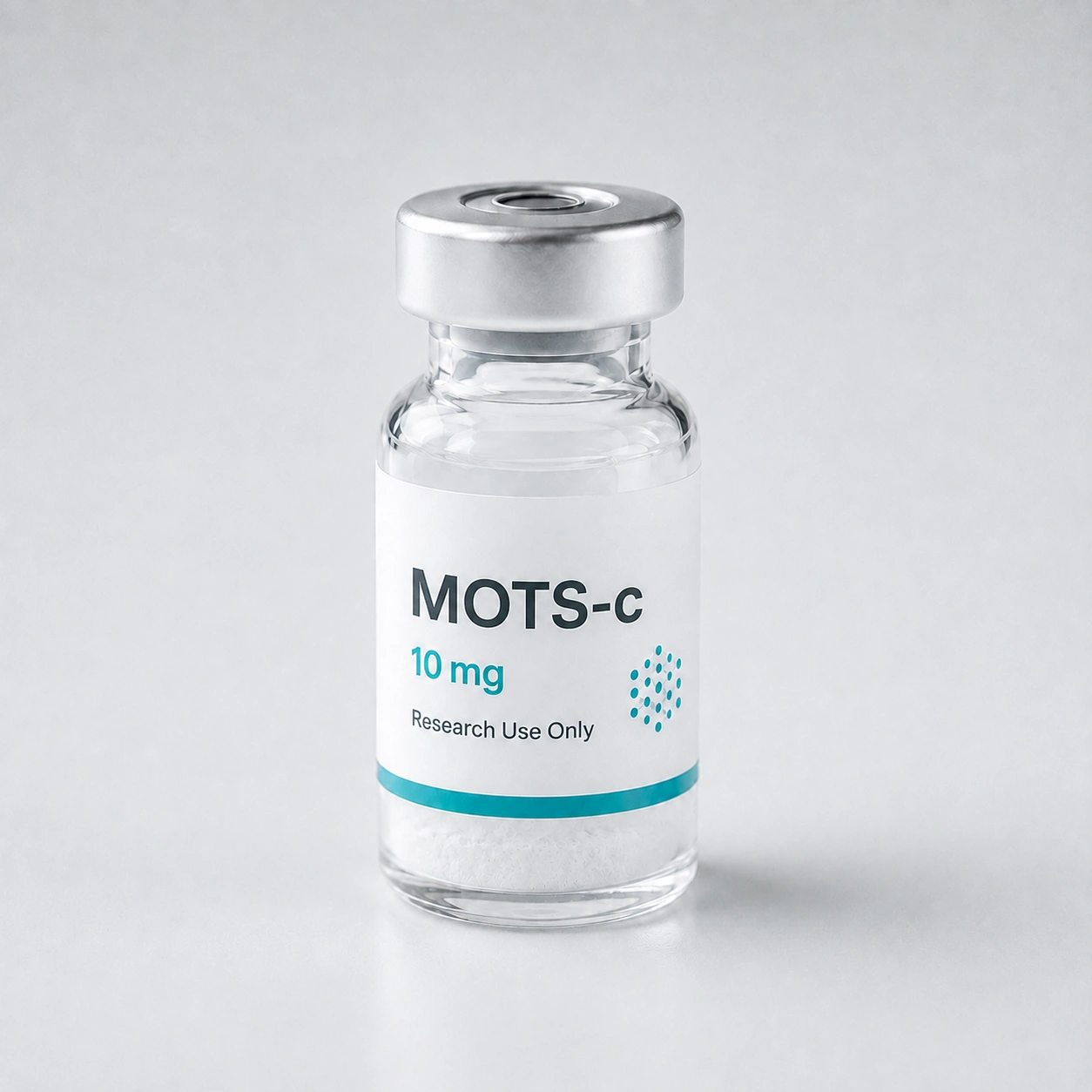
And where the numbers on this page come from.No. MOTS-c is not approved for any use, anywhere. It is sold labeled for laboratory research only, and there is no legal route to buy it for human use.
- Approval statusResearch only
- RouteUnder the skin (subcutaneous)
- Checked23 October 2026
- DoseFrom community reports. No regulator or trial established this dose.
- Vial sizeFrom what vendors typically list; not a recommendation.
- Sources
What has happened recently
Not eligible for compounding under Section 503A: no monograph, not a component of an approved drug, not on the Bulks List. Previously in Category 2; the nomination was withdrawn. An FDA advisory committee recommended inclusion on July 23-24, 2026; that recommendation is non-binding and no rule has taken effect. The use the FDA evaluated: Obesity and osteoporosis. Evaluation is not approval; if listed, the listed use would define what a pharmacy could compound it for. The FDA’s safety page states that it has identified no human exposure data on drug products containing this substance administered via any route of administration.
What regulators say
From official documentsBriefing package prepared for the July 23, 2026 session
FDA's proposal for MOTS-c is in its own briefing document, not read at source here
Checked 22 September 2026FDA: FDA Briefing Document, Pharmacy Compounding Advisory Committee meeting of July 23 to 24, 2026: introduction and FDA proposalsConsidered at the July 23, 2026 session
Checked 22 September 2026FDA: July 23 to 24, 2026 meeting of the Pharmacy Compounding Advisory Committee: meeting materialsNominated but withdrawn; previously category 2
FDA has not identified any human exposure data for any route
Checked 11 September 2026FDA: Certain Bulk Drug Substances for Use in Compounding that May Present Significant Safety Risks (category 2 and withdrawn nominations), current as of April 22, 2026Uses evaluated: obesity and osteoporosis
Checked 22 September 2026FDA: Federal Register notice of April 16, 2026: Pharmacy Compounding Advisory Committee meeting, bulk drug substances nominated for the 503A listProhibited at all times, in and out of competition. S4.4.1 Metabolic modulators: activators of AMP-activated protein kinase (AMPK), e.g. mitochondrial open reading frame of the 12S rRNA-c (MOTS-c). Non-Specified.
Checked 12 September 2026WADA: The 2026 Prohibited List (in force 1 January 2026)
Banned in drug-tested sport. Most research peptides are prohibited under WADA's S0 category, which covers any substance with no approval from any regulatory authority for human use. That means a compound can be banned without ever being named on the prohibited list. Check with your own anti-doping authority rather than assuming absence from the list means permitted.
You can compare this against the whole library, or read how to check a seller.
What else is like MOTS-c?
Others in Longevity and energy, side by side.If you're weighing MOTS-c, it's worth reading Epitalon, SS-31 (Elamipretide), and FOXO4-DRI in the same class.
A shot people use for energy, metabolism, and healthy aging.
- Dose
- 1 up to 5 mg per day (start low, increase slowly)
- How often
- Daily
A longevity peptide taken in short courses for sleep and anti-aging.
- Dose
- 5 up to 10 mg per day (start low, increase slowly)
- How often
- 10-20 day courses
A mitochondrial peptide, approved in 2025 for the rare genetic disease Barth syndrome.
- Dose
- 2 to 5 mg per day (community-reported)
- How often
- Daily
An experimental senolytic that clears aging cells, with no human safety data.
- Dose
- Research only
- How often
- Cycled
Also sold in a blend: MitoPrime blend (NAD+ / MOTS-c / 5-Amino-1MQ)
Compared with
One has an FDA approval and a failed Phase 3. The other has never been given to a person in a published study.
Read comparison →Two longevity peptides with no published human trial between them. Epitalon's famous human data belongs to a bovine extract, and MOTS-c is something your body already makes.
Read comparison →Guides for this compound
- How to Reconstitute a Peptide
Mix peptide powder with bacteriostatic water, step by step.
- How to Read an Insulin Syringe
Read the units, convert to millilitres, and draw the exact dose.
- mcg vs mg: The Peptide Dosing Mistake to Avoid
Your vial says mg and your protocol says mcg. Here is the conversion and how to check it.
- How to Read a Peptide COA
What the purity number does and does not tell you, and how to spot an edited report.
- How to Vet a Peptide Vendor
Independent COAs, HPLC purity, and the red flags that mean walk away.
Sources
- FDA, bulk substances that may present significant safety risks(2026)FDA states that it has identified no human exposure data by any route for this substance.
- MOTS-c and insulin sensitivity, PubMed Central
- MOTS-c, exercise and aging, Nature Communications, 2021
- FDA, Pharmacy Compounding Advisory Committee meeting, July 23-24, 2026(2026)FDA meeting page listing the bulk drug substances reviewed and the uses considered.
- MOTS-c phase 2a trial record, ClinicalTrials.gov NCT07505745(2026)The first registered human trial of MOTS-c itself: a phase 2a study in adults with prediabetes and overweight or obesity, sponsor Hudson Biotech, 120 participants planned, started February 2, 2026 and recruiting. MOTS-c or placebo once daily under the skin for 12 weeks, with insulin sensitivity by the Matsuda index at 12 weeks as a primary endpoint alongside safety. No dose is published and no results have been reported.
Beyond these, 286 records are indexed. Browse the records