
All comparisons
MOTS-c vs SS-31
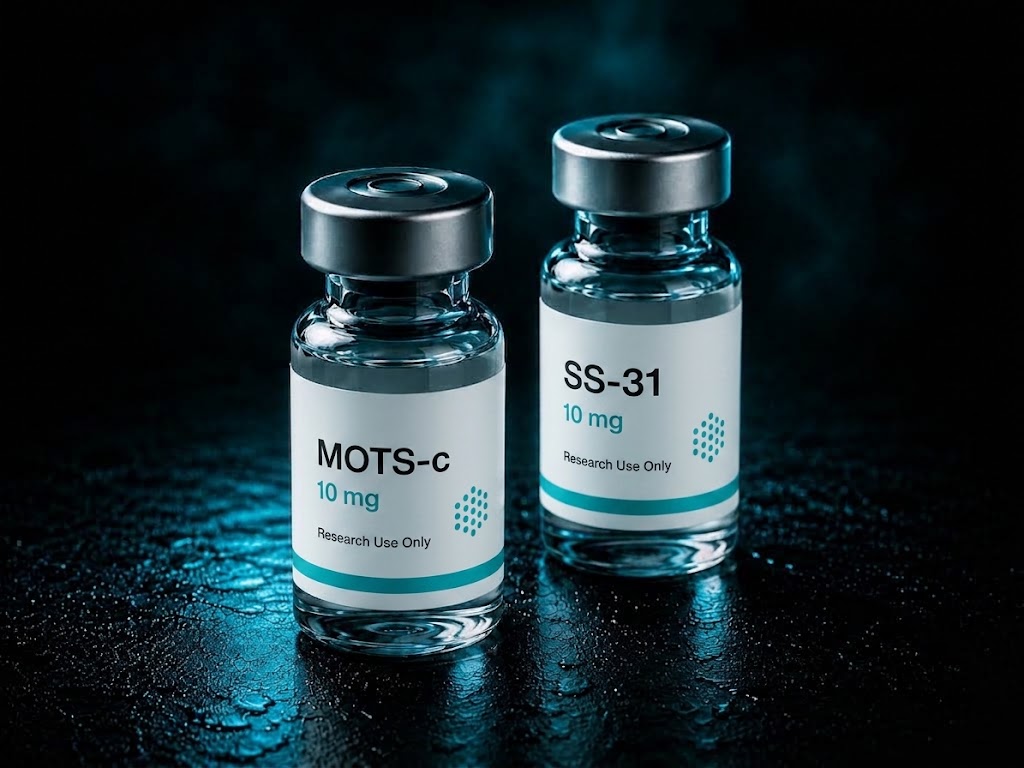
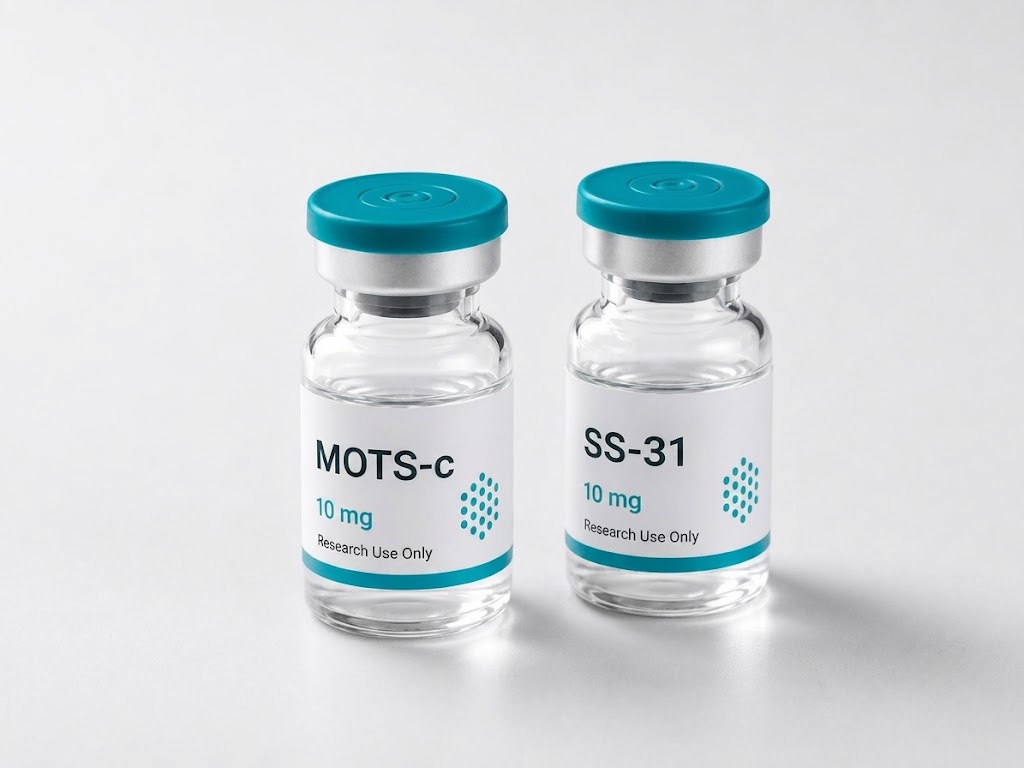
Both are sold as mitochondrial peptides for energy and aging. SS-31 is elamipretide, approved by the FDA in September 2025 for a rare inherited disease, with a decade of trials behind it including one that missed its endpoints in 218 patients. MOTS-c has no published human trial of any kind.
- Mitochondria
- One is approved
- Neither is approved for longevity
Published August 17, 2026 · Updated October 8, 2026
The short answer
Has either one actually been tested in people?
SS-31 went through the full process and came out with a narrow approval for one rare disease. MOTS-c has never been given to a person in a published study.
| Attribute | MOTS-c | SS-31 |
|---|---|---|
| Proper name | MOTS-c | Elamipretide, brand name Forzinity |
| Length | 16 amino acids | 4 amino acids |
| Where it comes from | Your own mitochondrial DNA [1] | Designed by chemists [5] |
| Human trials | None | Four randomized trials. None met its primary endpoint [6][7][14][15] |
| FDA status | Not approved [10] | Accelerated approval, 19 September 2025, for Barth syndrome [8] |
| Approved for longevity | No | No |
The approval covers one rare inherited disease. Research-grade SS-31 is not the approved product.
Endogenous · Metabolic signal · Untested in people
MOTS-c
Sixteen amino acids, written into the small separate genome inside your mitochondria rather than the DNA in your cell nucleus. In plain terms: a signal your mitochondria send out about energy status, which rises when you exercise.
Length16 amino acids
OriginYour own mitochondrial DNA
Human trialsNone
Rises with exerciseYes

Designed · Cardiolipin · Approved for one disease
SS-31
Four amino acids, two of them not the standard building blocks your body uses, designed to concentrate inside mitochondria and stick to a specific fat in the inner membrane. In plain terms: a drug built to stabilise mitochondrial structure, approved for one rare inherited condition.
Length4 amino acids
OriginDesigned by chemists
Human trialsMultiple, Phase 1 to Phase 3
FDA approvedSeptember 2025, accelerated, for Barth syndrome
What is actually known
Are they even the same kind of thing?
One is a research chemical. One is a prescription medicine with a research chemical version. The word peptide covers both, and almost nothing else does.
MOTS-c is endogenous. Your mitochondria have their own small genome and MOTS-c is encoded in it. It circulates in your blood, it rises with exercise, and levels appear to fall with age. [1][2] Nobody has ever given it to a person in a published study.
SS-31 is a designed drug. Four residues, including a D-form arginine and a modified tyrosine, chosen so the molecule concentrates hundreds of times over inside mitochondria. It has been through Phase 1, Phase 2 and Phase 3 trials for several conditions, and it was approved in September 2025. [5][8]
And here is the distinction that trips people up. SS-31 being approved does not make the SS-31 you can buy an approved product. The approval belongs to Forzinity, manufactured to pharmaceutical standard and dispensed on prescription for one rare disease. A vial of research-grade SS-31 is nominally the same molecule and none of the rest of it. This is the third compound in this library where that distinction matters, alongside Melanotan I and tesamorelin. The approval belongs to a product, not to a molecule.
MOTS-c16 amino acids, encoded in your own mitochondria
01
02
03
04
05
06
07
08
09
10
11
12
13
14
15
16
SS-314 amino acids, two of them not naturally occurring, designed
D-Arg
Dmt
Lys
Phe
One your body writes, one chemists wrote.
Opposite origins. One is read off your own mitochondrial genome. One was built to solve a delivery problem.
Opposite evidence. One has none in humans. One has a decade of trials and an approval.
Same shelf. Both are sold as research chemicals for longevity, which neither is approved for.
What does the evidence actually show?
Why did the approved drug fail its biggest trial?
0 of 4
Randomized SS-31 trials that met their primary endpoint, including the one behind the approval
218
Patients in MMPOWER-3, which missed both primary endpoints
0
Published human trials of MOTS-c, of any kind
2004→
SS-31
A family of mitochondria-targeted peptides
Work begins on peptides designed to concentrate inside the inner mitochondrial membrane. SS-31 emerges as the lead compound, later named elamipretide. [5]
2015
MOTS-c
Discovery paper
Lee, Cohen and colleagues describe MOTS-c, encoded within mitochondrial 12S rRNA and detectable in tissue and circulation. It raises AICAR more than twentyfold and activates AMPK. In mice it prevented weight gain and insulin resistance on a high fat diet. [1]
2015
MOTS-c
The longevity hypothesis
Fuku and colleagues publish a hypothesis paper noting a mitochondrial variant found in Japanese people with exceptional lifespan. The title ends in a question mark, and later work found the variant produces a less active peptide and raises diabetes risk in men. [3][4]
2016
SS-31
EMBRACE-STEMI
A Phase 2a trial in patients having a heart attack, testing whether elamipretide could limit damage when blood flow is restored. It did not improve the primary or secondary outcomes. Published in the European Heart Journal. [14]
2017–18
SS-31
Phase 1 and Phase 2 in mitochondrial myopathy
An early ascending-dose trial gave five days of intravenous elamipretide and reported it well tolerated, with headache the most common event at about 17 percent. [9] Karaa and colleagues publish a randomized dose-escalation trial in Neurology. [7]
2020
SS-31
PROGRESS-HF
A Phase 2 trial in 71 patients with heart failure, testing 4 milligrams or 40 milligrams daily against placebo for 28 days, with heart volume measured by MRI. Neither dose beat placebo, at p equals 0.90 and p equals 0.28. [15]
2021
MOTS-c
Exercise-induced
Reynolds and colleagues publish in Nature Communications, establishing MOTS-c as exercise-induced. Animal and observational work. [2]
2021
SS-31
TAZPOWER, the Barth syndrome trial
Only 12 patients were randomized, which is what an ultra-rare disease allows. It did not significantly improve walking distance or fatigue, its two primary endpoints, and muscle strength did not improve during the randomized phase either. Improvement in knee extensor strength appeared later, during the open-label extension, where 10 of the 12 continued and 8 reached week 168. [7]
2023
SS-31
MMPOWER-3, the pivotal Phase 3
218 patients with genetically confirmed primary mitochondrial myopathy, randomized evenly, 40 milligrams daily by injection for 24 weeks, mean age 45.6. It missed both of its primary endpoints, walking distance and fatigue score. [6] Our SS-31 tiredness guide examines the fatigue findings and the “repair stage” explanation.
- six-minute walk test, missed
- total fatigue score, missed
2024
SS-31
A subgroup finding
A pre-planned reanalysis of MMPOWER-3 by genetic subtype finds a real effect in one group. Patients with a particular class of mitochondrial DNA disorder gained 37.3 meters on the walking test while the placebo group lost 8.0, p equals 0.0024. Graded Class I evidence. A follow-up Phase 3 called NuPOWER is designed around that subgroup. [11]
May 2025
SS-31
The FDA rejects the application
Stealth BioTherapeutics lays off about 30 percent of its staff. Over the following months, members of Congress write to the FDA Commissioner about the review, and a group of physicians and scientists writes asking the agency to reconsider. [8]
Sep 2025
SS-31
Accelerated approval
On 19 September the FDA grants accelerated approval to Forzinity, to improve muscle strength in adults and children with Barth syndrome weighing at least 30 kilograms. It is the first approved treatment for the condition and the first approved mitochondria-targeted drug. Roughly 150 people in the United States have Barth syndrome. The FDA's own language: the evidence is reasonably likely to predict patient benefit but does not directly assess the benefit to the patient. [8]
Jul 2026
MOTS-c
Advisory committee vote
The FDA's advisory committee recommends MOTS-c for the compounding list, 7 votes to 5 with two abstentions, against the advice of FDA scientists who objected that the evidence was thin. [10]
Today
Both
One prescription medicine, one untested signal
SS-31 is a prescription medicine for one disease. MOTS-c has never been given to a person in a published study.
MMPOWER-3 enrolled 218 patients and missed both primary endpoints. That is a negative result, published in a major neurology journal, by the company that stood to gain from a positive one. What happened next is why it matters: a pre-planned look at genetic subgroups found a clear effect in patients with one particular type of mitochondrial DNA disorder, and a new Phase 3 was built around it.
And it is not one failure. Elamipretide missed its outcomes in a heart attack trial in 2016, missed its endpoint at both doses in a heart failure trial in 2020, missed both endpoints in mitochondrial myopathy in 2023, and missed both primary endpoints in the Barth syndrome trial that led to its approval. [6][7][14][15] Four randomized trials, none met its primary endpoint.
The approval still happened, and understanding why is the useful part. Barth syndrome affects about 150 people in the United States, so a large trial is not possible. TAZPOWER randomized twelve. The muscle strength improvement that supported the approval appeared in the open-label extension, where eight patients reached week 168. The FDA granted accelerated approval, a pathway built for exactly this situation, and said plainly that the evidence is reasonably likely to predict benefit but does not directly assess it. [8]
So SS-31's file contains four missed primary endpoints, one pre-planned subgroup finding, a redesigned trial, a rejection, and then an accelerated approval in an ultra-rare disease. That is what a real development program looks like when the disease is too rare for conventional evidence. MOTS-c's file contains mice, cells and a hypothesis paper. Not because MOTS-c failed, but because nobody has tried.
How do they compare, side by side?
How do they compare, side by side?
| Attribute | MOTS-c | SS-31 |
|---|---|---|
| Also called | Mitochondrial ORF of the 12S rRNA type-c | Elamipretide, Bendavia, MTP-131, Forzinity |
| Length | 16 amino acids | 4 amino acids |
| Sequence notes | Standard residues, endogenous | D-Arg and a modified tyrosine, not naturally occurring |
| Developed by | Discovered by Lee and Cohen's group | Stealth BioTherapeutics |
| Mechanism | Activates AMPK, partly by raising AICAR more than twentyfold [1] | Binds cardiolipin in the inner mitochondrial membrane, stabilising structure [5] |
| Made in your body | Yes | No |
| Rises with exercise | Yes [2] | Not applicable |
| Human trials | None | Phase 1 through Phase 3, multiple conditions [6][7] |
| Largest trial | None | 218 patients [6] |
| That trial's result | Not applicable | Missed both primary endpoints [6] |
| Trial record | None | Four randomized trials, none met its primary endpoint. Approved anyway, via accelerated approval [6][7][8][14][15] |
| Dose in trials | None | 40 mg daily by injection [6][15] |
| FDA approved | No [10] | Yes, September 2025, for Barth syndrome [8] |
| Approved for aging | No | No |
| Advisory committee | Recommended for compounding July 2026 [10] | Not applicable, it has an approval |
Mechanism
How does each one work?
Both act on mitochondria, and that is where the similarity stops.
MOTS-c
Your mitochondria send messages to the rest of the cell about energy status, and MOTS-c appears to be one of them. It works partly by raising a molecule called AICAR more than twentyfold, which switches on AMPK, the sensor that tells a cell to make energy rather than store it. [1]
That is the same switch exercise flips, which is why MOTS-c gets called an exercise mimetic. It is also the reason for an obvious unanswered question: if training raises it naturally, what does injecting more do, and where does the benefit stop? Nobody has looked. [2]
SS-31
Mitochondria have an inner membrane folded into deep pleats, and the folding depends on a fat called cardiolipin. When cardiolipin is damaged or abnormal, the folds flatten, the electron transport chain works less efficiently, and more reactive oxygen leaks out.
SS-31 was designed to concentrate inside mitochondria and bind cardiolipin, stabilising the structure. [5] That is a mechanical fix rather than a signaling one, which is why it was developed for diseases where cardiolipin is specifically abnormal. Barth syndrome is exactly that: a genetic fault in the tafazzin gene produces abnormal cardiolipin. [8]
Why the mechanism explains the trial results. SS-31 failed in heart attack, failed in heart failure, and missed both endpoints in a mixed population of mitochondrial myopathy patients. [6][14][15] It succeeded in Barth syndrome, where a genetic fault makes cardiolipin abnormal, and in a genetically defined subgroup within the myopathy trial. [8][11] That is a pattern rather than a run of bad luck. The signals appear where cardiolipin is genetically abnormal and are absent where it is not, and even in Barth syndrome the randomized comparison did not reach significance. [7]
Which is the reason to be cautious about the longevity use. In a healthy person, cardiolipin is not broken. There is no evidence the drug does anything when there is nothing specific to stabilise, and three failed trials in people who did have real disease.
Mechanism summaries compiled from published trials and laboratory work.
What are the key differences?
What actually separates them?
Shared: both target mitochondria · both are injected · both are sold as research chemicals for longevity · neither is approved for aging · neither has been tested in healthy people
MOTS-c
OriginEncoded in your own mitochondrial DNA
Size16 amino acids
ApproachSignaling, via AMPK
Human trialsNone
Approved anywhereNo
Regulatory positionRecommended for compounding, July 2026
Rises with exerciseYes
What is unknownEverything, in humans
SS-31
OriginDesigned, with non-natural residues
Size4 amino acids
ApproachStructural, stabilising cardiolipin
Human trialsPhase 1 through Phase 3
Approved anywhereYes, September 2025, for Barth syndrome
Regulatory positionApproved product, plus a research chemical version
Rises with exerciseNot applicable
What is unknownWhether it does anything in healthy people
Summary compiled from published trials and regulatory records.
What has nobody answered?
What has nobody answered?
Nobody has given MOTS-c to a person in a published study.Not once, for anything. Every claim about it in humans is extrapolation from mice, cells, and observations about circulating levels.
Nobody has tested SS-31 for aging.Its trials were in people with specific mitochondrial diseases, where a specific thing is broken. Whether stabilising cardiolipin does anything measurable in a healthy person whose cardiolipin is fine has never been studied, and the mechanism gives some reason to doubt it.
Nobody knows what extra MOTS-c does.Exercise raises it. Levels fall with age. That is the argument for supplementing, and it is also the reason a dose-response study is needed before anyone can say what a useful amount looks like. [2]
The doses people use are not the doses that were studied.The trials used 40 milligrams of elamipretide daily by injection, in both PROGRESS-HF and MMPOWER-3. [6][15] Community protocols circulate at a fraction of that. Neither the trial dose nor the smaller one has been studied in a healthy person, and a dose chosen for a rare disease is not automatically the right dose for anything else.
And nobody has compared them.No trial has put the two against each other, and they work through unrelated mechanisms, so there is no reason to assume one substitutes for the other.
What are the side effects, and what are you buying?
What are the side effects, and what do we know?
01Measured
SS-31, from its trials
Years of adverse event data across multiple Phase 2 and Phase 3 studies.
- Injection site reactions, the dominant reported event across the program [7]trial data
- Headache, reported in about 17 percent in an early intravenous trial [9]trial data
- Dizziness and gastrointestinal symptoms at lower rates [7]trial data
- Generally described as well tolerated across trials lasting monthstrial data
02Unstudied
MOTS-c, and both for aging
Nobody has run these studies. That is different from a clean result.
- MOTS-c in a person, in any published trialno data
- Either compound in healthy people for longevityno data
- Any dose-response relationship for MOTS-cno data
- Long-term use of either, which is the proposition being soldno data
03Supply
What you are actually buying
One has an approved product. Neither research version is it.
- Forzinity is the approved SS-31 product. Research-grade and compounded SS-31 are not [8]regulatory
- MOTS-c has no approved product anywhere to compare a vial againstregulatory
- The trials used 40 mg daily. Community doses are much lower and unstudieddosing
- Testing of seized peptides found purity between 5 and 75 percent, plus arsenic and lead [12]analysis
- One US lab reported problems in almost 30 percent of samples, including bacteria [13]testing
*Where this page says nothing is established, it means nobody has studied it. It does not mean a compound is safe.
SS-31 has the best safety dataset of any compound in this category, and it is worth being precise about why. Multiple Phase 2 and Phase 3 trials ran for months in patients who were monitored throughout, and the company had to report everything. None of that transfers automatically to a research-grade vial used at a dose nobody studied, in a person with no disease, for a purpose never tested. Our guide on reading a certificate of analysis covers what to actually look for.
Are they banned in sport?
Are either of them prohibited in sport?
Neither MOTS-c nor SS-31 appears by name on the 2026 WADA Prohibited List.
Absence from the list does not mean a substance is permitted. A compound can be caught by having a similar structure or a similar effect to something listed.
WADA Prohibited List · general provisions
MOTS-c is the one worth thinking about, because it affects metabolism and muscle and rises with exercise, which is close to the territory the list's catch-all language covers.
If you compete under a testing body, ask that body directly rather than reasoning from absence.
Are they FDA approved?
What is the legal and regulatory position?
SS-31 is approved, for one disease, on an accelerated pathway. The FDA granted accelerated approval to elamipretide as Forzinity on 19 September 2025, to improve muscle strength in adults and children with Barth syndrome weighing at least 30 kilograms. Barth syndrome is a rare X-linked condition caused by a fault in the tafazzin gene, which produces abnormal cardiolipin. About 150 people in the United States have it. [8]
Accelerated approval means the evidence bar is different, and the FDA said so directly: the evidence is reasonably likely to predict patient benefit but does not directly assess the benefit to the patient. Continued approval depends on confirmatory trials. The application had been rejected in May 2025 and refiled under this pathway.
None of that makes the approval improper. It is the pathway built for diseases too rare to study conventionally, and Forzinity is the first treatment those patients have had. It does mean the approval is a narrower statement than approvals usually are. That approval covers Barth syndrome. It does not cover aging, energy, athletic performance or general mitochondrial support, and research-grade SS-31 is not Forzinity, however similar the powder.
MOTS-c is not approved anywhere. It went through the FDA's 503A bulk substances process, into Category 2 and then out again in April 2026 after nominations were withdrawn rather than because anything was settled. On 23 July 2026 the advisory committee recommended it for the compounding list, 7 votes to 5 with two abstentions, against the advice of FDA scientists who objected that the evidence was thin. [10] That recommendation is not approval, it is not binding, and rulemaking would take many months. MOTS-c cannot legally be compounded today.
The asymmetry is worth stating plainly. One of these compounds has been through the full regulatory process and emerged with a narrow indication. The other was recommended for a compounding list on the strength of no human trials at all.
Common questions
Questions people ask
Is SS-31 FDA approved?
Elamipretide was approved in September 2025 as Forzinity, for Barth syndrome. That is one rare inherited disease. It is not approved for aging, energy or performance, and research-grade SS-31 is not the approved product.
Did SS-31 fail its trials?
All four randomized trials missed their primary endpoints, including the Barth syndrome one. A reanalysis of the myopathy trial found a clear effect in one genetic subgroup, which led to a new Phase 3. The approval rests on open-label follow-up data in a disease too rare for a large trial.
Does MOTS-c have any human trials?
No. None, for anything. Everything known about it comes from mice, cells, and observations about circulating levels.
Which has better evidence?
SS-31, by a very large margin, for the diseases it was studied in. Neither has evidence for aging in healthy people.
How many SS-31 trials succeeded?
None of the four randomized ones met its primary endpoint, including the Barth syndrome trial that led to the approval. The approval came through the accelerated pathway, supported by muscle strength gains during open-label follow-up in eight patients, in a disease affecting about 150 people in the United States.
Can I use SS-31 for general energy or aging?
It has not been tested for that. Its mechanism is stabilising a specific fat in mitochondrial membranes, and it was developed for conditions where that fat is abnormal. Whether it does anything when nothing is broken is unstudied.
Did the FDA approve MOTS-c?
No. An advisory committee recommended it for the compounding list in July 2026. That is advisory, it concerns compounding rather than approval, and nothing has changed yet.
Are they banned in sport?
Neither is named on the 2026 list. MOTS-c affects metabolism and muscle, so catch-all language could apply. Ask your own anti-doping authority.
References
What this page is built on
- 01Lee C, Zeng J, Drew BG, et al. The mitochondrial-derived peptide MOTS-c promotes metabolic homeostasis and reduces obesity and insulin resistance. Cell Metab. 2015. Discovery paper. MOTS-c encoded within mitochondrial 12S rRNA, detected in tissue and circulation. Raises AICAR more than twentyfold and activates AMPK. Mouse work used 5 mg/kg/day into the abdominal cavity.
- 02Reynolds JC, Lai RW, Woodhead JST, et al. MOTS-c is an exercise-induced mitochondrial-encoded regulator of age-dependent physical decline and muscle homeostasis. Nat Commun. 2021;12:470. PMID 33469029. Animal and human observational work.
- 03Fuku N, Pareja-Galeano H, Zempo H, et al. The mitochondrial-derived peptide MOTS-c: a player in exceptional longevity? Aging Cell. 2015;14(6):921-923. PMID 26289118. Hypothesis paper. The functional prediction is computational rather than measured, and the authors state that further research is needed.
- 04A pro-diabetogenic mtDNA polymorphism in the mitochondrial-derived peptide MOTS-c. Population genetics across three Japanese cohorts, more than 27,000 individuals. The m.1382A>C variant significantly increased type 2 diabetes prevalence in men. The substitution reduces the peptide's activity.
- 05Birk AV, Liu S, Soong Y, et al. The mitochondrial-targeted compound SS-31 re-energizes ischemic mitochondria by interacting with cardiolipin. J Am Soc Nephrol. Laboratory work establishing the cardiolipin mechanism.
- 06Efficacy and safety of elamipretide in individuals with primary mitochondrial myopathy: the MMPOWER-3 randomized clinical trial. Neurology. 2023 Jul 18;101(3):e238-e252. PMID 37268435. Trial NCT03323749. Human Phase 3, randomized, double blind, placebo controlled. 218 patients, 40 mg daily subcutaneously for 24 weeks, mean age 45.6. The study did not meet its primary endpoints on the six-minute walk test or the total fatigue score.
- 07Karaa A, et al. Randomized dose-escalation trial of elamipretide in adults with primary mitochondrial myopathy. Neurology. 2018. PMID 30587518. And Reid Thompson W, et al. TAZPOWER, a randomized, double blind, placebo controlled crossover trial in Barth syndrome. PMID 34192522. Human trials. TAZPOWER randomized 12 patients and did not significantly improve either primary endpoint. Knee extensor strength improvement appeared during the open-label extension, where 10 of 12 continued and 8 reached week 168. Injection site reactions were the most common adverse event across the program.
- 08US Food and Drug Administration. Accelerated approval of FORZINITY (elamipretide HCl) injection, 19 September 2025. NDA 215244, Stealth BioTherapeutics. Regulatory document. Indication: to improve muscle strength in adult and pediatric patients with Barth syndrome weighing at least 30 kg. First approved treatment for Barth syndrome. Approximately 150 affected individuals in the United States. The application received a complete response letter on 15 May 2025 and was refiled on 15 August 2025. FDA stated the evidence is reasonably likely to predict patient benefit but does not directly assess the benefit to the patient.
- 09SPIMM-201. Phase 1/2 multicentre, randomized, double blind, placebo controlled multiple ascending intravenous dose trial in primary mitochondrial myopathy. Well tolerated with no increase in adverse events against placebo. Headache in about 17 percent, dizziness in three subjects, no severe treatment-related events.
- 10US Food and Drug Administration. 503A bulk drug substances Category 2 removals, April 2026, and Pharmacy Compounding Advisory Committee meeting of 23 to 24 July 2026. MOTS-c recommended 7 to 5 with two abstentions. Regulatory documents. Non-binding recommendation, not approval.
- 11Genotype-specific effects of elamipretide in patients with primary mitochondrial myopathy: a post hoc analysis of the MMPOWER-3 trial. 2024. Human data, pre-planned genetic subgroup analysis. Patients with chronic progressive external ophthalmoplegia gained 37.3 meters on the six-minute walk test against a loss of 8.0 meters on placebo, p equals 0.0024. Graded Class I evidence. Formed the basis for the NuPOWER Phase 3 trial.
- 12Janvier S, Cheyns K, Canfyn M, Goscinny S, De Spiegeleer B, Vanhee C, Deconinck E. Impurity profiling of the most frequently encountered falsified polypeptide drugs on the Belgian market. Talanta. 2018;188:795-807. Peer-reviewed analytical study.
- 13NBC Washington. Lab finds problems in 30% of peptide vials tested. December 2024. News report of commercial laboratory testing, not peer reviewed.
- 14EMBRACE STEMI. A Phase 2a trial of intravenous MTP-131 on reperfusion injury in patients undergoing primary percutaneous coronary intervention. Eur Heart J. 2016;37:1296-1303. Human Phase 2a. Elamipretide did not improve the primary or secondary outcomes.
- 15Butler J, Khan MS, Anker SD, et al. Effects of elamipretide on left ventricular function in patients with heart failure with reduced ejection fraction: the PROGRESS-HF Phase 2 trial. J Card Fail. 2020;26(5):429-437. PMID 32068002. Human Phase 2, 71 patients randomized 1:1:1 to placebo, 4 mg or 40 mg daily for 28 days. Neither dose improved the primary endpoint. 4 mg against placebo p equals 0.90, 40 mg against placebo p equals 0.28.
Keep reading
Compound page
MOTS-c
Full evidence file, dosing context, sourcing notes.
Compound page
SS-31
Full evidence file, dosing context, sourcing notes.
Comparison
Epitalon vs MOTS-c
Two longevity peptides with no published human trial between them.
Tool
Compare any peptides
Line these up against anything else in the library.