
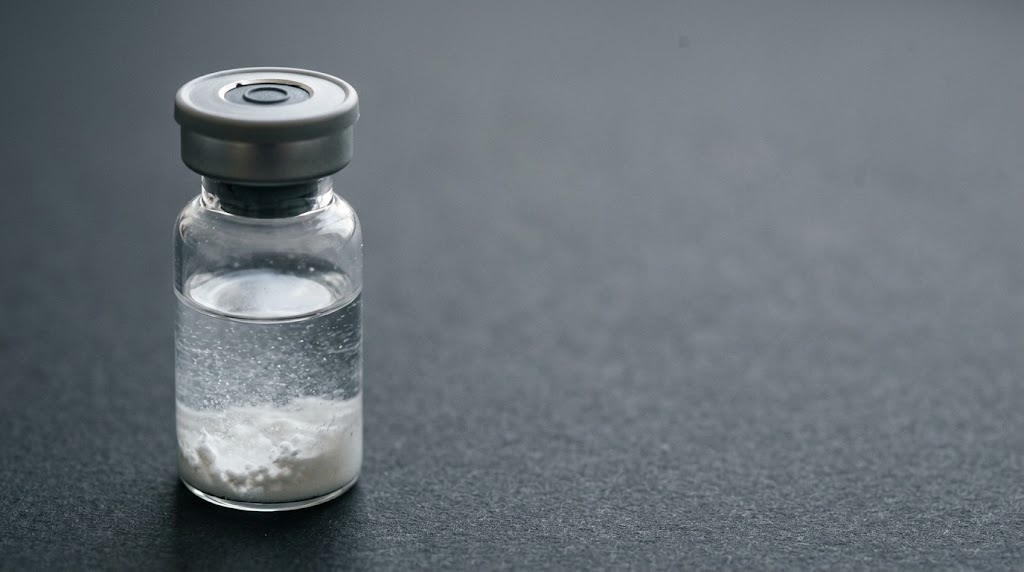
Usually nothing is wrong. Cold powder in cold water takes several minutes. Specks still floating after thirty seconds are normal.
The real exceptions are narrow. A few compounds need something other than bacteriostatic water. A few others just take much longer. Knowing which is which saves you from binning a vial that was fine, or injecting one that never mixed.
What the chemistry says about our library:12
- 56 compounds have a published sequence we can assess
- 53 of them should dissolve in water on the manufacturers' own rule
- 2 records in our library carry a mixing exception: IGF-1 LR3 and IGF-1 DES, which need dilute acetic acid instead of bacteriostatic water
- 0 of the compounds people most often report trouble with are explained by charge alone
How long should a peptide take to dissolve?
Two to five minutes of gentle swirling for a typical vial, and longer when powder and water are both cold. Slower than you expect. Learn the shape of it before deciding something has gone wrong.
Powder straight from the fridge in cold water is the slow combination. Bubbles and foam on the surface come from agitation, not from the compound.
What is not normal: powder still visibly present after ten minutes of gentle swirling, or a solution that clears and then goes cloudy again on standing. Our guide on cloudy vials covers the second case, which is a different problem.
Things that make normal dissolution look like failure. Aiming the water stream directly at the cake, which compacts it. Shaking, which foams the solution and hides what is left. Adding too little water for the amount of powder. Judging the result against a light-coloured background where fine particles are invisible.
Why do some peptides dissolve and others fight you?
Charge, mostly. Peptide manufacturers publish the same guideline for it, and it is simpler than it sounds.12
Count the charged amino acids in the sequence. Acidic residues, D and E, count as minus one. Basic residues, K and R, count as plus one. The more charged residues a peptide has as a share of its length, the better it dissolves in water, because those charges repel each other and keep the molecules apart.
From that come three cases:
Plenty of charge, around a quarter of residues or more. Water is fine. This is most of what people buy.
Few charges and a net positive charge. Dilute acetic acid helps, because acid protonates the basic residues and increases the repulsion that keeps molecules in solution.
Few charges, or a hydrophobic sequence with little charge. Water alone may never work. These need an organic co-solvent first, then dilution.
One more case matters and is not about charge at all: a peptide sitting near its isoelectric point, the pH at which it carries no net charge, has nothing keeping its molecules apart and will aggregate. Bacteriostatic water sits around pH 5.7, which is unluckily close to the isoelectric point of some peptides.
Does AOD-9604 dissolve in bacteriostatic water?
It should, on the rule. We applied that rule to every compound in our library with a published sequence. Fifty-three of fifty-six fall into the water-is-fine category.3
| Compound | Charged residues | Hydrophobic | What the rule predicts |
|---|---|---|---|
| AOD-9604 | 31% | 44% | Water should work |
| HGH fragment 176-191 | 33% | 47% | Water should work |
| Melanotan II | 71% | 43% | Water, easily |
| BPC-157 | 40% | 53% | Water should work |
| Tesamorelin | 32% | 34% | Water should work |
| Pramlintide | 11% | 43% | Acid may help |
| Orexin A | 21% | 48% | Acid may help |
Melanotan II sits at 71% charged residues, which makes it one of the easiest things in the library to dissolve, despite turning up constantly in threads about difficult vials. When it resists, the cause is cold water, a compacted cake or too little volume.
AOD-9604 and fragment 176-191 are the two compounds people most often report fighting with, and the rule says both should dissolve. So when they do not, charge is not the reason.
Two other things about that pair explain it. Both contain two cysteines and a disulfide bridge, which makes the molecule a loop instead of a string, and looped molecules dissolve more slowly than the arithmetic suggests. And both are sold small: the median vial is 5 mg for both, against 10 mg for BPC-157 and 20 mg for tirzepatide.3 A small cake with a modest amount of water on top of it means a high concentration at the bottom of the vial while it works through.
Slower, in other words. Not impossible.
Which peptides need acetic acid?
In our library, two: IGF-1 LR3 and IGF-1 DES, the same molecule in two forms. Both should be reconstituted with dilute acetic acid, not bacteriostatic water, and that is not a preference. These are long, structured proteins that aggregate near neutral pH, and the acid keeps them apart. Plain bacteriostatic water can degrade them.3
The instruction that matters is not ours. Follow the mixing instructions supplied with the product in front of you, because concentration and acid strength vary by supplier.
What should I do if my peptide will not dissolve?
Five things in order, and the first two solve most cases.
Wait, with the vial in your hand. Body heat against the glass and slow rolling for two or three minutes does more than anything else. Do not shake.
Let it sit. Some compounds finish dissolving over ten to twenty minutes in the fridge without any further intervention. Come back to it before escalating.
Check the volume. Too little water for the amount of powder is the most common self-inflicted cause. The dose calculator will tell you whether your ratio is sensible for the vial in front of you.
Warm the water, not the vial. Room-temperature bacteriostatic water dissolves powder faster than cold water does. Heating a peptide after it is mixed is a different thing, and it damages it.
Check the label against the compound. If you are holding IGF-1 LR3, IGF-1 DES, or anything whose own instructions specify a diluent, the answer is the diluent, not technique.
What not to do: add more water to "help it along" without recalculating, shake hard, warm the vial in hot water, or inject a solution with visible undissolved material in it.
Why do sellers not tell you which diluent to use?
Because the instruction that would help is specific to the compound, and most listings are generic.
In our September capture, mixing guidance on product pages ranges from nothing at all to a single line about bacteriostatic water, irrespective of what is in the vial.3 The two compounds in our library that genuinely need a different diluent are sold by sellers whose pages mostly do not say so.
That gap is the reason this page exists. Check a compound's own requirements before you open the vial, not after.
Is it undissolved powder, gel, or cloudiness?
Three different things get described the same way, and they need different responses.
| What you see | What it usually is | What to do |
|---|---|---|
| Visible grains or a cake that has not shrunk | Not dissolved yet | Roll, wait, check your volume |
| Clear liquid with small jelly-like blobs | Partly hydrated clumps, sometimes called fisheyes | Roll for longer; they usually go |
| Uniform haze with nothing solid in it | A solution problem, not a mixing problem | See the cloudy vial guide |
| Cleared, then went cloudy on standing | Aggregation after dissolving | Cloudy vial guide; do not inject |
| Powder stuck above the liquid line | Water hit the cake and threw it up the wall | Roll so the solution washes the glass |
The fisheye case is the one people panic about. A partly wetted clump has a hydrated skin holding dry powder inside, and it dissolves from the outside in, which takes patience rather than force.
Bacteriostatic water, sterile water or acetic acid?
Not interchangeable, and the differences matter more than people expect.
Bacteriostatic water contains benzyl alcohol as a preservative, which is why a vial can be used over several weeks. Its pH sits around 5.7. This is the default for most compounds.
Sterile water has no preservative. It is appropriate for a vial used once, and it is a poor choice for anything you will puncture repeatedly.
Dilute acetic acid is not a general-purpose diluent. It exists for compounds that aggregate near neutral pH, and the concentration matters. Use what the product's own instructions specify, since suppliers differ, and do not improvise a strength.
The mistake to avoid: reaching for acetic acid because something is dissolving slowly. Slow is usually temperature and time. Acid is for the short list of compounds whose instructions call for it.
Four things people get told that are wrong
"Shake it to speed it up." Shaking foams the solution, and foam hides undissolved powder rather than removing it. Rolling works and shaking does not.
"Warm the vial in hot water." Warm the water before you add it, if anything. Heating a peptide once it is in solution degrades it, and the manufacturer guidance is unanimous that temperature is a primary driver of degradation.2
"If it does not dissolve, it is fake." The compounds people report fighting with most are ones the solubility rule says should dissolve, which points at technique and temperature before purity. A slow vial is not evidence of anything.
"Every peptide can use acetic acid." Most do not need it, and a few are damaged by the wrong diluent. Our library carries a mixing exception on two records, not on most of them.
Common questions
How long should a peptide take to dissolve?
A few minutes of rolling for a typical vial, and longer if both the powder and the water came out of the fridge. Ten minutes with grains still visible is worth investigating. Thirty seconds of impatience is not.
Why won't my AOD-9604 dissolve?
Usually time and temperature, not chemistry. By the standard solubility rule, AOD-9604 has enough charged residues to dissolve in water. It also contains a disulfide bridge that makes the molecule a loop, which dissolves more slowly than the sequence alone suggests, and it is often sold in small vials where the powder compacts.
Which peptides need acetic acid?
Two of ours: the IGF-1 forms, LR3 and DES. They aggregate at neutral pH and plain bacteriostatic water can degrade them. For anything else, go by the instructions that came with the product, because acid strength differs between suppliers.
Can I shake the vial to speed it up?
No. Shaking foams the solution, which hides undissolved powder and can damage some peptides. Rolling the vial between your palms is the method that works.
Does cold bacteriostatic water slow dissolution?
Yes, noticeably. Room-temperature water dissolves powder faster than water straight from the fridge. Warming the vial after mixing is a different thing and is not advisable.
What if some powder is stuck at the top of the vial?
Common when the water stream hits the cake directly. Roll the vial so the solution washes the sides. Next time, aim the stream at the glass, not the powder.
Is undissolved powder the same as a cloudy vial?
No, and the distinction matters. Undissolved powder is solid that has not gone into solution yet. Cloudiness is usually a solution that has gone wrong, which our cloudy vial guide covers.
Did I get a bad batch?
Slow dissolution is weak evidence for it. The compounds people most often report fighting with are ones the solubility rule says should dissolve, which points at temperature, volume and technique first. A vial that eventually goes clear and stays clear behaved normally.
Does this mean I reconstituted it wrong?
Not necessarily, though volume is the most common self-inflicted cause. Our reconstitution guide covers the process itself; this page covers what to do when the powder will not cooperate.
What are the jelly-like blobs in my vial?
Partly hydrated clumps, often called fisheyes: a wetted skin holding dry powder inside. They dissolve from the outside in and usually clear with more rolling. They are not the same as a cloudy solution.
Should I use sterile water or bacteriostatic water?
Bacteriostatic water contains a preservative and suits a vial you will use over several weeks. Sterile water has none and suits a single use. Neither is a substitute for a diluent a product's own instructions specify.
Can I inject it if a little powder is left?
No. You cannot know how much compound is in the dose, and particles should not be injected. Finish dissolving it or discard the vial.
Citing this page. Peptide Decoding. Why Won't My Peptide Dissolve? What to Do Before You Worry. Charge and hydrophobicity computed from the compound library, September 2026. https://peptidedecoding.com/guides/peptide-wont-dissolve
Sources
- Merck (Sigma-Aldrich). Solubility guidelines for peptides, and Synthetic peptide handling and storage protocol. sigmaaldrich.com. Manufacturer technical guidance. Source for the charge-counting method: acidic residues and the C-terminal carboxyl count as minus one, basic residues and the N-terminal amine as plus one, and solubility improves with the proportion of charged residues. Sets the thresholds used here: acidic peptides or those with charges above 25% of residues dissolve near neutral pH; basic peptides with charges between 10% and 25% may need dilute acetic acid; neutral or hydrophobic peptides need an organic co-solvent added before dilution.
- Bachem. Handling and storage guidelines for peptides. bachem.com. Manufacturer technical guidance. States that no single protocol covers all peptides, that hydrophobic sequences are the hardest case, and that peptides near their isoelectric point carry no net charge and aggregate. Corroborates the approach in reference 1 from an independent manufacturer.
- Peptide Decoding compound library and vendor price capture, 23 September 2026. peptidedecoding.com/prices. Our own data. Charge and hydrophobicity figures were computed from the published sequences in our compound library, 56 of which are long enough to assess, using the method in reference 1. Mixing exceptions are the handling notes recorded on individual compound records.