
mcg vs mg: The Peptide Dosing Mistake to Avoid
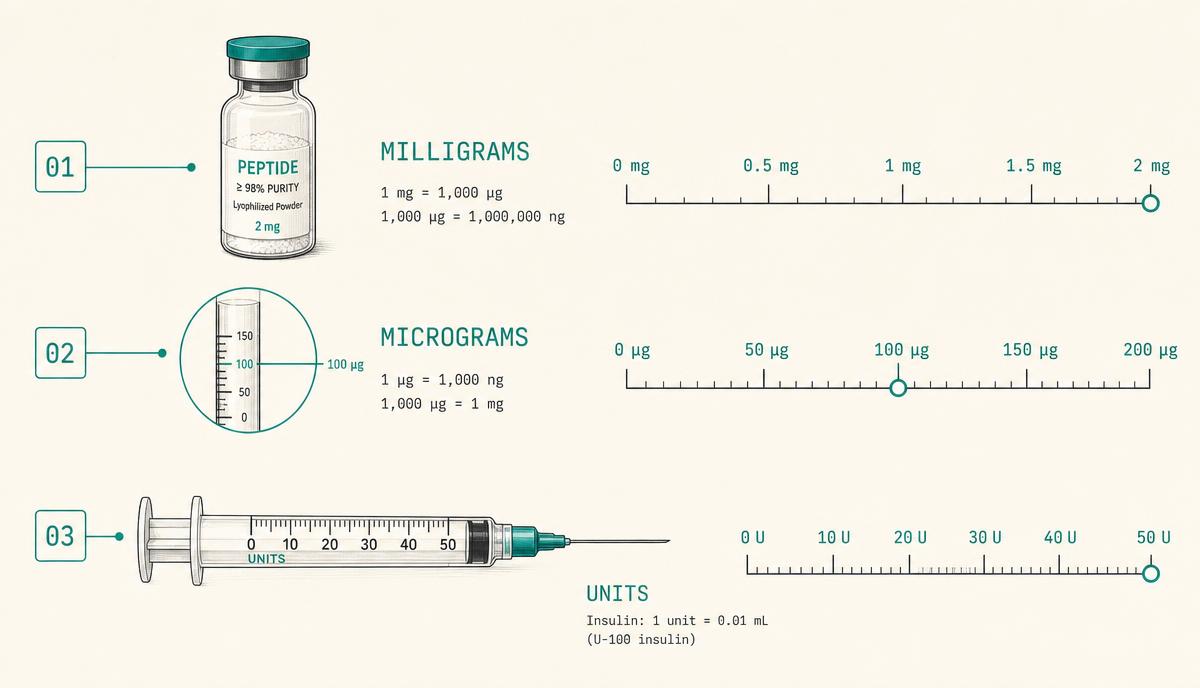
Your vial is labelled in milligrams. The protocol you are following is written in micrograms. Between those two numbers sits a factor of a thousand. It is the one arithmetic error in this process that can genuinely hurt you.
Here is the conversion, why peptides invite the mistake more than most things, and how to catch it before it reaches a syringe.
Already injected and worried? Skip to what to do now.
The conversion
1 mg = 1,000 mcg.
That is the entire piece of arithmetic. A milligram is a thousandth of a gram. A microgram is a millionth. A thousand micrograms make one milligram.
So these pairs are the same amount written two ways:
| Micrograms | Milligrams |
|---|---|
| 100 mcg | 0.1 mg |
| 250 mcg | 0.25 mg |
| 500 mcg | 0.5 mg |
| 1,000 mcg | 1 mg |
| 2,000 mcg | 2 mg |
| 5,000 mcg | 5 mg |
To go from mcg to mg, divide by 1,000. To go from mg to mcg, multiply by 1,000. On paper you are moving the decimal point three places, left for one direction and right for the other.
You will also see µg, with the Greek letter mu. It means the same thing as mcg. Some countries prefer mcg in medical writing because µ gets misread when handwritten or when a font renders it badly.
One more unit turns up if you read the research: nanograms, written ng. A nanogram is a thousandth of a microgram. It appears in study results as ng/mL, describing concentrations in blood. It is not a dosing unit and you will never draw one. Meeting ng on a compound page means you are looking at what was measured in someone's bloodstream, not at a dose.
What if you already injected the wrong amount?
Work out what actually happened first. Most of these get caught on paper, not in the arm.
If the error was a thousand-fold, the odds are it never left the vial. A dose that size does not fit in a syringe and usually does not exist in the vial. On rechecking, people generally find they wrote the wrong number and drew the right one.
If a wrong dose did go in, how far over you went matters more than the fact of it. Twice the intended amount of a growth hormone secretagogue sits in a different category from a large overshoot on a GLP-1. There the predictable consequence is nausea and vomiting that can run a day or more,3 plus a risk of low blood sugar. That risk is lower than people expect from a GLP-1 on its own, because these drugs prompt insulin release only while blood sugar is high, and it rises sharply if you also take insulin or a sulfonylurea. GLP-1 overdoses are the ones most likely to need medical attention, though most are still managed at home. In one poison centre series two thirds of people reported no symptoms at all, and nationally about a third of exposures are referred to or managed in a health care facility.12 The effects build over hours rather than arriving straight away.
Call Poison Control. In the US that is 1-800-222-1222, free and staffed around the clock, and they will tell you whether this needs watching at home or a hospital. Their online triage tool does the same thing if you would rather not call. Have the compound name, the concentration, the amount you think went in, and the time to hand. Do not post about it and wait for replies.
Go to an emergency department without waiting if there is trouble breathing, chest pain, fainting, confusion, a severe headache, persistent vomiting, or signs of very low blood sugar such as shaking, sweating and disorientation.
Afterwards, write down what happened while it is fresh, including which number you crossed. That note is what stops it happening twice.
Why peptides invite this mistake
Most substances get discussed in one unit. Peptides get discussed in two, and the split follows convention, not logic. You cannot work out which unit a compound uses by reasoning about it.
Vials are almost always labelled in milligrams. A 5 mg vial, a 10 mg vial, a 2 mg vial. That is the unit manufacturers use for the powder.
That milligram figure is not always pure peptide. Synthesised material carries salts and residual water. The figure accounting for it is called net peptide content, and most vendors here do not report it. None of the arithmetic below changes, since you have to work from the labelled number either way. It is one reason two vials of the same nominal size can behave slightly differently.
Doses, though, split. Growth hormone secretagogues, healing peptides, and most of the older research compounds are conventionally dosed in micrograms: 100 mcg, 250 mcg, 300 mcg. The GLP-1 family and the larger-volume compounds are dosed in milligrams: 0.25 mg, 2.5 mg, 5 mg.
So a single vial can carry one unit on its label and a different unit in every protocol written about it. A 5 mg vial of a compound dosed at 250 mcg holds twenty doses, and nothing on the label tells you that.
Then the syringe is marked in neither. Insulin syringe units measure liquid volume, not peptide weight. A third scale enters at the last step.
What the mistake actually looks like
It rarely appears as someone typing "mcg" when they meant "mg." It shows up in three quieter ways.
Dropping the unit entirely. Community protocols get shortened. "Run it at 250" is unambiguous to the person writing it and a coin flip to the person reading it. If 250 mcg is the standard dose and someone reads it as 250 mg, they have written down a number larger than the entire vial.
Entering the wrong unit in a calculator. Every dose calculator asks for a number and a unit. Selecting mg while thinking in mcg produces a draw a thousand times too large. Usually the syringe cannot physically hold it. That is a crude safety net, and a dilute mix narrows it.
Shifting the decimal. This one is subtler and more common. 0.25 mg and 2.5 mg are both plausible-looking doses, both appear in real protocols, and they are a factor of ten apart. Micrograms avoid the problem, and that is part of why small doses are written that way. A dose of 250 mcg cannot lose a decimal point. It does not have one.
The GLP-1 titration schedules are where this bites hardest. Semaglutide steps through 0.25, 0.5, 1.0, 1.7 and 2.4 mg, with each step held for around four weeks.4 Every number on that ladder has a decimal point, the whole range spans a factor of about ten, and the steps are close enough together that a misplaced decimal produces a number that still looks like a real dose. Someone at 0.25 mg who reads their next step as 2.5 mg has jumped past the top of the entire schedule while writing down something that looks unremarkable.
Tirzepatide runs 2.5, 5, 7.5, 10, 12.5 and 15 mg, the same shape again.4 These are the compounds most people start with, they are dosed in milligrams, and the ladder gives a misplaced decimal somewhere plausible to land. How the two compare is a separate question from how they are written down.
The same vial, done right and done wrong
Take a 5 mg vial mixed with 2 mL of bacteriostatic water. The concentration is 2.5 mg per mL, or 2,500 mcg per mL. If you would rather convert between mcg and mg without doing it in your head, the converter handles it in both directions.
Done right. The dose is 250 mcg. Divide 250 by 2,500 and you get 0.1 mL, or 10 units on an insulin syringe. The vial holds 5,000 mcg, so it carries 20 doses. Everything about that is ordinary.
Done wrong. The same 250 gets entered as 250 mg. Divide 250 by 2.5 mg per mL and the answer is 100 mL. A hundred times the volume of the entire vial. A thousand times the syringe.
The wrong version fails loudly. You cannot draw 100 mL into a 1 mL barrel, and there is not 100 mL of liquid in front of you.
The near miss is the dangerous one. Take that same vial and enter 2.5 mg where you meant 0.25 mg. The draw comes out at 100 units instead of 10. That fits in a syringe. It looks like a full barrel, not an impossible number, and nothing about it is physically wrong. Ten times the intended dose is the error that survives to the injection. This is not hypothetical. Poison centre analyses attribute tenfold overdoses specifically to vial-supplied compounded GLP-1s and confusion over units dosing, which is the failure this page describes.1 Nothing in the physical setup stops it, which is why the next check exists.
The sanity check that catches it
Before you draw anything, ask how many doses your vial should hold. This is the check that catches the near miss the syringe will happily accept.
Divide the vial size by the dose, in matching units. A 5 mg vial at 250 mcg per dose: convert the vial to 5,000 mcg, divide by 250, and you get 20 doses. Check that number against how the compound is normally used.
If the arithmetic tells you the vial holds one dose, or a fraction of a dose, stop. There are compounds where a vial genuinely is one or two doses, but for anything conventionally measured in micrograms it means a unit got crossed somewhere. Run it on the wrong version above and you get a fiftieth of a dose per vial. Run it on the ten-fold slip and you get five doses instead of fifty.
The reverse fails the same way. If the math says your vial holds two thousand doses, you converted in the wrong direction.
One division catches essentially every thousand-fold error. A factor of a thousand is impossible to miss once it lands in a dose count.
Where IU fits in
You will occasionally see doses in IU, or international units, mostly in conversations about growth hormone itself.
IU is not a weight at all. It measures biological activity, and the conversion to weight is specific to the substance being measured. For somatropin the commonly used figure is roughly 3 IU per mg.4 That ratio applies to that substance only. It cannot be carried across to anything else.
A protocol quoting IU for a peptide is a signal to find out what compound is actually being discussed. IU dosing usually means the conversation has drifted to growth hormone.
Insulin syringe units are a separate thing again, despite the name. They measure volume: 100 units is 1 mL. They tell you how much liquid you are drawing and nothing about what is in it.
Getting from one to the other on a vial
The mcg to mg conversion is only half the job. The other half is turning your dose into a mark on a syringe, and that depends on how much water you added when you mixed the vial.
The short version: divide your vial size by your water volume to get a concentration in mg per mL, then work out what fraction of a millilitre carries your dose. The insulin syringe guide walks through this properly, and the calculator does it for you if you give it the three numbers it needs.
What matters here is that a crossed unit at the start propagates all the way through. It produces a concentration that looks fine, a volume that looks fine, and a mark on the syringe that is wrong by a thousand.
Habits that prevent it
Write the unit every time. In your notes, in your log, in anything you send someone else. A number without a unit is not a dose.
Pick one unit per compound and stay in it. If a compound is conventionally dosed in micrograms, keep your notes in micrograms even when the vial says mg. Converting once, at the point where you write the note, is safer than converting each time you draw.
Convert on paper before you touch the calculator. Do the conversion first and you arrive at the tool with a number you already understand, instead of trusting it to interpret you correctly.
Treat a strange-looking result as a unit problem first. When a draw comes out at half a unit, or larger than the syringe, a crossed unit is the cause far more often than a slip in the rest of the arithmetic.
Common questions
Is 250 mcg the same as 0.25 mg?
Yes. Both are a quarter of a milligram. Which one you see depends on the writing convention for that compound rather than on any difference in amount.
Why do some peptides use mcg and others use mg?
Convention, mostly following whatever the early research used. Growth hormone secretagogues and healing peptides were studied at doses where micrograms give whole numbers, and the literature stuck with it. The GLP-1 family was developed at doses where milligrams are the tidier unit. Neither tells you anything about potency on its own.
What does µg mean?
The same as mcg. It is the standard scientific symbol, using the Greek letter mu. Some medical guidance prefers mcg in writing because µ can be misread.
Can a syringe even hold a thousand-fold overdose?
Often not, which is a useful accident. A dose entered as mg instead of mcg usually produces a volume far larger than the barrel, or larger than the vial holds. That said, a very dilute mix narrows the gap, so do not rely on the syringe to catch the error for you.
My vial says 10 mg and my dose is 500 mcg. How many doses is that?
Twenty. Convert the vial to micrograms first, 10 mg being 10,000 mcg, then divide by 500. Running the same division on your own numbers before you draw is the fastest check available.
Is mcg per kg the same as mcg?
No. Some research protocols express doses per kilogram of body weight, written as mcg/kg. A dose of 1 mcg/kg means one microgram for every kilogram you weigh, so the actual amount differs between people. Check whether a protocol is quoting a flat dose or a weight-based one before using the number.
Does the concentration of my mix change the mcg to mg conversion?
It does not. A thousand micrograms is a milligram regardless of how much water is in the vial. Concentration changes how much liquid carries that amount, which is the next step and a separate calculation.
What is ng, and do I need to convert it?
A nanogram, a thousandth of a microgram. It shows up in study results describing concentrations in blood, usually written ng/mL. It is not a dosing unit and you will never measure one, so there is nothing to convert.
Why do the GLP-1 doses all have decimals when other peptides do not?
Because they are dosed in milligrams at amounts smaller than one. Semaglutide's schedule runs from 0.25 to 2.4 mg, which is 250 to 2,400 mcg. Written in micrograms none of those numbers would need a decimal point, but milligrams is the convention the trials and the labels use, so that is what protocols repeat.
What if I inject the wrong dose?
Check first whether it actually happened, since a thousand-fold error usually cannot fit in a syringe and turns out to be a paper mistake. If a wrong dose did go in, call Poison Control, which in the US is 1-800-222-1222, free and open around the clock, or use their online triage tool. Go to an emergency department without waiting for trouble breathing, chest pain, fainting, confusion, or persistent vomiting.
What if a protocol gives a number with no unit at all?
Do not use it. Find the source, or find the compound's normal dosing range and work out which unit makes the number sensible. Guessing between two options that are a thousand apart is not a risk worth taking to avoid asking.
Sources
- National Poison Center Trends in GLP-1 Receptor Agonist Exposures Following FDA Approval for Weight Loss. Journal of Medical Toxicology, 2026. Peer-reviewed analysis, abstract read at source. Over 10,000 human GLP-1 receptor agonist exposures reported to the National Poison Data System from 2012 to 2023, split before and after July 2021. Nausea rose from 14.6% to 30.7% of reports and vomiting from 9.6% to 28.5%. Hypoglycaemia was reported in 3.1% before and 2.4% after. Exposures managed in or referred to a health care facility rose from 23.0% to 33.5%, relative risk 1.46, 95% CI 1.36 to 1.57. Tenfold overdoses were attributed specifically to vial-supplied compounded GLP-1s and confusion over units dosing.
- GLP-1 Receptor Agonist Exposures Are Increasingly Common and Generally Associated with Mild Symptoms: A Single Poison Center Experience. Peer-reviewed retrospective review, abstract read at source. 152 charts from a single poison centre, 2006 to 2023. Therapeutic errors accounted for 91% of exposures. 67% of patients reported no symptoms. Nausea, vomiting, generalised weakness and abdominal pain predominated. 62% were monitored at home. Hypoglycaemia was rare, occurring in two patients on a GLP-1 alone and two more where insulin was co-administered. 21% of exposures related to errors on first use of the pen.
- Washington Poison Center, GLP-1 receptor agonist exposures. Poison centre guidance, read at source. Callers report vomiting and inability to tolerate food or liquids for one to three days. Management of GLP-1 overdose is supportive: treating nausea, vomiting and dehydration. Hypoglycaemia was reported in 3.4% of GLP-1 exposures at one poison centre, and patients monitored at home should be counselled on its signs.
- FDA prescribing information via DailyMed: WEGOVY (semaglutide) injection, ZEPBOUND (tirzepatide) injection and HUMATROPE (somatropin) for injection. Labels, read at source. Semaglutide escalates 0.25, 0.5, 1, 1.7 and 2.4 mg once weekly; tirzepatide 2.5, 5, 7.5, 10, 12.5 and 15 mg once weekly. The Humatrope label gives 6 mg as 18 IU, which is where roughly 3 IU per mg comes from.
Once your units are straight, run the numbers in the dose calculator.
Keep reading
- How to Read an Insulin Syringe
U-100 insulin syringes are the standard measuring tool for peptides.
- How Much Water Do I Add to a Peptide?
There is no single right amount.
- What Are Peptides? A Plain-Language Guide
What a peptide actually is, how the category differs from proteins, hormones, steroids and supplements, what research use only means, and the words you need before reading anything else.
- How to Tell Your Dose Calculation Is Wrong
A calculator gives you an answer whether or not your inputs made sense.
The peptide stuff worth knowing.
Get new guides, tools, compound pages, and important peptide news in your inbox 1–3 times a month. If there’s nothing worth sending, we don’t send one.