
Thymosin Alpha-1 vs LL-37
Thymosin alpha-1 is approved in more than 35 countries as Zadaxin, has been through more than thirty trials, and its largest study found no benefit in sepsis. LL-37 produced a strong result in 34 patients and nothing in 148. Neither is FDA approved, and every published LL-37 trial applied it to skin instead of injecting it.
- Immune
- One approved abroad
- Both failed their largest trial
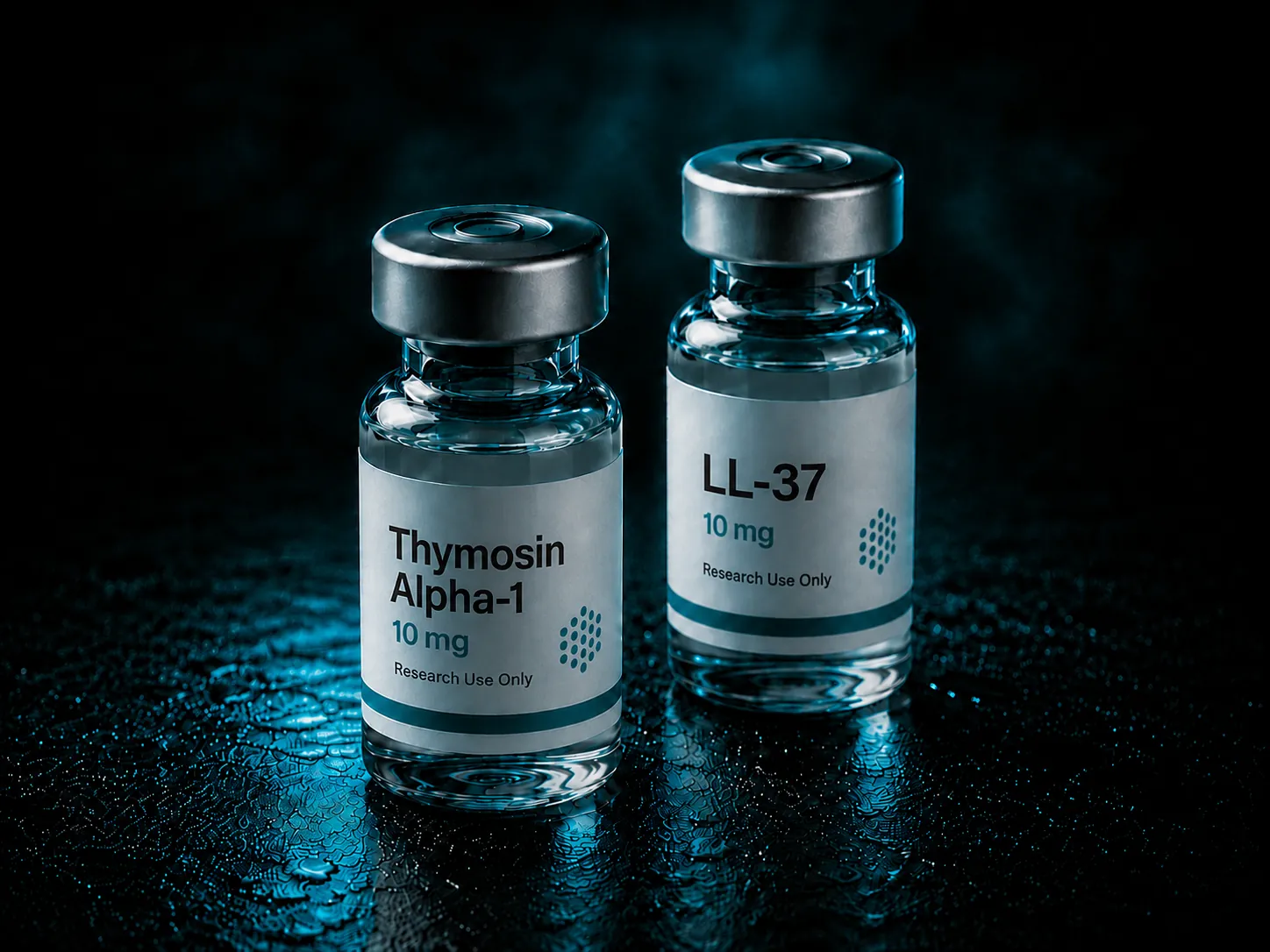
Why did both look good in a small trial and fail the bigger one?
One has more human evidence than almost anything else in this library. The other has been studied twice, and never the way it is sold.
| Attribute | Thymosin Alpha-1 | LL-37 |
|---|---|---|
| Length | 28 amino acids | 37 amino acids |
| Comes from | Prothymosin alpha | Cathelicidin, hCAP18 |
| Approved | 35 countries, as Zadaxin. Not the US [1] | Nowhere |
| Trial subjects | More than 11,000 [4] | 182 across two trials [6][7] |
| Largest trial result | No mortality benefit in sepsis [3] | No healing benefit [7] |
| A specific caution | None comparable | A validated autoantigen in psoriasis and lupus [11] |
| How it was tested | Injected | Applied to skin |
Every published LL-37 trial used a topical formulation.
Thymosin Alpha-1
Twenty-eight amino acids, copied from the front section of a protein called prothymosin alpha, originally isolated from the thymus. In plain terms: a signal that tells the cells organizing your immune response to get organized, sold as Zadaxin in most of the world and not in the United States.
LL-37
Thirty-seven amino acids, cut from a protein called hCAP18. It is the only cathelicidin humans make, and it punches holes in bacterial membranes while also signaling to immune cells. In plain terms: part of your own first line of defense.
What happened when a bigger trial tried to confirm the promising small one?
Thymosin alpha-1 in sepsis. The ETASS trial randomized 361 patients. Deaths within 28 days were 26.0 percent on thymosin alpha-1 against 35.0 percent on control. That is a nine point difference and it sat right on the edge of significance, at p equals 0.062 on one analysis and p equals 0.049 on another. Encouraging enough to justify a larger trial. [2] Then TESTS, published in the BMJ in 2025. Multicenter, double blind, randomized, placebo controlled, 1,106 patients. No reduction in 28-day mortality. [3]
LL-37 in leg ulcers. The first-in-man trial enrolled 34 patients in Sweden, with a three week placebo run-in and then four weeks of randomized double-blind treatment. Healing rate constants were roughly six times placebo at the lower dose, p equals 0.003. [6] Then HEAL LL-37, a Phase 2b in 148 patients across Poland and Sweden, three arms, mean ulcer duration twenty months. No significant improvement in healing across the full study population. [7]
Neither result means the compound does nothing. Thymosin alpha-1's subgroup analyses point to possible benefit in patients over 60 and in those with diabetes, and LL-37 showed a signal in larger ulcers on a post-hoc look. [3][7] Both are hypotheses generated after the fact, and that is the weight they deserve. One thing separates them completely: every published LL-37 trial applied it to skin. The compound is sold as an injectable for immune support, and no published trial has given it that way. [8]
How do they compare, side by side?
How do they compare, side by side?
| Attribute | Thymosin Alpha-1 | LL-37 |
|---|---|---|
| Also called | Thymalfasin, Zadaxin, Tα1 | Cathelicidin, hCAP18 fragment |
| Length | 28 amino acids | 37 amino acids |
| Parent protein | Prothymosin alpha | hCAP18 |
| Mechanism | Activates dendritic cells through TLR9 signaling, driving T-cell maturation [1] | Disrupts bacterial membranes directly, and modulates immune signaling |
| Approved | Zadaxin, in more than 35 countries. Not the US [1] | Nowhere |
| Approved for | Chronic hepatitis B, immune support in cancer patients [1] | Nothing |
| Total trial subjects | More than 11,000 across 30-plus trials [4] | 182, across two published trials [6][7] |
| Strongest result | 40.6 percent virological response against 9.4 percent in hepatitis B [5] | Six-fold higher healing rate in 34 patients [6] |
| Largest trial | TESTS, 1,106 patients, null [3] | HEAL LL-37, 148 patients, null [7] |
| Route in trials | Injected | Applied to skin |
| Route as sold | Injected | Injected |
| Safety record | 600,000-plus post-marketing patients [4] | No long-term data for injection [8] |
What does the evidence actually show?
Why did its largest trial find nothing despite all that human evidence?
Isolated from thymus tissue
Goldstein and colleagues isolate and characterize the peptide from thymus tissue, describing it as a regulator of both innate and adaptive immunity. [2]
Zadaxin launches
SciClone launches Zadaxin. It goes on to be approved in more than 35 countries, mostly for chronic hepatitis B and as an immune adjunct in cancer patients. It is never submitted successfully in the United States. [1]
The pivotal hepatitis B trial
98 patients, with complete virological response in 40.6 percent on thymosin alpha-1 against 9.4 percent in untreated controls. Published in Hepatology, and it remains the compound's strongest result. [5]
The mechanism
Romani and colleagues at Perugia publish in Blood, showing the peptide activates dendritic cells through toll-like receptor signaling. This is the mechanism that explains the rest. [1]
First-in-man, topical
34 patients with hard-to-heal venous leg ulcers in Sweden, three weeks of placebo, then four weeks of randomized double-blind topical treatment at three concentrations.
Healing rate constants about six times placebo at 0.5 mg/mL, p equals 0.003, and about three times at 1.6 mg/mL, p equals 0.088. Reported as safe and effective. [6]
ETASS, in severe sepsis
361 patients, 28-day mortality 26.0 percent against 35.0 percent on control, relative risk 0.74. Significance sat on the boundary, p equals 0.062 on the unstratified analysis and p equals 0.049 on the log rank. Immune markers improved measurably on days 3 and 7. [2]
HEAL LL-37, the Phase 2b
148 patients across Poland and Sweden, mean age 67.6, median ulcer duration 20.3 months, mean wound area 11.6 square centimeters, three arms.
No significant improvement in healing across the full study population. A signal appeared in larger ulcers on post-hoc analysis. [7]
Diabetic foot ulcers
A randomized trial in diabetic foot ulcers reports greater granulation tissue in the treated group. Topical again. [8]
The safety review
A comprehensive review of the human trial record concludes the compound is safe and well tolerated across every indication studied. [4]
TESTS, in the BMJ
Multicenter, double blind, randomized, placebo controlled, 1,106 patients with sepsis. No reduction in 28-day mortality. The largest randomized trial of the compound ever run. Subgroup analyses suggested possible benefit in patients over 60 and those with diabetes. [3]
Where this leaves them
Thymosin alpha-1 is prescribed in 35 countries and compounded in the US. LL-37 has no approval anywhere and is sold as a research chemical.
The hepatitis B result is genuinely strong: 40.6 percent complete virological response against 9.4 percent in controls. [5] That is what an approval in 35 countries was built on. Then sepsis, where a 361-patient trial produced a nine point mortality difference sitting on the edge of significance and a 1,106-patient trial produced nothing. [2][3] LL-37 ran the same course on a smaller scale. [6][7] The lesson is not that either compound is useless. It is that a promising small trial is a reason to run a bigger one, not a reason to believe the result. Both compounds got their bigger trial, and both trials came back flat.
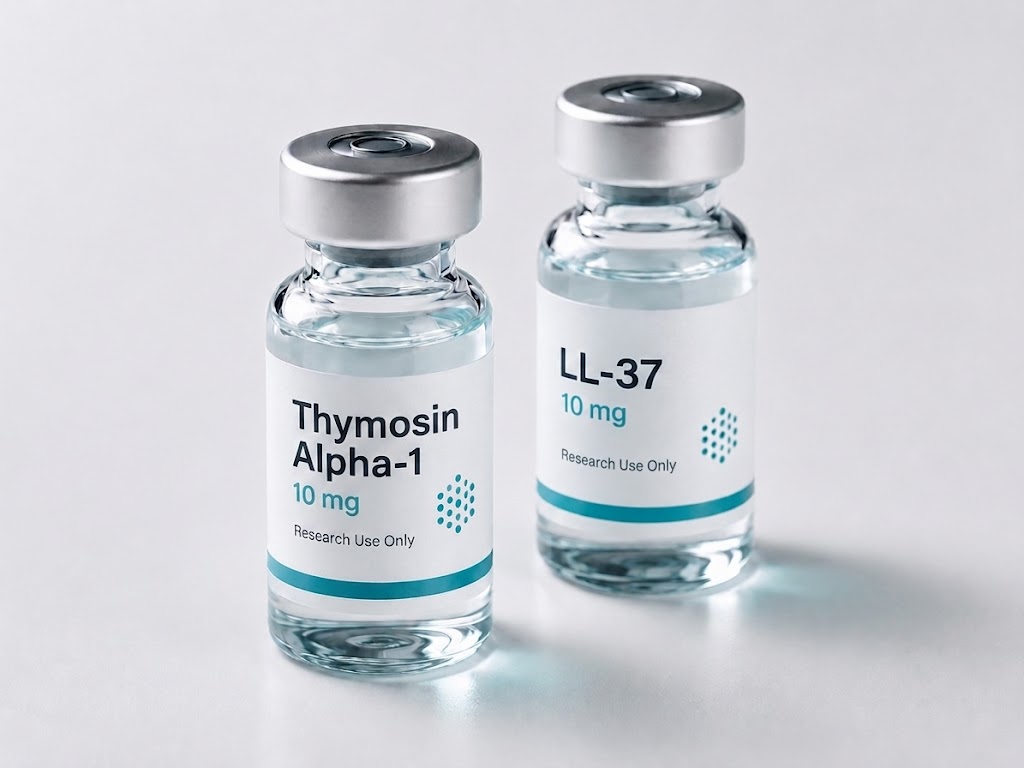
How do their mechanisms differ — one organizes the response, the other is part of it?
Thymosin Alpha-1
It does not attack anything. It acts on dendritic cells, the cells that pick up fragments of a pathogen and present them to the rest of the immune system. Romani's work showed it does this through toll-like receptor signaling, pushing the response toward the pattern that handles viruses and intracellular threats. [1]
Its logic is restoration, not stimulation. In sepsis, the problem is often that the immune system has become exhausted and stops responding, and the ETASS trial measured a marker of exactly that, finding it improved on treatment even in a trial whose main result was borderline. [2]
That is worth holding onto when reading the TESTS result. The compound did something measurable to immune cells. It did not change how many people died.
LL-37
It is positively charged and folds into a shape that lets it insert into bacterial membranes and break them open. That is a physical mechanism, not a signaling one, and it works against a wide range of bacteria and some fungi and viruses. It also signals, recruiting immune cells and influencing inflammation. Acute wounds contain plenty of it and chronic wounds contain very little, and that observation is what the entire wound-healing program was built on. [6]
Your own supply depends on vitamin D. The gene encoding LL-37's precursor is switched on by the vitamin D receptor, established in Science in 2006. [12] So if the reason for looking at LL-37 is immune support, the upstream measure with evidence behind it is a vitamin D test rather than an injection.
Route matters more here than in most of these comparisons. LL-37's proposed job is local: sitting in a wound, where bacteria are. Injecting it puts a membrane-disrupting molecule into circulation, and nobody has published what happens. [8]
What has nobody answered?
Which five gaps has nobody answered?
Nobody has injected LL-37 in a published trial.Every human study applied it to skin. It is sold as an injectable for immune support, and that use has no trial behind it, no dose behind it, and no safety data. [8]
Nobody knows whether thymosin alpha-1's subgroups hold.TESTS suggested possible benefit in patients over 60 and in those with diabetes. Those analyses came after the main result and were not what the trial was designed to test. Confirming them needs a trial built around them. [3]
Nobody has tested either compound for general immune support.Thymosin alpha-1's approvals are for hepatitis B and as an adjunct in cancer patients. LL-37's trials were for leg ulcers. Neither has been studied in healthy people wanting a stronger immune system, and that is what both are mostly sold for.
LL-37 is a validated autoantigen, and that is not theoretical.In psoriasis, LL-37 binds to your own DNA and the resulting complex activates plasmacytoid dendritic cells through TLR9, driving the interferon response that sits at the center of the disease. That was established in Nature in 2007, and T cells from psoriasis patients recognize LL-37 directly, producing IL-17 and interferon gamma. Circulating levels are raised in people with psoriasis, and it behaves the same way in lupus. So injecting LL-37 into someone with either condition means injecting a molecule their immune system already treats as a target, and nobody has run a trial to find out what happens. [11]
And its role in cancer runs both directions.In colorectal cancer, losing cathelicidin is associated with progression, so more of it looks protective there. In some other tumor types the concern runs the other way. [13] These are mechanistic observations rather than trial findings, and they do not point to a single answer.
What are the side effects, and what are you buying?
Why does one have 600,000 patients behind it while the other has none for the route being sold?
Thymosin alpha-1
The safety record here is unusually large for anything in this library.
- More than 11,000 clinical trial subjects across over 30 trials [4]measured
- More than 600,000 patients in post-marketing surveillance [4]measured
- The most common complaint is injection site discomfort [4]measured
- A 2024 review found it safe and well tolerated across all indications studied [4]review
LL-37, and both for general use
Nobody has run these studies. That is different from a clean result.
- Injectable LL-37, in any published human trial [8]not studied
- Either compound for general immune support in healthy peoplenot studied
- Whether thymosin alpha-1's over-60 and diabetes subgroups hold up [3]not studied
- Long-term use of eithernot studied
What you are buying
Two different kinds of problem.
- LL-37 is a validated autoantigen in psoriasis and lupus, established mechanism, not a theory [11]caution
- It is also implicated in rosacea when abnormally processed, and its cancer biology runs both directions [8][13]caution
- Thymosin alpha-1 sold in the US is compounded or research-grade, not Zadaxinidentity
- Testing of seized peptides found purity between 5 and 75 percent, plus arsenic and lead [9]analysis
- One US lab reported problems in almost 30 percent of samples, including bacteria [10]testing
*Where this page says nothing is established, it means nobody has studied it. It does not mean a compound is safe.
Thymosin alpha-1's safety record deserves its weight. Very few compounds discussed on this site have been given to hundreds of thousands of people under any kind of monitoring, and the consistent finding across four decades is that it does not do much harm. That is separate from whether it works, and the largest trial says it did not work for the condition it was tested in. For LL-37 the position is simpler and worse: the safety data that exists is for a cream applied to an ulcer, and nothing about it transfers to an injection. Our guide on reading a certificate of analysis covers what to look for in a research vial.
Are they banned in sport, and are they FDA approved?
Why is it approved in 35 countries and never approved here?
Sport. Neither thymosin alpha-1 nor LL-37 is named on the 2026 WADA Prohibited List. Thymosin alpha-1 needs a moment here because of its name. It is unrelated to thymosin beta-4, and thymosin beta-4 is named on the list under S2.3 along with its derivatives such as TB-500. Alpha and beta thymosins were grouped together historically because both came out of thymus extracts, and they are structurally unrelated. The prohibition applies to the beta family. If you compete under a testing body, ask that body directly.
Thymosin alpha-1 is approved widely, and not in the United States. Zadaxin, the synthetic form, is approved in more than 35 countries, primarily for chronic hepatitis B and as an immune adjunct in cancer patients, and it has been marketed since the 1990s. [1] It has never been FDA approved. The usual explanation is commercial, not scientific: the US market for hepatitis B moved toward antivirals, and the cost of a US registration program was never justified by the expected return. Approval elsewhere carries no legal weight here, so thymosin alpha-1 sold in the US is either compounded or research-grade, and neither is Zadaxin.
LL-37 has no approval anywhere. Its development program produced a Phase 2b that missed, and no regulator has ever considered it for approval. What is sold under the name is a research chemical. One claim is worth treating carefully: some sources state that thymosin alpha-1 was reclassified into FDA Category 2 in February 2026. We could not confirm that date, and it does not fit the sequence of category changes documented elsewhere on this site. Check the current regulatory status page before relying on it.
Questions people ask
Which one has better evidence?
Thymosin alpha-1 has far more, with over 11,000 trial subjects against LL-37's 182. That said, its largest trial found no benefit, so a bigger evidence base is not the same as a better answer.
Is thymosin alpha-1 FDA approved?
No. It is approved in more than 35 countries as Zadaxin, mostly for chronic hepatitis B. The reason it never reached the US market is generally described as commercial, not scientific.
Does thymosin alpha-1 work for sepsis?
The largest trial, with 1,106 patients, found no reduction in 28-day mortality. An earlier 361-patient trial found a nine point difference sitting on the boundary of significance. Subgroup analyses in the larger trial hinted at benefit in older patients and those with diabetes, and those need their own trial.
Does LL-37 work for wounds?
The first trial in 34 patients found a six-fold higher healing rate. The Phase 2b in 148 patients found no significant improvement. Both were topical.
Can I inject LL-37?
No published human trial has ever injected it. Every study applied it to skin, and there is no dose, no safety data and no efficacy data for injection. Its proposed mechanism is local, working in a wound where bacteria are, and injecting it is a different proposition.
Is thymosin alpha-1 the same as TB-500?
No, and they are commonly confused. Thymosin alpha-1 and thymosin beta-4 are structurally unrelated and were grouped only because both came out of thymus extracts. TB-500 is a fragment of the beta protein, and it is named on the WADA list. Thymosin alpha-1 is not.
Is LL-37 safe if I have psoriasis or lupus?
LL-37 is a validated autoantigen in both psoriasis and lupus, which makes this the clearest caution attached to either compound on this page. It binds self-DNA, activates plasmacytoid dendritic cells through TLR9 and drives the interferon response central to psoriasis, and T cells in those patients recognize it directly. Nobody has tested what injecting it does in that population, and the mechanism is well established. This is a conversation for a doctor.
Does vitamin D matter here?
Yes. Your body's production of LL-37 is switched on by the vitamin D receptor, so low vitamin D means less capacity to make it. If immune support is the goal, checking vitamin D is the measure with evidence behind it.
What is thymosin alpha-1 used for?
It is approved in more than 35 countries, mainly for chronic hepatitis B and as an immune support treatment alongside cancer therapy. It is not FDA approved in the United States, so any American use is off-label, compounded, or research-grade.
What are the side effects of thymosin alpha-1?
Injection site discomfort is the most common, and the safety record is unusually large for a compound in this category: more than 11,000 clinical trial subjects and over 600,000 patients in post-marketing surveillance, with no significant adverse effect pattern identified across four decades.
How is thymosin alpha-1 different from thymosin beta-4?
They are structurally unrelated peptides that share only a name and an origin in thymus extracts. Thymosin alpha-1 is 28 amino acids and works on immune signaling. Thymosin beta-4 is a different protein entirely, and TB-500 is a fragment of it. Only the beta family appears on the WADA Prohibited List.
Are they banned in sport?
Neither is named on the 2026 list. Thymosin beta-4 and its derivatives are, so the name similarity is worth understanding.
What this page is built on
- 01Thymosin alpha-1, marketed as ZADAXIN (thymalfasin), SciClone Pharmaceuticals. Approved in more than 35 countries, sources giving 35 and 37, primarily for chronic hepatitis B and as an immune adjunct in cancer patients. Not FDA approved. A 28 amino acid synthetic peptide corresponding to the N-terminal fragment of prothymosin alpha. PubChem CID 16132341. Mechanism established in Romani L, Bistoni F, Gaziano R, et al., Blood, 2004.
- 02Wu J, Zhou L, Liu J, et al. The efficacy of thymosin alpha 1 for severe sepsis (ETASS): a multicenter, single-blind, randomized and controlled trial. Crit Care. 2013. PMC4056079. Human randomized controlled trial. 361 patients. 28-day all-cause mortality 26.0 percent against 35.0 percent, relative risk 0.74, 95% CI 0.54 to 1.02. Unstratified p equals 0.062, log rank p equals 0.049.
- 03Wu J, et al. The efficacy and safety of thymosin alpha 1 for sepsis (TESTS): multicentre, double blinded, randomized, placebo controlled, phase 3 trial. BMJ. 2025. Human Phase 3. 1,106 patients. No reduction in 28-day mortality. The largest randomized trial of thymosin alpha-1 ever conducted. Subgroup analyses suggested possible benefit in patients aged 60 and over and in those with diabetes.
- 04Dinetz E, Lee K. Comprehensive review of human clinical trials of thymosin alpha-1. 2024. Review. More than 11,000 subjects across over 30 clinical trials, with post-marketing surveillance covering more than 600,000 treated patients. Injection site discomfort the most common complaint.
- 05Pivotal chronic hepatitis B randomized controlled trial, published in Hepatology, 1998. Human RCT, 98 patients. Complete virological response in 40.6 percent on thymosin alpha-1 against 9.4 percent in untreated controls.
- 06Grönberg A, Mahlapuu M, Ståhle M, Whately-Smith C, Rollman O. Treatment with LL-37 is safe and effective in enhancing healing of hard-to-heal venous leg ulcers: a randomized, placebo-controlled clinical trial. Wound Repair Regen. 2014. PMID 25041740. Human first-in-man trial. 34 patients, topical, three concentrations. Healing rate constants approximately six-fold higher than placebo at 0.5 mg/mL, p equals 0.003.
- 07Mahlapuu M, et al. Evaluation of LL-37 in healing of hard-to-heal venous leg ulcers: a multicentric prospective randomized placebo-controlled clinical trial. Wound Repair Regen. 2021. PMC9298190. Human Phase 2b. 148 patients in Poland and Sweden, topical. No significant improvement in healing against placebo in the full study population. A signal in larger ulcers appeared on post-hoc analysis.
- 08LL-37 route and safety. All published human trials of LL-37 used topical formulations. Long-term human safety data for injectable LL-37 is not available. A 2023 randomized trial in diabetic foot ulcers reported greater granulation in the treated group, also topical.
- 09Janvier S, Cheyns K, Canfyn M, Goscinny S, De Spiegeleer B, Vanhee C, Deconinck E. Impurity profiling of the most frequently encountered falsified polypeptide drugs on the Belgian market. Talanta. 2018;188:795-807. DOI 10.1016/j.talanta.2018.06.023. Peer-reviewed analytical study. Purity 5 to 75 percent, plus arsenic and lead.
- 10NBC Washington. Lab finds problems in 30% of peptide vials tested. December 2024. News report of commercial laboratory testing, not peer reviewed.
- 11Lande R, Gregorio J, Facchinetti V, et al. Plasmacytoid dendritic cells sense self-DNA coupled with antimicrobial peptide. Nature. 2007. Establishes LL-37 as a psoriasis autoantigen. LL-37 complexes with self-DNA and activates plasmacytoid dendritic cells through TLR9, driving the interferon-alpha response central to psoriasis. LL-37 acts as an autoantigen in lupus erythematosus as well.
- 12Liu PT, Stenger S, Li H, et al. Toll-like receptor triggering of a vitamin D-mediated human antimicrobial response. Science. 2006. Establishes that vitamin D receptor activation drives transcription of the CAMP gene encoding hCAP-18, the LL-37 precursor.
- 13Cathelicidin and cancer biology. Loss of cathelicidin expression is associated with progression in human colorectal cancer. Concerns about pro-tumor activity in other tumor types run the opposite direction. Mechanistic observations rather than trial findings.