
LL-37_Dosage, benefits & legal status
Also known as cathelicidin, hCAP-18
A natural germ-fighting peptide for stubborn infections and wound healing.
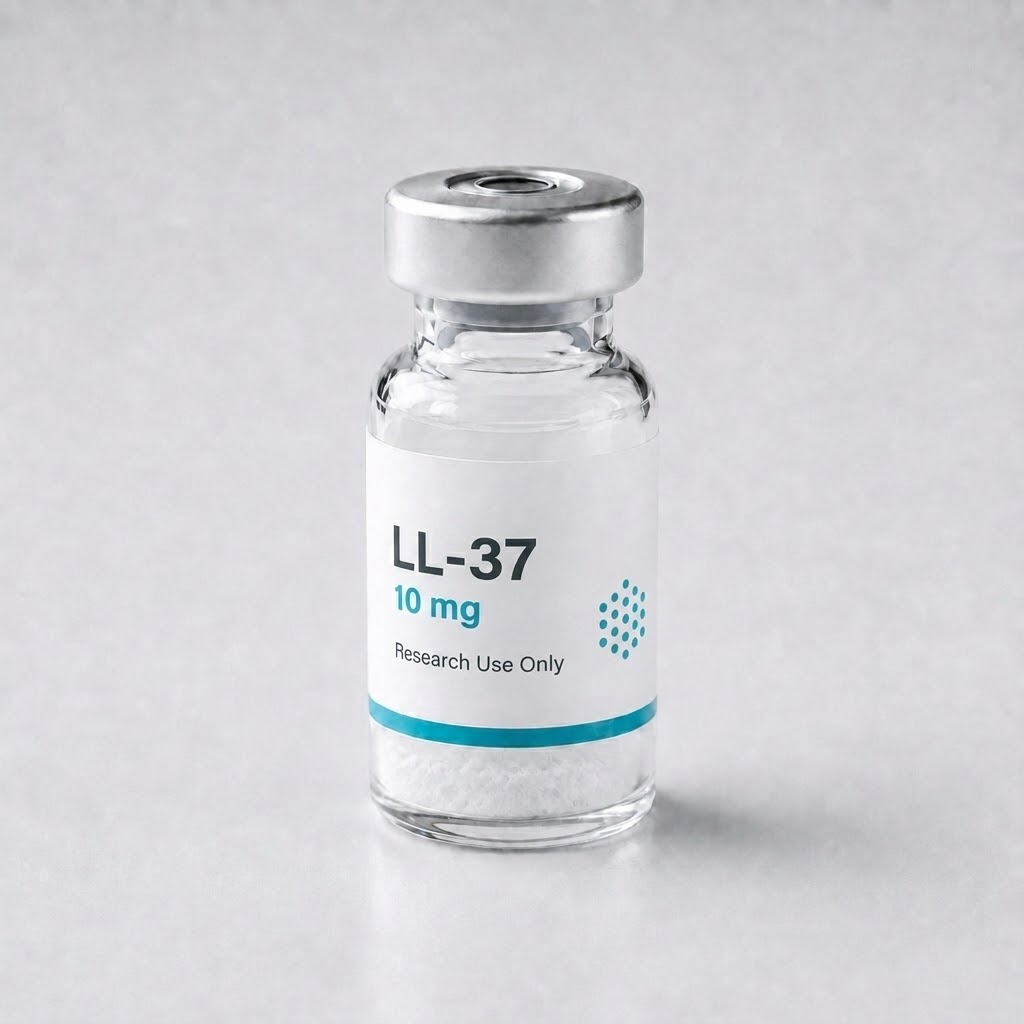
Common vial size is what vendors typically sell, not a recommendation. Enter your own vial in the calculator.
What is LL-37?
Plain language first. The technical label stays, but it never stands alone.Overview
It punches holes in bacteria and helps wounds heal. That is why it is explored for stubborn infections. Human data is limited.
LL-37 is a natural 37-amino-acid antimicrobial peptide, part of your innate immune system's first line of defense.
What it's used for
A natural germ-fighting peptide used against stubborn infections, biofilms, and gut bugs, and to support wound healing.
How does LL-37 work?
What it does in the body, and where.LL-37 is part of your innate immune system, the fast general-purpose defense that acts before your body has identified what it is fighting.
- 01It physically disrupts bacterial membranesRather than interfering with bacterial chemistry, it punches holes in the cell wall, which is why resistance to it develops slowly.
- 02It also signals wound repairRecruiting immune cells and promoting new blood vessel growth at the site.
- 03It is not selective about which membranesAt higher concentrations it damages human cells too, which is the central difficulty in developing it as a drug.
- 04Human evidence is minimalSmall studies in wound healing. Nothing establishing systemic use.

What else is it used for?
Each use below carries its own evidence level. Approved means regulators have cleared it for that purpose. Investigational means it is in trials. Early research means it is being studied and is not established.
- Stubborn bacterial infections and biofilmsEarly research
- Wound healingEarly research
- Gut infections, which is a common reason people seek it outResearch only
The published record
Papers and trials about LL-37
Searched: LL-37, cathelicidin, hCAP-18.
340 papers tagged human · 195 not reviews or lab · 3 clinical trial publications
34 registered trials · 7 with posted results
Furthest stage reached: Phase 2, status not updated
Compare this against the whole library →
Nominated but withdrawn; previously category 2RegulatorsCounted from Europe PMC indexing, not read by a person; a human tag can land on reviews, commentary or lab papers; clinical trial publications is the narrower count. 501 papers and 34 trials indexed in detail.
At a glance
Four things to know about LL-37
How much, and do you cycle it?
The range, and whether you take breaks.0.1 up to 0.5 mg per dose (start low, increase slowly), daily, short courses. Taken in daily, short courses Community practice
Course dosing is how this one is normally used. Where the course length comes from is the thing to check: for most compounds in this pattern it is convention rather than a tested schedule.
Nothing publishedNo figure
Described as short-lived in the literature without any number attached. No study has measured it.
You can compare this against the whole library to see where it sits.
How do I dose and price it?
Enter your vial and your dose. Pick a mix. We show the draw and the cost.The vial holds a fixed amount of drug. Adding more water does not make more drug, it just spreads it thinner, so you draw a bigger number on the syringe for the same dose.
Choose your mix
Measuring the water1 mL = one full 100-unit syringe.
LL-37 starts at $22.74 across 85 vendors, typically $6.00 – $17.80 per mg.
99 listings, last read Oct 24, 2026. Shipping and card fees are not included.
How do you store it?
Before mixing, and after.Dry powder in the freezer or fridge. Once mixed, fridge, and use within about a month.
Unmixed lyophilized LL-37 keeps for a long time cold. Once you add water the clock starts: most reconstituted vials hold up for roughly 28 to 30 days at fridge temperature. Keep it out of light, and do not freeze it after mixing.
What are the side effects and cautions?
Known cautions and warnings for this compound.Solubility, computed: 49% charged residues, 38% hydrophobic. Water usually sufficient.
A first-pass rule from peptide manufacturers' guidance. It does not account for disulfide bridges, salt form or how the powder was dried, and it predicts what should be easy rather than what will happen in your vial.
Who should avoid it
- No established systemic safety profile
- Pregnancy
- Autoimmune conditions, as a theoretical precaution
Stop and get help
- Signs of an allergic reaction
- A spreading rash or worsening inflammation
Common effects
- Injection-site irritation
- Only small local experimental human studies exist
- Research also notes it can be pro-inflammatory and may have pro-tumour effects in some settings
Where this page says nothing is established, that means nobody has studied it, not that a compound is safe.
Is LL-37 approved?
And where the numbers on this page come from.No. LL-37 is not approved for any use, anywhere. It is sold labeled for laboratory research only, and there is no legal route to buy it for human use.
- Approval statusResearch only
- RouteUnder the skin (subcutaneous)
- Checked22 July 2026
- DoseFrom community reports. No regulator or trial established this dose.
- Vial sizeFrom what vendors typically list; not a recommendation.
- SourcesNone traced yet.
What has happened recently
We have not yet written a full regulatory note for this compound. The status above is current as of the date shown.
What regulators say
From official documentsNominated but withdrawn; previously category 2
Nonclinical findings suggest detrimental effects on male reproduction and protumorigenic effects in some tissues
Checked 11 September 2026FDA: Certain Bulk Drug Substances for Use in Compounding that May Present Significant Safety Risks (category 2 and withdrawn nominations), current as of April 22, 2026
You can compare this against the whole library, or read how to check a seller.
What else is like LL-37?
Others in Immune support, side by side.If you're weighing LL-37, it's worth reading Thymalin, Vilon, and Thymulin in the same class.
A natural germ-fighting peptide for stubborn infections and wound healing.
- Dose
- 0.1 up to 0.5 mg per dose (start low, increase slowly)
- How often
- Daily, short courses
A thymus peptide taken in courses to refresh immune function and aging.
- Dose
- 5 up to 10 mg per day (start low, increase slowly)
- How often
- 10-day courses
A tiny bioregulator taken in courses for immunity and aging, with thin evidence.
- Dose
- Varies (course-based)
- How often
- Courses
A thymus peptide studied for immune balance and calming inflammation.
- Dose
- 1 mg per dose
- How often
- Daily/weekly
Guides for this compound
- How to Reconstitute a Peptide
Mix peptide powder with bacteriostatic water, step by step.
- How to Read an Insulin Syringe
Read the units, convert to millilitres, and draw the exact dose.
- mcg vs mg: The Peptide Dosing Mistake to Avoid
Your vial says mg and your protocol says mcg. Here is the conversion and how to check it.
- How to Read a Peptide COA
What the purity number does and does not tell you, and how to spot an edited report.
- How to Vet a Peptide Vendor
Independent COAs, HPLC purity, and the red flags that mean walk away.
Sources
No primary source has been traced for this compound yet. Treat everything on this page as unverified until one is. How we grade evidence
Beyond these, 535 records are indexed. Browse the records