
KLOW vs GLOW
These are not two products. One contains the other. GLOW is three peptides in one vial: GHK-Cu, BPC-157 and TB-500. KLOW is those same three plus KPV. So the real question is not which blend to pick, it is whether the fourth peptide earns its place. Neither blend has been tested as a blend, and the human trials behind the components tested different routes for different conditions than what these are sold for.
- Healing and recovery
- Research only
- No blend has been tested
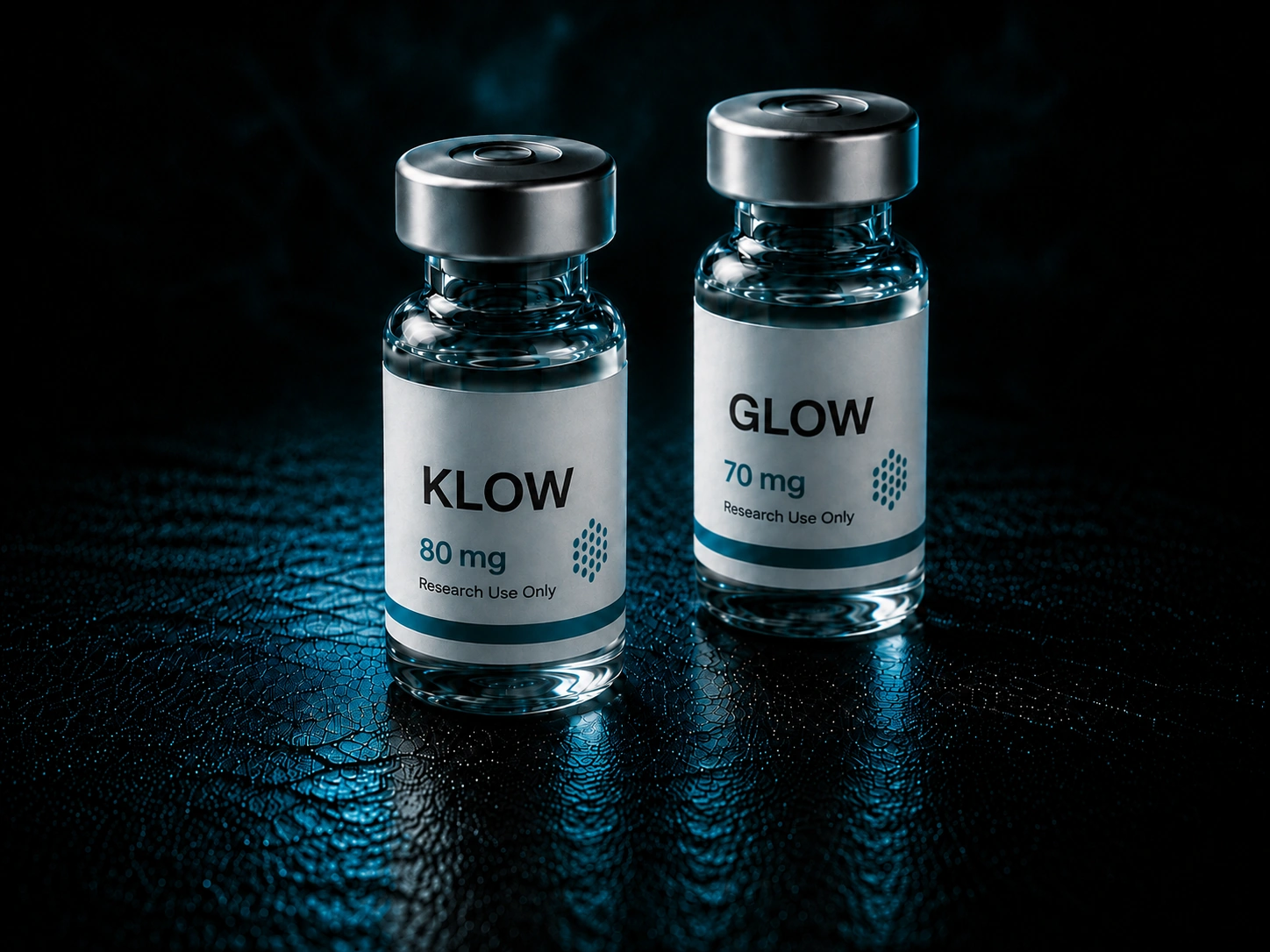
Is KLOW just GLOW plus one more peptide?
The three shared components are identical. The only thing to weigh is KPV, and KPV has never been tested in a person for anything.
| Attribute | GLOW | KLOW |
|---|---|---|
| Components | 3 | 4 |
| What is in it | GHK-Cu, BPC-157, TB-500 | GHK-Cu, BPC-157, TB-500, KPV |
| Common vial | 70 mg total | 80 mg total |
| Route | Under the skin | Under the skin |
| Trials of the blend | None | None |
| FDA status | No component approved | No component approved |
Common vial size is what vendors typically sell, not a recommendation. Ratios vary by seller.
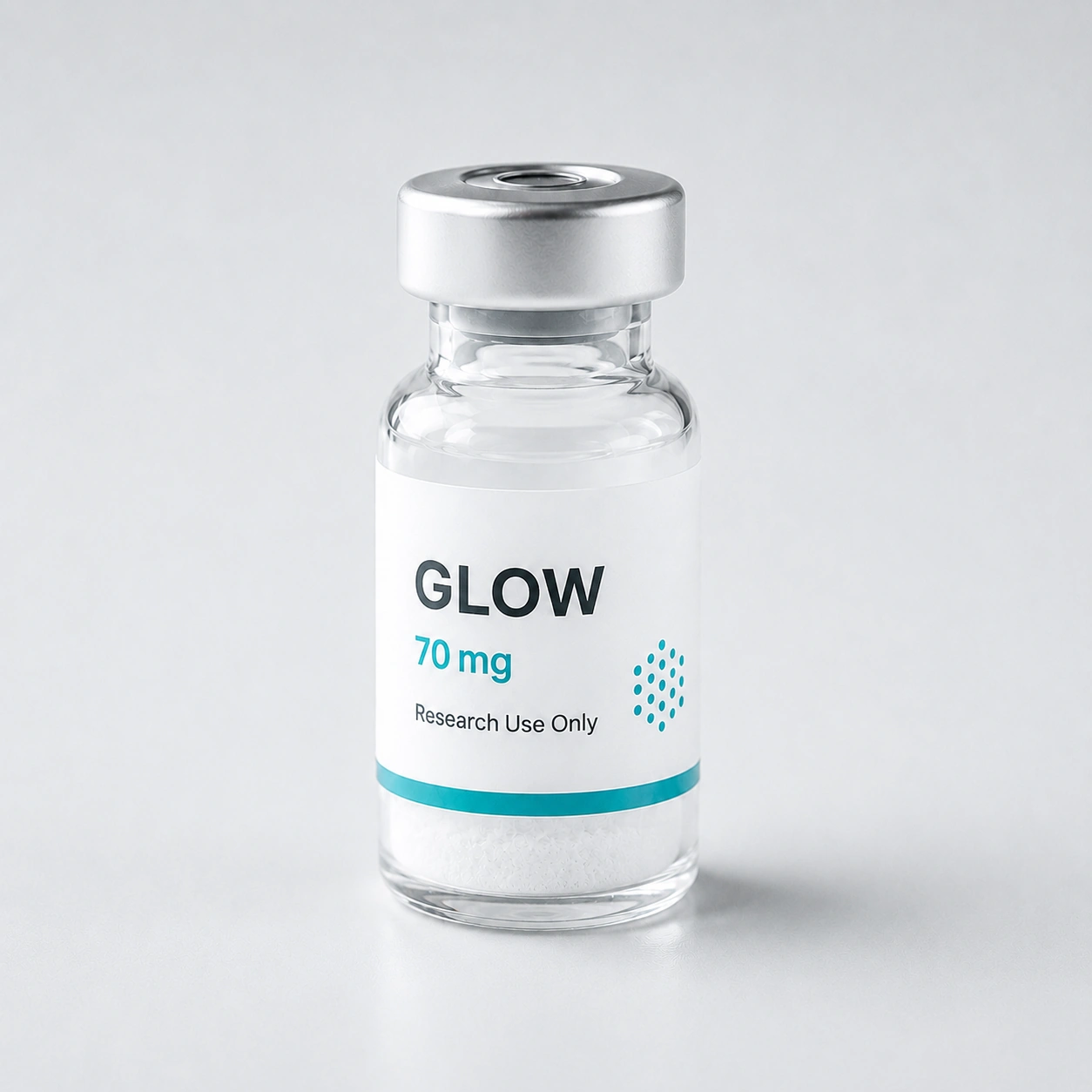
GLOW
Three peptides premixed in one vial. GHK-Cu for skin, BPC-157 and TB-500 for tissue repair. A skin and healing stack bundled into a single injection so you do not have to draw three.
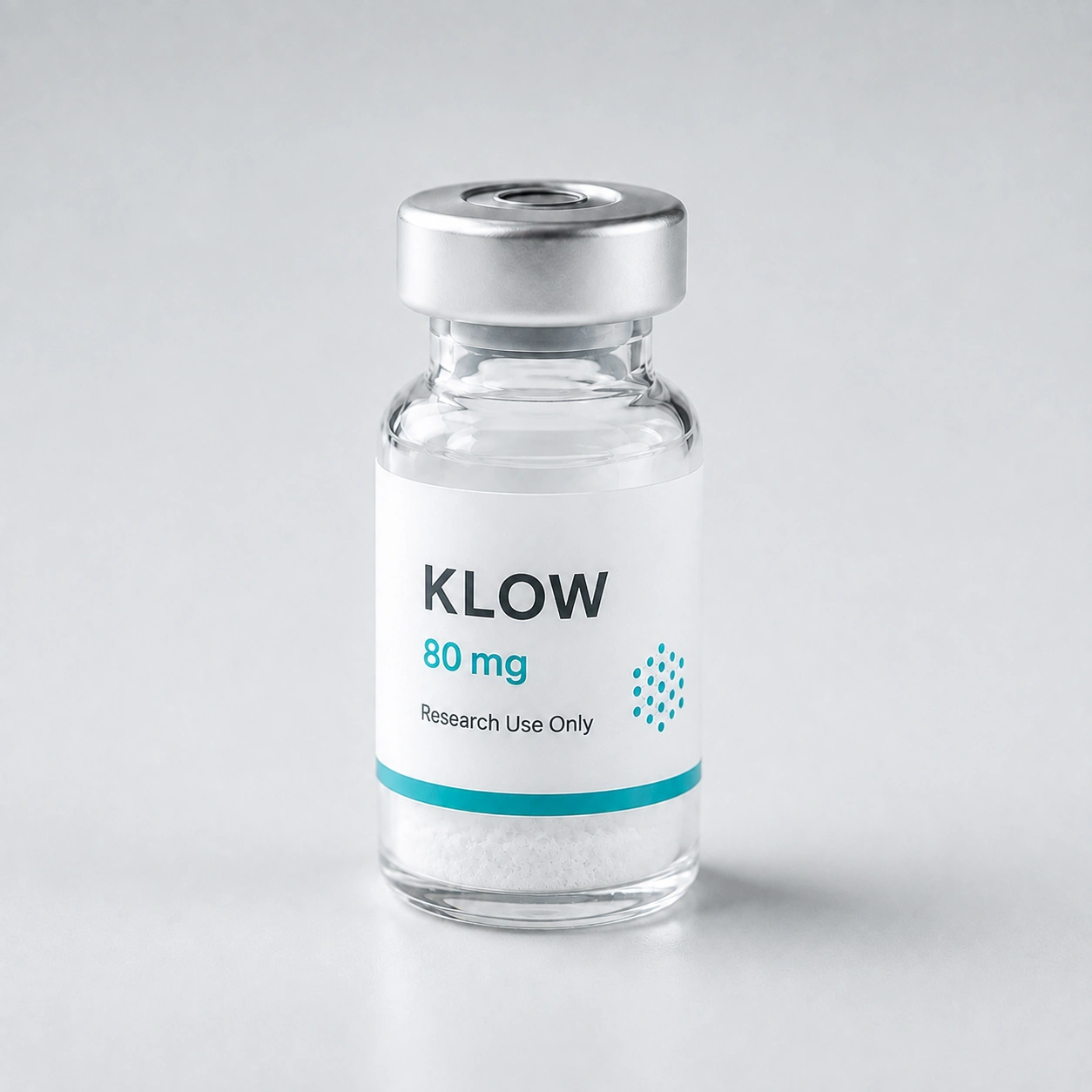
KLOW
The same three with KPV added. KPV is a three amino acid fragment of a hormone called alpha-MSH, studied for calming inflammation. In plain terms: GLOW with an anti-inflammatory on top.
Is everything in GLOW also in KLOW?
This is a subset comparison rather than a head to head. Whatever is true of GLOW is also true of KLOW, plus one more thing.
KLOW adds one thing. KPV, a three amino acid fragment studied for inflammation. Working from common vial sizes, GLOW is 70 milligrams of total peptide and KLOW is 80, so the fourth ingredient looks like roughly 10 milligrams of an 80 milligram vial. That is an inference from vial totals, not a published specification, because no published specification exists.
The ratio is fixed by the seller. You cannot raise one component and lower another. You get whatever was mixed.
Nobody defines these blends. Two vials labeled GLOW from different sellers may not contain the same amounts. The names are vendor inventions: no regulator, pharmacopoeia or standards body defines either one.
What does the evidence actually show?
Why does every date belong to a component and none to a blend?
The tripeptide is isolated
Loren Pickart isolates the GHK tripeptide from human blood plasma and reports in Nature that it prolongs liver cell survival. [3]
Nature New Biology1973;243(124):85-7 · Peer-reviewed paper
Thigh skin cream pilot
Abdulghani and colleagues apply creams to the thigh skin of 20 women for 12 weeks. Collagen production improved in 70 percent of those on GHK-Cu, against 50 percent on vitamin C and 40 percent on retinoic acid. [4]
Disease Manag Clin Outcomes1998;1:136-141 · Small pilot in a minor journal · Topical
- topical, not injected
- 20 subjects
Facial cream study, 71 women
Leyden and colleagues test a GHK-Cu facial cream on 71 women with photoaging for 12 weeks. The most cited human evidence for GHK-Cu, and the citation for it is inconsistent across the literature. All of it topical, not injected. [6]
Citation disputedAAD presentation 2002, Dermatol Surg 2005, or J Cosmet Dermatol 2002
- topical, not injected
- citation unresolved
The first human study, given rectally
Veljača and colleagues give PL 14736, the pharmaceutical name for BPC-157, rectally to healthy male volunteers and report it safe and well tolerated. [1]
Gut2003;51(Suppl):A309 · Conference abstract, not a full paper
- rectal, not injected
- abstract only
- methods never reviewed
Phase 2 enema trial for ulcerative colitis
A multicentre, randomized, double blind, placebo controlled Phase 2 trial of PL 14736 as an enema, for mild to moderate ulcerative colitis. The full trial data has never appeared as a standalone paper. [2]
Gastroenterology2005;128:A584 · Conference abstract in a supplement
- randomised
- placebo controlled
- enema, not injected
- full data never published
RegeneRx trials of the parent protein
RegeneRx runs human trials of thymosin beta-4, the parent of TB-500, as eye drops and topical gels, for corneal wounds, dry eye and skin conditions. A Phase 2 corneal wound trial in diabetic patients was terminated for slow recruitment. [5]
ClinicalTrials.gov NCT00598871Registry record · Phase 2 terminated for slow recruitment
- eye drops and gels
- the parent protein, not TB-500
Phase 1 registered, then gone
A Phase 1 safety and pharmacokinetics trial in 42 healthy volunteers is registered on ClinicalTrials.gov. Its status is listed as unknown, it was reportedly canceled the following year, and no results were ever published. [7]
ClinicalTrials.gov NCT02637284Registry record · Status unknown · No results posted
- cancelled
- no results
Category 2 at the FDA
The FDA places BPC-157, TB-500, KPV and injectable GHK-Cu in Category 2 of its 503A bulk substances list, the shelf for ingredients that may carry significant safety risks. Being on it means pharmacies cannot use them. [9]
US Food and Drug AdministrationRegulatory action · 503A bulk substances list
Off Category 2, nothing settled
All four come off Category 2 in a batch of twelve peptides, because the nominations were withdrawn rather than because anything was settled. [9]
US Food and Drug AdministrationRegulatory action · Nominations withdrawn
Advisory committee votes 8 to 6
The FDA's advisory committee votes on all three. Each is recommended for the compounding list by 8 votes to 6 with one abstention, against the advice of the FDA's own scientists, who recommended against all seven peptides heard over two days. [8]
Pharmacy Compounding Advisory CommitteeRegulatory vote record · Non-binding recommendation
- not approval
- does not cover blends
Injectable GHK-Cu still waiting
Injectable GHK-Cu was not on that agenda. It is scheduled for review by February 2027. [9]
US Food and Drug AdministrationRegulatory schedule
Still nothing
No published human trial of GLOW or KLOW exists.
- no blend trial
The human trials exist. They tested a different route, for a different condition. BPC-157 was given rectally, as an enema, to people with ulcerative colitis, in two conference abstracts. TB-500's parent was eye drops and topical gels for corneal wounds and dry eye. GHK-Cu's human work is topical creams for photoaged skin. None of that is a subcutaneous injection for tendon repair or skin quality, which is what these blends are sold for. The evidence is real. It is about something else.
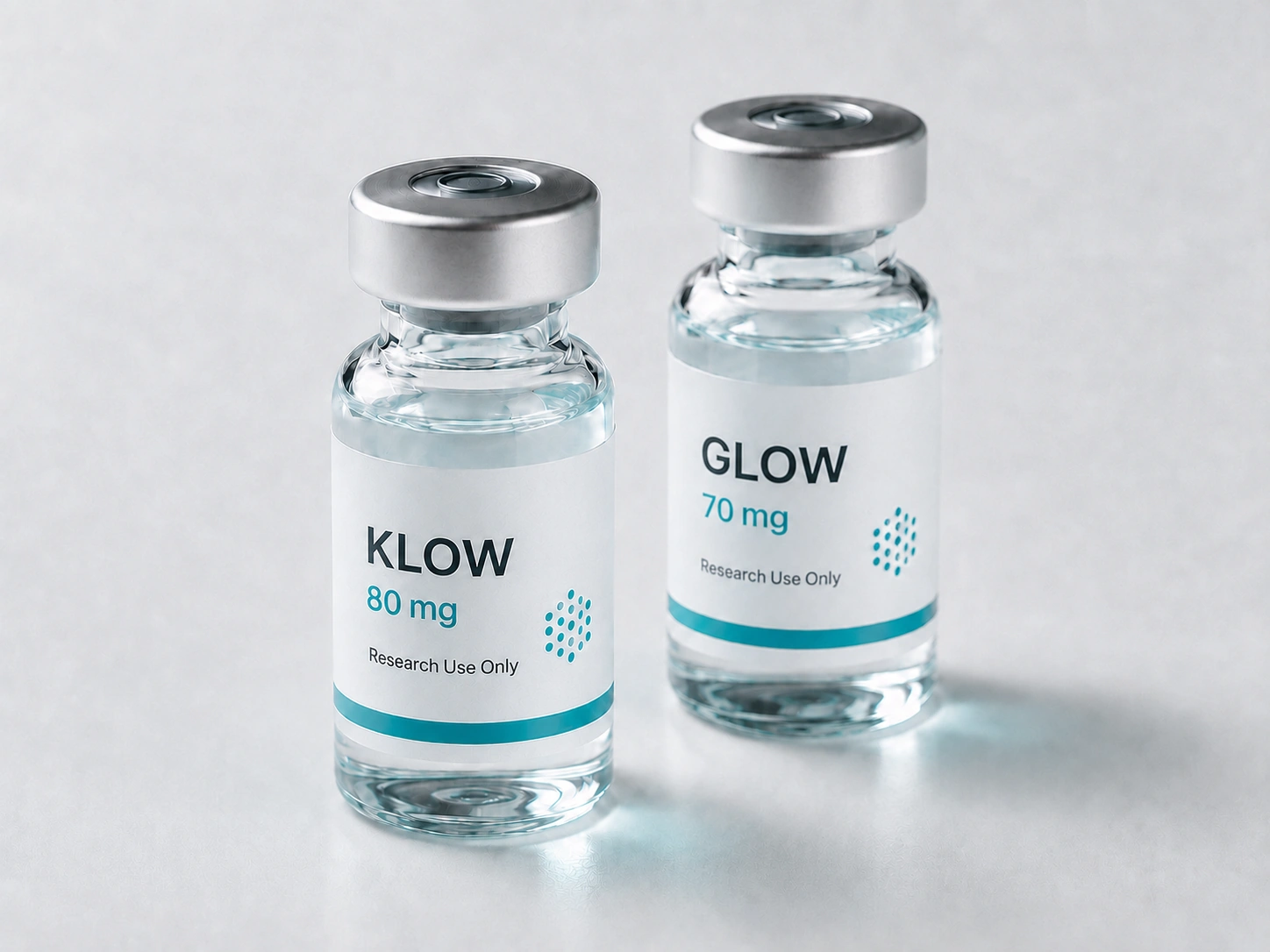
How do they compare, side by side?
How do they compare, side by side?
| Attribute | GLOW | KLOW |
|---|---|---|
| Components | GHK-Cu, BPC-157, TB-500 | GHK-Cu, BPC-157, TB-500, KPV |
| What the extra one does | Not applicable | KPV, studied for calming inflammation |
| Common vial | 70 mg total | 80 mg total |
| How it is sold | Injection under the skin | Injection under the skin |
| How it was given in the human trials | An enema or eye drops, depending on the component [1][2][5] | The same, and nothing at all for KPV |
| Human trials of the blend | None | None |
| Components with a favorable FDA advisory vote | 2 of 3 [8] | 3 of 4 [8] |
| Components still awaiting review | Injectable GHK-Cu [9] | Injectable GHK-Cu [9] |
| Legal to compound today | No | No |
| WADA status | Banned. TB-500 is named outright [10] | Banned. TB-500 is named outright [10] |
| Traceability if you react | Three suspects | Four suspects |
What is actually in each blend?
For each one, what it is, and how it was actually given to people.
GHK-Cu
A three amino acid chain your body makes, bound to copper. Reported to signal skin cells to rebuild collagen and to regulate the enzymes that break skin structure down.
What was tested in people: creams, applied to the face or thigh, for photoaged skin. [4][6] Injecting it is a different proposition with far less behind it.
BPC-157
A fifteen amino acid chain based on a protein found in stomach juice. Studied for healing tendon, muscle and gut tissue, with an enormous body of rat work behind it.
What was tested in people: an enema, for ulcerative colitis, in trials published only as conference abstracts. [1][2] A 2025 pilot gave it intravenously to two healthy adults. [11]
TB-500
Seven amino acids, copied from positions 17 to 23 of a 43 amino acid protein called thymosin beta-4. Seven out of forty-three, roughly a sixth of the molecule. [14]
What was tested in people: the full protein, as eye drops and topical gels, for corneal wounds and dry eye. The furthest that programme reached was a Phase 3 in a corneal disease, which reported healing in 6 of 10 treated patients against 1 of 8 on placebo and missed its primary endpoint at p = 0.0656, with 18 patients analysed out of 46 planned. [5] TB-500 is the fragment, not the protein those trials used.
KPV
Three amino acids, lysine, proline and valine. They are the last three of alpha-MSH, a thirteen amino acid hormone that does two jobs: it calms inflammation and it darkens skin. KPV keeps the calming job and drops the other one, because the part that binds the pigment receptors is not in the fragment. [16]
It is also unusual for a peptide in that it survives being swallowed. The gut has a transporter called PepT1 that pulls small peptides across the intestinal lining, and it becomes more active in inflamed tissue. Inside the cell it blocks NF-kB, a master switch for inflammatory signaling. [16]
What was tested in people: nothing. We could not find a published human trial of KPV for any purpose, and multiple independent sources say the same. Everything known about it comes from cells and animals.
What the blend assumes. That these four do not interfere with each other, that a fixed ratio suits every purpose, that a dose right for one is right for all, and that findings from an enema, an eye drop and a face cream carry over to a subcutaneous injection. None of that has been tested.
One thing worth flagging. BPC-157 and TB-500 both encourage new blood vessel growth. That is the mechanism behind the healing claims, and it is also why both carry a caution around active cancer.
What are the key differences?
What actually separates them?
What has nobody answered?
Which four gaps has nobody answered?
Nobody has tested either blend.No published human trial of GLOW or KLOW exists, for any endpoint. Every claim is inference from components studied separately, mostly in animals, mostly by other routes.
And the ingredient that separates them has no human data at all.KPV is the only difference between GLOW and KLOW. It has never been tested in a person, for anything. So the question this page is nominally about, whether the fourth peptide is worth adding, has no evidence on either side of it.
Nobody tested them the way people use them.The human evidence for three of the four components came from enemas, eye drops or face creams. These blends go in as a shot under the skin. How much of a compound reaches the place you want it, what it passes through on the way, and what it does to the rest of you all change with the method. The FDA does exactly this with one of these components: injectable GHK-Cu and non-injectable GHK-Cu sit in different categories on its own list. [9]
Nobody defines what is in them.GLOW and KLOW are seller names. There is no monograph, no standard, no regulatory definition. One seller's GLOW may not match another's. The only way to know what you have is a certificate of analysis, and that tells you what the seller had tested. A premixed vial also locks the ratio, so every dose moves all three or four together, and if you react you have three or four suspects and no way to separate them without stopping everything.
What are the side effects, and what are you buying?
Do every component's cautions apply at once?
Reported effects
Drawn from the individual components, not from the blends.
- Injection site reactionscommon
- Head rush or lightheadedness shortly after injectingreported
- Tirednessreported
- Mild skin irritation or redness, from the copper componentghk-cu
Do not use
Cautions inherited from the components.
- Active cancer, given that two components encourage blood vessel growthcaution
- Pregnancyno data
- Known copper allergy or metal sensitivityghk-cu
- Anyone subject to drug testing in sportbanned
What is in the vial
Blends make this harder, not easier.
- No standard defines GLOW or KLOW, so ratios vary by sellerundefined
- Products sold as TB-500 have been analyzed specifically, and the results support treating the label as a claim [15]analysis
- Testing of seized peptides found purity between 5 and 75 percent, plus arsenic and lead [12]analysis
- One US lab reported problems in almost 30 percent of samples, including bacteria [13]testing
*Four components means four chances for the vial to be wrong. Where this page says nothing is established, it means nobody has studied it. It does not mean a compound is safe.
At the July 2026 advisory committee meeting, people speaking against these peptides argued they were not sufficiently definable, given how much formulations vary across the industry. [8] Blends are the sharpest version of that problem. A four peptide premix has four ways to differ from its label. Our guide on reading a certificate of analysis covers what to actually check.
Are they banned in sport?
Are both blends banned, and which component is named outright?
TB-500 is named outright. No interpretation required.
BPC-157 is prohibited without being named. It does not appear by name on the 2026 list. It is caught anyway, either by the catch-all at the end of S2.3, which covers growth factors affecting muscle, tendon or ligament repair and blood vessel growth, or by S0, which covers substances with no approval from any government health authority. Either route reaches the same place.
Both are in both blends, so both blends are prohibited. There is no version of this where a blend containing BPC-157 is acceptable under a testing program. Both are prohibited at all times, in and out of competition, and substances in these categories carry a default four year ban.
Contaminated research vials have also caused positive tests for compounds the athlete never intended to take. A four component blend from an unregulated seller is the worst case for that risk.
If three components were recommended, why is neither blend legal?
It is a recommendation, not a decision. On 23 July 2026 the FDA's Pharmacy Compounding Advisory Committee voted on BPC-157, TB-500 and KPV, recommending all three for the 503A bulks list, each by 8 votes to 6 with one abstention. The committee advises; the FDA is not bound by it. The agency still has to open rulemaking, publish a proposed rule, take comment and publish a final rule. That typically runs 8 to 24 months. [8]
It is about compounding, not approval. A compounding pharmacy makes medicines to order for one patient with a prescription, and the 503A list governs which raw ingredients it may use. Getting on that list is not drug approval, and it is not a finding that anything is safe or effective.
And it would not cover a blend. Even after rulemaking, the list authorises individual bulk substances for a pharmacy to compound against a prescription. A premixed four peptide vial bought online is a different thing. One component is also a step behind: injectable GHK-Cu was not reviewed in July and is scheduled for review by February 2027. [9]
As things stand, no component of either blend is FDA approved, none may legally be compounded, and neither blend has any regulatory standing at all.
Questions people ask
What is the difference between GLOW and KLOW?
KLOW is GLOW with KPV added. GLOW has three peptides, KLOW has four. Everything else is the same.
Is KLOW better than GLOW?
Nobody has tested either, so there is no evidence either way. KLOW adds a peptide studied for inflammation, in cells and animals. Whether that helps in a person has not been measured.
What is actually in them?
GLOW is GHK-Cu, BPC-157 and TB-500. KLOW adds KPV. Amounts vary by seller, because no standard defines either blend.
Does BPC-157 have human trials?
Yes, and they are not what most people think. It was given as an enema to people with ulcerative colitis, under the name PL 14736, and both studies were published only as conference abstracts. The full Phase 2 data has never appeared as a paper. A Phase 1 registered in 2015 was canceled with no results.
Did the FDA just approve BPC-157 and TB-500?
No. An advisory committee recommended them for the compounding list in July 2026 by 8 votes to 6. That is not approval, it is not binding, rulemaking takes many months, and it does not cover blends.
Are the blends banned in sport?
Yes. TB-500 is named outright on the 2026 Prohibited List under section S2.3. BPC-157 is prohibited too, caught by catch-all wording rather than being named. Both are in both blends.
Can I just buy the components separately?
That is a different question from which blend to choose, and it is the one worth asking. Separate vials cost more and take more work, and they let you change one thing at a time and know what caused a reaction.
Why do blends exist at all?
Convenience. One reconstitution, one draw, one injection instead of three or four. That is a real benefit, and it comes at the cost of control and traceability.
What this page is built on
- 01Veljača M, Sladoljev D, Mildner B, et al. Safety, tolerability and pharmacokinetics of PL 14736, a novel agent for treatment of ulcerative colitis, in healthy male volunteers. Gut. 2003;51(Suppl):A309. Human study, rectal administration. Conference abstract, not a full paper.
- 02Ruenzi M, Stolte M, Veljaca M, Oreskovic K, Peterson J, Ulcerative Colitis Study Group. A multicenter, randomized, double blind, placebo-controlled phase II study of PL 14736 enema in the treatment of mild-to-moderate ulcerative colitis. Gastroenterology. 2005;128:A584. Human Phase 2 trial, enema. Conference abstract. Full trial data never published as a standalone paper.
- 03Pickart L, Thaler MM. Tripeptide in human serum which prolongs survival of normal liver cells and stimulates growth in neoplastic liver. Nature New Biology. 1973;243(124):85-7. Original identification of GHK. Confirm citation details.
- 04Abdulghani AA, Sherr S, Shirin S, Solodkina G, Tapia EM, Gottlieb AB. Effects of topical creams containing vitamin C, a copper-binding peptide cream and melatonin compared with tretinoin on the ultrastructure of normal skin. Disease Manag Clin Outcomes. 1998;1:136-141. Human pilot, 20 subjects, topical, minor journal.
- 05ClinicalTrials.gov NCT00598871. A randomized, double-mask, placebo-controlled, dose response, Phase 2 study of thymosin beta 4 in the treatment of diabetic patients' corneal wounds. Sponsor ReGenTree. Human Phase 2, eye drops. Terminated for slow recruitment.
- 06Leyden JJ, et al. GHK-Cu facial cream, 71 women, 12 weeks. Citation disputed: sources variously give an American Academy of Dermatology presentation from February 2002, Dermatol Surg. 2005;31(7):809-816, and J Cosmet Dermatol. 2002;1(3):197-204. Human study, topical. Verify against the journal before citing a specific version.
- 07ClinicalTrials.gov NCT02637284. Safety and pharmacokinetics of PCO-02 (BPC-157) in healthy volunteers. Registered December 2015, 42 subjects. Status listed as unknown. Reportedly canceled 2016. No results published.
- 08US Food and Drug Administration. Pharmacy Compounding Advisory Committee meeting and vote record, 23 to 24 July 2026. BPC-157, TB-500 and KPV each recommended 8 to 6 with one abstention. Regulatory document. Non-binding recommendation, not approval.
- 09US Food and Drug Administration. 503A bulk drug substances category updates, September 2023, and Category 2 removals, April 2026, following withdrawal of nominations. Injectable GHK-Cu scheduled for review by February 2027. Regulatory documents.
- 10World Anti-Doping Agency. The 2026 Prohibited List, effective 1 January 2026. Section S2.3 names thymosin beta-4 and its derivatives, giving TB-500 as the example, and closes with a catch-all covering other growth factors affecting tissue repair and vascularisation. All S2 substances are non-specified. Regulatory document.
- 11Lee E, Burgess A. Pilot study of intravenous BPC-157 in healthy adults. Altern Ther Health Med. 2025. PMID 40131143. Human pilot, 2 subjects. Confirm citation details before publishing.
- 12Janvier S, Cheyns K, Canfyn M, Goscinny S, De Spiegeleer B, Vanhee C, Deconinck E. Impurity profiling of the most frequently encountered falsified polypeptide drugs on the Belgian market. Talanta. 2018;188:795-807. DOI 10.1016/j.talanta.2018.06.023. Peer-reviewed analytical study.
- 13NBC Washington. Lab finds problems in 30% of peptide vials tested. December 2024. News report of commercial laboratory testing, not peer reviewed.
- 14Esposito S, Deventer K, Goeman J, Van der Eycken J, Van Eenoo P. Synthesis and characterization of the N-terminal acetylated 17-23 fragment of thymosin beta 4 identified in TB-500. Drug Test Anal. 2012;4(9):733-738. DOI 10.1002/dta.1402. Analytical study establishing what TB-500 actually is.
- 15Delcourt V, et al. TB500/TB1000 and SGF1000: a scientific approach for a better understanding of misbranded and adulterated drugs. Drug Test Anal. 2023. DOI 10.1002/dta.3421. Peer-reviewed analytical study of what products sold under these names contain.
- 16KPV, the C-terminal tripeptide of alpha-MSH, positions 11 to 13. Molecular formula C16H30N4O4, molecular weight about 342.4, PubChem CID 125672. Uptake via the PepT1 transporter; mechanism reported as NF-kB inhibition, independent of melanocortin receptors. Chemical identifiers and preclinical mechanism. CAS numbers conflict across sources.