
Common vial size is what vendors typically sell, not a recommendation. Enter your own vial in the calculator.
What is GLOW blend?
Plain language first. The technical label stays, but it never stands alone.Overview
It bundles a skin-and-healing stack into one injection.
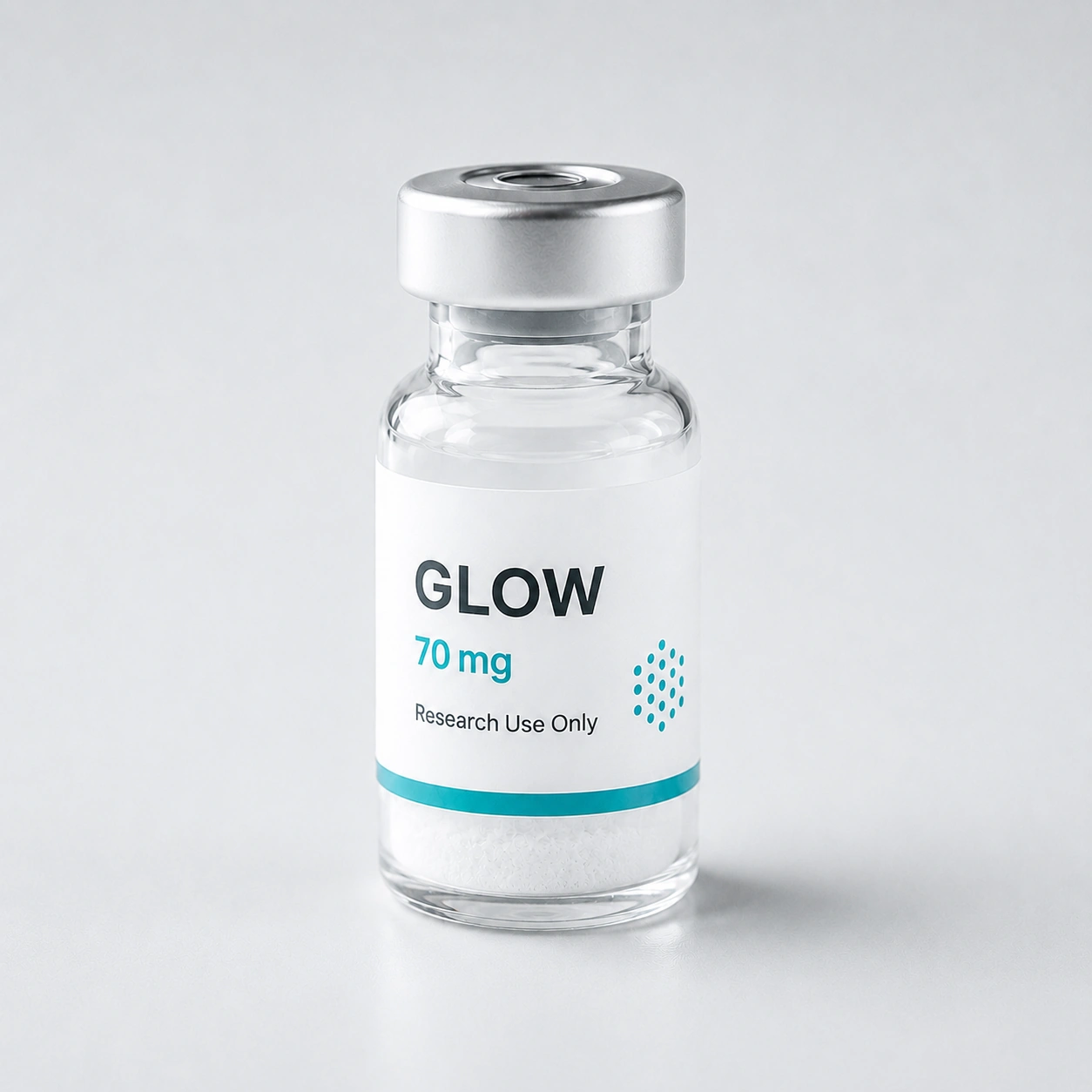
GLOW is a pre-mixed blend of three peptides: GHK-Cu for skin, plus BPC-157 and TB-500 for tissue repair.
What it's used for
A popular beauty-and-healing mix: a skin-repair copper peptide plus two recovery peptides, all in one injection.
How does GLOW blend work?
What it does in the body, and where.GLOW is three peptides pre-mixed in one vial: GHK-Cu, BPC-157, and TB-500.
- 01GHK-Cu carries copper into skin cellsSignaling collagen production and wound repair.
- 02BPC-157 and TB-500 handle tissue repairBlood vessel growth and repair-cell migration respectively.
- 03The blend itself has never been studiedEach component has its own evidence, none of it strong in humans, and nothing establishes what they do together. The ratio also differs between products, which is why this page shows no dose range.

What else is it used for?
Each use below carries its own evidence level. Approved means regulators have cleared it for that purpose. Investigational means it is in trials. Early research means it is being studied and is not established.
- Skin quality, firmness, and tone, from the copper peptide in the blendResearch only
- Healing tendons, muscle, and gut, from the two repair peptides in the blendEarly research
- Convenience, since it bundles three peptides into one injectionResearch only
The published record
Papers and trials about GLOW blend
Searched: BPC-157, BPC 157, TB-500, TB500, GHK-Cu, copper tripeptide.
Left out: GLOW (too short to disambiguate without context).
4 papers tagged human · 0 not reviews or lab · 0 clinical trial publications
Furthest stage reached: No clinical trial on record
Counted from Europe PMC indexing, not read by a person; a human tag can land on reviews, commentary or lab papers; clinical trial publications is the narrower count.
At a glance
Four things to know about GLOW blend
Evidence
Category
Healing and recovery
Common vial
70 mg
Half-life
One part measured in rats, two never measured
How much, and do you cycle it?
The range, and whether you take breaks.Community examples use 2 to 2.5 mg of total blend per day, or set the draw by GHK-Cu., daily. No established schedule No range
No published study has established how long to take this or whether a break is needed. Schedules quoted online come from vendors and forums, and different sources disagree.
One part measured in rats, two never measuredNo figure
BPC-157, TB-500 and GHK-Cu. The only real figure among them is BPC-157 in rats. TB-500 as sold is a fragment of a protein whose published work is on the full molecule, and GHK-Cu has no published figure for either route.
You can compare this against the whole library to see where it sits.
How do I dose and price it?
Enter your vial and your dose. Pick a mix. We show the draw and the cost.The vial holds a fixed amount of drug. Adding more water does not make more drug, it just spreads it thinner, so you draw a bigger number on the syringe for the same dose.
The 5:1:1 ratio at 70 mg is the common one, but 90 mg and 10 mg vials are also sold. At least one vendor lists the ratio backward on its own product page, putting 50 mg on TB-500 instead of GHK-Cu. Read your label, not the product name.
Pick your vial to see concentrations and a draw.
Choose your mix
Measuring the water1 mL = one full 100-unit syringe.
Your draw
What one draw delivers
The same arithmetic as the calculator, worked out for the vials vendors sell.GLOW is commonly calculated by total blend amount or by GHK-Cu, not by BPC-157. These total-blend examples show each component in the same draw at your vial’s ratio. No human study establishes a dose. Syringe units change with vial strength and water volume.
| Total blend | 1 mL water | 2 mL water | 3 mL water |
|---|---|---|---|
| 2 mg | 2.9 units
| 5.7 units
| 8.6 units
|
| 2.5 mg | 3.6 units
| 7.1 units
| 10.7 units
|
| 3.5 mg | 5.0 units
| 10.0 units
| 15.0 units
|
| Total blend | 1 mL water | 2 mL water | 3 mL water |
|---|---|---|---|
| 2 mg | 2.2 units
| 4.4 units
| 6.7 units
|
| 2.5 mg | 2.8 units
| 5.6 units
| 8.3 units
|
| 3.5 mg | 3.9 units
| 7.8 units
| 11.7 units
|
| Total blend | 1 mL water | 2 mL water | 3 mL water |
|---|---|---|---|
| 2 mg | 20.0 units
| 40.0 units
| 60.0 units
|
| 2.5 mg | 25.0 units
| 50.0 units
| 75.0 units
|
| 3.5 mg | 35.0 units
| 70.0 units
| Over 100 units: will not fit one U-100 syringe.
|
Community examples describe 2 to 2.5 mg of total blend per day. Another convention sets the draw by GHK-Cu. Neither is an established clinical range.
For a 50 + 10 + 10 mg vial mixed in 2 mL, 10 units delivers 3.5 mg total blend: 2.5 mg GHK-Cu, 500 mcg BPC-157 and 500 mcg TB-500. Ten units is a volume, not a fixed dose; a different vial or water volume changes the amount delivered.
GLOW blend starts at $45.00 across 139 vendors, typically $0.90 – $2.64 per mg.
180 listings, last read Oct 24, 2026. Shipping and card fees are not included.
How do you store it?
Before mixing, and after.Dry powder in the freezer or fridge. Once mixed, fridge, and use within about a month.
Unmixed lyophilized GLOW blend keeps for a long time cold. Once you add water the clock starts: most reconstituted vials hold up for roughly 28 to 30 days at fridge temperature. Keep it out of light, and do not freeze it after mixing.
What are the side effects and cautions?
Known cautions and warnings for this compound.Who should avoid it
- A known copper allergy or metal sensitivity, so patch test first
- Broken or actively irritated skin
- Layering with strong acids or retinoids on the same area
- Active cancer, as a precaution given that it promotes new blood-vessel growth
- Pregnancy
- Banned in drug-tested sport
- Active cancer, as a precaution given the tissue-growth mechanism
Stop and get help
- A spreading rash or significant swelling where applied
- Signs of an allergic reaction
- New lumps or masses
Common effects
- Mild, temporary skin irritation, redness, or itching
- Among the least irritating copper compounds in comparison studies
- The good safety record applies to topical use. Injectable and oral forms lack this database
- Generally well tolerated in the limited data that exists
- Injection-site reactions
- Almost all evidence is from animals, so the human profile is not established
- Head rush or lightheadedness shortly after injecting
- Tiredness
- This is a blend, so the cautions of every peptide in it apply at once. It is also harder to tell which component caused a reaction.
Where this page says nothing is established, that means nobody has studied it, not that a compound is safe.
Is GLOW blend approved?
And where the numbers on this page come from.No. GLOW blend is not approved for any use, anywhere. It is sold labeled for laboratory research only, and there is no legal route to buy it for human use.
- Approval statusResearch only
- RouteUnder the skin (subcutaneous)
- Checked14 August 2026
- DoseFrom community reports. No regulator or trial established this dose.
- Vial sizeFrom what vendors typically list; not a recommendation.
- SourcesNone traced yet.
What has happened recently
We have not yet written a full regulatory note for this compound. The status above is current as of the date shown.
Banned in drug-tested sport. Most research peptides are prohibited under WADA's S0 category, which covers any substance with no approval from any regulatory authority for human use. That means a compound can be banned without ever being named on the prohibited list. Check with your own anti-doping authority rather than assuming absence from the list means permitted.
You can compare this against the whole library, or read how to check a seller.
What else is like GLOW blend?
Others in Healing and recovery, side by side.If you're weighing GLOW blend, it's worth reading KLOW blend, ARA-290 (Cibinetide), and VIP (Vasoactive Intestinal Peptide) in the same class.
A popular skin-and-healing blend of three peptides in one shot.
- Dose
- Community examples use 2 to 2.5 mg of total blend per day, or set the draw by GHK-Cu.
- How often
- Daily
The GLOW blend plus an anti-inflammatory peptide, an all-in-one recovery stack.
- Dose
- Community examples use 2 to 4 mg of total blend per day, or set the draw by GHK-Cu.
- How often
- Daily
A peptide studied for calming nerve pain and inflammation.
- Dose
- 1 up to 4 mg per day (start low, increase slowly)
- How often
- Daily
A nasal-spray peptide used to calm chronic inflammation and immune problems.
- Dose
- 0.05 mg per dose
- How often
- Several daily
Guides for this compound
- How to Reconstitute a Peptide
Mix peptide powder with bacteriostatic water, step by step.
- How to Read an Insulin Syringe
Read the units, convert to millilitres, and draw the exact dose.
- mcg vs mg: The Peptide Dosing Mistake to Avoid
Your vial says mg and your protocol says mcg. Here is the conversion and how to check it.
- How to Read a Peptide COA
What the purity number does and does not tell you, and how to spot an edited report.
- How to Vet a Peptide Vendor
Independent COAs, HPLC purity, and the red flags that mean walk away.
Sources
No primary source has been traced for this compound yet. Treat everything on this page as unverified until one is. How we grade evidence
Beyond these, 9 records are indexed. Browse the records