
Melanotan I vs Melanotan II
The numbers imply a sequence. There isn't one. Melanotan I is a thirteen amino acid chain that fits one receptor and is an approved prescription drug. Melanotan II is seven amino acids closed into a ring, fits four receptors, and is approved nowhere.
- Skin and pigment
- Different molecules
- One approved, one warned against
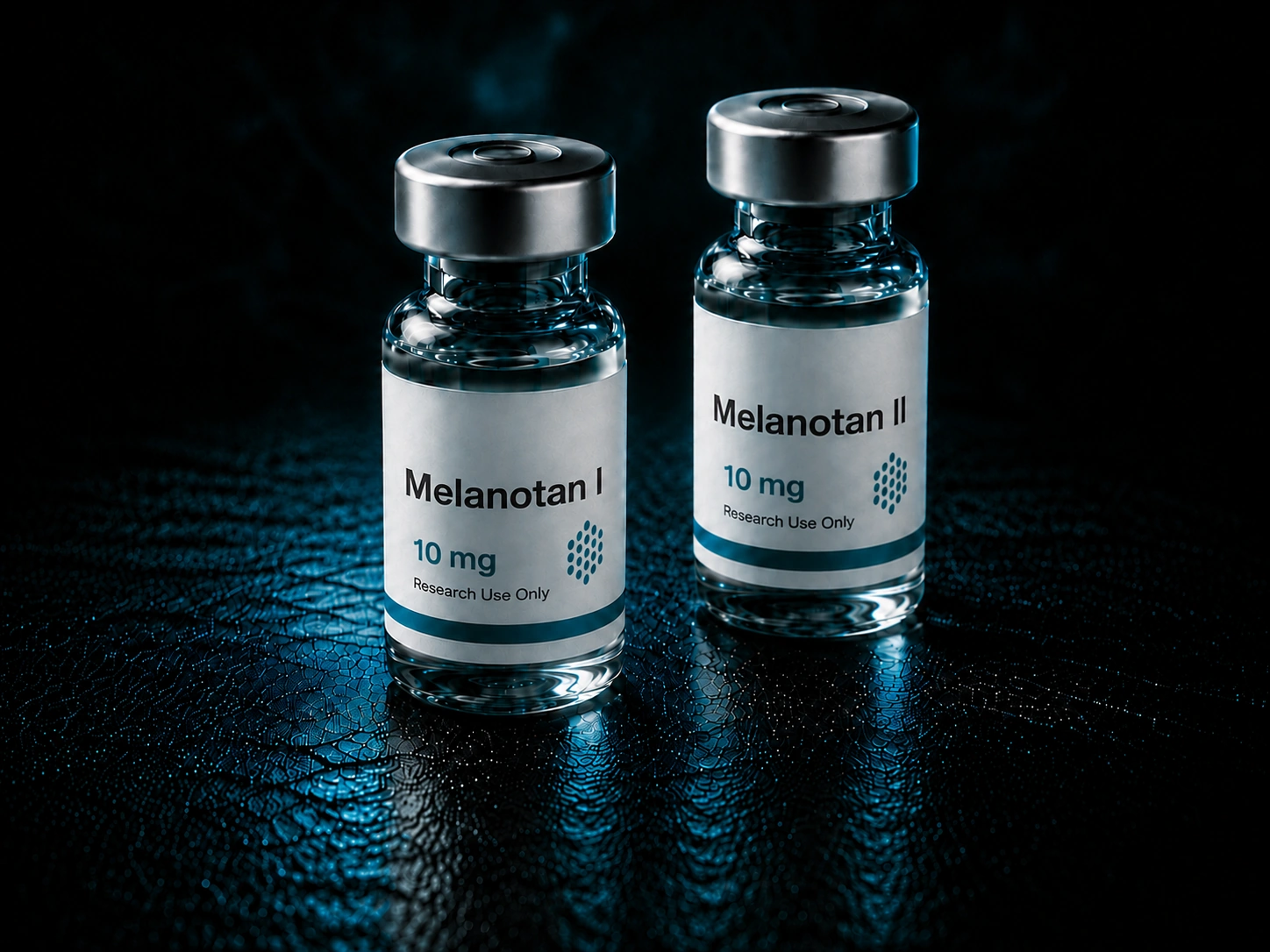
Are these two versions of the same molecule?
Melanotan I is an approved prescription drug for a rare disease, given as an implant by a clinician. Melanotan II has never completed a trial program, is approved nowhere, and four national regulators have warned against it.
| Attribute | Melanotan I | Melanotan II |
|---|---|---|
| Proper name | Afamelanotide | None. Melanotan II is the research name |
| Structure | 13 amino acids, linear chain | 7 amino acids, closed ring |
| Receptors | MC1R only | MC1R, MC3R, MC4R, MC5R |
| Approved | October 2019, FDA and EMA, as Scenesse | Nowhere, for anything |
| Approved for | Erythropoietic protoporphyria, a rare inherited condition | Nothing. FDA, EMA, TGA and MHRA have all warned |
| Route | Implant, placed by a clinician | Self-injected |
| Available for tanning | No | Sold online, not legally |
They share a family and a naming convention. That is close to all they share.
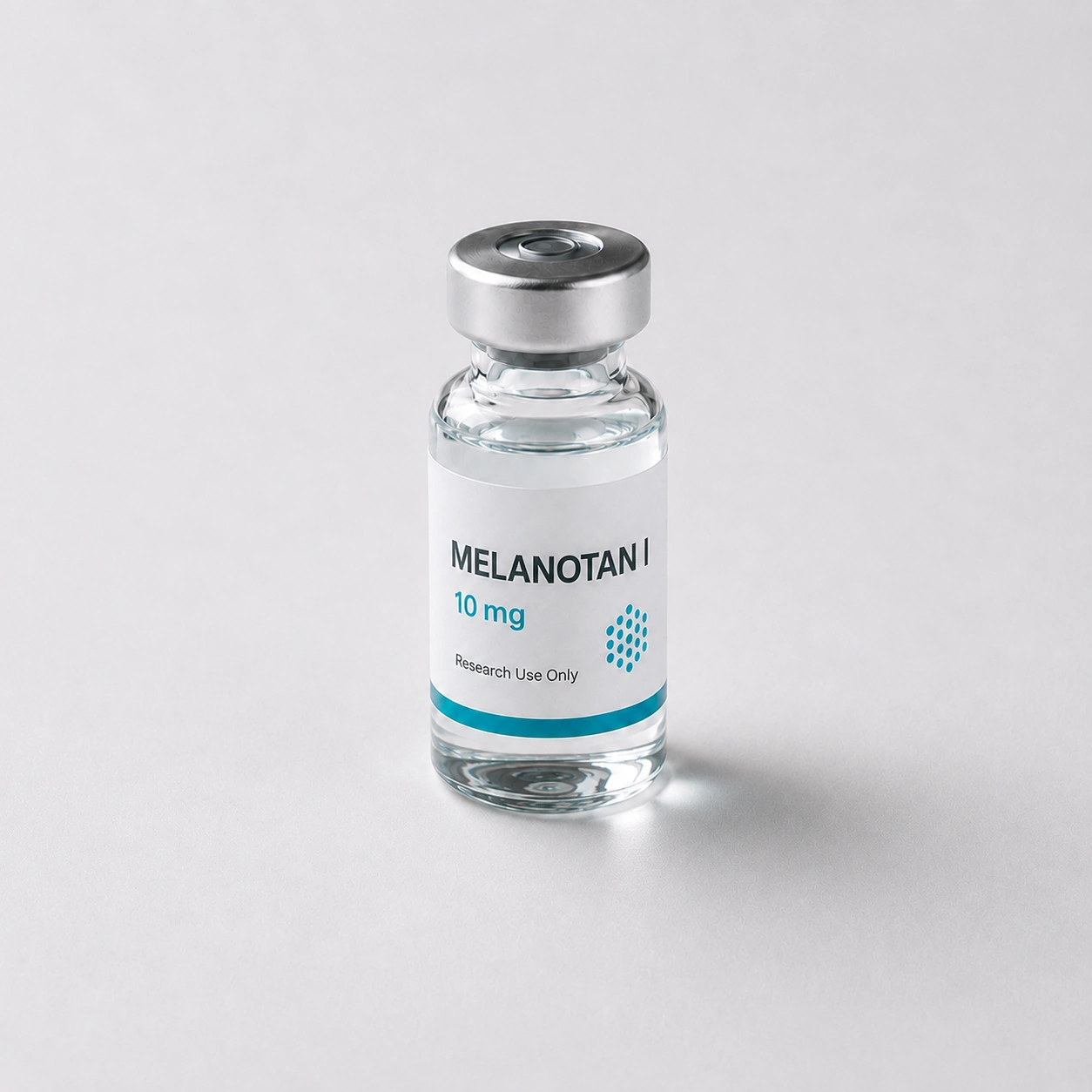
Melanotan I
A synthetic copy of alpha-MSH, the pigment hormone, selective for one receptor. Approved as Scenesse in October 2019 for erythropoietic protoporphyria, where sunlight causes severe pain within minutes. The powder sold online is the same molecule and not the same product.
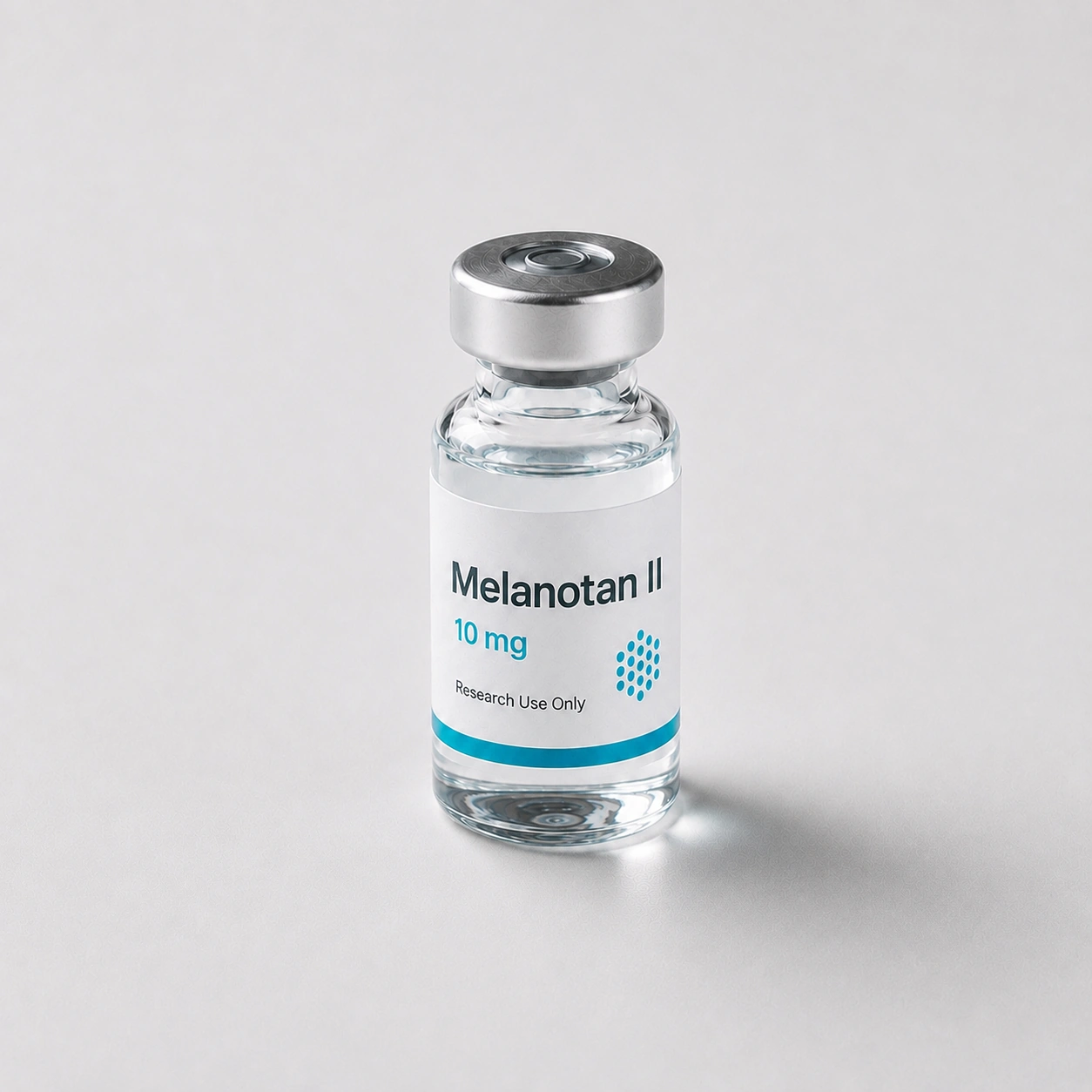
Melanotan II
A different synthetic melanocortin, built as a ring rather than a chain, which hits four receptors instead of one. In plain terms: the compound that became known online as the tanning peptide. It has never completed the trials an approval would need.
Why are the numbers the problem?
One and two imply a sequence. There isn't one. Melanotan I is a straight chain of thirteen amino acids that fits MC1R, the pigment switch, and nothing else. Melanotan II is seven amino acids closed into a ring, and the ring is what lets it reach MC3R, MC4R and MC5R as well. The second one is not a stronger version of the first. It is a shorter molecule with a different shape, and it is less selective, not more potent.
Different lengths, not two settings. Thirteen amino acids against seven. They are separate molecules, and the names came from a lab numbering research compounds rather than from a product line.
Shape decides selectivity. Closing into a ring is what lets Melanotan II reach receptors the chain cannot. More receptors is not more potent, it is less specific, and the extra effects are the side effects.
Even the category splits. In this library Melanotan I sits under skin and cosmetic. Melanotan II sits under weight loss and metabolic, because of what the extra receptors do.
You can buy Melanotan I powder online, and that changes nothing. The molecule in that vial is nominally the same peptide that is in Scenesse. What is different is everything around it: a 16 milligram rod made under pharmaceutical manufacturing controls, dispensed on prescription, implanted by a trained clinician, releasing over two months, with a label requiring twice yearly skin checks. A vial of powder has none of that, and injecting it is not how the drug was ever tested. The approval belongs to a specific product used a specific way. It does not travel with the molecule.
A third relative is also approved. Bremelanotide, sold as Vyleesi, is derived from Melanotan II and is FDA approved for low sexual desire in some women. This family has two approved prescription drugs and one compound that has never been approved for anything, and people treat all three as interchangeable. [5]
What does the evidence actually show?
Which one went through the process, and which did not?
University of Arizona
Researchers develop synthetic analogs of alpha-MSH, the pigment hormone, while looking for a way to protect skin from sun damage. Both compounds come out of this work, numbered as research compounds rather than as product generations.
Academic research programSource type: peer-reviewed literature
Out of the lab, into use
The compound circulates outside research and the extra receptor activity becomes apparent. Users report appetite suppression and sexual arousal alongside pigment change. No controlled program follows.
Unpublished community useSource type: no controlled data
- no trial program
- no approved dose
Three Phase 3 trials
Afamelanotide is developed as a prescription medicine for erythropoietic protoporphyria, a rare inherited condition where sunlight causes severe pain within minutes. CUV029, CUV030 and CUV039 are run. [2]
Expert Rev Clin PharmacolSource type: peer-reviewed review of the Phase 3 program
- randomized
- placebo controlled
- published
FDA approves Scenesse
Afamelanotide is approved for preventing phototoxic reactions in adults with erythropoietic protoporphyria. The pivotal result was median pain-free sun exposure of 69.4 hours against 40.8 hours on placebo. It is delivered as an implant placed under the skin by a trained clinician. Reported adverse events included nausea in about 31 percent of patients, implant site reactions in about 22 percent and headache in about 18 percent. [1][2]
US Food and Drug AdministrationSource type: regulatory approval record
FDA approvalVyleesi approved
Bremelanotide, derived from Melanotan II, is approved for low sexual desire in some premenopausal women. A second approved member of the same family. [5]
US Food and Drug AdministrationSource type: regulatory approval record
FDA approvalWarnings and enforcement
Regulators in the United States, European Union, Australia and United Kingdom issue consumer warnings. The Australian TGA confiscates products at the border. A 2017 review in the International Journal of Dermatology catalogues the reported harms and concludes the two compounds should not be treated as equivalent. Individual case reports link Melanotan II to melanoma, priapism and renal infarction. [4][6][7]
Int J Dermatol · MHRA · TGA · FDASource type: peer-reviewed review, regulatory actions, case reports
- no pharmacovigilance
- no denominator
Search demand climbs
Searches for tanning peptides reach roughly 27,100 a month in the United States, up around ninefold in twelve months. [8]
Rising Trends search analysisSource type: third-party search data, not peer reviewed
Where that leaves them
Melanotan I remains available only on prescription, for one rare condition. Melanotan II remains approved nowhere and sold everywhere.
Afamelanotide ran three Phase 3 trials, was reviewed by two major regulators, carries a defined indication, is dispensed under supervision, and has a formal system watching for problems after approval. Melanotan II has none of that. No trial program, no approved dose, no oversight, and critically no system counting what goes wrong. That absence of monitoring is the part people miss. A shorter list of reported harms is not a safer drug. It is an unwatched one.
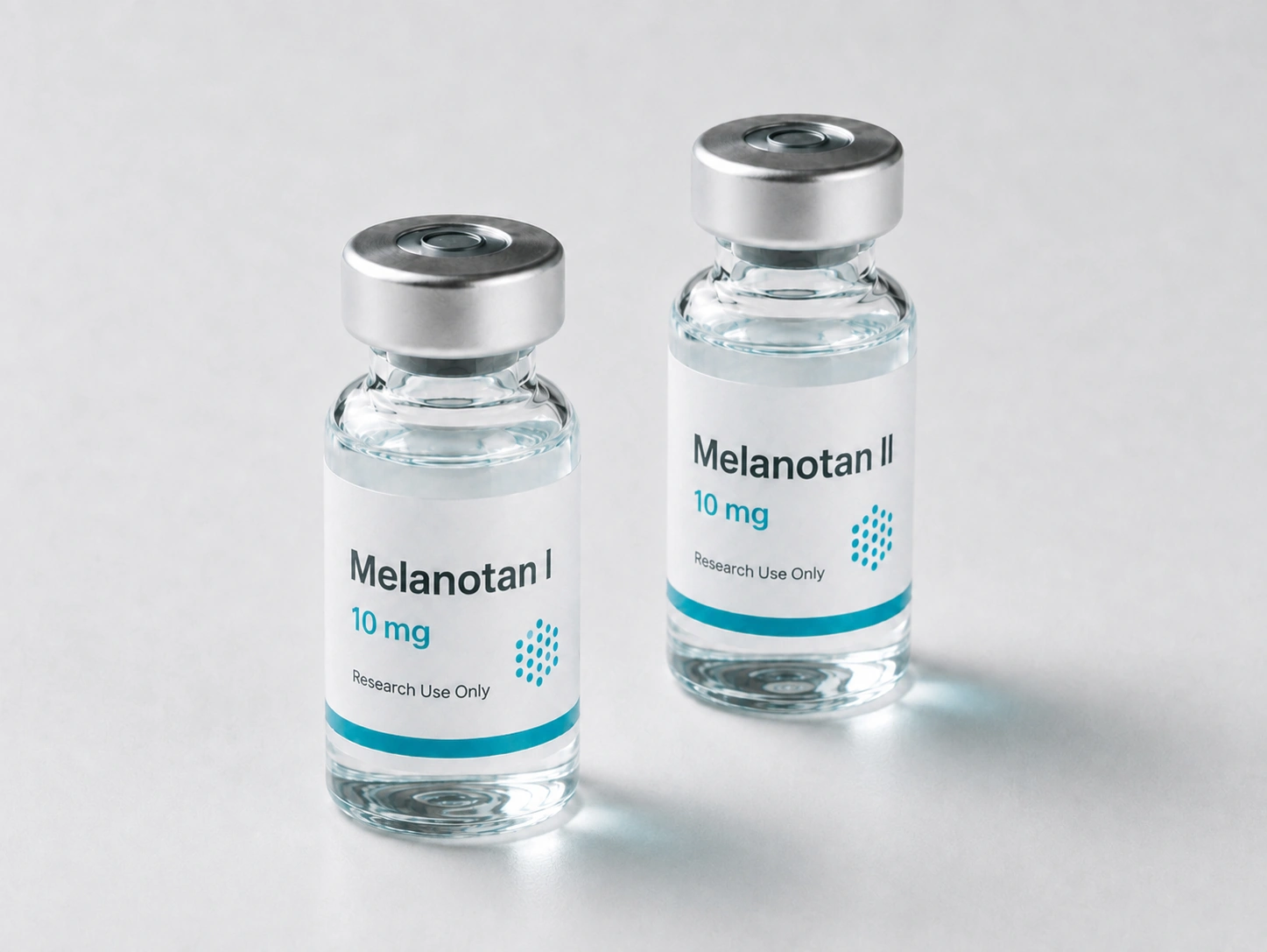
How do they compare, side by side?
How do they compare, side by side?
| Attribute | Melanotan I | Melanotan II |
|---|---|---|
| Proper name | Afamelanotide | None. Melanotan II is the research name |
| Brand | Scenesse | None |
| Structure | Linear peptide | Cyclic peptide |
| Receptors | MC1R only | MC1R, MC3R, MC4R, MC5R |
| FDA status | Approved October 2019 [1] | Not approved, anywhere [4] |
| EMA status | Approved | Not approved |
| Regulator warnings | None | FDA, EMA, TGA and MHRA have all warned [4] |
| Approved for | Preventing pain from light in erythropoietic protoporphyria | Nothing |
| Phase 3 trials | Three, completed [2] | None |
| Key result | Median pain-free sun exposure 69.4 hours against 40.8 on placebo [2] | No controlled efficacy data |
| How it is given | Implant under the skin, placed by a clinician | Self-injected |
| Tanning without UV | Minimal. It amplifies your response to sunlight | Some, at higher doses, and patchy |
| Time to visible tan | 2 to 4 weeks | 1 to 2 weeks |
| Effects beyond pigment | None reported | Appetite suppression, nausea, sexual arousal, flushing |
| Adverse event monitoring | Formal, as an approved drug | None. Case reports only |
| Available for cosmetic use | No | Sold online, not legally |
Where do they start the same, and where do they diverge?
Your skin makes pigment when a hormone called alpha-MSH docks with a receptor on your pigment cells, called MC1R. Both compounds copy that hormone and dock with that receptor. That is the shared part.
Melanotan I
It stops there. It is selective for MC1R, so pigment is the only system it touches.
It also does not create a tan on its own. It amplifies the response your skin already has to ultraviolet light, which is why the approved use is about tolerating sunlight rather than avoiding it.
A medicine that does one predictable thing is a medicine a regulator can evaluate. That selectivity is most of why this one could be approved.
Melanotan II
Being a ring rather than a chain lets it reach three more receptors.
MC3R and MC4R sit in the brain and help regulate appetite and sexual arousal. This is why Melanotan II suppresses hunger and produces erections, and why a drug derived from it was later approved for low sexual desire. [5] MC5R is involved in the glands that produce oil and sweat.
So the extra effects are not bonuses. They are the same molecule hitting systems it was not aimed at. The nausea, the flushing, the appetite change and the sexual effects all come from the same lack of selectivity that makes it hard to approve. Our guide on telling flushing from a drink covers why the two are hard to separate on a night out.
What are the key differences?
What actually separates them?
What has nobody answered?
Which four gaps has nobody answered?
Nobody is counting.Melanotan II has no pharmacovigilance, meaning no system tracking harm after the fact. Every approved drug has one. What exists instead is case reports, which reach the literature only when a clinician recognizes a connection and chooses to publish. So the true rate of any problem in Melanotan II users is unknown and will probably stay unknown, because nobody runs prospective studies on unapproved substances.
The approved drug's own label requires skin surveillance.Scenesse's FDA label warns that it may cause generalised increased pigmentation and darkening of pre-existing moles and freckles, and it recommends a full body skin examination twice a year for anyone on it. [3] A history of melanoma or other skin cancer is a reason for extra caution before starting. That is the selective version, the approved one, given by a clinician, in patients being monitored. Anyone self-injecting the non-selective version with no oversight is doing something the safer drug's own label says needs a doctor watching.
The melanoma question is unresolved, in both directions.A peer-reviewed review has cataloged the reported harms, and individual case reports link Melanotan II to melanoma and to changes in moles. [6][7] That is real and it is worth knowing. It is also not proof. No controlled prospective study has established that Melanotan II causes melanoma, and there is a serious confounder: people who use it tend to be young adults who also use tanning beds and seek sun. Melanoma has a lifetime risk of roughly 1 in 38 in the United States regardless. What can be said is narrower and still useful. The compound drives pigment cells to work harder, the approved drug in this family carries melanoma screening requirements for exactly that reason, and nobody has run the study that would settle it.
Nobody has tested Melanotan I for tanning.Its trials measured tolerance to light in people with a rare disease. Whether an approved drug for one thing works safely for a completely different purpose is a separate question, and it has not been asked. The injectable protocols have no basis either. The approved product is an implant, the trials used a 16 milligram implant every two months, and nothing was ever tested at half a milligram daily.
What are the side effects, and what are you buying?
Which has a monitored safety profile, and which has case reports?
Melanotan I, from its trials
Reported in the approval program, under supervision.
- Nausea, in roughly 31 percent of patients [3]rate
- Implant site reactions, in roughly 22 percent [3]rate
- Headache, in roughly 18 percent [3]rate
- Darkening of existing moles and freckles, stated in the label as an expected effect [3]label
- Twice yearly full body skin examination recommended for everyone on it [3]label
Melanotan II
These are published individual cases, not measured rates.
- Melanoma and changes in existing moles [6][7]case
- Priapism, meaning a prolonged and painful erection [7]case
- Rhabdomyolysis, a breakdown of muscle tissue [6]case
- Renal infarction, a loss of blood supply to part of a kidney [7]case
What is in the vial
No approved product exists to compare an online vial against.
- Four regulators have warned, and the Australian TGA confiscates it at the border [4]regulatory
- A 2022 study found 35 online sellers, with unknown ingredients, quality and sterility [12]study
- Testing of seized peptides found purity between 5 and 75 percent, plus arsenic and lead [9]analysis
- One US lab reported problems in almost 30 percent of samples, including bacteria [10]testing
- Nasal sprays and tablets sold as melanotan have no established absorption at allno data
*Where this page says nothing is established, it means nobody has studied it. It does not mean a compound is safe.
The two columns above are not comparable, and that is the point. Melanotan I's numbers are rates from a trial where everyone was counted. Melanotan II's list is a set of individual published cases with no denominator. You cannot say which is riskier from those two lists alone, only that one has been measured and the other has not.
Scenesse is a bioresorbable rod about 1.7 centimetres long, placed under the skin near the hip by a trained clinician every two months, usually three times a year. Patients wait thirty minutes afterward in case of a reaction. It is not something you can buy or administer yourself, and anything sold online as Melanotan I is not Scenesse.
The price gap is worth seeing. One 16 milligram Scenesse implant has an average listed cost of around 49,600 dollars. [11] A vial of Melanotan II sells for around 40. That is not a comparison of value. It is a measure of how much of that cost is trials, manufacturing standards, oversight and monitoring, none of which the cheap version has. Our guide on reading a certificate of analysis covers what a vendor document can and cannot tell you.
Are they banned in sport?
Is this mostly not a doping question?
Neither compound is a performance drug and neither is named on the 2026 WADA Prohibited List. Melanotan II's appetite suppression could matter for weight class sports, and any unapproved injectable carries the usual contamination risk, where a vial contains something the label never mentioned. That has caused positive tests for compounds athletes never intended to take. If you compete under a testing body and are considering either, ask that body directly.
Are they FDA approved?
Why is this the clearest split of any pairing in this library?
Melanotan I is an approved prescription drug. The FDA approved afamelanotide as Scenesse in October 2019, and the EMA approved it as well. The indication is narrow: preventing phototoxic reactions in adults with erythropoietic protoporphyria. It is dispensed through specialist centers and implanted by trained clinicians. It is not available for cosmetic tanning, and using an approved drug outside its indication is off-label, which is a prescriber's decision and responsibility rather than a consumer's option. [1]
The approval does not cover the powder. Melanotan I is also sold online as a powder for self-injection. That is the same peptide, and it is not an approved product. Nothing about the Scenesse approval makes an online vial legal, tested, or of known content. The FDA approved a manufactured implant used under supervision, not a molecule.
Melanotan II is not approved anywhere. Not by the FDA, the EMA, the Australian TGA or the UK MHRA. All four have issued warnings. It does not sit in the FDA's 503A Category 2 bulk substances process the way many research peptides do. It sits outside that framework entirely, in unapproved and unclassified status. No compounding pharmacy may legally make it, and no physician may legally prescribe it, because there is no indication to prescribe it for. [4]
One thing this does not mean. An approval is not a statement that a drug is safe for everyone or for every purpose. It means a regulator reviewed a specific use, at a specific dose, in a specific population, and concluded the benefit outweighed the risk for that use. Scenesse was approved for a rare painful condition. That says nothing about whether the same compound is a good idea for a tan.
Questions people ask
Are Melanotan I and Melanotan II versions of the same thing?
No. They are different molecules. One is a straight chain that fits one receptor, the other is a ring that fits four. The numbers came from a research lab, not a product line.
Is Melanotan I legal?
Scenesse is, on prescription, for one rare condition. Melanotan I powder sold online is not. Same molecule, different product, and the approval belongs to the product.
So why can I buy Melanotan I online?
Because it is sold as a research chemical rather than as a medicine. The peptide in the vial may well be the same one in the approved drug. What you are not getting is pharmaceutical manufacturing, verified content, a tested route of administration, or anyone monitoring your skin. Those are most of what the approval was actually for.
Is Melanotan II legal?
It is not approved anywhere in the world, and four national regulators have warned against it. It is sold as a research chemical, which is not the same as being legal to use.
Does Melanotan II cause melanoma?
No study has established that. There are published case reports linking it to melanoma and to changes in moles, and there is a serious confounder, since people who use it also tend to use tanning beds. The honest answer is that the question is open, nobody is measuring it, and the compound does push pigment cells to work harder.
Why does Melanotan II suppress appetite?
Because it reaches receptors in the brain that regulate hunger, which the more selective Melanotan I does not. Those extra receptors are also why it affects sexual arousal.
Do either of them work without sun?
Melanotan I mostly does not. It amplifies your skin's response to ultraviolet light rather than replacing it. Melanotan II can produce some darkening at higher doses, and the result is usually patchy.
How much does the approved version cost?
Around 49,600 dollars for a single implant, which lasts two months. That price reflects a rare disease drug with a full trial program behind it, not the value of a tan.
Is PT-141 related to these?
Yes. Bremelanotide, sold as Vyleesi, is derived from Melanotan II and is FDA approved for low sexual desire in some women. Same family, and the second approved member of it.
What this page is built on
- 01US Food and Drug Administration. Approval of SCENESSE (afamelanotide) implant, October 2019, for the prevention of phototoxicity in adult patients with erythropoietic protoporphyria. Also approved by the European Medicines Agency. Regulatory document.
- 02Wensink D, Wagenmakers MAEM, et al. Afamelanotide for prevention of phototoxicity in erythropoietic protoporphyria. Expert Rev Clin Pharmacol. 2021. Review of the Phase 3 evidence base, trials CUV029, CUV030 and CUV039. Median pain-free sun exposure 69.4 hours against 40.8 hours on placebo.
- 03Kim ES, Garnock-Jones KP. Afamelanotide: a review in erythropoietic protoporphyria. Am J Clin Dermatol. 2016. Drug review covering the evidence base and adverse event profile. Nausea about 31 percent, implant site reactions about 22 percent, headache about 18 percent.
- 04Regulatory action on Melanotan II. The UK MHRA issued a public warning in 2009. Australia banned its sale and the TGA confiscates products at the border. The US FDA has issued warning letters to domestic distributors and pursued a debarment proceeding against a Melanotan II seller, Docket No. FDA-2015-N-4619. Regulatory actions. Not approved by the FDA, EMA, TGA or MHRA for any indication.
- 05US Food and Drug Administration. Approval of VYLEESI (bremelanotide) injection, 2019, for hypoactive sexual desire disorder in premenopausal women. Bremelanotide is derived from Melanotan II. Regulatory document.
- 06Habbema L, Halk AB, Neumann M, Bergman W. Risks of unregulated use of alpha-melanocyte-stimulating hormone analogs: a review. Int J Dermatol. 2017. DOI 10.1111/ijd.13585. Peer-reviewed review. Concludes explicitly that afamelanotide's regulated development and Melanotan II's unregulated status mean the two should not be treated as equivalent.
- 07Individual case reports. Hjuler KF, Lorentzen HF. Melanoma associated with the use of melanotan-II. 2014. PMID 24355990. Dreyer BA, et al. Melanotan-induced priapism. 2019. PMC6388891. Peters B, et al. Melanotan II: a possible cause of renal infarction. 2020. PMC7148395. Individual case reports, not measured incidence rates. Causation not established by any controlled prospective study.
- 08Rising Trends. Peptide search volume analysis, March 2026. Tanning peptide searches at approximately 27,100 per month in the United States, an approximately ninefold increase over twelve months. Third-party search analysis, not a peer reviewed source.
- 09Janvier S, Cheyns K, Canfyn M, Goscinny S, De Spiegeleer B, Vanhee C, Deconinck E. Impurity profiling of the most frequently encountered falsified polypeptide drugs on the Belgian market. Talanta. 2018;188:795-807. DOI 10.1016/j.talanta.2018.06.023. Peer-reviewed analytical study.
- 10NBC Washington. Lab finds problems in 30% of peptide vials tested. December 2024. News report of commercial laboratory testing, not peer reviewed.
- 11GoodRx listed average price for a single 16 mg Scenesse implant, approximately 49,600 US dollars. Commercial pricing data. Drug pricing changes.
- 12Hadeler E, Haitz K, Bray F. Evaluation of synthetic alpha-melanocyte-stimulating hormone analogs: an observational study of unregulated, online-available drugs. J Am Acad Dermatol. 2022 Jul;87(1):199-201. DOI 10.1016/j.jaad.2021.07.036. PMID 34333078. Peer-reviewed observational study. Identified 35 online distributors with unknown ingredients, quality and sterility.