
MK-677 vs Ipamorelin
MK-677 and ipamorelin knock on the same door on the pituitary. MK-677 is a pill that works for about a day. Ipamorelin is an injection that clears in about two hours. MK-677 has been through far more human trials, and the reason people should care is that those trials found problems.
This pair sits inside a larger group. For the map of all eleven growth hormone compounds and how they relate, start with the growth hormone peptides guide.
- Growth hormone
- One is not a peptide
- Neither FDA approved
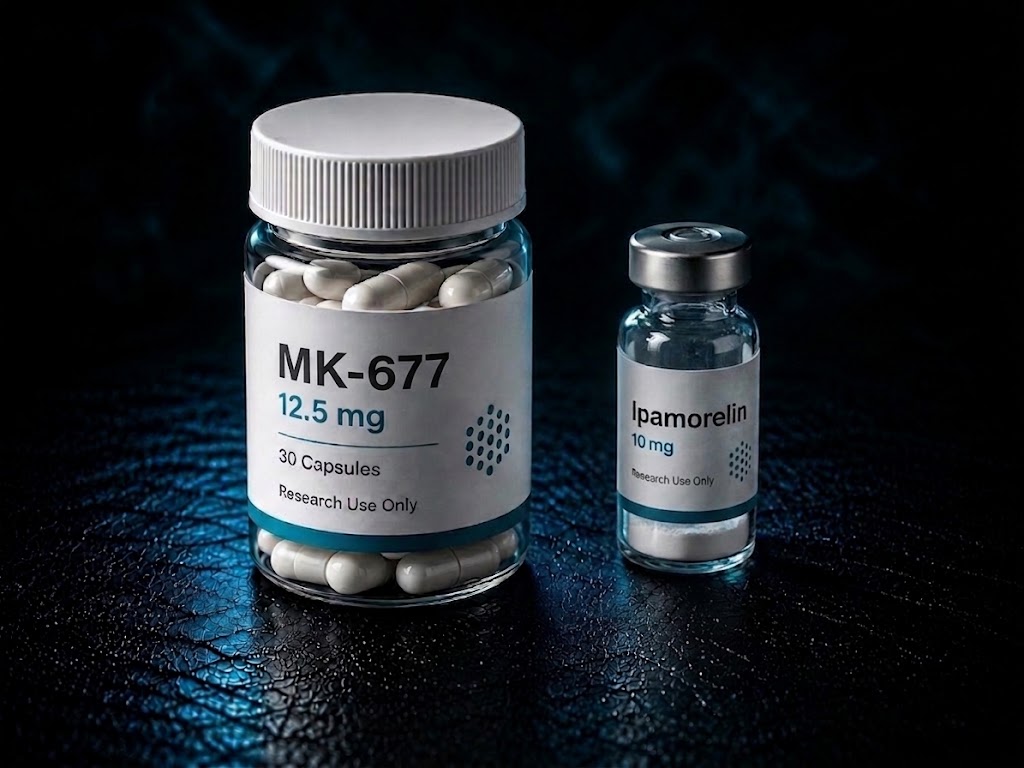
Is a pill on the same receptor as good as the injection?
MK-677 has far more human data, and that is exactly why we know more about what is wrong with it.
| Attribute | MK-677 | Ipamorelin |
|---|---|---|
| What it is | A small molecule, not a peptide | A peptide, 5 amino acids |
| How it goes in | Swallowed | Injected |
| How long it works | About 24 hours, once daily | About 2 hours [7] |
| Dose in trials | 10 to 25 mg daily, up to 2 years [1] | 0.03 mg/kg, up to 7 days [8] |
| Human trials | Six indications, extensive [1][2][3] | One efficacy trial [8] |
| Largest trial | 563 patients [2] | 114 patients [8] |
| FDA status | Never approved. No application ever filed | Never approved |
MK-677 is in this library because it is used the same way, not because it is a peptide.
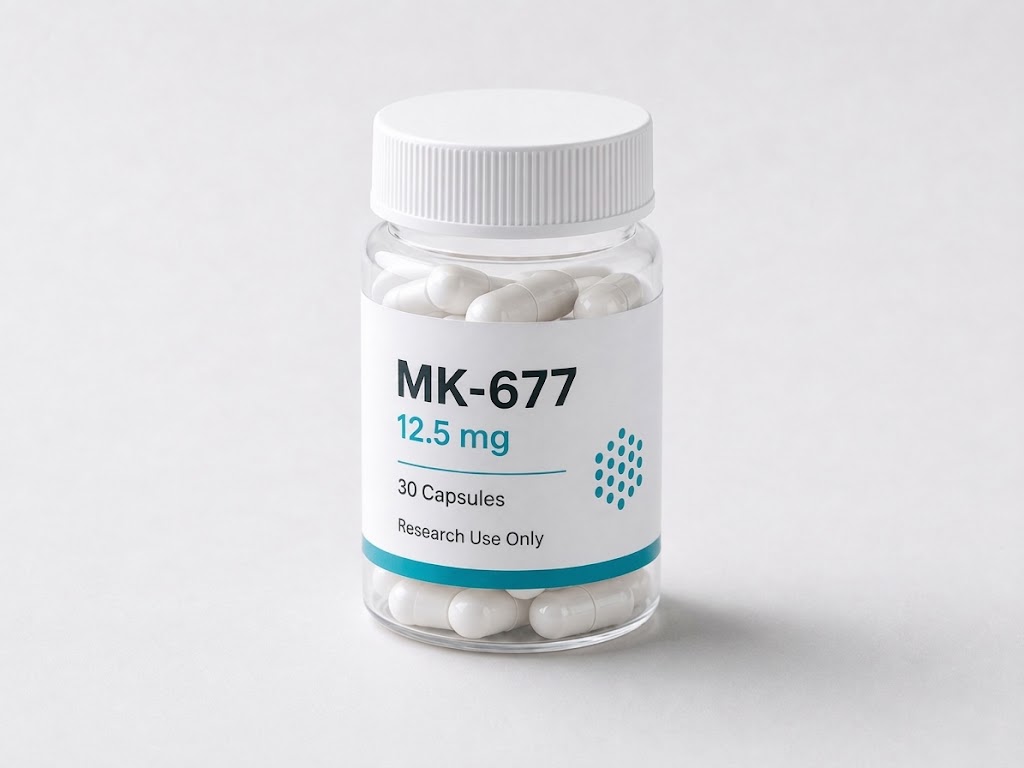
MK-677
A small molecule you swallow, developed by Merck in the 1990s. It copies ghrelin, the hunger hormone, at a receptor on the pituitary. In plain terms: a pill that tells the pituitary to release growth hormone, and keeps telling it for about a day.
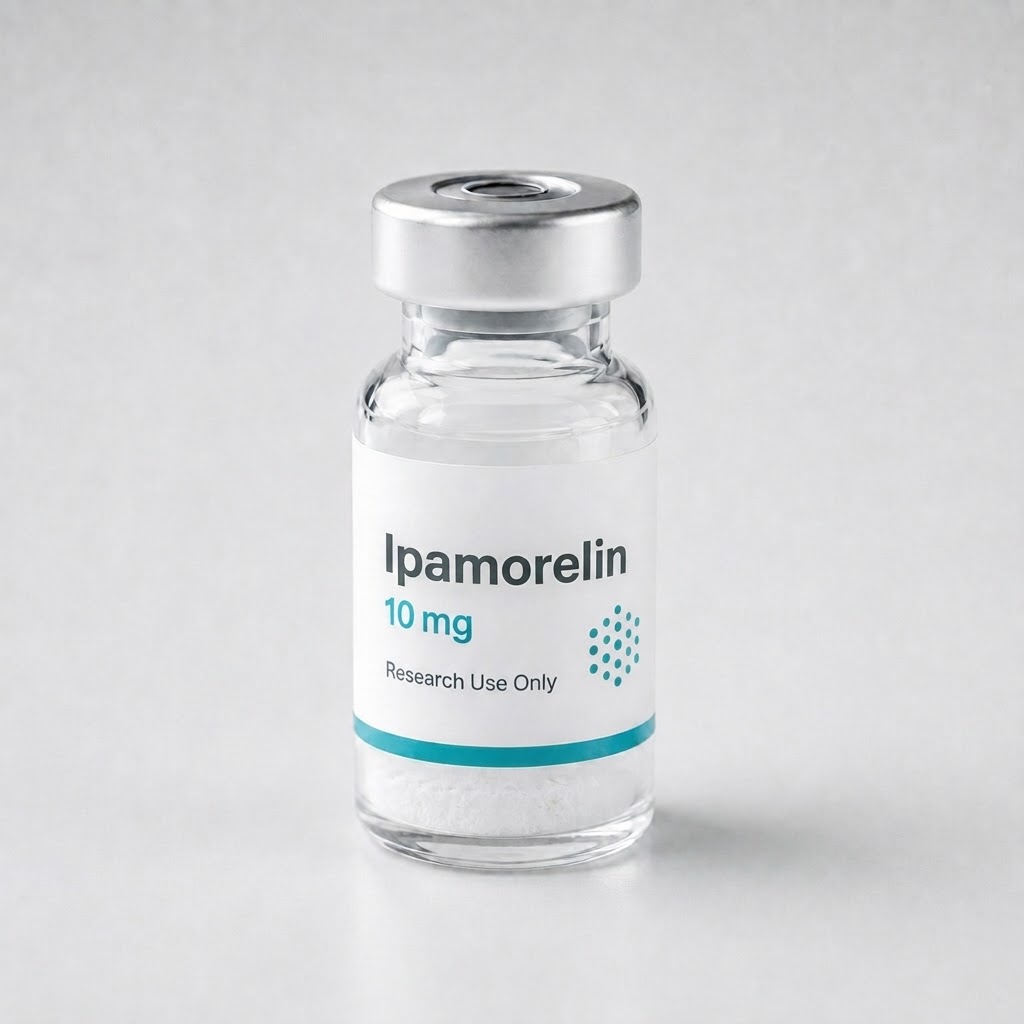
Ipamorelin
A chain of five amino acids that copies the same signal at the same receptor. In plain terms: an injection that produces a short, sharp release of growth hormone and then clears.
Is MK-677 even a peptide?
This single fact clears up most of the confusion around it. Same target, opposite designs. One trades convenience for a signal that never switches off. The other trades convenience for one that does.
Different chemistry, same receptor. Ipamorelin is five amino acids in a chain, which is why it has to be injected — your stomach breaks peptides down, so swallowing one mostly wastes it. MK-677 is not a peptide at all. It is a small molecule built by chemists to do the same job, and it survives digestion. Both act on GHS-R1a, the ghrelin receptor.
It is not a SARM either. MK-677 is routinely sold next to selective androgen receptor modulators and given a code name that looks like theirs. It has no androgenic activity, does not bind the androgen receptor and does not suppress testosterone, so the post-cycle protocols that go with SARMs have nothing to do with it. Two categories it is filed under, neither of them correct.
Why it matters practically. No reconstitution, no syringes, no cold chain, no injection sites. That is a genuine advantage and it is the reason MK-677 is popular. It is also why the dose sits in your system all day rather than for a couple of hours. The library lists both because people use them the same way, not because they are the same kind of thing.
What does the evidence actually show?
Which one has a real clinical history, and why is it not the flattering kind?
Merck starts testing it everywhere
Merck develops ibutamoren and begins testing it across a range of conditions: growth hormone deficiency, osteoporosis, hip fracture recovery, muscle loss with age, obesity and Alzheimer's disease. [5]
FDA briefing document, October 2024Regulatory summary of the development program
The appetite effect is documented
Chapman and colleagues document the appetite effect directly. It follows from activating the ghrelin receptor, which is the hunger signal, so the increase in hunger is the mechanism working rather than a side effect of it. [14] Copinschi and colleagues measure 24 hour cortisol the same year and find no meaningful change at therapeutic doses, with only a small shift in the timing of the overnight low. [15]
Human studies · PMID 8954023Human trials · oral dosing in adults
Sleep, actually measured
Copinschi and colleagues run a polysomnography trial, meaning sleep measured by EEG rather than reported by the person sleeping. Stage IV deep sleep rose about 50 percent in younger subjects and REM sleep by over 20 percent. Older adults showed close to a 50 percent increase in REM and faster onset. [16]
Human study · PMID 9349662Human trial · polysomnography
- objectively measured
- short duration
Novo Nordisk characterizes the molecule
Raun and colleagues report that ipamorelin releases growth hormone without raising cortisol or prolactin, unlike older compounds in its class. Rat pituitary cells and pigs. [10]
Eur J Endocrinol 1998;139(5):552-61Animal and laboratory study
Merck pulls back
Merck halts broader development after mixed results from an early trial in children with growth hormone deficiency.
The only human pharmacokinetic data
Gobburu and colleagues publish the only human pharmacokinetic study ipamorelin has. Growth hormone peaks around 30 to 40 minutes and the compound clears with a half-life of about 2 hours. [7]
Pharm Res 1999;16(9):1412-6Human pharmacokinetic study · intravenous
Two years in healthy older adults
Nass and colleagues publish a two year trial in healthy adults aged 60 to 81. 25 milligrams daily restored IGF-1 to young adult levels and increased fat-free mass. It did not increase strength, and the functional improvements did not reach statistical significance. [1]
Ann Intern Med 2008;149(9):601-11Human randomized trial · 2 years
- randomized
- two years long
- no strength gain
The largest MK-677 trial ever run
563 patients with Alzheimer's disease, 25 milligrams daily for 12 months. IGF-1 rose 60 percent by six weeks and 73 percent by twelve months. Cognitive scores did not differ from placebo on any of four measures at any timepoint. The authors concluded it was ineffective at slowing the disease. [2]
Sevigny et al. 2008Human trial · 563 patients, 12 months
- large
- no benefit on any measure
A trial stopped early
A Phase 2b trial in 123 patients recovering from hip fracture, aged 60 and over, planned for 24 weeks. It was stopped early. Four patients on MK-677, 6.5 percent, developed congestive heart failure, against one on placebo, 1.7 percent. IGF-1 had risen as expected. The authors wrote that the risk to benefit balance for this use was likely not acceptable. [3]
Arch Gerontol Geriatr 2011Human Phase 2b · terminated early
- placebo controlled
- stopped for a safety signal
The one efficacy trial, and it missed
114 patients, testing recovery of gut function after bowel surgery. Patients tolerated food about seven hours sooner than on placebo, 25.3 hours against 32.6, and it missed its primary endpoint at p=0.15. Development was discontinued. [8]
Int J Colorectal Dis 2014;29(12):1527-34 · NCT00672074Human Phase 2 · randomized, double blind, placebo controlled
- double blind
- missed its endpoint
Category 2 at the FDA
The FDA places both in Category 2 of its 503A bulk substances list, which decides which raw ingredients a compounding pharmacy may use. Category 2 is the shelf for ingredients that may carry significant safety risks. [4]
FDA 503A bulk substances listRegulatory action
Off Category 2, which is not clearance
Both come off Category 2 after the nominations are withdrawn, rather than because anything was settled. [4]
Reviewed on the same day, both turned down
The FDA's advisory committee reviews both compounds on the same day and votes against each of them. MK-677 was rejected over fluid retention, congestive heart failure and high blood sugar, the signals that came out of Merck's own trials. Ipamorelin was rejected too. They were two of four substances turned down that day. [5]
Pharmacy Compounding Advisory Committee · fda.gov/media/185412Regulatory action
MK-677 raised IGF-1 in every population it was tested in, reliably, for as long as it was given. It did not make anyone stronger, it did not slow Alzheimer's in 563 patients, and it produced a safety signal that stopped a trial. Ipamorelin has one efficacy trial, and it missed. That is the whole clinical record for both.
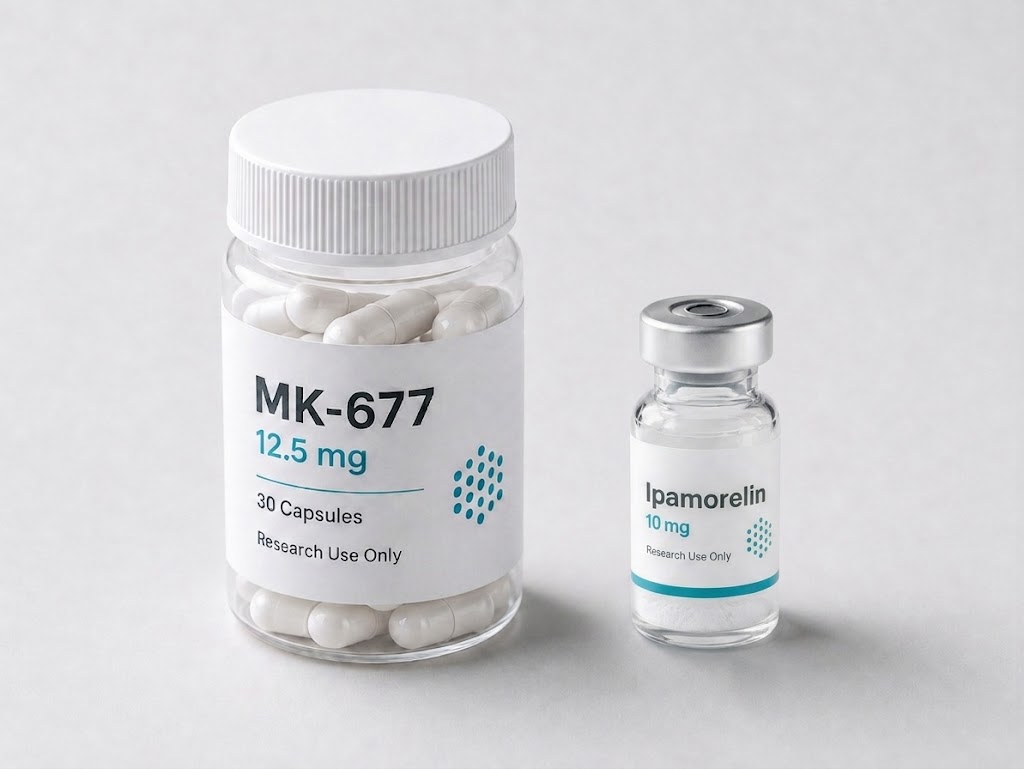
How do they compare, side by side?
How do they compare, side by side?
| Attribute | MK-677 | Ipamorelin |
|---|---|---|
| Full name | Ibutamoren, also MK-0677, sold as Nutrobal | Ipamorelin, also NNC 26-0161 |
| Chemistry | Non-peptide small molecule | Pentapeptide, 5 amino acids |
| Receptor | Ghrelin receptor, GHS-R1a | Ghrelin receptor, GHS-R1a |
| Route | Oral, once daily | Subcutaneous injection |
| Duration of action | About 24 hours | About 2 hours [7] |
| Effect on IGF-1 | Raised 60 percent at 6 weeks, 73 percent at 12 months [2] | Not measured over months |
| Effect on appetite | Raises it sharply. This is the mechanism, not a side effect [14] | Designed to leave it alone [10] |
| Effect on cortisol | No meaningful change at therapeutic doses [15] | No meaningful change [10] |
| Sleep | Measured. Deep sleep up about 50 percent, REM up over 20 percent [16] | Never measured |
| Developed by | Merck | Novo Nordisk, then Helsinn |
| Indications tested in people | Six [1][2][3][6] | One [8] |
| Largest trial | 563 patients, Alzheimer's [2] | 114 patients, post-surgical gut recovery [8] |
| Outcome | No cognitive benefit at any timepoint [2] | Missed its primary endpoint at p=0.15 [8] |
| A trial stopped early | Yes, for a heart failure signal [3] | No |
| Development status | Discontinued. No application ever filed | Discontinued |
| FDA advisory committee | Voted against, October 2024 [5] | Voted against, October 2024 [5] |
| WADA status | Named outright under S2.2.4 [9] | Named outright under S2.2.4 [9] |
How does one door get two lengths of knock?
MK-677
A pill that copies ghrelin at GHS-R1a and keeps copying it for about a day. That is the appeal and it is also the problem: the signal never switches off, and the same property that makes it convenient is the one behind the fluid retention and blood sugar findings.
Because it acts on the hunger receptor, appetite goes up. That is the mechanism working, not a side effect of it. [14] Cortisol, by contrast, does not meaningfully move at therapeutic doses, which is a point often used to separate ipamorelin from MK-677 and does not actually separate them. [15]
Ipamorelin
The same signal, delivered as a short pulse. Growth hormone peaks around 30 to 40 minutes after a dose and the compound clears with a half-life of about 2 hours. [7] Your pituitary releases growth hormone in bursts anyway, and ipamorelin was designed to imitate that shape.
It was also designed to leave appetite, cortisol and prolactin alone, and Raun's 1998 work reported exactly that. [10] That work was done in rat cells and in pigs, and nobody has tested whether a pulsed signal produces different results from a constant one in people.
What are the key differences?
What actually separates them?
What has nobody answered?
Which three gaps has nobody answered?
Ipamorelin's safety record is short, not clean.MK-677 has documented problems because Merck ran enough trials to find them. Ipamorelin has one efficacy trial and one pharmacokinetic study. The absence of findings is an absence of looking. Both act on the same receptor, so problems found with one are questions worth asking about the other.
Nobody has tested either one for what people use them for.MK-677 was tested for hip fracture recovery, Alzheimer's, muscle loss with age, obesity, growth hormone deficiency and osteoporosis. Ipamorelin was tested for gut recovery after surgery. Neither was tested for body composition, sleep or recovery in healthy adults.
Nobody has compared them.No trial has put MK-677 against ipamorelin, or tested whether a constant signal or a pulsed one produces different results.
What are the side effects, and what are you buying?
Which has documented problems, and which has an empty file?
Found in MK-677's trials
These come from Merck's own studies.
- Congestive heart failure in 6.5 percent against 1.7 percent on placebo, in the trial that was stopped [3]mk-677
- Raised fasting glucose and HbA1c, and reduced insulin sensitivity, across multiple populations [1][2][3]mk-677
- Increased appetite in most people, within days. This is the mechanism rather than a side effect [14]mk-677
- Water retention, commonly reported and related to the heart failure signalmk-677
- Fluid retention, cited by the FDA's advisory committee as a reason to reject it [5]regulatory
Nobody has looked
Nobody has run these studies. That is different from a clean result.
- Ipamorelin's effect on blood sugar over any length of timeno data
- Either compound used for months or years outside a trialno data
- Whether ipamorelin shares MK-677's cardiac signal, since they act on the same receptorno trial
- Use in anyone with a history of heart failure or diabetesno data
What is in the product
Neither has an approved product to check against.
- MK-677 has turned up undeclared in consumer products, prompting FDA action including a 2026 recall [11]enforcement
- Testing of seized peptides found purity between 5 and 75 percent, plus arsenic and lead [12]analysis
- One US lab reported problems in almost 30 percent of samples, including bacteria [13]testing
- MK-677 is sold in capsules and liquids with no dose verification of any kindlabeling
*Where this page says nothing is established, it means nobody has studied it. It does not mean a compound is safe.
The heart failure finding deserves a moment, because it is easy to dismiss and easy to overstate. It was found in elderly patients recovering from a hip fracture, which is a fragile population, and the numbers were four patients against one. The likely mechanism is fluid retention in people whose hearts were already struggling. That does not mean a healthy 30 year old faces the same risk. It does mean the compound moves fluid in a way that mattered enough for a data monitoring committee to stop a trial, and that nobody has studied what it does over years in anyone. Our guide on reading a certificate of analysis covers what to check before you buy.
Are they banned in sport?
Are both named, with no ambiguity?
This reflects the 2026 Prohibited List, in force from 1 January 2026. WADA publishes a new list each September, so check the current version if you are reading this later in the year.
Section S2.2.4 covers growth hormone secretagogues and their mimetics. Both are named in it directly, ibutamoren as MK-677 and ipamorelin by name, alongside anamorelin, capromorelin, macimorelin and others. [9]
Both are prohibited at all times, in and out of competition. Everything in S2 is a non-specified substance, which carries a default four year ban for a first violation.
MK-677 carries an extra risk worth knowing about. It has been found undeclared in consumer products sold as something else, which has prompted FDA consumer alerts and a recall. [11] An athlete can fail a test on a product that never listed it.
Are they FDA approved?
Why were both reviewed on the same day and both turned down?
Never approved. Neither compound has ever been approved by the FDA for any use. MK-677 went through more than a decade of Merck trials without an application ever being filed.
2023, into Category 2. In September 2023 the FDA placed both in Category 2 of its 503A bulk substances list, the category for ingredients that may present significant safety risks, meaning compounding pharmacies could not use them. [4] In September 2024 both came off Category 2. That gets read as the FDA clearing them and it is not what happened. The parties who nominated them withdrew their nominations. [4]
2024, the votes. The FDA took both to its advisory committee anyway. On 29 October 2024 the committee reviewed them on the same day and voted against both. MK-677 was rejected over fluid retention, congestive heart failure and high blood sugar, the signals that came out of Merck's own trials. Ipamorelin was rejected too. They were two of four substances turned down that day. [5]
Worth comparing. When the same committee reviewed a different set of peptides in July 2026, it recommended six of seven at 8 votes to 6, going against its own FDA scientists. Neither compound on this page got that treatment. They were reviewed first, and both were turned down. Neither is on the 503A list, neither is on the 503B outsourcing facility list, and there is no legal route to compound either one.
Questions people ask
Is MK-677 a peptide?
No. It is a small molecule designed to do the same job as a peptide, which is why it can be swallowed. It gets grouped with peptides because people use it the same way.
Which one is stronger?
MK-677 produces a larger and much longer signal, with IGF-1 rising 60 to 73 percent and staying up. Whether that is better is a separate question, and the trials suggest it did not translate into much.
Is ipamorelin safer?
Its safety file is shorter, not cleaner. MK-677 has documented problems because Merck ran enough trials to find them. Ipamorelin has one efficacy trial. They act on the same receptor, so the questions raised about one are worth asking about the other.
Did MK-677 really cause heart failure?
In one trial, in elderly hip fracture patients, four patients on the drug developed congestive heart failure against one on placebo, and the trial was stopped. The authors concluded the risk to benefit balance for that use was likely not acceptable. Whether the same applies to healthy adults has never been studied.
Why did Merck give up on it?
Because it worked at the biochemical level and not at any other. It raised IGF-1 reliably in every population tested, did not make anyone stronger, did not slow Alzheimer's in 563 patients, and produced a safety signal that stopped a trial.
Does MK-677 actually help sleep?
This is one of the few sleep claims in this space with real measurement behind it. A 1997 trial using EEG found deep sleep up about 50 percent in younger subjects and REM up over 20 percent, with older adults showing close to a 50 percent REM increase. Ipamorelin has never been measured this way.
Will MK-677 make me hungry?
Almost certainly. It acts on the ghrelin receptor, which is the hunger signal, so appetite increase is the mechanism working rather than a side effect. Ipamorelin was built to avoid this.
Is MK-677 a SARM?
No. It is sold alongside them and has a similar looking code name. It has no androgenic activity, does not bind the androgen receptor and does not suppress testosterone.
Are they FDA approved?
No. Neither is approved, and the FDA's advisory committee voted against both on the same day in October 2024.
Are they banned in sport?
Yes, both by name, under section S2.2.4. Prohibited at all times.
Can I take MK-677 instead of injecting?
That is the appeal, and it is real. It is also the compound with the documented cardiac and blood sugar signals. The convenience and the risk come from the same property, which is that it lasts all day.
What this page is built on
- 01Nass R, Pezzoli SS, Oliveri MC, et al. Effects of an oral ghrelin mimetic on body composition and clinical outcomes in healthy older adults: a randomized trial. Ann Intern Med. 2008;149(9):601-611. Human randomized trial · 2 years, adults aged 60 to 81. IGF-1 restored to young adult levels, fat-free mass up, no strength gain.
- 02Sevigny JJ, et al. Growth hormone secretagogue MK-677 in Alzheimer's disease. 2008. Human trial · 563 patients, 25 mg daily for 12 months. IGF-1 up 60.1 percent at 6 weeks and 72.9 percent at 12 months. No cognitive benefit on any of four measures.
- 03Adunsky A, Chandler J, Heyden N, et al. MK-0677 (ibutamoren mesylate) for patients recovering from hip fracture: a multicenter, randomized, placebo-controlled phase IIb study. Arch Gerontol Geriatr. 2011. Human Phase 2b · 123 patients, terminated early. Congestive heart failure in 4 patients (6.5 percent) against 1 (1.7 percent) on placebo.
- 04US Food and Drug Administration. 503A bulk drug substances category updates, September 2023, and Category 2 removals, September 2024 following withdrawal of nominations. Regulatory documents
- 05US Food and Drug Administration. Pharmacy Compounding Advisory Committee meeting, 29 October 2024, reviewing ibutamoren mesylate and ipamorelin. Both rejected. Regulatory document · summary minutes at fda.gov/media/185412
- 06Bach MA, et al. MK-677 in hip fracture recovery. 2004. Earlier human trial in the same Merck program
- 07Gobburu JV, Agersø H, Jusko WJ, Ynddal L. Pharmacokinetic-pharmacodynamic modeling of ipamorelin, a growth hormone releasing peptide, in human volunteers. Pharm Res. 1999;16(9):1412-6. Human pharmacokinetic study · half-life about 2 hours, growth hormone peak at 30 to 40 minutes
- 08Beck DE, Sweeney WB, McCarter MD; Ipamorelin 201 Study Group. Ghrelin mimetic ipamorelin for postoperative ileus in bowel resection patients. Int J Colorectal Dis. 2014;29(12):1527-34. NCT00672074. Human Phase 2 · 114 patients, missed its primary composite endpoint at p=0.15
- 09World Anti-Doping Agency. The 2026 Prohibited List, section S2.2.4, naming ibutamoren (MK-677) and ipamorelin. Effective 1 January 2026. Regulatory document · all S2 substances are non-specified
- 10Raun K, Hansen BS, Johansen NL, et al. Ipamorelin, the first selective growth hormone secretagogue. Eur J Endocrinol. 1998;139(5):552-61. Animal and laboratory study · rat pituitary cells and swine
- 11US Food and Drug Administration. Consumer alerts and product recall involving undeclared ibutamoren in consumer products. Regulatory enforcement action
- 12Analysis of seized peptide products reporting purity between 5 and 75 percent, with arsenic and lead detected. Laboratory analysis of seized product
- 13US analytical laboratory report describing problems in almost 30 percent of submitted peptide samples, including bacterial contamination. Commercial testing summary
- 14Chapman IM, et al. Oral administration of an MK-677 growth hormone secretagogue and its effect on appetite. 1996. Human study · PMID 8954023
- 15Copinschi G, et al. Twenty-four hour cortisol profiles during MK-677 administration. 1996. Human study · no meaningful cortisol change at therapeutic doses
- 16Copinschi G, et al. Effects of MK-677 on sleep quality measured by polysomnography. 1997. Human EEG sleep study · PMID 9349662. Stage IV sleep up about 50 percent, REM up over 20 percent.