
The Growth Hormone Peptides, Sorted Out
Ten compounds plus three blends, two mechanisms, one approved drug. How the GHRH analogs differ from the ghrelin mimetics, why half-lives run from eight minutes to eight days, and which three of the ten have anything behind them.
HGH, sermorelin, tesamorelin, CJC-1295 with DAC, CJC-1295 without DAC, ipamorelin, GHRP-2, GHRP-6, hexarelin, MK-677. Ten compounds, plus three blends built from them. They get discussed as though they were variations on one product, and they are nothing of the sort.
They split into two mechanisms plus an outlier. Once you have that split, most of the confusion in this corner of the subject resolves.
What growth hormone actually does
Worth settling before the mechanisms, because the whole category rests on it.
Growth hormone is made by the pituitary, a gland about the size of a pea sitting under your brain. It comes out in bursts, mostly during deep sleep, and it does most of its work indirectly by telling your liver to release a second signal called IGF-1. That second signal is what actually reaches muscle and other tissue.
In someone whose pituitary genuinely is not making enough, replacing it does a great deal. Children grow. Adults gain muscle, lose fat, and feel better.
In a healthy adult the picture is much less settled. Raising growth hormone raises IGF-1 fairly reliably, and that part is measurable. Whether the body-composition changes people are chasing follow from it, at the amounts and durations used outside a clinic, is a separate question that has not been answered for any compound on this page.
The one approval in the group is a useful reality check. Tesamorelin is approved for reducing visceral fat, the deep fat around the organs, in people with a specific HIV-related condition. Not for muscle, not for recovery, not for anti-aging. Everything else people want from this category is something no regulator has been shown.
For the muscle-preservation claim after major weight loss, our dedicated guide separates what the trials actually found from what is being sold.
Three categories, not one
First, growth hormone itself. HGH, sold as somatropin, is the actual hormone, made in a lab and injected. Your pituitary gland does not get consulted. It is a prescription drug, it is expensive, and it is the only item on this page that is growth hormone rather than a request for some.
Then the GHRH analogs. Sermorelin, tesamorelin and both versions of CJC-1295 copy growth hormone releasing hormone, the signal your brain sends to your pituitary telling it to release some. They knock on the front door.
And the GHRPs, short for growth hormone releasing peptides. Ipamorelin, GHRP-2, GHRP-6, hexarelin and MK-677 copy ghrelin instead. Ghrelin is your hunger hormone, the one your stomach releases when it is empty, and it happens to reach the same pituitary cells through a different receptor. A side door to the same room.
That detail about ghrelin explains something further down, so it is worth holding onto: anything copying the hunger hormone risks making you hungry.
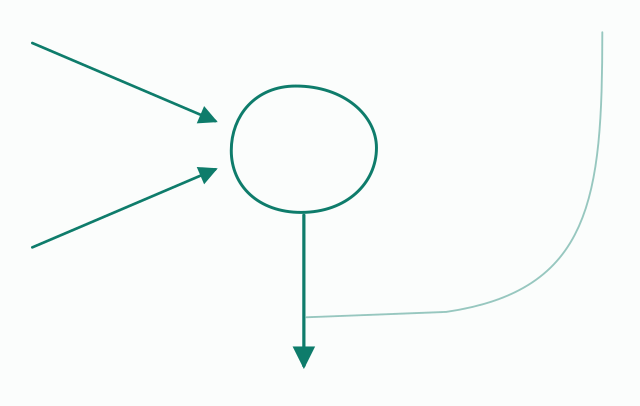
The practical difference between the last two and the first is that both ask your body to release its own growth hormone, so the ceiling is whatever your pituitary can produce. HGH has no such ceiling, which is both why it works more reliably and why it carries more risk.
Why they get combined
The two doors are the reason nearly every product in this space is sold as a pair.
A GHRH analog and a GHRP act on different receptors, so their effects add up rather than competing. That is the entire logic behind the CJC-1295 plus ipamorelin blend, the sermorelin plus ipamorelin blend, and the tesamorelin plus ipamorelin blend, all three of which exist as products.
The logic is sound on paper. No published study has tested any of those combinations in a person.
The four GHRPs are not interchangeable
Grouping ipamorelin, GHRP-2, GHRP-6 and hexarelin together hides the differences that actually decide which one somebody ends up with.
Ipamorelin is the selective one. It signals growth hormone release without meaningfully touching hunger, stress hormones or prolactin, which is why it turns up in almost every blend and why it is usually the first one people try. Cortisol is the stress hormone, and raising it works against muscle. Prolactin is the one behind breast tissue growth in men, which is why nobody wants it up either.
GHRP-2 produces a bigger pulse than ipamorelin, and it nudges appetite, cortisol and prolactin up along with it. More effect, less clean.
GHRP-6 is the hunger one, and this is where the ghrelin detail pays off. It activates the hunger receptor hard, and the appetite it produces is intense enough that people use it deliberately for bulking rather than putting up with it as a side effect.
Hexarelin is the most potent of the four, has the most interesting research angle outside growth hormone entirely in the form of heart-protective effects, and stops working faster than any of them.
That last point gets its own section below, because it is the only thing in this whole category anyone has actually measured.
Do they stop working
Everybody in this space cycles, and almost nobody can tell you why beyond "receptors."
The reason is real. Sustained exposure to a ghrelin-receptor peptide blunts the growth hormone response to a later dose of the same peptide, and that has been shown in people.
The schedules are not real. Twelve healthy older adults injected hexarelin twice a day for 16 weeks. Their growth hormone response fell steadily. Measured as total output over a session, it went from 19.1 at the start to 13.1 after one week, 12.3 at four weeks, and 10.5 by week sixteen. It recovered after four weeks off.
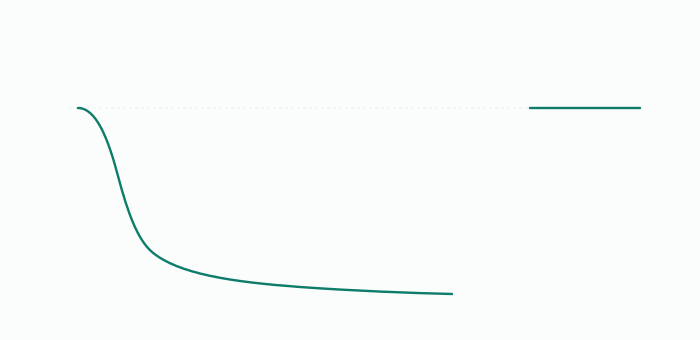
No stronger evidence exists behind cycling anything in this family, and it describes hexarelin specifically rather than the class. Our guide on how long these take to show anything covers what the trial timepoints do and do not establish. Notice how fast the drop is. Most of it happened in the first week.
Ipamorelin's own desensitisation has never been measured in a human. Neither has GHRP-2's. No published study has compared one on-off pattern against another for any compound in this group, and one widely repeated citation for an ipamorelin schedule points to a 2019 study that does not exist.
So the "8 weeks on, 4 weeks off" you see everywhere has one measured data point behind it, from a different compound, in twelve people.
The half-lives are not in the same universe
This is where the "they are all similar" idea breaks down hardest.
| Compound | How long it lasts |
|---|---|
| Tesamorelin | ~8 minutes in healthy adults |
| Sermorelin | ~10 to 20 minutes |
| CJC-1295 no DAC | ~30 minutes, though see below |
| Ipamorelin | ~2 hours |
| HGH | ~2 to 3 hours |
| MK-677 | ~24 hours |
| CJC-1295 with DAC | ~6 to 8 days |
Eight minutes to eight days, inside one supposed class. That is a factor of roughly 1,400, and it decides everything downstream: how often you inject, whether you get pulses or a plateau, and whether the compound is even compatible with the one it is blended with.
That creates a problem for the most popular blend in the category. CJC-1295 with DAC lasts about a week. Ipamorelin lasts about two hours. Pairing a week-long signal with a two-hour pulse defeats the reason for pairing them at all, which is why the blend almost always uses the no-DAC version. If your vial just says CJC-1295, resolve that before anything else.
One caveat on that table. The 30 minutes for CJC-1295 no DAC gets repeated everywhere and has never been measured in a human. It is an estimate carried across from how the molecule resists enzyme breakdown, and the human trials people cite for CJC-1295 tested the DAC version, a different molecule.
Sorted by evidence, which is a much shorter list
Strip out the marketing and the ten fall into four tiers. The tiers also hint at who these were actually studied in — mostly healthy young adults and deficiency populations, which matters if you are not one of them.
Approved: tesamorelin, and only tesamorelin. Approved for HIV-associated lipodystrophy, a fat redistribution condition, with dosing set by an FDA label. Nobody approved it for muscle, recovery or anti-aging, which is what almost everyone buying it wants.
Prescription: HGH. A real medicine with real indications, real monitoring and real cost, prescribed for growth hormone deficiency rather than for feeling better in the gym.
Legally compoundable: sermorelin. It was the active ingredient of an FDA-approved drug and appears on the 503B category 1 list, so a licensed pharmacy can prepare it against a prescription. Its dosing has a clinical guideline behind it. It is the only compound in this group with that status.
Everything else: ipamorelin, GHRP-2, GHRP-6, hexarelin, MK-677, and both CJC-1295 versions, plus all three blends. Research-use labeling, community-practice dosing, no approval anywhere and no published trial establishing what dose does what.
The separate dosage-chart guide shows what each dosing figure rests on.
That last tier holds seven of the ten, and every blend.
The MK-677 problem, which cuts the other way
MK-677 is the exception on this page, in two directions at once.
It is not a peptide at all, but a small molecule taken by mouth, and it sits in this group because it hits the same receptor as ipamorelin and the rest. It is also routinely sold and discussed as a SARM, which it is not, and our guide on peptides and SARMs covers why MK-677 is neither.
If you compete, the anti-doping position is a separate question from whether it is technically a peptide.
And it has more human data than anything else here except tesamorelin and HGH. Its dosing range comes from peer-reviewed human trials rather than from what vendors write.
And that is precisely how we know what is wrong with it. A trial in hip fracture patients was stopped early over heart failure concerns. That signal exists because somebody ran a trial large enough to find it.
Set that against ipamorelin, which has no such signal and also no trial capable of producing one. A clean safety record and an unexamined one look identical from outside, and MK-677 is the compound here that shows the difference.
One group deserves a page of its own. If you are still in your teens or early twenties, the growth plate question runs against you, and what this means if you are under 25 covers it directly.
The blends inherit both halves
Three combination products exist, and each carries its own wrinkle.
Sermorelin plus ipamorelin puts a legally compoundable compound in a vial with one that is not. Sermorelin is eligible for compounding; ipamorelin is in 503B category 2 and its 503A nomination was withdrawn in April 2026. The legal status of the mixture does not follow the easier half.
Tesamorelin plus ipamorelin puts an approved drug in a vial with an unapproved one. Reaching tesamorelin's own approved dose from a 10 mg and 3 mg vial delivers about twice ipamorelin's commonly cited amount. From a 5 mg and 5 mg vial, closer to seven times.
CJC-1295 plus ipamorelin is the most common of the three and depends entirely on which CJC-1295 is in it, for the half-life reason above.
All three share the same underlying constraint. A blend is one vial and one draw, so you cannot dose the components independently. Whatever ratio the manufacturer chose is the ratio you get.
What happens downstream
As above, growth hormone does most of its work through IGF-1, insulin-like growth factor 1, rather than directly. That second signal is what actually reaches muscle and other tissue.
That matters for two reasons.
IGF-1 is the measurable one. Growth hormone comes out in pulses and a single blood draw catches whatever the pulse was doing at that moment. IGF-1 sits fairly steady, so it is the number a doctor looks at to see whether any of this is having an effect. It is the closest thing to an objective check in this whole category.
And people skip the middle step entirely. This library carries IGF-1 LR3, a long-acting version, IGF-1 DES, a short local-acting version injected into a specific muscle, and MGF, a variant muscles make themselves after hard exercise. Those bypass the pituitary and the ceiling that comes with it, which is exactly why they are treated as a more serious proposition than anything on this page that just asks the pituitary nicely.
And two that go the other way
Growth hormone can also be cut up. AOD-9604 and HGH Fragment 176-191 are the tail end of the growth hormone molecule, the part linked to fat breakdown, isolated in the hope of getting the fat effect without the rest.
Two things about them. They are the same molecule, sold under two names. And they were tested properly in human obesity trials, given daily for up to twelve weeks, and showed no benefit over placebo.
Hold that next to everything else on this page. The compounds in this family with the most human testing are the ones we know failed.
What they cost, roughly
Price sorts this category almost as sharply as evidence does, and it often decides the question before mechanism gets a look in.
Prescription HGH is the most expensive by a wide margin, running to hundreds of dollars a month and generally not covered unless there is a diagnosed deficiency. Tesamorelin as the branded product sits in similar territory.
Compounded sermorelin through a pharmacy is a fraction of that, which is much of why it remains the entry point at anti-aging and hormone clinics.
Research-labelled vials of ipamorelin, the GHRPs and CJC-1295 are cheaper again, and the gap reflects the absence of approval, testing and oversight rather than anything about the molecules.
Two things make comparing them harder than the sticker price suggests. The compounds on this page are dosed anywhere from once a week to three times a day, so a vial that looks cheap can run out fastest. And the blends are one vial holding two compounds, so per-vial pricing tells you nothing until you know the ratio. Cost per dose is the only comparison that means anything here.
What the whole group has in common
Four of them, running from tesamorelin down to the cheapest vial.
There is a ceiling on all of them except HGH. The rest ask your pituitary to release its own growth hormone, so output is capped by what your pituitary can do. That caps the effect and the risk together.
Timing matters more here than with most compounds. Growth hormone comes out in pulses, mostly at night, and nearly every dosing convention in this group is built around not fighting that. Hence all the "at bedtime." Our guide on why these are dosed at night sets out the evidence, and our guide on what alcohol does to that pulse covers the other half of it.
Blood sugar is the shared caution. Growth hormone raises blood glucose, which gives anyone with diabetes, prediabetes or a family history a specific reason to talk to a doctor first. It is the most consistent physiological effect across the group.
And all are banned in tested sport, at all times, in and out of competition. Anything that makes your body release its own growth hormone sits under WADA category S2, growth hormone and its releasing factors, and they are detectable.
Common questions
What is the difference between sermorelin and ipamorelin?
Different doors to the same room. Sermorelin copies growth hormone releasing hormone and works through the GHRH receptor. Ipamorelin copies ghrelin and works through a separate one. They are often sold together for exactly that reason. Sermorelin can be legally compounded with a prescription; ipamorelin cannot.
Which one has the best evidence?
Tesamorelin, and its approval is for HIV-associated lipodystrophy rather than for anything most buyers want it for. After that, HGH as a prescription medicine, then sermorelin as the only legally compoundable option. Everything else runs on community practice.
Is CJC-1295 one compound or two?
Two, and the difference is large. The DAC version lasts about six to eight days. The no-DAC version, also called Mod GRF 1-29, is estimated at around 30 minutes, though that figure has never been measured in a human. They are used on completely different schedules and are not interchangeable.
Are these safer than HGH?
Different rather than safer. They ask your body to make its own growth hormone, so the amount is capped by your own pituitary, which limits the risk of overshooting and the upside alike. HGH is also a monitored prescription drug while most of these have no human safety data at all, so the comparison depends which risk you mean.
Why is MK-677 in this group if it is not a peptide?
Because it hits the same receptor as ipamorelin and the other ghrelin mimetics, and it is bought and discussed alongside them. It is an orally active small molecule, not a peptide.
Can I take a GHRH and a GHRP together?
Nearly every blend in this category does exactly that. The reasoning is that they act on different receptors, so the signals add rather than compete. No published study has tested any of these combinations in a person.
What does growth hormone actually do?
It raises IGF-1, the signal that tells tissue to grow and repair, and that part is reliable and measurable. Whether raising it delivers what people want in healthy adults, meaning more muscle, less fat, better sleep and faster recovery, is much less settled. The one approved compound in this group is approved for reducing deep belly fat in a specific HIV-related condition, not for any of those things.
Which GHRP should I look at first?
The four differ more than the shared label suggests. Ipamorelin is the selective one, without the hunger, cortisol or prolactin effects. GHRP-2 gives a bigger pulse and brings those effects with it. GHRP-6 produces intense hunger, deliberately. Hexarelin is the most potent and loses effect fastest.
Why does everyone cycle these?
Because sustained exposure to a ghrelin-receptor peptide blunts the response to a later dose, which has been shown in people. The specific schedules are another matter. Hexarelin's decline was measured in twelve older adults over sixteen weeks, and most of the drop happened in the first week. No comparable measurement exists for ipamorelin or GHRP-2, and no study has compared one on-off pattern against another.
How would I know if any of this is working?
IGF-1 bloodwork is the usual answer. Growth hormone comes in pulses so a single reading catches very little, while IGF-1 sits steady enough to track. It is the closest thing to an objective measure in this category.
Are AOD-9604 and HGH Fragment 176-191 different?
No. They are the same molecule under two names, both being the 176-191 tail of growth hormone. They went through human obesity trials, dosed daily for up to twelve weeks, and did not beat placebo.
Do any of these show up on a drug test?
Not on a standard workplace test. All are prohibited at all times in drug-tested sport, in the category covering anything that makes your body release its own growth hormone, and they are detectable. The full answer on drug testing is a separate guide.
Where this leaves you
Ten compounds, two mechanisms, one gland the size of a pea, one approved drug, one prescription hormone, one legally compoundable peptide, and seven that run on convention. Plus a downstream layer in IGF-1 and two growth hormone fragments that were tested and failed.
The most useful question is not which of these is best. It is which of the two doors a given compound uses, how long it lasts, and which of the four evidence tiers it sits in. Those three facts sort every compound on this page, and no product description will tell you any of them.
References
- Rahim A, Shalet SM. Does desensitization to hexarelin occur? Growth Hormone & IGF Research, 1998. PMID 10990150. pubmed.ncbi.nlm.nih.gov/10990150
- Adunsky A, Chandler J, Heyden N, et al. MK-0677 (ibutamoren mesylate) for the treatment of patients recovering from hip fracture: a multicenter, randomized, placebo-controlled phase IIb study. Archives of Gerontology and Geriatrics, 2011;53(2):183-9. PMID 21067829. doi.org/10.1016/j.archger.2010.10.004
- Stier H, Vos E, Kenley D. Safety and tolerability of the hexadecapeptide AOD9604 in humans. Journal of Endocrinology and Metabolism, 2013;3(1-2):7-15. Reports six clinical trials, including daily dosing for up to 12 weeks, with no weight-loss benefit over placebo. doi.org/10.4021/jem141w
Sources
Every figure on this page comes from the individual compound entries in this library, each of which carries its own citations: half-lives, dosing ranges, desensitisation data and evidence tiers on the tesamorelin, sermorelin, ipamorelin, CJC-1295 with DAC, CJC-1295 no DAC, GHRP-2, GHRP-6, hexarelin, MK-677 and HGH pages.
Keep reading
- Peptide Dosage Chart
A dosage chart that says where each figure came from: approved label, human trial, community practice or nothing at all.
- Are Peptides Legal? What "Research Use Only" Actually Means
Four different legal questions share one word.
- What Are Peptides? A Plain-Language Guide
What a peptide actually is, how the category differs from proteins, hormones, steroids and supplements, what research use only means, and the words you need before reading anything else.
- Why Most Peptides Have No Human Evidence
Four different situations look identical on a product page.
- mcg vs mg
1 mg equals 1,000 mcg.
- The Nootropic Peptides, Sorted Out
Five compounds, five kinds of thing.
- What Is the Best Time of Day to Take Peptides?
For growth hormone compounds the timing advice has real physiology behind it.
- How Long Do Peptides Take to Work?
For five compounds there is a real answer from trial data.
- Do Peptide Capsules, Nasal Sprays or Creams Work?
Peptide capsules, sprays and creams barely reach the blood.
- Peptides and Men in Midlife
Testosterone improved sexual function and not vitality.
The peptide stuff worth knowing.
Get new guides, tools, compound pages, and important peptide news in your inbox 1–3 times a month. If there’s nothing worth sending, we don’t send one.