
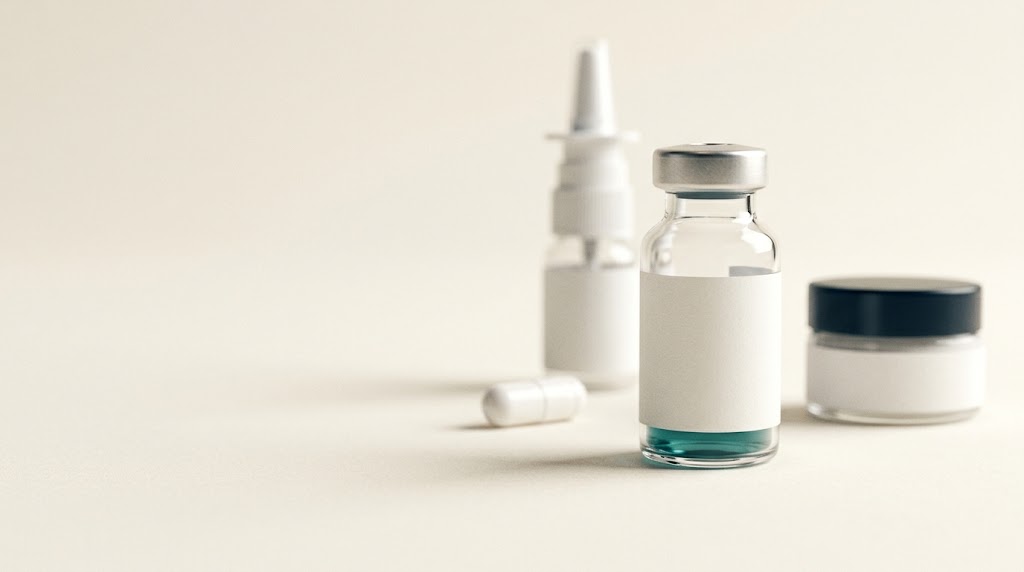
Most peptides taken as capsules, nasal sprays or creams barely reach the blood. The stomach digests them, the lining of the nose lets only a little through, and skin keeps most of them out. That is why nearly all peptides are sold as powder in a vial for injection.
A swallowed peptide and a nasal spray have each been made to work for at least one approved medicine. It took years of drug development, and even then only a few percent of the dose reached the blood.12 Skin is harder still. A patch built by drug delivery specialists to push a peptide through it failed its main trial.3
The FDA found no human absorption data for BPC-157 taken by any of these routes.4 Close to half the capsules in our price tracker are not peptides at all.5
Why are most peptides injected?
A peptide is a short chain of amino acids, the same building blocks that make up the protein in food. Digestion is designed to cut those chains apart, first in the stomach and then in the small intestine, so the body can absorb the pieces. A peptide that survives whole still has to cross the gut wall, and most are too large and too water-loving to pass through cell membranes on their own.
An injection under the skin skips all of that. The peptide goes straight into tissue with its own blood supply.
Of the 5,720 vendor listings in our price tracker, 283 are capsules, tablets, nasal sprays or creams, about one in twenty. Nearly all the others are vials of powder.5
How much reaches the blood, route by route
The approved examples, and the one serious attempt with a skin patch, set the scale for each route.
| Route | Approved peptide example | Share of the dose reaching the blood | BPC-157 absorption data in people |
|---|---|---|---|
| Injection under the skin | Semaglutide (Ozempic, Wegovy) | 89%6 | None found by the FDA4 |
| Swallowed tablet | Semaglutide (Rybelsus) | 0.4% to 1%, and 1% to 2% for newer tablets7 | None found by the FDA4 |
| Under the tongue | Desmopressin (Nocdurna) | About 0.25%8 | None found by the FDA4 |
| Nasal spray | Calcitonin-salmon (Miacalcin) | About 3%, ranging from 0.3% to 30.6%2 | None found by the FDA4 |
| Skin patch | Abaloparatide patch, never approved | Failed its phase 3 trial against the injection3 | None found by the FDA4 |
Can peptides be taken orally?
Some can, with a great deal of engineering, and even then very little of the dose gets through. Oral semaglutide, sold as Rybelsus for type 2 diabetes, is the best evidence that a swallowed peptide can work. It is the same molecule as the weekly injection, so the difference between the two comes down to the route.
Its bioavailability, the share of a swallowed dose that reaches the bloodstream, is 0.4% to 1% according to the US label, and 1% to 2% for the newer semaglutide tablets now sold under the Ozempic name.7 The same molecule injected under the skin reaches 89%.6 The European product information describes absorption as highly variable and says 2 to 4% of patients get no exposure at all.1
Each tablet contains an absorption enhancer called salcaprozate sodium, or SNAC. Laboratory data show it helps semaglutide cross the stomach lining, where nearly all of the absorption happens. The tablet is taken after a fast of at least eight hours with no more than half a glass of water. Nothing else can be eaten, drunk or swallowed for 30 minutes afterwards, since waiting less cuts absorption.1
To make up for the loss, the tablet carries far more drug. The instructions for switching from the injection pair each weekly shot with a daily tablet holding many times more semaglutide in one day than the injection gives in a week.1
A peptide capsule from a vendor comes without the enhancer, the fasting instructions or any testing of the formulation. It is hard to see how it would beat the 1% or so that Novo Nordisk managed with all three.
Do BPC-157 capsules work?
Nobody knows, because no one has measured what happens to swallowed BPC-157 in people.4 It is the peptide most often sold for swallowing, appearing in 37 capsule or tablet listings from 25 vendors in our tracker, alone or in blends.5
The case for the capsule is that BPC-157 survives the stomach. It is a 15-amino-acid fragment of a protein first found in human gastric juice. A 1995 laboratory study, cited in the FDA's 2026 review, reported that it resists being broken down there.4 The group that first made BPC-157, at the University of Zagreb, has produced a large share of what has been published on it. Its senior author is the last-listed author on about two in five of the papers our research index holds on the compound, a count that misses papers where a colleague is listed last.49
Surviving the stomach is a separate question from being absorbed. A peptide that stays whole still has to cross the gut wall to reach anything outside the gut. The FDA found no human data on how BPC-157 behaves after it is swallowed, sprayed into the nose, injected under the skin or applied to it.4
One small safety trial of BPC-157 tablets, planned for about 42 healthy volunteers in Mexico, was registered. It has posted no results, and the FDA could find no publication from it.4 None of the four BPC-157 trials on ClinicalTrials.gov has posted results.9
The only controlled trial in patients used neither a capsule nor a needle. It gave BPC-157 as an enema to 53 people with ulcerative colitis. It exists only as a 2005 meeting abstract, and the FDA found it too short on detail to support any conclusion. In the enema studies, blood tests mostly found no BPC-157 at all.4
Staying out of the blood is not necessarily a failure, though. If the target is the lining of the gut, swallowing is the route that reaches it, and the rat studies that gave BPC-157 by mouth, in drinking water or by tube, were mostly models of gut and liver injury.4 For that narrow use the argument is reasonable. It has not been tested in people, and it says nothing about tendons or joints, even though both feature in how BPC-157 is marketed.4
Some of these capsules carry supplement labels, and BPC-157 does not qualify as a supplement ingredient. The FDA notes that it turns up in supplement capsules and tablets with no supplement standard behind them.4 The Defense Department's supplement safety programme states plainly that it is not a dietary ingredient.10 Our guide on whether peptides are legal covers the wider position.
Are peptide capsules actually peptides?
Close to half of them are not. Of 175 capsule and tablet listings from 34 vendors in our tracker, at least 81 are small-molecule drugs, the ordinary kind of compound found in most tablets. Another 72 are peptides. The remaining 22 are unclear, mostly unnamed blends and Dihexa, a chemically modified peptide fragment.5
The small molecules include tesofensine, SLU-PP-332, 5-amino-1MQ, methylene blue, MK-677 and orforglipron, Eli Lilly's weight-loss pill. They also include SARMs, muscle-building drugs that act on the same receptor as testosterone, covered in our guide to why peptides and SARMs are not the same thing.5
These capsules are the ones more likely to be absorbed, because many small molecules pass from the gut into the blood without help. MK-677 raised growth hormone and IGF-1, the hormone that carries many of growth hormone's effects, in older adults who took it by mouth once a day in a two-year trial.11 An MK-677 capsule that works tells you nothing about a BPC-157 capsule from the same shop.
An oral peptide built for the job
Larazotide is a peptide that was developed properly for the mouth and taken as far as a phase 3 trial. It is an eight-amino-acid tight-junction regulator, meaning it acts on the seals between the cells lining the gut, and it was tested as a treatment for coeliac disease taken three times a day.12 It was designed to stay in the gut and never reach the blood. Its capsules held coated beads built to pass through the stomach intact and release the peptide in the small intestine.13
A phase 2 trial in 342 adults met its main goal of fewer symptoms than placebo at the lowest of three doses, and the two higher doses did no better than placebo on any measure.12 The phase 3 trial, the large final stage before approval, was designed for 525 people. In June 2022 its sponsor stopped it after an independent statistician estimated that the extra patients needed to show a clear difference from placebo were too many to continue.14
Two vendors in our tracker sell a modified form, N-acetyl larazotide, as capsules.5 It is a different compound from the one tested in those trials.
Do sublingual peptides work?
Only one peptide medicine is approved for use under the tongue, and very little of each dose gets through. Nocdurna is a sublingual tablet of desmopressin, a synthetic version of the pituitary hormone vasopressin, prescribed for adults who wake repeatedly at night to urinate. In the studies behind its label, about 0.25% of each dose reached the blood.8 It works because desmopressin is active in very small amounts, much as oral semaglutide works by packing far more drug into each tablet.81
Held under the tongue, a drug can soak into the blood through the lining of the mouth and skip the stomach. Sublingual tablets, dissolving strips and oral sprays all rely on that. Vendors we track sell Selank and Semax dissolving strips, and the FDA's review found a compounder selling BPC-157 as an oral spray.54 For BPC-157 there are no human data by this route either.4
Do peptide nasal sprays work?
Some peptides get through the nose, but only a few percent of the dose, and the amount varies widely from person to person. The lining there is thin and has a rich blood supply. Calcitonin-salmon, a 32-amino-acid hormone used for osteoporosis, is approved in the US as a nasal spray. Its label puts the amount reaching the blood at about 3% of an injection, and between people the figure ran from 0.3% to 30.6%, a hundredfold spread.2
Our tracker holds 88 nasal spray listings from 14 vendors. Semax or Selank appear in 25 of them, BPC-157 in 14 and melanotan in 3, and 23 are multi-peptide blends. One vendor sells a solution for mixing your own.5 What is known about Semax and Selank is in our guide to the nootropic peptides, and the tanning sprays are covered in our melanotan II guide.
How much peptide a spray delivers depends on the bottle, the pump and the size of the droplets. For BPC-157 no information exists on any of them, and the FDA's review said that gave it strong concerns.4 Even the approved calcitonin spray depends on its pump: the label warns that after 30 doses each spray may not deliver the right amount, even if the bottle is not empty.2
The same review notes that injection under the skin and the nasal route are generally linked to more immune reactions than swallowing, and that impurities and clumped peptide can make that worse.4 Calcitonin's own label warns of allergic reactions, including anaphylaxis, because it is a peptide. Rhinitis affected 12% of people on the spray against 6.9% on a placebo spray.2
The nasal route itself is sound, and approved medicines use it. What the research sprays lack is any measurement of how much arrives, from pumps nobody has tested.
Do peptide creams absorb through the skin?
Skin keeps out most molecules the size of a peptide, and its thin outer layer does most of the work. A widely cited rule of thumb in dermatology holds that a molecule needs a mass below about 500 daltons to get through. A dalton is the unit chemists use for the mass of a molecule. Its authors pointed out that common contact allergens and the drugs used in skin patches all fall under that line.15 BPC-157 weighs about 1,419 daltons, nearly three times the limit.4
Devices can get past the rule, though one built specifically for a peptide still fell short. Abaloparatide is an injected peptide approved for osteoporosis. Its maker and a specialist drug delivery company built a patch covered in microscopic projections to carry it into the skin. They tested it against the injection in a phase 3 trial of about 500 women.3
Spine bone density rose 7.1% on the patch against 10.9% on the injection. The patch failed its main goal of being no worse than the injection, despite carrying nearly four times as much drug, and the company later stopped work on it.3
A transdermal cream was one of the forms proposed when BPC-157 was nominated for pharmacy compounding. The FDA found no study that had given it to people through the skin. The nearest evidence in its reference list is a mouse burn-wound study from the Zagreb group.4
Cosmetic peptides are a separate question, since they only need to reach the skin itself. GHK-Cu, a three-amino-acid copper peptide, appears in several of the 20 cream and serum listings in our tracker.5 The evidence for it is in our GHK-Cu guide, and the wider group is covered in our guide to the skincare peptides.
Are peptide capsules safer than injections?
In some ways they are. The FDA judged the built-in risk of an immune reaction to BPC-157 taken by mouth to be likely low, and lower than by injection or spray.4 A capsule cannot cause an injection-site infection either, and a peptide that is simply digested amounts to a small amount of protein.
The larger risk is what else the capsule contains. The FDA's review stays concerned about impurities from peptide manufacture whatever the route.4 Some of the capsules on these shelves are other drugs with risks of their own, including the liver injury documented with SARMs and covered in our SARMs guide.
What to check before buying peptide capsules, sprays or creams
Check first whether the compound is a peptide at all. If it is a small molecule, the capsule may well be absorbed. That makes it a different drug with different risks, and nothing known about peptides applies to it.
Ask what the certificate covers. A certificate of analysis, the lab report a vendor posts to show what is in a product, may describe the raw powder and not the finished capsule. For capsules, the FDA looks at how they dissolve and whether they are free of microbes, and a purity figure for the powder answers neither.4 Our guide on reading a COA covers the rest.
For a spray, the questions are who made the pump and how much one spray delivers. If the answer is a bottle and a solution you mixed yourself, the amount per spray is unknown.
For a cream, the size of the molecule tells you most of what you need. Anything much bigger than about 500 daltons, roughly four or five amino acids, will struggle to get past the surface without a device built for it.15
Common questions
Do BPC-157 capsules work?
Nobody has measured it in people. The only registered trial of BPC-157 tablets has posted no results, and the FDA found no human data on the oral route. The case for capsules rests on a laboratory finding that BPC-157 survives gastric juice and on rat studies of gut injury.
Is oral BPC-157 better than injecting it?
For reaching the bloodstream, there is no reason to think so, since the approved semaglutide pill gets about 1% of its dose into the blood. For a target inside the gut, swallowing is the route that reaches it, though that has not been tested in people either.
If peptides are digested, how does oral semaglutide work?
Each tablet contains an absorption enhancer, and it is taken after an eight-hour fast with little water, with nothing else swallowed for 30 minutes. Even then about 1% reaches the blood, and a few percent of people absorb none.
Do peptide nasal sprays work?
Some peptides are absorbed through the nose. An approved calcitonin spray delivers about 3% of what an injection does, with wide variation between people. For BPC-157 sprays the FDA found no human data, and it raised concerns about untested spray devices and immune reactions.
Are nasal sprays safer than injections?
Not in the way most people assume. The FDA groups the nasal route with injection under the skin as carrying more risk of an immune reaction than swallowing.
Do peptide creams absorb through the skin?
Mostly not. Skin keeps out most molecules above about 500 daltons, and BPC-157 is nearly three times that. A purpose-built microneedle patch for another peptide still did worse than the injection in a phase 3 trial.
Do sublingual peptides work?
One peptide medicine, a desmopressin tablet, is approved for use under the tongue, and about 0.25% of each dose reaches the blood. It works because desmopressin is active in very small amounts. For BPC-157 sold as an oral spray, the FDA found no human data at all.
Can you drink a peptide meant for injection?
There is no human data on it. A peptide drunk from a mixed vial meets the same digestion as a capsule, with no enhancer, coating or fasting rule to help it through.
Is MK-677 a peptide?
No. It is a small molecule that mimics the hunger hormone ghrelin, and it works when swallowed for that reason. Peptide vendors sell it as a capsule alongside peptides.
Are peptide capsules legal as supplements?
Not for BPC-157. The US Defense Department's supplement safety programme states that it is not a dietary ingredient, and the FDA notes it is sold in supplement capsules and tablets with no supplement standard behind them.
Are collagen peptides the same thing?
No. Collagen peptides are food protein broken into short pieces during manufacture, and the body digests them like any other protein.
Sources
- European Medicines Agency. Rybelsus (semaglutide) tablets, summary of product characteristics, sections 4.2, 4.4 and 5.2. [ema.europa.eu](https://www.ema.europa.eu/sk/documents/product-information/rybelsus-epar-product-information_en.pdf). *Regulator product information, read at source. The address served the Slovak-language text, which was read directly; the English wording of section 4.2 was also seen in search results from the English document. Estimated oral bioavailability about 1% for the lower strengths and up to 2% for the two highest, with between-person variability around 100%. Absorption may be minimal, with 2 to 4% of patients having no exposure. In vitro data show salcaprozate sodium facilitates absorption, which happens mainly in the stomach. Taken after a fast of at least 8 hours with up to half a glass of water, waiting at least 30 minutes before eating, drinking or other oral medicines. The switching table pairs each weekly injection strength with a daily tablet carrying several times more semaglutide per day than the injection gives per week. The US label, cited separately, gives 0.4% to 1% for the original tablets, and the body text uses the US figure.* ↩
- Novartis. Miacalcin (calcitonin-salmon) Nasal Spray, prescribing information, revised October 2009. [accessdata.fda.gov](https://www.accessdata.fda.gov/drugsatfda_docs/label/2009/020313s029lbl.pdf). *FDA-held label, read at source. Bioavailability of the nasal spray 3 to 5% relative to intramuscular injection, mean about 3% (range 0.3% to 30.6%); a 32-amino-acid polypeptide; systemic allergic reactions including anaphylaxis reported, attributed to calcitonin being a polypeptide; rhinitis 12.0% against 6.9% on placebo; after 30 doses each spray may not deliver the correct amount. The label is marked as possibly not the latest. Current generic calcitonin nasal spray labels on DailyMed, seen via search results, carry the same 3 to 5% figure.* ↩
- Radius Health. Radius announces results from the wearABLe trial evaluating abaloparatide transdermal system in postmenopausal women with osteoporosis, 8 December 2021. [globenewswire.com](https://www.globenewswire.com/news-release/2021/12/08/2348411/31149/en/Radius-Announces-Results-from-the-wearABLe-Trial-Evaluating-Abaloparatide-Transdermal-System-in-Postmenopausal-Women-with-Osteoporosis.html). *Company announcement, read at source. The patch, developed with Kindeva Drug Delivery (formerly 3M Drug Delivery Systems) using microstructured transdermal technology, did not meet non-inferiority to the injection in about 500 patients: lumbar spine bone mineral density rose 7.1% against 10.9% at 12 months. The patch carried 3.75 times the injected amount. The decision in 2022 to cease the programme was read via a search result excerpt of the company's investor page, which blocks automated reading. The peer-reviewed report is Lewiecki et al., Journal of Bone and Mineral Research, 2023 (doi:10.1002/jbmr.4877), seen via search result and not read.* ↩
- US Food and Drug Administration. FDA Briefing Document, Pharmacy Compounding Advisory Committee meeting of 23 to 24 July 2026: evaluation of BPC-157 (free base) and BPC-157 acetate, dated 11 May 2026. [fda.gov/media/193343/download](https://www.fda.gov/media/193343/download). *Regulator review, read at source. Records the nominated forms (oral capsule, injection under the skin, nasal spray, rectal suppository, transdermal cream); that BPC-157 is marketed in the US in dietary supplement capsules and tablets with no USP supplement monograph; a molecular weight of 1,419.5; first synthesis at the University of Zagreb; resistance to gastric juice in vitro as reported by Veljaca et al. 1995; rat studies giving BPC-157 by mouth in drinking water or by gavage in fistula, liver and gut injury models; no human pharmacokinetic data after oral, subcutaneous, nasal or transdermal use; one enema trial in 53 people with ulcerative colitis, a 2005 meeting abstract judged inadequate; BPC-157 not detected in plasma in the enema studies; the registered phase 1 oral tablet study NCT02637284 (estimated 42 healthy subjects, Mexico, no results, no publication found); strong concerns about a nasal spray given no information on the container and pump; subcutaneous and nasal routes generally associated with more immunogenicity than oral or rectal, with inherent oral risk likely low and impurity concerns regardless of route; dissolution and microbial quality as critical attributes for capsules; a mouse burn-wound cream study (Mikus et al. 2001) in its reference list; and website marketing that includes tendons and ligaments alongside gut uses. This is the FDA staff position. The advisory committee later voted the other way on inclusion, which changes none of the findings cited here.* ↩
- Peptide Decoding vendor price data. [peptidedecoding.com/prices](https://peptidedecoding.com/prices). *The site's own tracker, 5,720 listings with checks dated 22 August to 6 September 2026, counted from the project pricing workbook. By form: 159 capsule, 16 tablet, 88 nasal spray and 20 cream or serum listings. The capsule and tablet split (81 small molecules, 72 peptides, 22 unclear) was made compound by compound for this guide, and the method is in the build notes. Counts drift as the weekly refresh runs and should be re-run from the live data on the day of publication.* ↩
- Novo Nordisk. Wegovy (semaglutide) injection, US prescribing information, 2025 revision, section 12.3. [accessdata.fda.gov](https://www.accessdata.fda.gov/drugsatfda_docs/label/2025/215256s024lbl.pdf). *FDA-held label, section 12.3 read via search result excerpt of the label itself: absolute bioavailability of semaglutide 89%. The same figure appears in Novo Nordisk's Canadian Ozempic product monograph, also seen via search result, and replaces the Mexican product information cited in an earlier draft.* ↩
- Novo Nordisk. Rybelsus and Ozempic (semaglutide) tablets, US prescribing information, 2026 revision, section 12.3. [accessdata.fda.gov](https://www.accessdata.fda.gov/drugsatfda_docs/label/2026/213051Orig1s030lbl.pdf). *FDA-held label, section 12.3 read via search result excerpt of the label itself, with identical wording on the DailyMed copy. Estimated absolute bioavailability of roughly 0.4% to 1% for the original Rybelsus tablets and 1% to 2% for the newer semaglutide tablets marketed as Ozempic tablets; co-formulated with SNAC; absorption mainly in the stomach. The EMA product information gives about 1% and up to 2% for its own strengths, which is consistent.* ↩
- Ferring Pharmaceuticals. Nocdurna (desmopressin acetate) sublingual tablets, prescribing information, revised June 2018. [accessdata.fda.gov](https://www.accessdata.fda.gov/drugsatfda_docs/label/2018/022517s000lbl.pdf). *FDA-held label, read at source. Section 12.3: overall mean absolute bioavailability of sublingual desmopressin 0.25% (95% CI 0.21 to 0.31%), measured in earlier dose-ranging studies at higher doses than the marketed tablets, whose own pharmacokinetics are stated as not characterised. Tablet strengths are in micrograms. Indicated for nocturia due to nocturnal polyuria in adults who wake at least twice a night. Carries a boxed warning for low blood sodium, which the body text does not need and does not cover.* ↩
- Peptide Decoding research index, BPC-157. [peptidedecoding.com/research?compound=bpc-157](https://peptidedecoding.com/research?compound=bpc-157). *The site's own index of Europe PMC and ClinicalTrials.gov records. Senior author share is the proportion of indexed records on which the most frequent last-listed author appears, shown as 41% for Sikiric P in the evidence summary on 18 September 2026. Last-author counting undercounts the group, since its most-cited paper lists a colleague last. Registered trials: four, none with posted results. Re-read the live figures before publishing.* ↩
- Operation Supplement Safety, US Department of Defense. BPC-157: a prohibited peptide and an unapproved drug found in health and wellness products, 29 April 2025. [opss.org](https://www.opss.org/article/bpc-157-prohibited-peptide-and-unapproved-drug-found-health-and-wellness-products). *Government education programme page, read via a search result excerpt of the page itself. States that BPC-157 is not a dietary ingredient and is an unapproved drug, lists it on the DoD Prohibited Dietary Supplement Ingredients List, and advises service members to avoid it however it is taken. Its line that BPC-157 cannot legally be prescribed predates the 2026 compounding developments and is not relied on here.* ↩
- Nass R, et al. Effects of an oral ghrelin mimetic on body composition and clinical outcomes in healthy older adults: a randomized trial. *Annals of Internal Medicine*, 2008. [doi:10.7326/0003-4819-149-9-200811040-00003](https://doi.org/10.7326/0003-4819-149-9-200811040-00003). *Peer-reviewed randomised trial, abstract read via search results. Sixty-five adults aged 60 to 81 took oral MK-677 or placebo daily over two years. Growth hormone and IGF-1 rose to young-adult levels and fat-free mass increased; strength and function did not change, fasting glucose rose and insulin sensitivity fell. The abstract establishes oral activity. The compound's class as a non-peptide small molecule is not stated in the abstract and rests on our growth hormone guide.* ↩
- Leffler DA, et al. Larazotide acetate for persistent symptoms of celiac disease despite a gluten-free diet: a randomized controlled trial. *Gastroenterology*, 2015. [doi:10.1053/j.gastro.2015.02.008](https://doi.org/10.1053/j.gastro.2015.02.008). *Peer-reviewed phase 2 trial, read via search result excerpts of the PubMed abstract, the PMC full text and the Mayo Clinic research record. 342 adults on a gluten-free diet for at least a year took 0.5, 1 or 2 mg three times daily, or placebo. The primary endpoint was met at the lowest dose; the 1 and 2 mg doses were no different from placebo on any endpoint. The full text describes larazotide as a locally acting, non-systemic, 8-amino-acid oral peptide.* ↩
- Innovate Biopharmaceuticals (renamed 9 Meters Biopharma in 2020). Annual report on Form 10-K for 2019, filed with the SEC. [sec.gov](https://www.sec.gov/Archives/edgar/data/1551986/000155198620000050/innt1231201910-k.htm). *Company filing, read via search result excerpt of the filing itself. Describes larazotide as an orally administered, locally acting, non-systemic, synthetic 8-amino-acid tight junction regulator, not absorbed into the circulation, formulated as enteric-coated multiparticulate beads in hard gelatin capsules designed to bypass the stomach and release in the duodenum, dosed 15 minutes before meals in trials.* ↩
- 9 Meters Biopharma. Press release, 21 June 2022, filed with the SEC as exhibit 99.1 to Form 8-K. [sec.gov](https://www.sec.gov/Archives/edgar/data/1551986/000155198622000046/ex-991pressreleasedated621.htm). *Company announcement, read at source. A pre-specified interim analysis by an independent statistician, on roughly the first half of target enrolment after the 12-week double-blind phase, found the additional patients needed to show a significant difference from placebo too many to support continuing. Design: 525 patients across two doses and placebo. Describes larazotide as a tight junction regulator and records the earlier phase 2 trial in 342 adults. No peer-reviewed report of the phase 3 results has been located.* ↩
- Bos JD, Meinardi MM. The 500 Dalton rule for the skin penetration of chemical compounds and drugs. *Experimental Dermatology*, 2000;9(3):165-169. [doi:10.1034/j.1600-0625.2000.009003165.x](https://doi.org/10.1034/j.1600-0625.2000.009003165.x). *Peer-reviewed argument paper, abstract read via search results. Proposes that a compound must be under 500 daltons to be absorbed through skin, supported by the observations that common contact allergens, common topical dermatology drugs and all then-known transdermal patch drugs fall under that weight. It is a rule of thumb, and later work with microneedles and other devices has moved larger molecules through skin. The conversion to four or five amino acids uses an average amino acid residue mass of roughly 110 daltons and is our arithmetic, not the paper's.* ↩