
BPC-157 and TB-500: What the Healing Pair Actually Is
These two get sold together, talked about together, and described in almost the same words. Search either one and the other shows up within a paragraph, usually with “synergy” nearby. Being sold as a set raises a separate question, which is whether to draw them together.
They are not the same kind of thing. They work in different ways, they are taken on schedules that look nothing alike, and one of them is not the molecule its research belongs to.
Here is what each one is, what the studies actually found, and where the popular story stops matching the papers. If you want the head-to-head instead, see the BPC-157 vs TB-500 comparison.
What BPC-157 is
BPC-157 is a lab-made chain of 15 amino acids, based on a protein found in stomach juice. The name is short for Body Protection Compound. That tells you what its developers hoped for, and nothing about whether it works.
The idea behind it is that it helps the body grow new blood vessels. New blood vessels mean more blood supply to an injured area, and more blood supply is part of how anything heals. In lab dishes it also made tendon cells more responsive to growth hormone, and that is the explanation usually given for the tendon results.
What TB-500 is
TB-500 covers two molecules that are not the same size or the same thing, and telling them apart is the most useful thing in this guide.
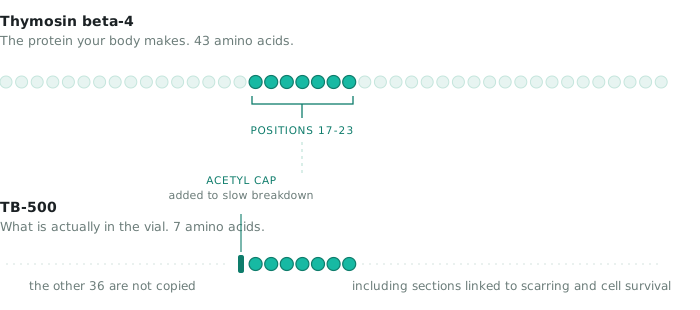
Thymosin beta-4 is a protein your body already makes, found in most of your cells. It is 43 amino acids long. Its job involves actin, the internal scaffolding that gives a cell its shape and lets it crawl from place to place. Crawling cells are how a wound closes.
TB-500 is a lab-made piece of that protein, seven amino acids long.
Seven out of forty-three. It copies the one short stretch that grabs onto the scaffolding and leaves the rest behind, which makes it a related molecule rather than the same one under a shorter name.
The identity problem
Every healing number you see quoted for TB-500 comes from the full 43 amino acid protein.
The most-repeated figures are from a 1999 study on rats: new skin grew over a wound about 42% faster by day four and up to 61% faster by day seven compared with saline, and wounds closed about 11% more by day seven. In lab dishes, the same protein made skin cells move two to three times as much.
Those are real results from a real paper, and every one of them describes the full protein.
The same goes for every human study. The full protein has been tested in people several times, and the seven amino acid piece has not been in any of them.
The strongest argument for the other side
There is a serious version of the case that the fragment should behave like the protein, and it deserves stating properly.
Researchers mapping the structure of thymosin beta-4 identified positions 17 to 23 as the actin-binding motif, the functional core of the molecule. That finding is why TB-500 was built around that stretch in the first place. So the argument goes: if you copy the working part, you get the working effect.
That argument has real evidence behind it. In 2003, researchers tested the full protein against a seven amino acid synthetic peptide covering the actin-binding stretch, in diabetic mice and in 26-month-old mice where healing is normally slow. The short peptide promoted repair in the aged animals comparably to the parent molecule.
So the fragment keeps more than people assume. What it does lose is a section linked to reducing scar tissue and a section linked to keeping cells alive under stress, and nobody has measured how much that costs.
But there is a catch in that 2003 study, and it is the detail the whole question turns on.
The catch is one chemical group
The peptide tested in 2003 was LKKTETQ. What is sold as TB-500 is Ac-LKKTETQ, the same seven amino acids with an acetyl group stuck on one end. That cap is added to slow the body breaking it down.
They are not the same molecule, and there is reason to think the difference matters.
In 2024, researchers tracked what happens to TB-500 in the body. It gets chopped into shorter pieces, and they tested those pieces for wound healing in cells alongside the parent compound. One breakdown product, Ac-LKKTE, significantly increased wound healing compared with control. TB-500 itself did not. The authors concluded that the wound healing activity previously reported for TB-500 may come from that metabolite rather than from the parent form.
One cell study, and it should not be over-read. But line the three up and the picture is not the one you get from any product page.
- The full 43 amino acid protein: works in animals, mixed results in people.
- The uncapped seven amino acid piece: comparable to the parent in aged mice.
- The capped version, which is what you buy: no activity in that 2024 assay, with its breakdown product carrying the effect instead.
The honest summary is not that nobody has compared the piece against the protein. Somebody did, and the piece held up. It is that the comparison was run on a slightly different molecule from the one in the vial, and the one chemical difference between them may be the one that matters.
One practical warning
Suppliers use “thymosin beta-4 fragment” loosely, and it does not always mean the same piece. Some products sold under that description are a completely different section of the protein.
What the human studies on the full protein found
The summary you will usually get is that thymosin beta-4 worked in people. The record is messier.
Dry eye
Eye drops made from the full protein went through three studies, ending in a large one. It did not hit the main results it was testing for. One smaller measure, how gritty people’s eyes felt, did improve.
Corneal damage
A small US study of 18 patients found more of them healed on the drug than on placebo, but the result sat right on the line of what counts as meaningful, and a larger European study afterwards failed outright.
Heart attack
In 2025, a study of 96 heart attack patients tested an injected version of the full protein. Overall, it did not reduce the amount of damaged heart muscle. Patients who got their first dose within eight hours did show less damage.
So the protein has a real research history, several studies that missed their main target, and one recent result in a smaller group. That is a good deal less than “it worked in humans” implies, and none of it is evidence about the seven amino acid piece being sold anyway.
What the BPC-157 research actually shows
Nearly all of it is rats and lab dishes.
In rats with a cut Achilles tendon, the tendon healed faster and ended up stronger. In another rat study it improved how well tendon reattached to bone. In lab dishes it made tendon cells grow out and move faster, and more so at higher doses.
The human record, in full
You will often read that BPC-157 was proven safe in human trials for inflammatory bowel disease. Something real sits behind that claim, and it is smaller than it sounds.
A Croatian drug company developed the identical molecule under a different product name in the early 2000s. A first-stage safety study in healthy men found it well tolerated. A follow-up study in people with mild to moderate ulcerative colitis was run and presented at a conference in 2005, but the results were never published as a full paper, and the company dropped the programme.
Everything since then is small. A safety study registered around 2015 whose results were never published. A 2021 report on 16 patients with knee pain. A 2024 report on 12 women with bladder pain. A 2025 report on two people given it through an IV.
That is roughly thirty people, none of them in a study with a comparison group, and no published trial testing whether it works for anything.
Who did the research matters here. A 2026 review counted up authorship across the BPC-157 literature and found that more than 80% of published studies trace to a single university group in Croatia. The animal work is large in volume and narrow in origin, and very little of it has been repeated by anyone else.
There is a second, less discussed problem with that body of work. Critics have pointed out that the experiments routinely use only one or two fixed amounts, and that almost nothing has been published on what higher amounts, repeated amounts, or long-term use do. For a compound people take daily for months, that is the gap that matters most.
The argument is happening in print. The Croatian group published a formal defence of the compound in 2025, and the researchers who raised the concerns published a reply. Both are worth reading if you want to see how thin the settled ground actually is.
They work in different ways
The pairing suggests two tools doing similar jobs, and the two mechanisms have almost nothing to do with each other.
BPC-157 is about blood supply, meaning new vessels and better signalling into the injured area.
Thymosin beta-4 is about cell movement, meaning cells rearranging themselves and crawling across a gap.
You can make an argument on paper for combining them, and nobody has tested it. No published study, in dishes, animals, or people, has looked at the two together. What the pairing actually traces back to is both compounds being sold by the same suppliers.
The blend they are sold as
Most people buying this pair buy one vial, often labelled BPC-157 + TB-500 or sold under the Wolverine nickname.
Know these three things before you calculate anything.
There is no standard ratio. Vials sold under the Wolverine nickname include 5 mg of each, 10 mg of each, 30 mg of each, and one compounding pharmacy version with 5 mg of BPC-157 against 10 mg of TB-500. A dose you read online tells you nothing unless you also know which vial the writer had.
A blend is one draw. Whatever you draw for one, you get the other at whatever the vial’s ratio is. You cannot dose them independently, which matters because the two are normally taken at amounts that differ by a factor of ten and on schedules that differ by a factor of seven.
Not everyone agrees they should be mixed. Some clinics give the two as separate injections and say stability suffers when they share a vial. No published study has tested whether a pre-mixed vial holds up, so this is a disagreement between sellers rather than a settled question.
The doses are nothing alike
BPC-157 is commonly taken at around 250 to 500 mcg, once or twice a day. TB-500 is commonly taken at around 2 to 5 mg, once or twice a week.
One is a small amount taken constantly, the other a bigger amount taken occasionally.
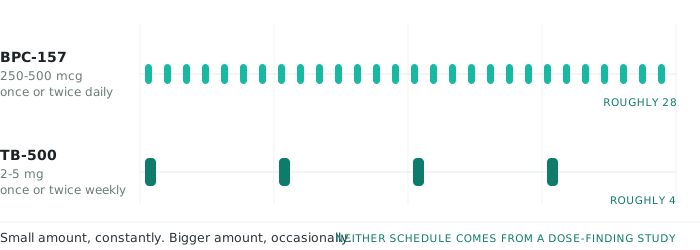
Two things follow from that. Anyone reading instructions for both is switching between micrograms and milligrams in the same sitting, which is exactly how the thousand-fold dosing error happens. And the two vials run out at different times, so work out the weekly cost of each separately.
Neither range comes from a study designed to find the right dose. Both are community habit, and there is a tell that they are: across retailer sites, compounds in this group keep landing on the same round numbers. Real dose-finding produces awkward figures, because it follows what the data did. Numbers that look tidy across a dozen different compounds are numbers somebody chose.
Taking BPC-157 by mouth
Some people swallow it instead of injecting, which is unusual for a peptide. The reasoning is that something that comes from a stomach protein might survive the stomach.
The first half holds up: BPC-157 does appear to survive stomach acid, and rats given it in drinking water show effects.
The second half has never been shown. The only proper study of where the compound goes in the body tested injection into a vein and into muscle, in rats and dogs. It found the compound clears out fast, in under half an hour. It did not test swallowing at all, and nobody has measured any of this in a human.
Surviving your stomach and reaching your bloodstream in useful amounts are separate claims, and only the first has support behind it. The better case for swallowing it is for gut problems, not for a knee.
Where these stand legally
Compounding pharmacies
In 2023 the FDA put both compounds on a list of ingredients that may carry significant safety risks, so pharmacies could not use them. The reasons given for BPC-157 were that it might trigger an immune reaction depending on how it is given, that there are complications around impurities and confirming what the ingredient actually is, and that safety information is limited.
In April 2026 both were taken off that list, along with ten other peptides. That removal was a paperwork step. Neither compound moved onto the approved list pharmacies can actually use, and both were sent to an advisory committee for review.
That review happened on 23 July 2026. The committee voted to recommend adding both to the list of substances pharmacies may compound: BPC-157 for ulcerative colitis and TB-500 for wound healing, each by 8 votes to 6 with one abstention. The FDA’s own scientific reviewers had advised against both.
Almost every outlet is reporting this badly, in three specific ways.
A recommendation from an advisory committee is advice. It is not a decision, and the FDA is not bound by it. HHS still has to accept it and write formal rules before any pharmacy can legally compound either compound, and none of that has happened. Compounding both is still not legal today.
And a recommendation for pharmacy compounding is not drug approval. Even if it goes all the way through, that would mean a licensed pharmacy could make it on a prescription. It would not mean either compound had been shown to work.
Approval
Neither is approved for any medical use in the US, Europe, or Australia.
Vendors
The FDA has sent warning letters to companies selling research-labelled peptides for people to use, and has tightened up on imports.
Tested sport
Both are banned at all times, in and out of competition.
The full explanation of where they stand in tested sport, including sanctions and exemptions, is covered separately.
This needs saying plainly, because a review published in 2025 claims BPC-157 is no longer banned, and that claim is simply incorrect. It is named on the current banned list, as is thymosin beta-4 and products derived from it, with TB-500 given as the example. Both can be detected by current testing, and athletes have been sanctioned for both.
What neither one is proven to do
Post-surgical healing is a common sales claim, but a fresh surgical wound is the wrong place to test it.
- Neither has a proper trial showing it works, for the version sold online.
- Neither is approved for any use anywhere.
- Neither has been tested alongside the other.
- Neither has long-term safety data in people. That matters more than usual here, because both are supposed to work by encouraging tissue to grow.
Shared cautions
Active cancer
Both are avoided as a precaution. BPC-157 encourages new blood vessels and thymosin beta-4 encourages cells to move, and tumours use both of those. The concern is theoretical: no study has shown either compound causing or spreading cancer, and no study has been designed to check properly either, so the absence of evidence is not reassurance.
Pregnancy
No safety information exists.
What is actually in the vial
This risk is separate from the compounds themselves and is probably the bigger one. Both sell through unregulated channels where products have turned up mislabelled, containing the wrong sequence, weaker than stated, or contaminated. You are holding a substance and a claim about it.
For both, new lumps and signs of an allergic reaction mean stop and get medical attention rather than wait and see.
Side by side
| BPC-157 | TB-500 | |
|---|---|---|
| What it is | A 15 amino acid lab-made peptide | A 7 amino acid piece of a larger protein |
| Where it comes from | Based on a protein in stomach juice | Part of thymosin beta-4, which is 43 amino acids |
| How it is meant to work | Grows new blood vessels | Helps cells move and rearrange |
| Best evidence | Rat tendon studies | Human studies, but of the full protein |
| Proper trials of the version sold | None published | None |
| People studied | About 30, none with a comparison group | None, as the fragment |
| Usual amount | About 250 to 500 mcg | About 2 to 5 mg |
| Usual frequency | Once or twice daily | Once or twice weekly |
| Approved anywhere | No | No |
| Banned in tested sport | Yes, at all times | Yes, at all times |
Common questions
Which one is better for a tendon injury?
Neither has been shown to work for tendon injuries in people, so there is no honest way to pick. BPC-157 has more animal research aimed at tendon specifically, though most of it comes from one group. The comparison cannot honestly be taken further than that.
Do they work better together?
Nobody knows. No study has ever tested the combination. The pairing comes from how they are sold and talked about, not from research.
Is TB-500 the same as thymosin beta-4?
No. Thymosin beta-4 is a 43 amino acid protein. TB-500 is a 7 amino acid piece of it, with a chemical cap added. All the human research belongs to the full protein. An uncapped version of that same seven amino acid piece was tested against the full protein in aged mice in 2003 and held up well. The capped version that is actually sold has not been through that comparison, and one 2024 cell study found the capped form inactive where a breakdown product was not.
Did the thymosin beta-4 human studies succeed?
Mostly not. The large dry eye studies missed what they were testing for. A European corneal study failed. A 2025 heart attack study missed its main result, with a benefit only in people treated early. Anyone using those studies as proof it works is overstating them, and anyone using them for TB-500 is talking about a different molecule.
Did the FDA just approve BPC-157 and TB-500?
No. An advisory committee recommended in July 2026 that both be added to the list of substances pharmacies may compound. That is advice to the FDA, not a decision by it, and formal rulemaking has to follow before anything changes. Compounding either is still not legal. Approval as a medicine is a separate thing entirely and neither has it.
What ratio is the BPC-157 + TB-500 blend?
There is no standard. Vials sold under the Wolverine nickname run from 5 mg of each up to 30 mg of each, and at least one is 5 mg of BPC-157 with 10 mg of TB-500. Read your own label, because a dose quoted online is meaningless without knowing what was in the writer's vial.
Can I take BPC-157 by mouth?
People do. It survives stomach acid and works orally in rats. Whether a useful amount reaches your bloodstream has never been measured in a person, so swallowing it makes more sense for gut problems than for anything far from the gut.
Is the cancer concern real?
It is theoretical, not demonstrated. No study shows either compound causing cancer, and no study has been built to look properly. The caution exists because both act on processes tumours also use, and neither has long-term human safety data.
How long do people use them?
Community habits vary and have no published basis, so this site does not publish cycle lengths. The commonly repeated block lengths track how long an injury feels like it should take rather than anything measured, and nobody has long-term safety data on either compound.
Will they show up on a drug test?
Not on a standard workplace test. Both are banned at all times in tested sport and both are detectable, so a tested athlete should stay away.
Sources
- Fragment identity, Ac-LKKTETQ, residues 17 to 23 of thymosin beta-4: Esposito et al. 2012, Drug Testing and Analysis 4(9):733-738.
- The 42%, 61% and 11% rat wound figures: Malinda et al. 1999, PubMed.
- Rat tendon-to-bone: PubMed.
- Tendon cell and growth hormone receptor mechanism: Journal of Applied Physiology.
- Uncapped LKKTETQ compared against the full protein in diabetic and aged mice: Philp et al. 2003, Wound Repair and Regeneration 11(1):19-24.
- TB-500 metabolites, with Ac-LKKTE active in a wound assay where TB-500 itself was not: Rahaman et al. 2024, Journal of Chromatography B.
- BPC-157 pharmacokinetics, IV and IM only, half-life under 30 minutes: He et al. 2022, Frontiers in Pharmacology 13:1026182.
- IV safety report in two people, 2025. Case report; URL not yet confirmed, so no link is given.
- FDA compounding list: FDA. July 2026 advisory vote: Pharmacy Compounding Advisory Committee, 23-24 July 2026. Non-binding recommendation.
- WADA prohibited list, BPC-157 under S0, thymosin beta-4 and derivatives under S2.3: WADA.
- The Croatian BPC-157 programme was PL 14736, also called PL-10 and PLD-116. Phase 1 abstract, Gut 2003;51 Suppl III:A309. Phase II ulcerative colitis enema abstract, Gastroenterology 2005;128:A584. Neither was published in full.
- The single-research-group finding is Pharmaceutics 2026, 18(5):625. The published dispute over the BPC-157 literature is Sikiric et al., Comment and Jozwiak et al., Reply, Pharmaceuticals 2025.
- The eye studies were RGN-259 (ARISE-3 and SEER-3); the 2025 heart trial is Cardiovascular Research 121(17):2747-2758. Two of its authors are employed by the company developing the drug.
Keep reading
- What Are Peptides? A Plain-Language Guide
What a peptide actually is, how the category differs from proteins, hormones, steroids and supplements, what research use only means, and the words you need before reading anything else.
- How to Read a Peptide COA (Certificate of Analysis)
What HPLC purity and mass spectrometry each establish, what purity is actually good enough, why the lot number matters more than the percentage, and the red flags that mean a COA is worthless.
- mcg vs mg
1 mg equals 1,000 mcg.
- The Nootropic Peptides, Sorted Out
Five compounds, five kinds of thing.
- How Long Do Peptides Take to Work?
For five compounds there is a real answer from trial data.
- Can You Mix Two Peptides in One Syringe?
Nobody has tested it for peptides.
The peptide stuff worth knowing.
Get new guides, tools, compound pages, and important peptide news in your inbox 1–3 times a month. If there’s nothing worth sending, we don’t send one.