They are not the same molecule, and the FDA says so in writing. Thymosin beta-4 is a protein of 43 amino acids. TB-500 is a seven-amino-acid piece of it, and the agency's own review calls them "not the same substance."1
No human has ever been given that seven-amino-acid piece in a trial. The FDA went looking and reported that "no articles were found in which TB-500 was administered to humans."1
The full protein has been in twelve trials, 2,082 people in the eleven that reported a count. Its record there has a clear shape. The dry eye signal was significant in nine patients, absent in 72, and absent again in trials of 317, 601 and 700.2345
The fragment has evidence of its own. One animal experiment put both molecules in the same wounds and found them alike. Two cell studies point the same way.678 All three are twenty years old or more. All three come from one group.
What is the difference between TB-500 and thymosin beta-4?
Thirty-six amino acids. The FDA has written down both.
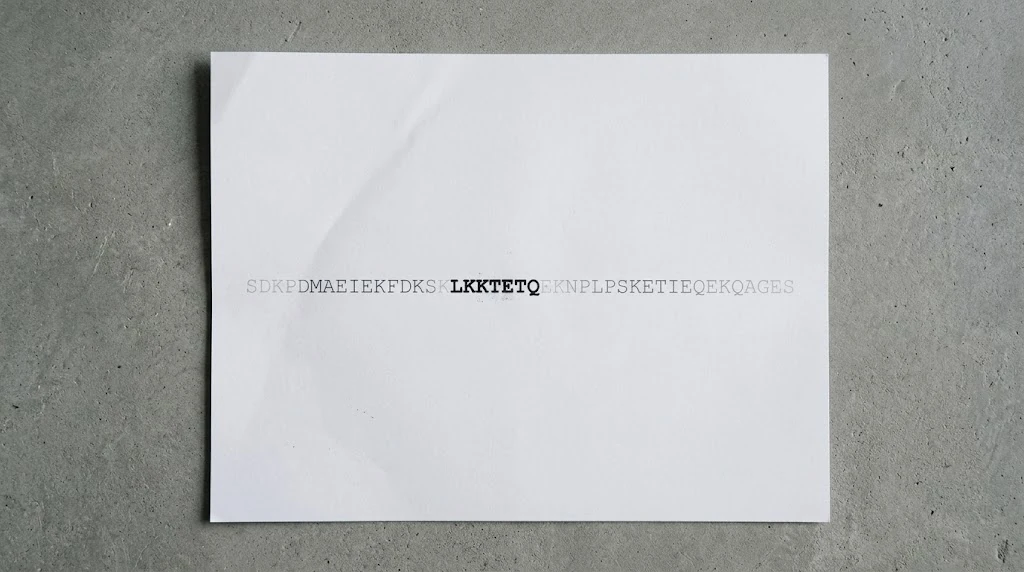
Thymosin beta-4 is a small protein your body makes. Mature thymosin beta-4 runs 43 residues, sequence SDKPDMAEIEKFDKSKLKKTETQEKNPLPSKETIEQEKQAGES, carrying an acetyl group on the first residue.9 It binds actin, the filament protein cells use to change shape and crawl.
TB-500 is defined in the FDA's compounding review as "a synthetic N-acetylated heptapeptide containing the amino acid sequence 17 through 23 (LKKTETQ)," with a molecular weight of "889.01 g/mol."1
| Thymosin beta-4 | TB-500 | |
|---|---|---|
| Length | 43 amino acids | 7 amino acids |
| Sequence | SDKPDMAEIEKFDKSKLKKTETQEKNPLPSKETIEQEKQAGES | LKKTETQ |
| Position | the whole protein | residues 17 to 23 |
| N-terminus | acetylated | acetylated |
| Mass | 4,963 daltons | 889.01 g/mol |
| Human trials | twelve | none |
That 889.01 figure is the FDA's, read at source. The 4,963 is calculated from the sequence with the acetyl group the reference entry records at residue 2. Positions 17 to 23 are the FDA's wording and match the numbering in the study that located the domain.18
Naming is where people come unstuck. "TB-500" reads like a development code, the sort a drug candidate carries through its trials. The FDA addresses that directly: "TB-500 is a common name and not a United States Adopted Name."1 Nobody developing thymosin beta-4 as a medicine used that name for it in a trial.
A 2026 scoping review in Applied Sciences describes TB-500 as "a commercially used designation for synthetic peptide products marketed as related to TB4," and says the term's use "varies across commercial, regulatory, and research contexts."10 So the commercial name is loose. The molecule behind it, when a regulator pins it down, is not.
Why does a 36-amino-acid difference matter?
Enough that a mass spectrometer separates them in one run.
TB-500 is 889.01 g/mol by the FDA's figure.1 The full protein is 4,963 daltons. The gap is about 4,074 daltons, which no instrument capable of reading either number could miss.
Size has consequences past identification. A 43-residue protein and a seven-residue peptide would not be expected to clear at the same rate, survive the same enzymes, or distribute the same way. Nothing in that sentence has been measured for the fragment in a person, which is why it is phrased as an expectation.
Half-life figures circulating for TB-500 should be treated as unsourced. Numbers from minutes to several hours appear in vendor copy and forum posts. No published human pharmacokinetic study of the seven-residue peptide has been identified, by this page or by the FDA, whose review states that it found no clinical studies of the substance at all.1
This site's compound page lists the half-life as not established. That entry stands.
Which molecule did each human trial use?
The full protein, all twelve times.
| Trial or report | People | Route | Molecule | Primary result |
|---|---|---|---|---|
| Ruff 2010, Phase 1 | 40 | intravenous | "synthetic thymosin beta 4" | safety and PK only, no efficacy endpoint |
| Wang 2021, Phase 1 | 84 | intravenous | recombinant, "NL005" | safety and PK only, no efficacy endpoint |
| Guarnera 2010, venous ulcers | 73 | topical | "synthetic copy of the naturally occurring 43 amino acid peptide" | no significance testing reported in the abstract |
| Sosne 2015, severe dry eye | 9 | eye drops | thymosin beta-4, 0.1% | significant on both signs and symptoms |
| Sosne 2015, dry eye Phase 2 | 72 | eye drops | thymosin beta-4 ophthalmic solution | both co-primaries missed, P = 0.2586 and P = 0.2210 |
| ARISE-1, dry eye | 317 | eye drops | RGN-259 | co-primaries not met |
| ARISE-2, dry eye | 601 | eye drops | RGN-259 | co-primaries not met |
| ARISE-3, dry eye | 700 | eye drops | RGN-259 | co-primaries not met |
| Sosne 2023, keratopathy Phase 3 | 18 | eye drops | RGN-259 | primary missed, p = 0.0656 |
| RGN-137, pressure ulcers | 72 | topical gel | RGN-137 | safety primary met, no significant difference on healing |
| RGN-137, epidermolysis bullosa | not reported | topical gel | RGN-137 | trial closed, no endpoint result reported |
| Zhang 2025, STEMI | 96 | not stated in the abstract | "recombinant human thymosin beta 4 (rhTB4)" | overall difference not significant |
Molecule descriptions in quotation marks are the source's own words. Unquoted entries are product codes or the page's summary. Routes are sourced per trial in the footnotes, and the one route the abstract does not give is marked as such. Sourcing tier varies by row and the footnotes say which.
Nothing in that column reads seven amino acids. One entry says 43 outright. Two say recombinant, which is a production method and not a length, so neither certifies a molecule on its own; both of those trials came from the same sponsor, whose published Phase 1 paper describes its article as recombinant human thymosin beta-4, not any fragment.1112
Eye drops account for 1,717 of the 2,082 participants. Fluid on the surface of an eye is not an injection into a shoulder, and six of the twelve trials were drops. Two were intravenous infusions in healthy volunteers with no efficacy endpoint. None injected anything under the skin to repair a tendon.
Has anyone ever given the TB-500 fragment to a person?
No human has received it in any study the FDA could find. The agency went looking specifically.
The FDA conducted its own literature search while evaluating TB-500 for the compounding list and reported the result plainly: "no articles were found in which TB-500 was administered to humans."1 It added that "the nomination did not include, and FDA has not identified, any clinical studies."1
That is a better class of evidence than a database search by a journalist, because the agency had a statutory reason to look hard and a nominator with every incentive to supply anything it missed.
A 2026 scoping review points the same way from a different angle. Searching PubMed, Europe PMC and ClinicalTrials.gov to a final date of March 26, 2026, it screened 1,506 records, read 124 full texts and included 80 studies.10 Full-length thymosin beta-4 accounted for 70 of 80, 87.5%. Four studies, 5.0%, were derivative or fragment work. One, 1.3%, was a direct TB-500 study.10
One limit belongs on those percentages. The review's eligibility was tissue healing and musculoskeletal repair, so it was never counting the whole fragment literature.10 Five percent of healing studies is not five percent of everything published on LKKTETQ. The FDA's search carries the weight for the human claim; the review carries the weight for how the literature is distributed.
The review also states that "No human interventional studies of administered TB4 or TB-500 were identified in tendon" and the other musculoskeletal tissues it covered.10 Tendon, ligament, muscle, bone and cartilage are the uses people buy it for.
Does the TB-500 fragment work in animals?
Exactly one experiment has compared the fragment with the full protein in a live animal. That one reported them comparable.
A 2003 study in Wound Repair and Regeneration gave both the full protein and the synthetic seven-residue peptide LKKTETQ to wounded mice, and reported that the fragment promoted repair in aged animals at a level comparable to that of the parent molecule.6 Healing in the 26-month-old animals was significantly delayed to begin with, and the full protein accelerated it.
Two cell studies point the same direction without being head-to-head animal work. A 2003 paper in The FASEB Journal reported that thymosin beta-4 and the actin-binding motif "display near-identical activity at ~50 nM" in endothelial migration and vessel sprouting assays, and that "peptides lacking any portion of the actin motif were inactive."7 A 2006 paper in the Journal of Cellular Physiology reported that "The central actin-binding domain, amino acids 17-23, had all of the activity for metalloproteinase induction."8
Five limits belong on those three papers, and the page states them instead of burying them. They come from one group centered on Philp and Kleinman, with collaborators at Erlangen and George Washington University, not a single NIH laboratory. The newest is twenty years old. Only the 2003 mouse study is a full-versus-fragment comparison in an animal. The 2006 paper's "all of the activity" applies to metalloproteinase induction specifically, and its own conclusion is narrower, that "part of the wound healing activity" resides in that domain. Finally, whether the peptide in the 2003 wound study was acetylated is not something this page can establish, because the full text sits behind a publisher it cannot reach and the abstract does not say.6
That last gap matters. What the FDA defines as TB-500 is acetylated, and on a seven-residue peptide an acetyl group is a meaningful fraction of the molecule.
Does thymosin beta-4 research apply to TB-500?
Partly. The human record cannot carry over at all, while the preclinical mechanism partly can.
What cannot carry over is the human record. Twelve trials, 2,082 participants, zero fragment exposures, confirmed by the agency that went looking. Anyone citing a human trial in support of an injected seven-residue peptide is citing something that does not exist.
What can partly carry over is the preclinical mechanism. One animal experiment compared the two molecules and found them comparable, two cell studies agree, and clipping the motif abolishes the activity.678 A flat claim that the published research cannot be mapped onto the product overstates the case. This site has made that claim on its compound page, and it is being corrected.
Stated accurately, it runs like this. Published animal and cell work suggests the fragment reproduces some of the full protein's actin-related activity in those models. No human has received the fragment. Both sentences are true and neither cancels the other.
What happened to thymosin beta-4 as the trials got bigger?
The signal shrank, then vanished.
| Dry eye trial | Participants | Result |
|---|---|---|
| Sosne 2015, Cornea | 9 | significant on both signs and symptoms |
| Sosne 2015, Clinical Ophthalmology | 72 | both co-primaries missed, P = 0.2586 and P = 0.2210 |
| ARISE-1 | 317 | co-primaries not met |
| ARISE-2 | 601 | co-primaries not met |
| ARISE-3 | 700 | co-primaries not met |
Participant counts and outcomes per source; the three ARISE figures come from the sponsor's own filings, which record 1,618 patients treated across the three.5
Read down that table. A nine-patient trial, randomized and double-masked against vehicle, reported a 35.1% reduction in ocular discomfort and a 59.1% reduction in total corneal fluorescein staining by day 56, and its title says "Significantly Improves Signs and Symptoms."2 Then 72 patients, and both co-primaries missed. Then 1,618 patients across three trials, and no co-primary met in any of them.
The shrinking pattern is the most informative thing in the thymosin beta-4 record, and more useful than a flat claim that nothing ever worked. Small trials with multiple outcomes at multiple timepoints produce significant results regularly. The test of whether the result was real is what happens when the trial gets big enough to be hard to fool, and here the answer came back three times.
Two near misses deserve naming so nobody thinks the page is hiding them. The Phase 3 keratopathy trial healed 6 of 10 against 1 of 8 and reported p = 0.0656, which the paper itself calls a narrowly missed primary with a strong efficacy trend.4 The same paper reports an ad hoc Chi-square on that primary at p = 0.0400, while noting the test's "assumption of larger sample size is violated."4 In eighteen patients, neither figure settles anything.
Limits belong on the negative record too, and they are not small. Three of the twelve entries rest on sponsor filings, not peer-reviewed papers.5 One trial closed with no endpoint result reported. Two were Phase 1 studies with no efficacy endpoint by design. One abstract reports no significance testing at all. The Phase 3 had eighteen patients. A defender of these compounds would write that paragraph, so the page writes it.
Animal work has null results as well. A 2016 study in Frontiers in Pharmacology, titled for its own finding, reported that systemic dosing "Does Not Attenuate" global myocardial ischemia-reperfusion injury in pigs, concluding that "the cardioprotective effect of TB4 was not demonstrated in this model."13 It used ten animals, so it is a null result in a small study and not a refutation.
What did the one study of TB-500 as sold find?
Metabolites in rats, plus a wound-healing screen in cells.
The single study the 2026 review classified as a direct TB-500 study is a 2024 paper in the Journal of Chromatography B on simultaneous quantification of TB-500 and its metabolites in vitro and in rats, with wound-healing screening in cells.14 The review describes it as "a single mixed study centered on metabolite profiling and fibroblast wound-healing screening."10
Rats were dosed, so the earlier framing on this site that nothing has ever been given the sold article was wrong. What remains true is narrower and still the point: no efficacy study of TB-500 has been run in any animal model of the injuries people buy it for, and none in a person.
Identity and purity are separate problems from efficacy. A laboratory synthesizing LKKTETQ for an experiment characterizes it. Nothing in the published record tells you what is in a vial from a research-chemical site, and the FDA's review notes that even the nomination package it received contained a molecular formula matching neither the free base nor the acetate.1
Why does the name point at two different molecules?
Because the market uses it loosely and the literature followed.
A regulator is not the source of that confusion, though an earlier version of this page said it was. The FDA identified the nominated substance precisely as the acetylated heptapeptide, gave its formula and mass, and stated that "thymosin beta-4 and TB-500 are not the same substance."1 The only thing it called unclear was the salt form: "it is unclear whether the nomination was for TB-500 (free base) or TB-500 acetate."1
So on identity, two institutions have taken a position and they agree.
| Institution | Position |
|---|---|
| FDA, compounding review, 2026 | TB-500 is the acetylated 7-mer at 889.01 g/mol, and is "not the same substance" as thymosin beta-4 |
| WADA, 2026 prohibited list | "Thymosin-β4 and its derivatives e.g. TB-500", banned in one entry |
| Applied Sciences review, 2026 | a commercial designation whose use "varies across commercial, regulatory, and research contexts" |
Positions quoted from each source, all three read at source.
Only the scoping review sits apart, and not because it disagrees. McGuire's team declined to treat the two as interchangeable, built separate categories for full-length, derivative and direct TB-500 work, and wrote that "these categories are often discussed together despite limited direct equivalence data."10 A review that has to invent a taxonomy to cope with a word is telling you how the word is used in practice.
The sources carry one genuine disagreement about the molecule, and this page prints it instead of settling it quietly. The FDA calls the actin-binding region "the 6-amino acid segment (LKKTET)."1 The 2003 FASEB paper calls it the seven-amino-acid actin binding motif.7 TB-500 is seven residues either way. Whether the seventh does anything is unsettled.
Is TB-500 banned in sport the same as thymosin beta-4?
Both molecules sit inside the same list entry, so for eligibility the distinction makes no difference.
WADA's 2026 prohibited list names "Thymosin-β4 and its derivatives e.g. TB-500" as a single entry under S2.3, growth factors and growth factor modulators, prefaced "including, but not limited to."15 It sits beside IGF-1, VEGF, PDGF, HGF and the fibroblast and mechano growth factors, followed by a catch-all covering "other growth factors or growth factor modulators affecting muscle, tendon or ligament protein synthesis/degradation, vascularisation, energy utilization, regenerative capacity or fibre type switching."15
Anyone subject to testing should read what that wording does. Both molecules are covered, so which one is in the vial makes no difference to eligibility. The catch-all would capture a novel fragment that nobody had thought to name. By writing "and its derivatives e.g. TB-500," WADA has placed TB-500 in a relationship to the parent compound rather than treating it as an unrelated substance.
An anti-doping list is built to resist evasion, not to settle pharmacology. Breadth is the point of that drafting, so it should not be read as a scientific finding about equivalence. For the narrow question of whether an athlete is covered, it is unambiguous.
What do thymosin beta-4 papers say they injected?
Often they say very little. That vagueness turns out to be a finding of its own.
A field careless about naming its test article is a field where conflation comes easy. Four of the most-cited papers do not specify in their methods.
| Paper | How it describes what it gave | Problem |
|---|---|---|
| Xiong 2012, rat brain injury | "a regenerative multifunctional peptide" | names neither a length nor a source |
| Tan 2021, Theranostics | a named commercial preparation for the pigs | a his-tagged recombinant was used for the rat sub-study |
| Bock-Marquette 2004, Nature | 43 amino acids, in the introduction only | methods give a dose without naming the molecule |
| Maar 2025 | unspecified in methods | same laboratory, twenty-one years later |
The Maar 2025 row was verified at source. The other three are reported at abstract and structural level, and the footnotes say so.
Take the 2025 paper, because it is the cleanest example. Maar's methods give mice 150 micrograms of peptide in 300 microliters of saline, and 2 micrograms in cell culture, with no supplier, no catalogue number, no length and no acetylation state.16 The 43-residue length appears in the introduction and the discussion. A reader who wants to know what was injected cannot find out from the section that exists to tell them.
Nobody is concealing anything. The field treats "thymosin beta-4" as self-evident, which works inside the field and fails the moment the word is printed on a vial for sale.
Which TB-500 claims rest on the fragment's own evidence?
Wound healing, angiogenesis and hair growth.
A 2021 review in Frontiers in Endocrinology states that "The active fragment encoded by amino acids 17-23 triggers angiogenesis and growth of hair follicles," and its table lists improved wound healing under the same fragment.17 Hair growth and wound healing are both things the seven-residue peptide is sold for.
Tendon, ligament, muscle, bone and cartilage are not on that list. The functions attributed to residues 17 to 23 overlap part of what vendors claim and not the part most buyers are after, which is the musculoskeletal repair the 2026 review found no human study of at all.10
Accurate reporting here cuts both ways and should. Anyone writing against these products would prefer the 17-to-23 literature did not exist. Xing's review attributes three functions to the exact stretch TB-500 copies. What the fragment lacks is a human trial, replication outside one group, and any way to know what is in a given vial.
What did the 2025 thymosin beta-4 heart trial find?
Read the abstract past the title.
A trial published in Cardiovascular Research in November 2025 randomized 96 STEMI patients to recombinant human thymosin beta-4 or placebo, double-blind.12 Zhang's title says the drug "improves ischemic cardiac dysfunction in mice and patients with acute ST-segment elevation myocardial infarction after reperfusion."12
The abstract says this about the overall comparison, with its own grammar preserved: "the overall differences in infarcted areas were not significantly between the rhTB4 group and the placebo group."12 The improvement in the title comes from the 43 patients in the drug arm who received a first dose within 8 hours of their stent procedure, whose infarcted areas were significantly reduced against placebo at 90 days.12
Calling that a subgroup undersells how much of the arm it is. At an even split of 96 the drug arm is about 48, so those 43 are nearly everyone who got the drug, and the handful dosed later are the exception. The finding is better read as a timing hypothesis than as a slice chosen after the fact, and a plausible one, since a drug meant to limit damage has to arrive before the damage is done.
The abstract leaves out two things. No primary endpoint is named anywhere in it, and nothing states what those 43 were compared against, whether the whole placebo arm or a time-matched subset. Only the abstract was readable; the full text is paywalled.12 The test article was recombinant, from the same sponsor as the 2021 Phase 1 study.1112
Do TB-500's residues 17 to 23 mean the same thing everywhere?
Two numbering frames are both in use. Sequence comparisons trip on the difference.
Counting the mature protein, 43 residues, LKKTETQ sits at positions 17 through 23, which is the numbering the FDA uses and the numbering in the paper that located the domain.18 The reference database entry runs 44 residues, because it counts the initiator methionine that gets removed during processing, so in that frame the same seven residues are 18 through 24.9
Both are correct and both describe the same amino acids. Any page printing "17 to 23" should say it means the mature protein. This site's compare page prints the positions without naming the frame, and that is being fixed.
What does this change if you bought something labeled TB-500?
Less than you might hope. None of what follows is a recommendation.
You probably hold the acetylated seven-residue peptide, because that is what the FDA found the name denotes when it went looking.1 A certificate of analysis naming the sequence and reporting a mass near 889 would confirm it, and one reporting a mass near 4,963 would mean you have the full protein instead. An independent assay is worth more than a sheet supplied with the product.
The human trial record describes a different molecule from the one you probably hold. That record also shows a signal that faded as trials grew. Those are two separate problems, and people usually hear about only the first.
Animal evidence for your molecule exists, is thin, is old, and comes from one group. More accurate than either "no evidence" or "proven to work."
This site does not publish dosing guidance for compounds in this category, and nothing above should be read as any.
What would settle the TB-500 question?
Four gaps, in rough order of how cheaply each could be closed.
| What is missing | Why it would settle something |
|---|---|
| Routine identity reporting in methods sections | four of the most-cited papers never specify what they injected |
| Confirmation of whether the tested fragment was acetylated | what the FDA defines as TB-500 is acetylated; the 2003 comparison may not have been |
| Independent replication of the fragment work | the comparability finding rests on one group and one animal experiment |
| A trial in people | nobody has given the fragment to a human in any study the FDA could find |
Whether anything on that list is underway now is something this page cannot report, because the trials registry could not be reached from this session.
Sources that could not be read
- Wound Repair and Regeneration, The FASEB Journal and the Journal of Cellular Physiology full texts, all behind a publisher this site cannot reach. The three fragment papers are reported at abstract level, and the acetylation question could not be resolved.
- The Cornea publisher page for the nine-patient dry eye trial. Its title, design, participant count and reported reductions come from a bibliographic record rather than the publisher's own page, so the p-values that record does not carry are not printed here.
- Cardiovascular Research full text for the 2025 STEMI trial. Its abstract was read at source; methods, results tables and any primary endpoint designation were not reachable.
- The trials registry, which returned nothing usable through either route available here. Registration numbers on this page come from publications and sponsor filings that cite them.
- The 1999 rat wound study behind the widely circulated healing percentages. Those figures are not reprinted here, because the paper could not be read at source.
Common questions
Is TB-500 the same thing as thymosin beta-4?
No, and the FDA states it directly: "thymosin beta-4 and TB-500 are not the same substance." Thymosin beta-4 is a 43-amino-acid protein. TB-500 is an acetylated seven-residue piece of it, residues 17 to 23, at 889.01 g/mol.
Did any human trial test the TB-500 fragment?
No. The FDA searched the literature while evaluating it for compounding and reported that no articles were found in which TB-500 was administered to humans, and that it identified no clinical studies.
So the animal research does not apply to TB-500 at all?
Too strong, and this site said it previously. A 2003 experiment gave both molecules to the same wounded mice and found the seven-residue piece comparable to the full protein in aged animals, and two cell studies agree. That evidence is real, preclinical, twenty years old or more, and from one group.
Has thymosin beta-4 ever worked in a human trial?
A nine-patient randomized trial reported significant improvement in both signs and symptoms of severe dry eye. A 72-patient trial of the same indication missed both co-primaries, and three larger trials totaling 1,618 patients met no co-primary. The signal did not survive scale.
Why does that heart trial's title say "improves"?
Its abstract states that the overall difference in infarcted areas was not significant. The improvement comes from the 43 drug-arm patients dosed within 8 hours of their stent procedure, which is most of that arm, so it reads as a timing hypothesis rather than a cherry-picked slice.
Where do the TB-500 42% and 61% healing figures come from?
Both figures trace to a 1999 rat wound study of the full-length protein. They are animal figures for a different molecule from the one sold. This page does not reprint them, because the paper could not be read at source.
Is TB-500 approved for anything?
No. The FDA's reviewers proposed "not adding TB-500 (free base) or TB-500 acetate to the 503A Bulks List," and an advisory committee recommended adding it anyway in July 2026. A committee recommendation is advice, not a decision. The FDA published no minutes and no vote tallies for that meeting.
Did the FDA say it could not tell what TB-500 was?
No, and an earlier version of this page implied it. The agency identified the molecule precisely, including its formula and mass. What it called unclear was the salt form, free base against acetate, and a molecular formula in the nomination package that matched neither.
Does WADA treat TB-500 and thymosin beta-4 as the same substance?
WADA bans them in one 2026 list entry worded "Thymosin-β4 and its derivatives e.g. TB-500." Whichever molecule is in the vial, the ban applies, and a catch-all clause would capture a new fragment nobody had named.
Is TB-500's actin-binding region six residues or seven?
Sources disagree. The FDA calls it "the 6-amino acid segment (LKKTET)." A 2003 paper calls it a seven-amino-acid motif. TB-500 is seven residues either way, and whether the seventh contributes anything is unsettled.
Does it matter whether TB-500 is acetylated?
Probably. An acetyl group is a meaningful fraction of a seven-residue peptide, and N-terminal acetylation changes charge. What the FDA defines as TB-500 is acetylated. Whether the 2003 comparability experiment used the acetylated form could not be confirmed here.
Which numbering frame does 17 to 23 refer to?
Right for the mature 43-residue protein, which is the frame the FDA uses. The reference database entry numbers 44 residues because it counts the initiator methionine, so in that frame the same amino acids are 18 to 24.
What is the half-life of TB-500?
Not established. No published human pharmacokinetic study of the seven-residue peptide has been identified, and the FDA reported finding no clinical studies of it. Figures circulating from minutes to several hours have no study behind them.
How do I know if my vial holds TB-500 or thymosin beta-4?
A certificate of analysis naming the sequence and reporting a mass. About 889 means the acetylated seven-residue peptide; about 4,963 means the full protein. The two differ by roughly 4,074 daltons, so mass spectrometry separates them easily, and an independent assay beats a sheet supplied with the product.
Why does this site's compound page say the results "do not transfer directly"?
It was written before the fragment comparison papers were checked. That line overstates the case and is being corrected to something accurate: no human has received the fragment, and one animal experiment plus two cell studies found the fragment comparable to the full protein.
Sources
- US Food and Drug Administration, briefing document on TB-500 for the Pharmacy Compounding Advisory Committee, meeting of July 23-24, 2026. Read at source at fda.gov/media/193349/download. Source for the definition "a synthetic N-acetylated heptapeptide containing the amino acid sequence 17 through 23 (LKKTETQ)", the sequence notation "(Ac-Leu-Lys-Lys-Thr-Glu-Thr-Gln-OH)", the formula C38H68N10O14 and molecular weight "889.01 g/mol", the statement "thymosin beta-4 and TB-500 are not the same substance", the literature-search result "no articles were found in which TB-500 was administered to humans", "the nomination did not include, and FDA has not identified, any clinical studies", "TB-500 is a common name and not a United States Adopted Name", the salt-form ambiguity "it is unclear whether the nomination was for TB-500 (free base) or TB-500 acetate", the formula mismatch in the nomination package, the recommendation "we propose not adding TB-500 (free base) or TB-500 acetate to the 503A Bulks List", and the description of "the 6-amino acid segment (LKKTET) known as the actin-binding region of thymosin β4". The agency published no minutes and no vote tallies for the meeting; the committee's recommendation is reported by trade coverage rather than any FDA primary record, and is labeled as such on this page.
- Sosne G, Dunn SP, Kim C. "Thymosin β4 Significantly Improves Signs and Symptoms of Severe Dry Eye in a Phase 2 Randomized Trial." Cornea 2015;34(5):491-496. DOI 10.1097/ico.0000000000000379. NCT01393132. Nine patients with severe dry eye including graft-versus-host-associated cases, randomized, double-masked, vehicle-controlled, 28 days of treatment and 56 days of follow-up. Reported reductions of 35.1% in ocular discomfort and 59.1% in total corneal fluorescein staining against vehicle at day 56. The publisher page could not be reached; title, design, participant count and these figures come from a bibliographic record of the abstract, so p-values are not printed here. One author disclosed an advisory relationship with the sponsor.
- Sosne G, Ousler GW, McLaughlin J. "Thymosin beta 4 ophthalmic solution for dry eye: a randomized, placebo-controlled, Phase II clinical trial." Clinical Ophthalmology 2015;9:877-884. DOI 10.2147/OPTH.S80954. 72 randomized, 36 per arm. Both co-primaries missed: "Neither of the primary endpoints, ie, ocular discomfort or inferior corneal staining, showed a significant difference", with P = 0.2586 and P = 0.2210. Read at source.
- Sosne G, Kleinman HK, Springs C, Gross RH, Sung J, Kang S. Phase 3 trial of RGN-259 in neurotrophic keratopathy, NCT02600429. International Journal of Molecular Sciences 2023;24(1):554. DOI 10.3390/ijms24010554, online December 29, 2022. 18 patients, 10 against 8. "Complete healing occurred after 4 weeks in 6 of the 10 RGN-259-treated subjects and in 1 of the 8 placebo-treated subjects." The primary "was not met with statistical significance (p = 0.0656) but showed a strong efficacy trend." The paper also reports an ad hoc Chi-square on the same primary at p = 0.0400 while stating that "the assumption of larger sample size is violated". Read at source. Note the volume: issue 1 of volume 24 is the 2023 volume, although the paper appeared online in late December 2022.
- RegeneRx Biopharmaceuticals filings, SEC filer CIK 0000707511, read at source. ARISE-1 "317 patient, Phase 2B/3", ARISE-2 "601 patient, Phase 3", ARISE-3 "700 patients", and "Total of 1,618 treated at 20 sites in all 3 trials", from the 8-K exhibit of November 15, 2021. Outcomes: ARISE-1, "While the primary outcome measures were not met"; ARISE-2, improvements "albeit not in the designated co-primary endpoints"; ARISE-3, "the trial failed to meet its co-primary sign and symptom endpoints". RGN-137 pressure ulcers, FY2008 10-K: "15 clinical sites in the United States enrolled a total of 72 patients", "RGN-137 was safe and well-tolerated at all three dose levels", which "was the primary objective of the study", and "no statistically significant differences observed for complete wound healing". The epidermolysis bullosa program reports no endpoint result in any filing; later filings record the Phase 2 trial closed in late 2011 and the trial put on hold or terminated, so this page records no result for it rather than a failure. The characterization of ARISE-2 as failing to replicate ARISE-1 appeared in an earlier version of this page and is not supported by any filing; it has been removed.
- Philp D, Badamchian M, Scheremeta B, Nguyen M, Goldstein AL, Kleinman HK. "Thymosin β4 and a synthetic peptide containing its actin-binding domain promote dermal wound repair in db/db diabetic mice and in aged mice." Wound Repair and Regeneration 2003;11(1):19-24. DOI 10.1046/j.1524-475x.2003.11105.x. The study used both db/db diabetic and aged mice; the full-versus-fragment comparison was in the aged animals, where the seven-amino-acid peptide LKKTETQ promoted repair at a level comparable to the parent molecule. Wiley is unreachable from this site, so this is reported at abstract level through a bibliographic record, and the "comparable" finding should be read as close paraphrase rather than a literal quotation. The abstract does not state whether the peptide was acetylated.
- Philp D, Huff T, Gho YS, Hannappel E, Kleinman HK. "The actin binding site on thymosin β4 promotes angiogenesis." The FASEB Journal 2003;17(14). DOI 10.1096/fj.03-0121fje. Thymosin beta-4 and the actin-binding motif "display near-identical activity at ~50 nM" in endothelial migration and chick aortic arch sprouting assays, and "peptides lacking any portion of the actin motif were inactive". Abstract level; full text behind the same unreachable publisher. Authors include collaborators at Erlangen, so this is not solely an NIH group.
- Philp D, Scheremeta B, Sibliss K, Zhou M, Fine EL, Nguyen M, Wahl LM, Hoffman MP, Kleinman HK. "Thymosin β4 promotes matrix metalloproteinase expression during wound repair." Journal of Cellular Physiology 2006;208(1):195-200. DOI 10.1002/jcp.20650. "The central actin-binding domain, amino acids 17-23, had all of the activity for metalloproteinase induction." The paper's own broader conclusion is narrower, that "part of the wound healing activity" of thymosin beta-4 resides in that domain. This is also the source for the 17-23 numbering. Abstract level; full text behind the same unreachable publisher.
- UniProt, entry P62328, Thymosin beta-4, human. Read at source via the UniProt REST text endpoint. The entry is 44 residues; the mature chain is residues 2 to 44, giving the 43-residue protein, with the initiator methionine recorded as removed and residue 2 recorded as N-acetylserine. The entry carries no feature spanning residues 17 to 23, so the position of the actin-binding domain on this page is cited to the FDA review and to the 2006 paper that located it, not to UniProt. The 4,963 dalton mass is calculated from the mature sequence with that acetyl group.
- McGuire F, Hughes E, Maak T, Cushman DM. "Thymosin Beta-4 and TB-500 in Tissue Healing, Regeneration, and Musculoskeletal Repair: A Scoping Review." Applied Sciences 2026;16(12):6202. DOI 10.3390/app16126202, published June 19, 2026. Read at source. 1,772 records identified, 266 duplicates removed, 1,506 screened by title and abstract, 124 full texts reviewed, 80 studies included; final search March 26, 2026 across PubMed, Europe PMC and ClinicalTrials.gov. "TB4 accounted for most included interventions (70/80, 87.5%)", "four (5.0%) as derivative or fragment studies", "one (1.3%) as a direct TB-500 study", "Five studies (6.3%) were categorized as no-direct-intervention or endogenous-only studies". Also "a commercially used designation for synthetic peptide products marketed as related to TB4", "varies across commercial, regulatory, and research contexts", "these categories are often discussed together despite limited direct equivalence data", "products marketed as TB-500, which may not be interchangeable", "No human interventional studies of administered TB4 or TB-500 were identified in tendon", and "the absence of direct human musculoskeletal interventional studies". Eligibility was tissue healing, regeneration and repair in musculoskeletal and related contexts, which is the basis for the caveat this page places on the percentages.
- Wang J, et al. "A first-in-human, randomized, double-blind, single- and multiple-dose, phase I study of recombinant human thymosin β4 in healthy Chinese volunteers." Journal of Cellular and Molecular Medicine 2021;25(17):8222-8228. DOI 10.1111/jcmm.16693. Open access. Safety, tolerability, pharmacokinetics and anti-drug antibodies of NL005, a recombinant human thymosin beta-4, given intravenously: 54 participants across seven ascending single-dose cohorts and 30 across three multiple-dose cohorts, 84 in total. No efficacy endpoint. "There were no dose-limiting toxicities or serious adverse events." Three of eleven authors are at Beijing Northland Biotech, the remainder at a hospital Phase I centre. Read at source through a bibliographic record of the abstract.
- Zhang Y, et al. "Recombinant human thymosin beta 4 improves ischemic cardiac dysfunction in mice and patients with acute ST-segment elevation myocardial infarction after reperfusion." Cardiovascular Research 2025;121(17):2747-2758. DOI 10.1093/cvr/cvaf223, online November 12, 2025. Abstract read at source; full text paywalled. Source for the 96-patient randomization, the quoted sentence on the overall comparison, which is reproduced with the abstract's own grammar, the 43-patient within-8-hour subgroup and the "recombinant human thymosin beta 4 (rhTB4)" description. The abstract names no primary endpoint, gives no p-values, and does not state the comparator for the subgroup. Three authors are at the R&D Center, Beijing Northland Biotech, the same sponsor as the 2021 Phase 1 study. A PMID circulating for this paper could not be verified and is not printed.
- Stark K-J, et al. "Systemic Dosing of Thymosin Beta 4 before and after Ischemia Does Not Attenuate Global Myocardial Ischemia-Reperfusion Injury in Pigs." Frontiers in Pharmacology 2016;7:115, published May 3, 2016. Open access. Ten Landrace pigs, thymosin beta-4 given intravenously before and after ischemia. "The cardioprotective effect of TB4 was not demonstrated in this model for global myocardial I-RI", and the authors "conclude that TB4 treatment was not beneficial in this model". Read at source. The first author's initials should be confirmed against the journal byline before any reuse.
- Rahaman, et al. "Simultaneous quantification of TB-500 and its metabolites in in-vitro experiments and rats by UHPLC-Q-Exactive orbitrap MS/MS and their screening by wound healing activities in-vitro." Journal of Chromatography B 2024;1235:124033. DOI 10.1016/j.jchromb.2024.124033. Identified through the 2026 scoping review as the single direct TB-500 study in its set; not read at source, and reported here on the review's description plus the paper's own title.
- World Anti-Doping Agency, 2026 Prohibited List, in force January 1, 2026, section S2.3, growth factors and growth factor modulators. The entry reads "Thymosin-β4 and its derivatives e.g. TB-500", prefaced "including, but not limited to", alongside fibroblast growth factors, hepatocyte growth factor, IGF-1 and its analogues, mechano growth factors, platelet-derived growth factor and vascular endothelial growth factor, followed by a catch-all covering "other growth factors or growth factor modulators affecting muscle, tendon or ligament protein synthesis/degradation, vascularisation, energy utilization, regenerative capacity or fibre type switching". Read at source from WADA's prohibited list web page; the official PDF is robots-disallowed and was not retrieved. Quotations preserve the source's own spelling.
- Maar K, Thatcher JE, Karpov E, Rendeki S, Gallyas F Jr, Bock-Marquette I. "Thymosin Beta-4 Modulates Cardiac Remodeling by Regulating ROCK1 Expression in Adult Mammals." International Journal of Molecular Sciences 2025;26(9):4131. DOI 10.3390/ijms26094131, online April 26, 2025. Open access, read at source including methods. The in vivo section gives mice "150 μg peptide in 300 μL of PBS" intraperitoneally and the cell culture section "2 μg TB4 in PBS", with no supplier, catalogue number, length or acetylation state; the 43-residue length appears only in the introduction and discussion. Ildiko Bock-Marquette is corresponding author, the same laboratory as the 2004 Nature paper.
- Xing Y, Ye Y, Zuo H, Li Y. "Progress on the Function and Application of Thymosin β4." Frontiers in Endocrinology 2021;12:767785. DOI 10.3389/fendo.2021.767785, published December 21, 2021. Open access. "The active fragment encoded by amino acids 17-23 triggers angiogenesis and growth of hair follicles", with improved wound healing listed under the same fragment in its table. The review does not use the string LKKTETQ and does not itself call residues 17 to 23 the actin-binding motif. An earlier version of this page cited this review as "Yuan Z, et al.", reading the first author's given name as a surname; the correct form is Xing Y.