
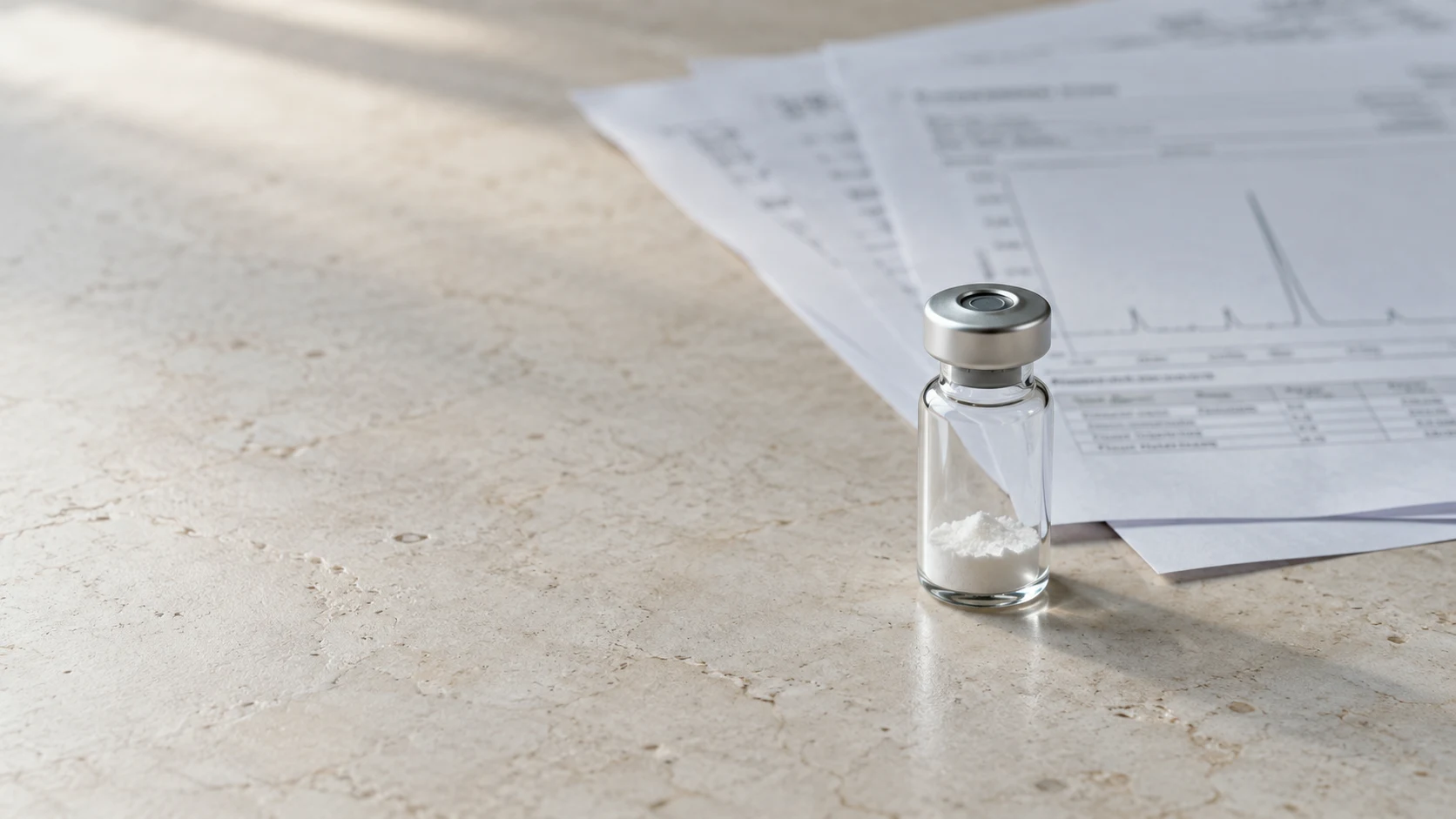
Not that the vial is 99% peptide. On a worked example below, a 98.4% pure sample comes out at roughly 82% peptide by weight.
Purity and content are two different measurements. The certificate of analysis you were shown probably reports only the first.
Purity compares the target peptide with other peptide-related species, by HPLC. If 99% of the peptide material is the molecule you ordered, that is 99% purity.
Net peptide content is how much of the powder is peptide at all, as against water, salt and counterions. It is a separate test. Most research-grade certificates leave it out.
A vial can be 99% pure and still carry a sixth of its weight as salt and water. The 10 mg on the label is then not 10 mg of peptide, and your dose calculation inherits the gap.
Whether 97%, 98% or 99% is the safe number has no answer, for reasons set out below.
What does the purity number measure?
It measures one thing, at one wavelength, against one comparison.
A sample is run through reverse-phase HPLC. The peptide and its relatives come off the column at different times, each producing a peak. A detector set at around 214 or 220 nanometres, where the peptide bond absorbs, measures each peak, and the software expresses the target peak as a percentage of the total peak area.
So 99% purity means: of everything in this sample that this detector saw at this wavelength, 99% of the signal was the target peptide.
The 1% is not random contamination. It is mostly close relatives of the molecule you wanted: sequences missing an amino acid, truncated chains, oxidised variants. The synthesis itself produces them, and they are chemically similar to the target, so they are hard to remove.
What does it leave out?
It leaves out weight, and that is where the practical problem lives.
HPLC purity compares peptide to peptide. It is blind to everything that is not peptide, because those things do not absorb at that wavelength or do not come off the column as peaks.
The difference is made up of counterions, water and residual solvents. Counterions are the largest of the three. Peptides come off the purification process as salts, usually trifluoroacetate, because TFA is used in the solvent, and that salt is physically part of the powder. In one worked example from a peptide analysis laboratory, a sample with 98.4% HPLC purity carried 11.2% TFA by weight.1 Water is next: lyophilised peptides hold residual and bound moisture, typically a few percent and sometimes more. Residual solvents are whatever is left from synthesis and purification.
How much TFA is normal is not a small question. An ion chromatography method note from Thermo Fisher measured a crude synthetic peptide at 19.6% TFA by dry weight, and after gel permeation chromatography as a purification step the same material still held 16.7%, leading the authors to conclude that TFA was not effectively removed by it. Two trifluoroacetate salt peptides in the same work carried 193 to 202 mg of TFA per gram of peptide, about 19 to 20% by weight.3 So the 11.2% in the laboratory example is not an outlier at the high end.
These combine through a formula:1
net peptide content = (100% − moisture − counterions − residual solvents) × (HPLC purity ÷ 100)
Run the numbers on that example. The laboratory reports 98.4% purity and 11.2% TFA. Moisture is not given, so take 5% as an illustration: (100 − 16.2) × 0.9840000000000001 comes out at about 82%. Change the moisture figure and the answer moves, and that is why the inputs matter more than the result. Without them the calculation cannot be done at all.
So a vial labelled 10 mg, with a certificate showing 98.4% purity, may hold around 8 mg of peptide. Our guide on dose calculation covers what that does to the arithmetic in a reconstitution calculator, and the short answer is that it shifts every number downward by an amount nobody has told you.
Is 97%, 98% or 99% safer?
The question assumes the percentages are comparable. They are not, for three reasons.
The difference is smaller than the measurement error between laboratories. Different HPLC methods, gradients, detection wavelengths and columns give different numbers for the same sample. Two certificates reading 97% and 99% may be describing identical material analysed differently. Without the method, the numbers are not comparable to each other.
What sits in the remainder matters more than how big the remainder is. Three percent of a deletion sequence one amino acid short is a different proposition from three percent of something else. A percentage tells you how much and never what.
Purity is also silent on everything that actually hurts people. The things that put someone in hospital are sterility failures, endotoxin, heavy metals, and vials containing a different compound entirely. None of those is measured by an HPLC purity test. Our guide on buying retatrutide online covers what testing found in grey-market vials.
So a 99% certificate and a 97% certificate are both consistent with a vial that is sterile and correct, and both are consistent with a vial that is neither.
What does purity not tell you at all?
People commonly read a purity figure as covering all five of these. It covers none of them.
- Sterility. A separate test on a different question, whether anything is alive in the vial. Purity is run on the chemical.
- Endotoxin. Bacterial cell wall fragments survive sterilisation and cause fever and worse. A different assay entirely.
- Identity. Purity says one species dominates the chromatogram. Mass spectrometry says which species that is. A certificate without MS has shown you a clean peak without saying what the peak is.
- How much is in the vial. Fill accuracy is its own measurement. A vial can be pure, correctly identified and underfilled.
- Pharmaceutical grade. The phrase describes a manufacturing system and not a test result: documented processes, validated methods, batch records, inspection.
That last one is where the gap is widest. A research-grade vial with a 99% purity certificate is not pharmaceutical grade, and no purity figure can make it one. The protocol for one GMP peptide vaccine trial gives a sense of the difference: each lot is tested for identity, sterility, general safety, purity, lack of peptide aggregation and endotoxin, with identity confirmed by verifying mass and amino acid sequence by mass spectrometry.2 Six attributes, one of which is the single number a research certificate usually reports.
So should you adjust your dose?
No, and the reasoning matters more than the answer.
You cannot know the figure for your own vial. Net peptide content varies by compound, by batch and by how the material was finished. Without that number for your specific batch, any correction you apply is a guess layered on an unknown, and that is worse than simply knowing your dose is approximate.
The error is also already inside the numbers people quote. Community dosing figures were produced by people dosing from label weight, with the same gap sitting in their vials. When a forum says a compound is typically used at a given amount, that amount was measured in label milligrams and not in peptide milligrams. Correcting your dose upward would move you away from the figures those reports describe.
What it does change is how precisely any of this can be discussed. A dose calculated to two decimal places from a label weight carries an error in the first decimal place. Small differences between protocols are therefore noise, and an effect reported from a 10% dose change is not worth much.
The one case where it matters concretely is comparing vials from different sellers. Two 10 mg vials with different counterion loads are not the same quantity of drug, and nothing on either label tells you that.
Why do sellers report purity and not content?
The explanation is an incentive rather than a conspiracy.
Purity by HPLC is one run on equipment a testing lab already has, and it produces a number in the high nineties. Net peptide content needs amino acid analysis or elemental analysis, costs more, takes longer, and produces a smaller number describing exactly the same material.
A seller choosing between publishing 99% and publishing 82% for the same vial, where both are accurate and only one is standard practice, is not facing a difficult decision.
So the test that would tell you what you are buying is the one least often reported, and asking a seller for it is an ordinary request.
Does the same thing happen with salt forms?
It does, and the numbers there get larger.
Peptides sold as different salts carry different amounts of non-peptide mass by design, and how much depends on the peptide's own weight. A heavy counterion on a light peptide takes a larger share than the same counterion on a heavy one.
Take BPC-157, at 1,419 daltons. As an acetate it is roughly 96% peptide by weight. As an arginate it runs 73 to 89%, depending on how many arginine molecules are bound per peptide. So a 500 mcg capsule of one may contain meaningfully less peptide than 500 mcg of the other, and our guide on oral BPC-157 salt forms works that case through.
Run the same arithmetic on a larger peptide and the gap narrows, because the counterion is a smaller fraction of a bigger molecule. The principle holds; the percentage is specific to the compound.
Counterions and salt forms are two views of one problem. The label reports the weight of the powder, and not all of the powder is drug.
What should you ask for instead?
There are four things to ask for, in the order that matters; our guide on vetting a vendor covers the wider checks. "Third party tested" on a product page covers none of them by itself, because it describes who ran a test and not which test or what it found.
- The method behind the purity number. Wavelength, gradient, column. Without them the percentage cannot be compared to any other percentage, including the one on a competitor's certificate of analysis.
- A mass spectrometry result, to establish what the compound is. Purity tells you that one species dominates the sample; only MS tells you which species.
- Net peptide content, or the counterion and moisture figures that let you work it out. This is the number that turns a label weight into an actual dose.
- Whether the certificate is for your batch. A certificate of analysis with no batch number, or one matching no marking on your vial, is a document about some other material. Our guide on reading a COA covers how to check.
Common questions
Does 99% purity mean the vial is 99% peptide?
No. Purity compares the target peptide to other peptide-related species by HPLC. It does not count water, salt or counterions, and those can be a sixth of the powder by weight or more. On the worked example on this page, a 98.4% pure sample comes out at roughly 82% peptide by mass.
What is the difference between peptide purity and peptide content?
Purity is the target peptide as a share of peptide material. Net peptide content is peptide as a share of everything in the vial, including moisture and counterions. They are different tests and most research certificates report only the first.
Is 97% purity safe? Is 99% better?
The question cannot be answered as asked. The difference between those figures is often smaller than the variation between testing methods, what is in the remainder matters more than its size, and the things that actually cause harm, sterility failures and endotoxin, are not measured by a purity test at all.
Does "third party tested" mean the peptide is good?
It means an outside lab ran a test, not which test or what it showed. Most often it refers to HPLC purity, the measurement this page is about. It says nothing about sterility, endotoxin, identity, fill accuracy or how much of the powder is peptide.
Is a 99% purity peptide pharmaceutical grade?
No. Pharmaceutical grade describes a manufacturing system, with documented processes, validated methods, batch records and inspection. It is not a test result, and no purity figure on a research-grade vial can produce it. A GMP peptide lot is released against identity, sterility, general safety, purity, aggregation and endotoxin, with identity confirmed by mass spectrometry.
Does purity mean the vial is sterile?
No. Sterility is tested separately and measures something else entirely: whether anything is alive in the vial. A chemically pure peptide can be contaminated.
What is TFA and why does it matter?
Trifluoroacetic acid is used in peptide purification and ends up as a counterion bound to the peptide, adding weight that is not peptide. One laboratory example reports 11.2% TFA by mass in a sample that was 98.4% pure. Published ion chromatography work has measured 19.6% in a crude synthetic peptide, and 16.7% in the same material after a purification step, so double figures are normal rather than exceptional.
Does purity tell you what the compound is?
No. Purity shows that one species dominates the chromatogram. Mass spectrometry identifies which species it is. A certificate with purity and no MS has shown you a clean peak without saying what the peak is.
So is my dose wrong?
Probably smaller than you think, if your vial carries a typical counterion load and you dosed from the label weight. How much smaller depends on figures most certificates do not report.
Should I increase my dose to compensate?
No. You cannot know the figure for your batch, so any correction is a guess on top of an unknown. The gap is also already inside the community dosing figures people quote, because those were measured in label milligrams too. What it should change is how precisely you treat small differences between protocols.
Why do sellers report purity instead of peptide content?
Purity is a single cheap test that produces a number in the high nineties. Net peptide content requires amino acid or elemental analysis, costs more, and produces a smaller number for the same material. Both figures are accurate, and only one of them is standard practice.
What should I ask a seller for?
The HPLC method behind the purity figure, a mass spectrometry identity result, net peptide content or the counterion and moisture figures, and confirmation that the certificate matches the batch marked on your vial.
Sources
- Net Peptide Content and Amino Acid Analysis testing services for peptide APIs. ResolveMass Laboratories. resolvemass.ca. Commercial analytical laboratory describing the distinction between chromatographic purity and net peptide content. States that chromatographic purity evaluates relative sequence integrity while net peptide content and amino acid analysis quantify the absolute mass percentage of target peptide in a bulk lyophilised drug substance. Gives the mass balance formula: net peptide content equals 100% minus moisture, counterions and residual solvents, multiplied by chromatographic purity divided by 100. Worked example carries an RP-HPLC purity at 220 nm of 98.40% alongside a TFA counterion content of 11.20% measured by ion chromatography. Counterion content is determined by ion chromatography or fluorine NMR.
- Protocol, Phase I/II Trial of a Long Peptide Vaccine (LPV7) Plus TLR Agonists. NCT02126579. clinicaltrials.gov, protocol document Prot_SAP_000.pdf. Section 5.1.4 states that each lot of peptide vaccine is evaluated as required by the FDA to confirm identity, sterility, general safety, purity and lack of peptide aggregation, and is tested for endotoxin. Section 5.1.1 states that peptide identity will be confirmed by verifying mass and amino acid sequences by mass spectrometry, and that the peptides were purified by HPLC. The numerical acceptance criteria sit in Appendix 5 and in the Chemistry and Manufacturing section of the IND, neither of which is public, so no purity threshold, fluorine limit or net peptide content specification is quoted here. The companion protocol for NCT02385669 defers the same details to its IND. Cited only for the list of attributes a GMP lot is released against.
- Determination of Trifluoroacetic Acid (TFA) in Peptides. Thermo Fisher Scientific, Application Note 115 (LPN0898-01). thermofisher.com. Ion chromatography method for residual TFA, fluoride and acetate in synthetic peptides intended for preclinical and clinical study. States that residual TFA, fluoride and to a much lesser extent acetate are toxic and undesirable in peptides, and that knowing the amount and type of counterion is important to the safety and effectiveness of the product. Reports a crude synthetic peptide at 19.6% TFA by dry weight, 16.7% in the same material after gel permeation chromatography, with the conclusion that TFA was not effectively removed by GPC, and two trifluoroacetate salt peptides at 193 to 202 mg TFA per gram of peptide. Gives no acceptable limit for residual TFA; the figures are measurements, not specifications.
Citing this page. Peptide Decoding. What Does 99% Peptide Purity Actually Mean? https://peptidedecoding.com/guides/what-does-peptide-purity-mean