
What it is
GHK-Cu is three amino acids, glycine, histidine and lysine, holding a copper atom. Your body makes it. It turned up in human blood in 1973, and the amount you carry drops as you get older.1
The copper is the point. Your body cannot build collagen or elastin without it, and this peptide is one of the ways copper gets delivered to where it is needed.
In cosmetics it goes by the name Copper Tripeptide-1, which is what you will find on an ingredient list.
The family also includes AHK-Cu, and the study that gets misattributed, a different copper peptide whose hair-follicle laboratory study is often credited to GHK-Cu.
Three products, one name
Everything confusing about GHK-Cu starts here, so it needs settling before anything else.
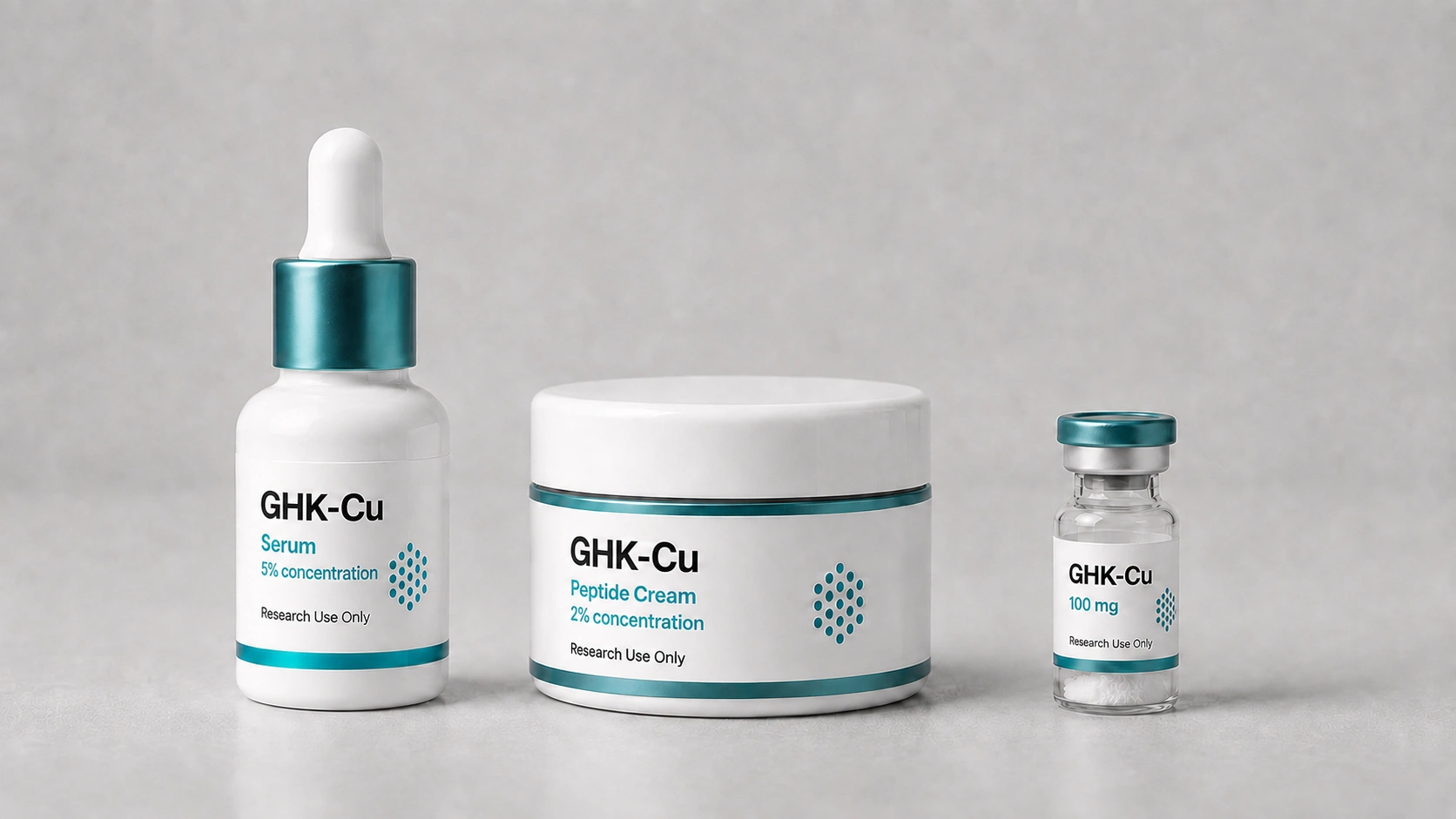
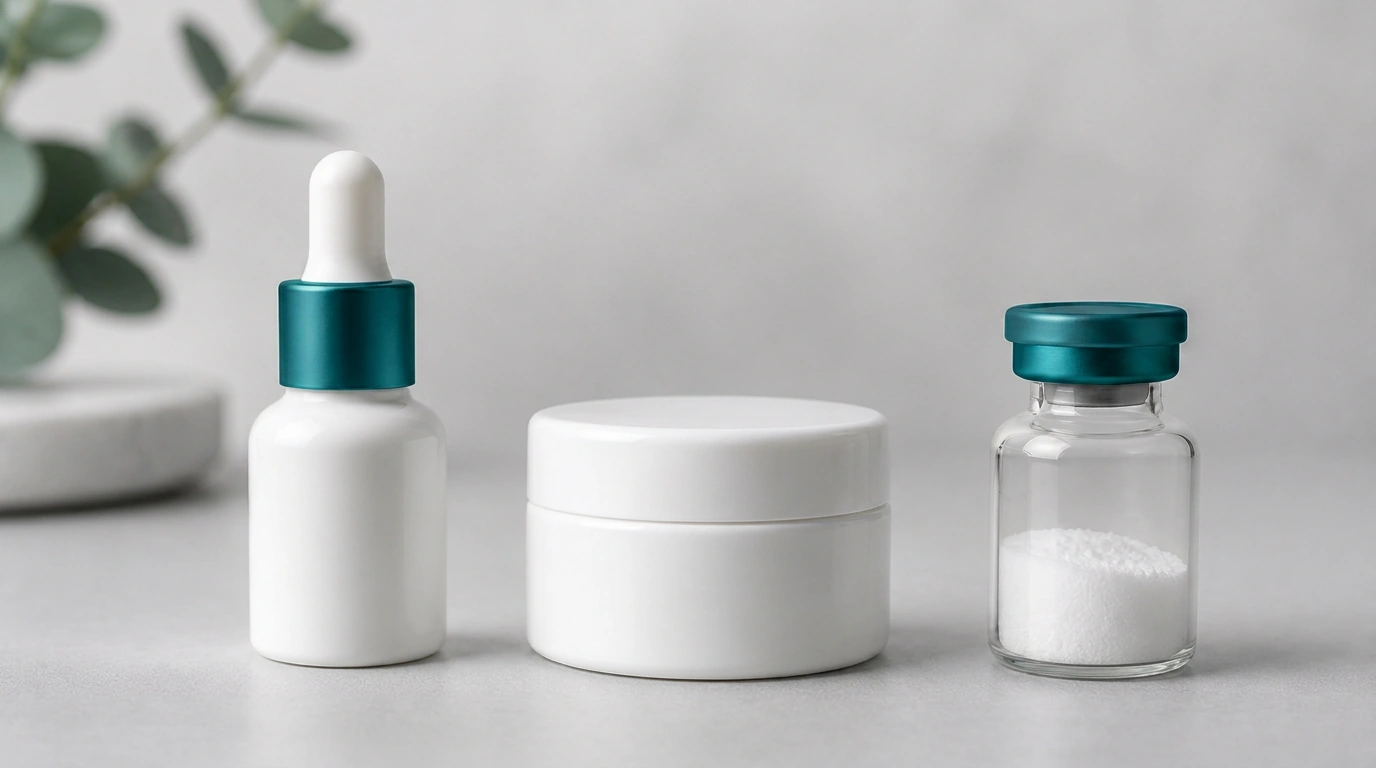
Over-the-counter skincare. Serums and creams containing Copper Tripeptide-1, sold anywhere, regulated as cosmetics. Typical concentrations run 1% to 2%.2
Compounded topical. A prescription cream made by a pharmacy, usually stronger than an off-the-shelf product.
Injectable. A vial of powder you reconstitute and inject, sold under research use only labeling.
The evidence behind these three is not evenly distributed, and neither is their legal status. The rest of this page is about that gap.
The FDA split them apart in April, and the paperwork is odd
This part is documented in the FDA's own nomination records and almost nobody has written it up.
GHK-Cu came off the FDA's Category 1 list entirely on 22 April 2026, because whoever had nominated it withdrew. Then on 5 May one of them wrote back to say they had meant to withdraw only the injectable nomination and wanted to keep the rest. The FDA agreed. GHK-Cu, except for injectable routes, went back into Category 1.3
Category 1 means still under evaluation, and pharmacies have generally been permitted to compound those substances while the FDA works through them.
So the cream is back in Category 1 on the strength of a clarification letter, with no committee review at all. The injectable form was separately removed from Category 2 and is scheduled to go before the Pharmacy Compounding Advisory Committee before the end of February 2027, alongside Dihexa, LL-37, PEG-MGF and Melanotan II.4
One molecule, two regulatory positions, decided by which end of a needle it came out of.
The topical evidence, and what it actually is
Almost every article about GHK-Cu cites the same three studies. They are real, and they are not what the citations make them sound like.
The two most-cited are conference posters from 2002. Leyden and colleagues presented "Skin Care Benefits of Copper Peptide Containing Facial Cream" at the American Academy of Dermatology's 60th annual meeting in New Orleans in February 2002. It was abstract P68. A companion eye cream poster was abstract P69.5
Neither was ever published as a full paper. Twenty-four years later they are still abstracts, cited in review after review as though they were trials you could read.
The findings, as reported. The facial cream study followed 71 women with mild to advanced photoaging over 12 weeks and reported improved skin laxity, clarity and firmness, reduced fine lines and wrinkle depth, and increased skin density and thickness measured by ultrasound. The eye cream study followed 41 women and beat both a placebo and a vitamin K cream.6
Who ran them matters. Several of the authors were employed by Neutrogena, and the testing was conducted by a contract research firm.5 Industry-sponsored cosmetic testing is normal and it is not a scandal. It does mean the most-cited evidence for this ingredient is a company's own unpublished data on its own product.
The third study is a book chapter. The 67-woman facial trial appears in a chapter of a cosmetics textbook published in 2005, not in a journal.7
And the head-to-head is a pilot study. The comparison where GHK-Cu increased collagen in 70% of women against 50% for vitamin C and 40% for retinoic acid comes from a 1998 pilot study of 20 volunteers, published in an obscure clinical outcomes journal.8 Twenty people. The 70/50/40 figures are quoted everywhere with no mention of the sample size.
What is in a proper journal
Two things belong in a different category from everything above.
A double-blind randomized controlled trial in the British Journal of Dermatology in 2009 found that a cosmetic anti-ageing product improved photoaged skin, with measurable changes in fine wrinkles, mottled pigmentation and roughness.9 A real trial in a real journal. It tested a finished product and not GHK-Cu on its own, so it cannot tell you which ingredient did the work.
And laboratory work has repeatedly shown GHK-Cu increasing collagen and elastin production in human skin cells, at concentrations as low as 0.01 nanomolar.10 Cells in a dish, not skin on a face.
One trial is registered, and we do not trust the registration
A registered topical GHK-Cu wound trial exists, NCT07437586, with a design that would be much stronger than the 2002 posters: paired punch-biopsy wounds on the same person, one treated and one on vehicle gel, each participant acting as their own control. We are not treating it as running. Its sponsor, Hudson Biotech, holds eight registry entries, three of which state in their own text that they are fictional, mock or example records, and two of which copy Eli Lilly protocol identifiers. Nothing in this particular record says so, and we could find no evidence the company exists.11
So how good is the evidence
Better than most compounds in this library, and thinner than the citation count suggests.
Something is probably happening. Multiple independent lines point the same way: cell work showing collagen production, a real journal RCT on a product containing it, decades of use with a good safety record, and a plausible mechanism through copper delivery.
What does not exist is a large, independent, published, placebo-controlled trial of GHK-Cu alone on human skin. The studies people cite for that are two conference abstracts, a book chapter and a 20-person pilot.
And one more thing about who assembled it
The review that gathers all of this into one place, and that nearly every article on the subject draws from, was co-written by Loren Pickart. He identified GHK-Cu in 1973 and founded a company selling copper peptide skincare.13
That does not make any of the findings wrong. It does mean the same structural problem this site flags on BPC-157 applies here. The published record traces heavily to people with something invested in the answer, and independent replication is thinner than the citation count suggests.
The negative result nobody cites
There is also a negative result nobody cites. A study in Archives of Facial Plastic Surgery applied a copper tripeptide complex to skin after CO2 laser resurfacing. Thirteen patients completed it and blinded evaluators found no statistically significant difference between groups.12 The authors noted the laser itself improves wrinkles, which may have masked any effect.
The injectable evidence
Short section, because there is very little to report.
Our guide on why the injectable burns separates the proposed causes from what has actually been measured.
No published human randomized trial has evaluated injectable GHK-Cu for skin, hair or wound outcomes.14 Not one.
What exists is animal work, cell studies, and user reports. Rodent studies have followed where it goes after an injection under the skin. It absorbs quickly and clears the blood in a few hours.15 Aged mice have shown effects on tissue. Those are legitimate starting points and they are not human evidence.
The FDA's stated worry about the injectable form, recorded while it sat in Category 2, was that it might set off an immune reaction, because the peptide can clump together and carry impurities. That, and how little human data exists.16
The other question the agency documents do not lead with: injecting a copper compound is a different proposition from rubbing one on your face. Anyone whose body cannot handle copper properly, as in Wilson's disease, is ruled out entirely.
The claim you will meet is that injection bypasses the skin barrier and reaches deeper tissue, so results come faster and stronger. A reasonable hypothesis about delivery, and one nobody has tested against topical application in a person.
The copper uglies
The most common real experience with this compound has no place in any of the studies.
Skincare communities use the phrase for a reaction some people get in the first weeks of using copper peptides: irritation, dryness, small breakouts, sometimes a period where the skin looks worse before it looks better.2
Two honest things about it.
It appears in none of the published work. The 2002 abstracts recorded no adverse or subjective irritation findings at all.6 So either the formulations in those studies did not cause it, or the studies were not asking, or the reaction comes from something else in a modern product. Nobody has looked.
And the community response is to start slowly, two or three times a week for the first fortnight, then build up.2 That advice has no trial behind it and it is what people who have been through it suggest.
A reaction that is severe, spreading, or still going after a few weeks has stopped being an adjustment period and belongs with a doctor.
Copper is a mineral with a ceiling
A point the skincare conversation mostly skips.
Copper is an essential mineral and also one you can have too much of, which matters here in three ways.
Anyone whose body cannot process copper properly is ruled out, most obviously with Wilson's disease, a condition where copper builds up in the liver and brain.
Stacking is a real question nobody asks. Someone using a copper peptide serum, taking a copper supplement, and injecting a copper peptide is getting it from three directions. The topical amount is small and the supplement and injection are not.
And copper and zinc compete. They use overlapping absorption pathways, so heavy supplementation of one can affect the other. That is standard nutrition, not anything peptide-specific, and it is the kind of interaction that gets missed when a compound is filed under skincare.
None of this makes a face serum risky. It does mean the injectable and oral versions raise a question the cream does not.
What it does not sit well with
Two formulation questions come up constantly and the guide would be incomplete without them.
Vitamin C. The standard advice is to keep them separate, usually by using one in the morning and one at night. Vitamin C is a strong antioxidant and copper is a metal ion, and the concern is that they interact in the bottle or on the skin in ways that reduce both. The evidence for it is chemistry reasoning, not trial data, and the separation costs nothing.
Direct acids. Glycolic, salicylic and similar exfoliating acids sit at a low pH, which is not where copper peptides are stable. Same advice: separate applications.
Notably, the one study that compared GHK-Cu against vitamin C put them head to head as alternatives instead of combining them.8 Nobody has tested them together.
Hair is thinner still
Copper peptide hair serums are a fast-growing product category and the human evidence has not kept up.
The most cited work is animal work. A 2024 paper used a special delivery system to get copper peptide into mouse skin and reported effects on hair.17 A mouse is not a scalp.
The plausible version is that GHK-Cu may support follicles that are shrinking but still alive, and cannot do anything for follicles that are gone. A reasonable reading of the mechanism, and not a trial result.
You may be getting it without meaning to
This one applies if you have ever bought a blend.
GHK-Cu is the largest component of two of the most commonly sold peptide blends. GLOW is GHK-Cu with BPC-157 and TB-500. KLOW is the same three plus KPV.
In the most common GLOW vial, 50 mg of that 70 mg total is GHK-Cu. KLOW is 50 mg of 80 mg. So somebody injecting either blend for tendon or gut reasons is receiving injectable GHK-Cu as the bulk of the vial, whether or not they were thinking about it.
The arithmetic is the useful part. A commonly described GLOW draw of 10 units from a 70 mg vial in 2 mL delivers 2.5 mg of GHK-Cu alongside 500 mcg each of BPC-157 and TB-500.18 That is one vial and one draw, so the GHK-Cu amount is set by the ratio the manufacturer chose, not by anything you decided.
And the thing to hold alongside that: there is no established human dose for injectable GHK-Cu, because there is no human trial. The amount arriving in a blend draw is whatever falls out of a ratio somebody picked.
Our calculator handles the component math for both blends, and the blend pages carry the ratios.
What to do with all this
Three practical conclusions, all of them following from the evidence above.
If you want the skin effect, the cream is the version with the evidence. It is also the version with no legal complication, no injection risk and no contamination question, because it is a regulated cosmetic ingredient sold openly.
A concentration of 1% to 2% covers the range used in the studies, which ran from 0.01% to 1% in trials and sit at 1% to 2% in most well-formulated products.2 Higher is not obviously better and the trials did not test it.
Twelve weeks is the timeframe the evidence uses. Every one of the studies behind it ran that long. Judging a serum at three weeks is judging it before the work supporting it had finished.
Common questions
Is GHK-Cu a peptide or a cosmetic ingredient?
Both, and the confusion is understandable. It is a copper peptide your body makes. Sold as skincare it is regulated as a cosmetic ingredient called Copper Tripeptide-1. Sold as a vial for injection it is a research chemical. Same molecule, three products.
Does topical GHK-Cu actually work?
Probably something, and the evidence is thinner than it looks. The two most-cited studies are conference posters from 2002, never published as full papers, with Neutrogena employees among the authors. A third is a book chapter and the famous 70/50/40 collagen comparison comes from a 20-person pilot. A real journal trial in 2009 found a cosmetic product improved photoaged skin, though it tested a finished product and not the ingredient on its own. A trial on laser-treated skin found nothing. A properly controlled wound trial is registered, but its sponsor is one we do not rely on.
Is injectable GHK-Cu better than the cream?
Nobody knows, because nobody has compared them in a person. No published human randomized trial has evaluated injectable GHK-Cu for any skin, hair or wound outcome. The argument for injection is about delivery, which is plausible and untested.
Is GHK-Cu legal?
The cosmetic version is an ordinary regulated cosmetic ingredient. The topical compounded version returned to the FDA's Category 1, meaning under evaluation, in May 2026. The injectable version goes before an advisory committee before the end of February 2027 and is not currently on the list pharmacies may compound from.
Does it work for hair?
The human evidence is thin. The most cited study is in mice with a specialized delivery system. The plausible reading is that it may support follicles that are shrinking but still alive, which is an argument about mechanism, not a result.
How long before I see anything?
The studies behind it ran 12 weeks, which is longer than most people give a serum before deciding it does nothing.
What are the copper uglies?
A term from skincare communities for an irritation or purging reaction some people get when starting copper peptides. It is not documented in the trials, and starting at a lower frequency is the usual community response.
Can I use it with vitamin C?
The usual advice is to separate them, one in the morning and one at night. Vitamin C is a strong antioxidant and copper is a metal ion, and the worry is that they work against each other. That reasoning is chemistry, not trial data, and separating them costs nothing. The same goes for exfoliating acids, which sit at a pH where copper peptides are not stable.
Am I getting GHK-Cu in a blend?
If you use GLOW or KLOW, yes, and as the largest component. In the common GLOW vial, 50 mg of the 70 mg total is GHK-Cu. In KLOW it is 50 mg of 80. Somebody injecting either for tendon or gut reasons is receiving injectable GHK-Cu as the bulk of the vial. There is no established human dose for it, so the amount is whatever the manufacturer's ratio produces.
Can I have too much copper?
It is possible in principle, and the face serum is not where it would come from. Copper is an essential mineral with an upper limit, anyone with a copper metabolism disorder such as Wilson's disease is ruled out, and copper competes with zinc for absorption. The question becomes real if someone is combining a serum, a copper supplement and an injectable.
Should I use it with retinol?
The one head-to-head study put GHK-Cu against retinoic acid on collagen production and GHK-Cu came out ahead, at 70% against 40%. One small study, and it compared them instead of combining them. Nobody has tested them together.
Sources
1: GHK-Cu copper peptide: skin, hair, benefits, dosage and results, 2026. Industry reference. First isolated from human blood plasma in 1973; known in cosmetics as Copper Tripeptide-1; not FDA-approved for any human therapeutic indication. 2: GHK-Cu peptides: dosage, benefits and how it works, June 2026. Industry reference. Clinical studies used concentrations from 0.01% to 1%; most well-formulated consumer products fall between 1% and 2%. Also the source for the copper uglies terminology. 3: FDA. Certain bulk drug substances for use in compounding that may present significant safety risks. Regulatory. Records the 22 April 2026 removal from Category 1, the 5 May nominator clarification, and the return of GHK-Cu except for injectable routes to Category 1. 4: FDA. Meeting of the Pharmacy Compounding Advisory Committee. Regulatory. Names GHK-Cu among five substances for a meeting before the end of February 2027. 5: Leyden J, Stephens T, Finkey MB, Appa Y, Barkovic S. Skin care benefits of copper peptide containing facial cream. Proceedings of the American Academy of Dermatology 60th Annual Meeting, New Orleans, 22-27 February 2002, abstract P68. And Leyden J, Stephens T, Finkey MB, Barkovic S. Skin care benefits of copper peptide containing eye creams. Same meeting, abstract P69. Conference abstracts. Never published as full papers. Author affiliations include Neutrogena Corporation, with testing conducted by Thomas J Stephens and Associates, a contract research firm. 6: Pickart L, Margolina A. Regenerative and protective actions of the GHK-Cu peptide in the light of the new gene data. International Journal of Molecular Sciences, 2018. Review. Reports the findings of the 2002 abstracts: 71 women over 12 weeks with increased skin density and thickness, reduced laxity and fine lines; and the 41-woman eye cream study outperforming placebo and vitamin K. 7: Finkley MB, Appa Y, Bhandarkar S. Copper peptide and skin. In Elsner P, Maibach H, eds. Cosmeceuticals and Active Cosmetics: Drugs vs. Cosmetics, 2nd edition. Marcel Dekker, New York, 2005, pp. 549-563. Book chapter reporting the 67-woman 12-week facial study. Not a journal publication. 8: Abdulghani AA, Sherr A, Shirin S, Solodkina G, Tapia E, Wolf B, Gottlieb AB. Effects of topical creams containing vitamin C, a copper-binding peptide cream and melatonin compared with tretinoin on the ultrastructure of normal skin: a pilot clinical, histologic and ultrastructural study. Disease Management and Clinical Outcomes, 1998;1:136-141. Pilot study, approximately 20 volunteers. Source of the frequently quoted 70%, 50% and 40% collagen figures. 9: Watson REB, Ogden S, Cotterell LF, Bowden JJ, Bastrilles JY, Long SP, Griffiths CEM. A cosmetic 'anti-ageing' product improves photoaged skin: a double-blind, randomized controlled trial. British Journal of Dermatology, 2009 Aug;161(2):419-426. PMID 19438432. Human RCT in a peer-reviewed journal. Tested a finished cosmetic product rather than GHK-Cu in isolation. 10: Badenhorst T, Svirskis D, Merrilees M, Bolke L, Wu Z. Effects of GHK-Cu on MMP and TIMP expression, collagen and elastin production, and facial wrinkle parameters. Journal of Aging Science, 2016;4(3):166. Laboratory study in human dermal fibroblasts. 11: Topical GHK-Cu gel for acute skin wound healing, NCT07437586, Hudson Biotech. Registry record, not relied on. The sponsor's portfolio includes three self-declared fictional or mock records. Paired 5 mm punch-biopsy wounds on the same participant, randomized to GHK-Cu gel or vehicle gel, primary endpoint time to complete re-epithelialization. Record last updated 27 February 2026. 12: Effects of topical copper tripeptide complex on CO2 laser-resurfaced skin, Archives of Facial Plastic Surgery. Human trial. Thirteen patients completed. Computer analysis and blinded evaluators found no statistically significant differences between groups. Authors note the laser treatment itself improves wrinkles, which may confound the result. 13: Same as reference 6, with authorship noted. The review assembling the topical evidence is co-authored by Loren Pickart, who identified GHK-Cu in 1973 and founded a company selling copper peptide skincare. A matter of public record, noted here as context for reading the evidence base. 14: GHK-Cu peptide dosing guide, 2026. Industry reference. States that no published human randomized trial has evaluated long-term injectable GHK-Cu for skin, hair or wound endpoints, and that injectable evidence is mostly preclinical and community-derived. 15: GHK-Cu clinical profile. Industry reference citing rodent pharmacokinetic work. Rapid absorption after subcutaneous injection, Tmax approximately 30 minutes, plasma half-life approximately 2 to 4 hours in rodent models. 16: Same as reference 3. FDA Category 2 rationale for injectable GHK-Cu cited immunogenicity arising from aggregation and peptide-related impurities, alongside limited human data. 18: Peptide Decoding compound data, GLOW and KLOW blend entries. Component ratios and the worked draw: 10 units from a 70 mg GLOW vial reconstituted in 2 mL delivers 2.5 mg GHK-Cu, 500 mcg BPC-157 and 500 mcg TB-500. 17: Liu et al., Bioactive Materials, 2024, as reported in reference 1. Preclinical. Ionic-liquid microemulsion delivery system in mice.