GHK-Cu_Dosage, benefits & legal status
Also known as copper peptide, copper tripeptide-1, GHK copper, GHK-Cu Copper Peptide, Copper Peptide GHK-Cu
A copper peptide used in skincare and also sold in vials for injection, where far less has been studied.
Common vial size is what vendors typically sell, not a recommendation. Enter your own vial in the calculator.
343 of 420 listings we track are vials, the form used for injection.
What is GHK-Cu?
Plain language first. The technical label stays, but it never stands alone.Overview
Put on the skin, it signals collagen and healing. That is why it is a popular anti-aging skincare ingredient.
GHK-Cu is a natural copper-binding tripeptide (glycyl-histidyl-lysine plus copper) the body uses in tissue repair, and levels fall with age.
What it's used for
In skincare it is used to smooth fine lines, fade dark spots, firm skin and help wounds heal. It is also sold in vials and injected for the same goals. The human studies are on skin products, not injections.
For hair color, see whether it does anything for hair color.
How does GHK-Cu work?
What it does in the body, and where.GHK-Cu is three amino acids bound to a copper atom. Your body makes it, and the copper is doing much of the work. The widely quoted figure for levels falling with age has no primary measurement behind it that we could find.
- 01It carries copper into skin cellsCopper is required by the enzymes that build collagen and elastin, and this peptide is how the body delivers it.
- 02Collagen production rises in cell cultureShown in fibroblast cultures since 1988. In people the picture is mixed: a 2016 split-face trial in 39 women found a 55.8 percent reduction in wrinkle volume against vehicle, but it tested GHK-Cu inside a proprietary nano-carrier and was funded by the company selling it. A 2006 trial on laser-resurfaced skin found no difference on any objective measure.
- 03Most of the evidence is on skin, not injectedThe cosmetic evidence is for topical use. Injecting it is not off-label use of an approved drug, because no approved GHK-Cu drug exists. It is an unapproved product, and far less has been studied.

What else is it used for?
Each group carries its own evidence level.Approved means regulators have cleared it for that purpose. Investigational means it is in trials. Early research means it is being studied and is not established.
Skin and wrinkles
Early research- Human trialOver 8 weeks in a 2016 split-face trial of 39 women, GHK-Cu delivered in a proprietary nano-carrier reduced wrinkle volume by 55.8% and wrinkle depth by 32.8% against vehicle. It did not test plain GHK-Cu.
- Human trialIn the same nano-carrier trial, it reduced wrinkle volume 31.6% more than Strivectin SD, a peptide comparator.
- Human trialIn 21 women measured by ultrasound, skin collagen density rose about 28% on average over three months, and near 51% in the top quarter.
Wound healing and gene activity
Research only- Animal studyWound-healing activity is documented across multiple animal studies.
- Lab studyA 2014 reanalysis of public Connectivity Map data reported GHK changing expression of about 31.2 percent of 13,424 genes in two cancer cell lines, PC3 and MCF7. A later review rounded that to "at least 4,000 human genes," which is the figure now repeated everywhere. The concentration is not stated, the copper status is not specified, and neither cell line is a skin cell.
- No dataThe strong safety record applies to topical use. Injectable forms do not have this evidence behind them.
The wrinkle figures quoted for this compound trace to a 2016 randomized split-face trial in 39 women, so they are real measurements. Two things usually go missing when they are quoted: the trial tested GHK-Cu inside a proprietary lipid nano-carrier rather than the plain peptide, and it was funded by the company whose product it was. The solid evidence is topical, not injectable.
The published record
Papers and trials about GHK-Cu
Searched: GHK-Cu, copper peptide, copper tripeptide-1, GHK copper.
55 papers tagged human · 34 not reviews or lab · 1 clinical trial publications
5 registered trials · none with posted results
Furthest stage reached: Phase 2, under way
Compare this against the whole library →
Category 1, except injectable routesRegulatorsCounted from Europe PMC indexing, not read by a person; a human tag can land on reviews, commentary or lab papers; clinical trial publications is the narrower count.
At a glance
Four things to know about GHK-Cu
Evidence
Cosmetic
Category
Skin and cosmetic
Common vial
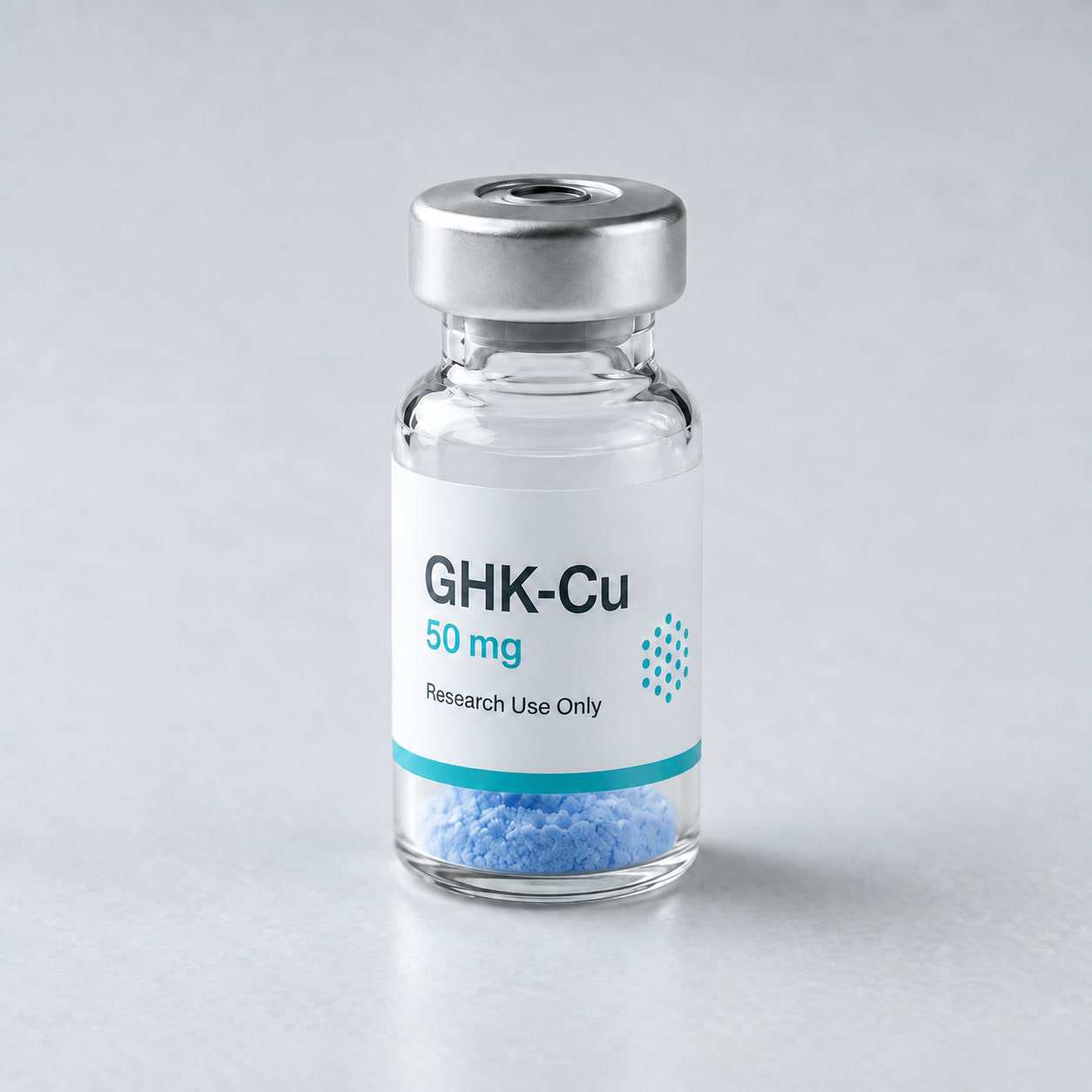
50 mg
Half-life
Not measured for either route
How much, and do you cycle it?
The range, and whether you take breaks.0.5 up to 2 mg per day injected (community practice). On the skin: per product, daily. Not cycled Community practice
Used daily as part of a routine. The effect depends on continued use and returns to baseline when you stop, so there is nothing to cycle off.
Not measured for either routeNo figure
Applied to the skin, a blood half-life is the wrong measure, since it is not meant to reach the bloodstream. Injected, no measurement has been published. Papers showing GHK levels falling with age measure what the body already contains rather than what happens after a dose.
You can compare this against the whole library to see where it sits.
How do I dose and price it?
Enter your vial and your dose. Pick a mix. We show the draw and the cost.The vial holds a fixed amount of drug. Adding more water does not make more drug, it just spreads it thinner, so you draw a bigger number on the syringe for the same dose.
Choose your mix
Measuring the water1 mL = one full 100-unit syringe.
GHK-Cu starts at $14.99 across 184 vendors, typically $0.43 – $1.20 per mg.
420 listings, last read Oct 24, 2026. Shipping and card fees are not included.
How do you store it?
Before mixing, and after.Vials: dry powder cold, then fridge once mixed. Skin products: room temperature.
GHK-Cu is sold both as vials of powder and in skin products. Keep unmixed vials in the freezer or fridge. Once you add water, keep the vial in the fridge, out of light, and use it within about a month. Keep creams and serums at room temperature, away from sun and heat, unless the label says otherwise.
What are the side effects and cautions?
Known cautions and warnings for this compound.Stinging as it goes in is commonly reported and is usually mild and brief. Injecting slowly into a fattier area helps. A reaction that spreads, hardens into a lump, or comes with facial or throat swelling is not the ordinary sting and needs a doctor.
Who should avoid it
- A known copper allergy or metal sensitivity, so patch test first
- Broken or actively irritated skin
- Layering with strong acids or retinoids on the same area
Stop and get help
- A spreading rash or significant swelling where applied
Common effects
- Mild, temporary skin irritation, redness, or itching
- Among the least irritating copper compounds in comparison studies
- The good safety record applies to topical use. Injectable and oral forms lack this database
Where this page says nothing is established, that means nobody has studied it, not that a compound is safe.
Is GHK-Cu approved?
And where the numbers on this page come from.Not as a medicine. GHK-Cu is sold without a prescription as a cosmetic ingredient, which is a different thing from being approved as a drug.
- Injected under the skinResearch onlyNomination withdrawn, not permittedThe injectable form was listed in 2023 as possibly presenting significant safety risks. That nomination was withdrawn in April 2026, which ended the review rather than clearing the compound. The listing never applied to the topical form. FDA's stated concern was a possible immunogenicity risk from aggregation and peptide-related impurities, alongside limited human safety data, and that entry still stands in the withdrawn table.
- On the skinCosmeticPermitted in pharmacy compoundingTopical GHK-Cu is permitted in pharmacy compounding and is widely sold as a cosmetic ingredient.
- RouteOn the skin, or injected under the skin
- Checked15 October 2026
- DoseFrom community reports. No regulator or trial established this dose.
- Vial sizeFrom what vendors typically list; not a recommendation.
- SourcesPeer-reviewed review, tripeptides in wound healing and skin regenerationNIH PMC, GHK-Cu studyGHK-Cu regeneration review, PubMed CentralPickart L, Vasquez-Soltero JM, Margolina A. GHK and DNA: resetting the human genome to health. BioMed Research International 2014;2014:151479Miller TR, Wagner JD, Baack BR, Eisbach KJ. Effects of topical copper tripeptide complex on CO2 laser-resurfaced skin. Arch Facial Plast Surg 2006;8(4):252-259Badenhorst T, Svirskis D, Merrilees M, Bolke L, Wu Z. Effects of GHK-Cu on MMP and TIMP expression, collagen and elastin production, and facial wrinkle parameters. J Aging Sci 2016;4(3):1000166
What has happened recently
Topical GHK-Cu is permitted in pharmacy compounding. The injectable form was listed in 2023 as possibly presenting significant safety risks, and that nomination was withdrawn in April 2026.
What regulators say
From official documentsCategory 1, except injectable routes
Added back to category 1 on May 5, 2026 for non-injectable routes only; FDA intends to consult PCAC before the end of February 2027
Checked 11 September 2026FDA: Bulk Drug Substances Nominated for Use in Compounding Under Section 503A (interim categories 1, 2, 3), updated May 14, 2026Injectable route: nominated but withdrawn; previously category 2
Non-injectable routes are in 503A category 1
Checked 11 September 2026FDA: Certain Bulk Drug Substances for Use in Compounding that May Present Significant Safety Risks (category 2 and withdrawn nominations), current as of April 22, 2026
You can compare this against the whole library, or read how to check a seller.
What else is like GHK-Cu?
Others in Skin and cosmetic, side by side.If you're weighing GHK-Cu, it's worth reading Melanotan II, Melanotan I (Afamelanotide), and SNAP-8 (Acetyl Octapeptide-3) in the same class.
A copper peptide used in skincare and also sold in vials for injection, where far less has been studied.
- Dose
- 0.5 up to 2 mg per day injected (community practice). On the skin: per product
- How often
- Daily
A shot for a fast, deep tan, plus libido and appetite effects.
- Dose
- 0.25 up to 1 mg per dose (start low, increase slowly)
- How often
- Daily loading, then maintenance
A tanning peptide. The FDA-approved version is an implant for a rare sun-pain condition.
- Dose
- 0.5 up to 1 mg per day (loading phase)
- How often
- Daily then weekly
A stronger topical wrinkle-smoothing peptide for forehead and eye lines.
- Dose
- Serum, per product
- How often
- Daily
Also sold in a blend: GLOW blend, KLOW blend
Compared with
The same sequence, with or without copper: topical trial evidence, formulation caveats and the research-vial market.
Read comparison →Two topical skin peptides with very different evidence: one carries copper, one carries a fat tail, and Matrixyl 3000, a widely used formulation, is built on the same tripeptide as GHK-Cu.
Read comparison →Guides for this compound
- How to Reconstitute a Peptide
Mix peptide powder with bacteriostatic water, step by step.
- How to Read an Insulin Syringe
Read the units, convert to millilitres, and draw the exact dose.
- mcg vs mg: The Peptide Dosing Mistake to Avoid
Your vial says mg and your protocol says mcg. Here is the conversion and how to check it.
- Do Copper Peptides Work for Menopausal Skin and Hair? What Has Been Measured
No copper peptide trial has enrolled postmenopausal women. The newest hair study ran in 18 people aged 18 to 40, on eyebrows, and published no numbers.
- Why Does My Peptide Injection Itch or Welt
Injection-site irritation, a histamine reaction, or a true allergy, and how to tell them apart.
Sources
- Peer-reviewed review, tripeptides in wound healing and skin regeneration(2025)Peer-reviewed review of tripeptides in wound healing.
- NIH PMC, GHK-Cu study(2025)Study of GHK-Cu in tissue repair.
- GHK-Cu regeneration review, PubMed Central
- Pickart L, Vasquez-Soltero JM, Margolina A. GHK and DNA: resetting the human genome to health. BioMed Research International 2014;2014:151479(2014)Reanalysis of Connectivity Map data reporting GHK changing expression of about 31.2 percent of 13,424 genes in PC3 and MCF7 cancer cell lines.
- Miller TR, Wagner JD, Baack BR, Eisbach KJ. Effects of topical copper tripeptide complex on CO2 laser-resurfaced skin. Arch Facial Plast Surg 2006;8(4):252-259(2006)Randomized trial, 13 patients completed. No statistically significant difference between groups on erythema, wrinkles or overall appearance; only the patient questionnaire differed (p = 0.04).
- Badenhorst T, Svirskis D, Merrilees M, Bolke L, Wu Z. Effects of GHK-Cu on MMP and TIMP expression, collagen and elastin production, and facial wrinkle parameters. J Aging Sci 2016;4(3):1000166(2016)Randomized, double-blind, split-face trial, 40 women enrolled and 39 analyzed, 8 weeks, GHK-Cu in a nano-carrier. Wrinkle volume −55.8% (p < 0.0001) and depth −32.8% (p = 0.0123) against vehicle; volume −31.6% against Strivectin SD (p = 0.0044).
Beyond these, 163 records are indexed. Browse the records