
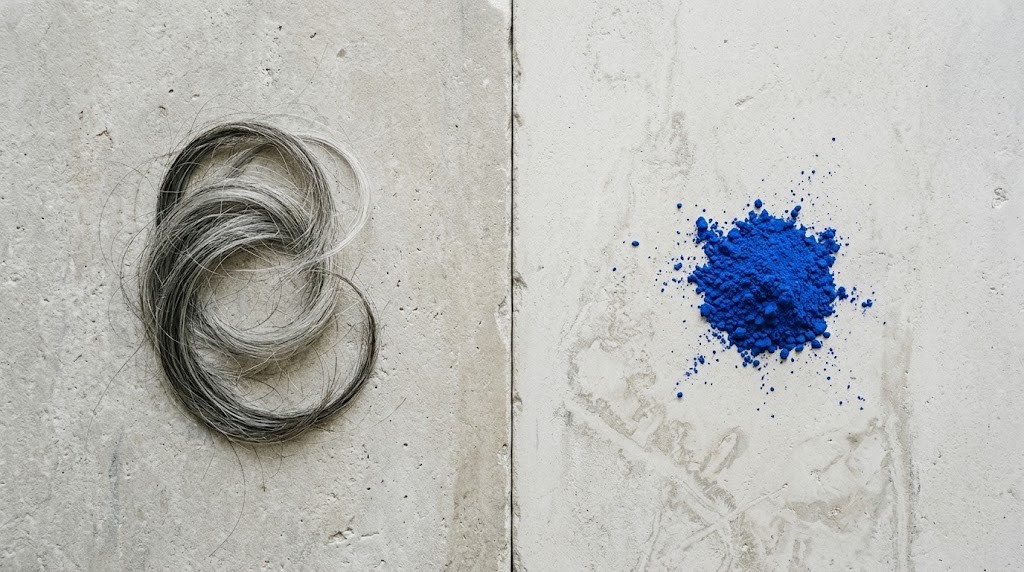
Nobody has tested it. No study in any species, by any route, has measured hair color or hair pigment after GHK-Cu.
Claims for it rest on one fact: the enzyme that builds pigment needs copper. That fact is real. What follows from it has been tested once, and the test came out the wrong way. When researchers put GHK-Cu and that enzyme together, the effect was "negligible," and they were studying it as a skin lightening ingredient.1
Gray hair does come back on its own. Individual hairs regain color spontaneously, and around twenty different drugs have been recorded doing it.23 Not one of them is a copper peptide.
Two literatures bear on this question and neither mentions the other. The most thorough review of GHK-Cu ever published contains no instance of the words pigment, melanin or gray hair. A twenty-page review of reversing gray hair contains no instance of the word copper.45
Has anyone tested whether GHK-Cu reverses gray hair?
No. Not in a person, not in an animal, not in a dish.
Seven differently shaped searches of a major citation index returned no study measuring hair repigmentation or hair melanin content after GHK-Cu by any route. The narrowest of them paired GHK with every pigment term at once, melanin, pigment, tyrosinase and melanocyte, and returned ten records in total. None is a hair study.
Every GHK-Cu hair study that does exist measured something else: hair count, hair diameter, follicle elongation.678 The distinction between growing more hair and changing the color of hair is the whole subject of this page, and the published record sits entirely on one side of it.
Two reviews make the same point from opposite directions. The most comprehensive GHK-Cu review published contains no instance of pigment, melanin, melanocyte or repigmentation anywhere in its text.4 A twenty-page review devoted to reversing gray hair contains no instance of the word copper.5 Both were word-checked for this page.
Two limits on that negative, stated plainly. One citation index was unavailable during this research, so several of the findings below rest on a single index rather than two. In two of the seven searches the full result set was large enough that only the top portion was reviewed. The core negative, the ten-record intersection of GHK and every pigment term, was read in full.
Where does the copper and gray hair idea come from?
From a real enzyme fact, stretched a long way.
Melanin is built by tyrosinase, and tyrosinase is a copper enzyme. The reference database entry for human tyrosinase records that it "Binds 2 copper ions per subunit," with six copper-binding positions on the protein.9 Nothing about that is in dispute.
From there the argument runs: gray hair means pigment production has stopped, pigment production needs copper, GHK-Cu is a copper peptide, therefore GHK-Cu should restart pigment production. Each step sounds reasonable. The chain has at least four joints, and two of them fail.
One detail about even the starting fact belongs here. The copper-binding annotation on the human protein carries an evidence code meaning it was inferred by similarity to the enzyme in another organism, rather than demonstrated directly on the human protein.9 That does not make it wrong, and tyrosinase being copper-dependent is not a fringe position. It does mean the foundation is slightly less solid than the confidence of the marketing suggests.
What happened when someone tested GHK-Cu on tyrosinase?
The effect came out close to zero. What makes that more interesting is the direction the researchers were hoping for.
A 2023 study in Pharmaceutics ran GHK-Cu against tyrosinase in a cell-free assay. The result: "the GHK-Cu did not significantly affect the tyrosinase activity," and "the degree of tyrosinase inhibition (10.23 ± 3.03%) by the peptide was negligible." The authors conclude that "GHK-Cu is not an effective tyrosinase inhibitor."1
Read the direction of that carefully, because it is the opposite of what people expect. The researchers were testing whether GHK-Cu could suppress tyrosinase, because suppressing tyrosinase means less melanin, which is what a skin-lightening product is for. Their own framing is that "the GHK-Cu peptide can be used as a supporting substance in whitening products."1
| What was measured | Result | |
|---|---|---|
| Tyrosinase, the pigment enzyme | inhibition at 0.5 mg/mL | 10.23 ± 3.03%, called negligible |
| Elastase, for comparison | inhibition at the same concentration | 48.90 ± 2.50% |
Both figures from the same paper, read at source.1 The elastase row is there to show the assay was capable of detecting an effect.
So the only direct test of the popular mechanism is a negative, and it was run by people interested in lightening skin rather than darkening hair. That is a stronger finding than an absence of evidence. An absence means nobody looked. This means somebody looked and the needle did not move.
Does gray hair contain less copper than pigmented hair?
Yes. That finding cannot tell you which way the arrow points.
A 2000 study measured trace elements in black and gray hairs taken from the same head. "Magnesium, copper, zinc, manganese and iron in gray hairs were lower than those in black hairs," with significant differences for manganese, copper, magnesium, calcium and sodium, with no significant difference for iron, zinc and potassium.10
Now the problem. Melanin itself binds metals. A gray hair has less melanin by definition, so it has fewer binding sites, so it measures lower for several metals at once. The study found exactly that pattern: not copper alone, but copper along with magnesium, manganese, calcium and sodium together.
Cross-sectional measurement cannot tell the two apart. Low copper may have cost the hair its pigment, or the hair may have lost pigment and so measure lower for everything melanin binds. The study design does not permit the causal reading, and the abstract states no sample size beyond the hairs coming from the same person.10
Does copper deficiency cause gray hair?
In severely deficient infants, documented. In a copper-replete adult, not the same question.
A 1973 case report described neonatal copper deficiency in two babies, one premature and fed copper-deficient milk, one after three months of intravenous feeding. The syndrome included "depigmentation of the skin and hair," and "treatment with oral copper 1 to 3 mg/day dramatically cured both patients."11
That is a genuine and clean finding, and it is doing a lot of unearned work in copper peptide marketing. It describes whole-body copper deficiency severe enough to be a medical emergency in an infant, corrected by swallowing copper. Nothing in it concerns a nourished adult with ordinary age-related graying, and nothing in it concerns a peptide applied to skin.
A 2025 review of gray hair puts the nutritional case at its highest: "reversible hypopigmented graying has been associated with nutritional defects, especially copper and iron," and supplementing trace elements "may help reverse" premature graying. The same review calls "the results regarding zinc and iron" inconclusive.12 The primary study behind its copper claim could not be read for this page, so no figure from it appears here.
Does GHK-Cu even reach a hair follicle?
The most thorough review of this compound says plainly that you cannot claim it does.4
A 2026 review in Pharmaceutics, the most comprehensive treatment of GHK-Cu published, is blunt about delivery. Studies "cannot establish that the intact complex crossed the barrier," and "claims of dermal delivery should not be made on that basis." It notes that "hydrophilicity and ionization constrain passive partitioning across intact stratum corneum," and that measured permeability coefficients across studies "differ by four orders of magnitude."4
Only one penetration study produced numbers, and it measured copper, not the peptide. Applying 0.68% aqueous copper tripeptide to isolated skin, "136.2 ± 17.5 μg/cm2 copper permeated 1 cm2 of that tissue over 48 h."13 Copper got through. Whether the intact GHK-Cu complex got through is a different question, and whether anything reached a follicle melanocyte is a third question nobody has asked.
That gap matters more here than for a skin claim. A pigment cell sits in the hair bulb, deep in the follicle, well below the surface layers these studies measured. A molecule that may or may not cross the outer skin at all still has a long way to go.
What has GHK-Cu actually been tested on, for hair?
Count, diameter and length. Never color.
| Study | What it was | What it measured |
|---|---|---|
| 2016, 45 men, 6 months, topical | 5-ALA combined with GHK, not GHK-Cu | hair count, length, thickness, satisfaction |
| 2026, 18 people, 12 weeks, topical | 2% GHK-Cu serum on eyebrows | hair count and diameter |
| 2026, 1 patient, 14 days, topical | GHK-Cu plus red-light therapy | photographs only |
| 2007, human follicles in culture | AHK-Cu, a different molecule | follicle elongation, apoptosis markers |
Outcome lists taken from each report. Sourcing tier varies by row and the footnotes say which.
Not one of those outcome columns contains a pigment measure. The 2016 trial reported hair count rising by 52.6 and 71.5 in its two active groups at six months, both at p below 0.05, but it tested a combination product containing 5-aminolevulinic acid, so GHK's own contribution cannot be separated out, and the peptide named is GHK, not GHK-Cu.6
The eyebrow trial is the only randomized GHK-Cu hair study, and this page could not verify it at source. It is described by the 2026 review as small, single-center and chemically undercharacterized, reporting improved hair count and diameter but not defining the compound's speciation or local exposure.4 The citation carries no DOI and the study could not be located in the citation index under any relevant term. Everything above about it is at one remove, and it should carry less weight than its being a randomized trial would normally earn.
That case report deserves its own sentence. One 46-year-old man, fourteen days, GHK-Cu applied after daily red-light therapy, with before-and-after photographs taken by the patient's wife and no hair counts, no trichoscopy and no standardized photography.7 Two interventions, one patient, two weeks, family photographs. Most before-and-after claims rest on evidence of exactly that shape.
Is the famous copper peptide hair study even GHK-Cu?
It tested a different molecule, which is the whole trouble with the way that study gets cited.
Everyone cites Pyo and colleagues, 2007, which grew human hair follicles in organ culture and exposed them to a copper tripeptide. The follicles elongated.8
That compound was AHK-Cu, alanyl-histidyl-lysine copper. GHK-Cu is glycyl-histidyl-lysine copper. They differ at the first amino acid. Anyone citing that study as GHK-Cu evidence is citing the wrong peptide, and this site has documented the misattribution running in both directions: AHK-Cu collects credit for GHK-Cu's much larger literature, and GHK-Cu collects credit for the one hair study that belongs to AHK-Cu.
Pigment, melanin, melanocyte and color do not appear in that paper's record either.8 Even the study that is not about GHK-Cu is also not about hair color.
Do the copper and gray hair literatures mention each other?
Checking each review for the other's vocabulary returns nothing in either direction.
| Review | Scope | Word check |
|---|---|---|
| Pharmaceutics, 2026 | the most comprehensive GHK-Cu review published | no instance of pigment, pigmentation, melanin, melanocyte, gray hair or repigmentation; tyrosinase appears once |
| International Journal of Biological Sciences, 2023 | a twenty-page review devoted to reversing gray hair | no instance of the word copper anywhere |
| Clinical, Cosmetic and Investigational Dermatology, 2025 | gray hair, prevention and treatment | no instance of GHK, GHK-Cu or copper peptide; every copper mention is nutritional |
| Journal of International Medical Research, 2026 | follicular depigmentation | no instance of GHK, GHK-Cu or copper peptide |
All four read at source and word-checked for this page.451214
Consider a review dedicated to reversing gray hair, surveying every documented cause of repigmentation, written by researchers whose job was to find candidates to develop, never once writes the word copper. The specialists looking hardest for something that repigments hair did not consider copper peptides worth a mention.
Does gray hair reverse on its own?
Routinely, for individual hairs. Any before-and-after photo has to be measured against that.
A 2021 study in eLife profiled pigment along single hair shafts. It found "white/grey hairs that naturally regain pigmentation across sex, ethnicities, ages," with greying and reversal occurring "in parallel with psychological stressors."2 The full text could not be read for this page, so no participant count appears here.
A 2023 review puts it plainly. "Restoring the color of a single gray hair to its original pigmentation is a general phenomenon regardless of age," and "individual gray hair darkening is a common phenomenon." The same review notes that "widespread repigmentation of gray hair is uncommon."5
So the baseline is not zero. Single hairs regain color without anybody doing anything, which means a photograph showing some darker hairs after three months of a serum is consistent with the serum having done nothing at all.
What else makes gray hair repigment?
Around twenty different drugs have been recorded doing it incidentally. None of them is a copper peptide.
The 2023 review catalogues documented causes of human hair repigmentation. Immune and inflammatory drugs including anti-PD-1 agents, dupilumab, adalimumab, secukinumab, ustekinumab and cyclosporine A. Tyrosine kinase inhibitors including imatinib, where "9 cases of hair repigmentation were reported," plus nilotinib, sorafenib and erlotinib. Thyroxine, latanoprost, tamoxifen, lenalidomide, L-DOPA, etretinate and acitretin. In one series, "hair repigmentation occurred in 24 of the 62 Alzheimer's patients" on cholinesterase inhibitors.5
Non-drug causes too: repigmentation after micro-injury, including an "84-year-old woman after Mohs micrographic surgery," around a scalp melanoma, and as a paraneoplastic effect of lung cancer.5
Separately, a systematic review of medication-induced repigmentation identified 27 studies, six where repigmentation was the primary objective and 21 where it was incidental, grouping the responsible drugs as anti-inflammatory agents, melanogenesis stimulators, vitamins, one tissue-accumulating drug and one of undetermined mechanism. Its conclusion is that these compounds are not currently indicated for gray hair.3 No copper peptide appears among the drug groups.
The point of that list is not that any of it is a better option. It is that hair repigmentation has roughly twenty documented explanations, plus a spontaneous one, before anyone reaches for a copper peptide with no pigment data at all.
What GHK-Cu are people actually buying?
Vials, overwhelmingly, for a claim that rests on topical use.
Of 246 GHK-Cu listings in this site's vendor capture, 222 are vials. Eleven are capsules, four topical, four sprays, two nasal sprays, and one each of strip, solution and tablet.15
Exactly one listing in the entire set states a topical concentration: a 3% serum at $69.99 for 30 mL. Two other listings carry a percentage, and both are purity figures rather than strengths. Zero listings are shampoos, scalp treatments or anything naming hair in the product.15
Compare the published concentrations. The only randomized hair trial used a nominal 2% serum. The skin penetration study used 0.68%. The tyrosinase assay used 0.5 mg/mL.1413 The one product on the market that tells you its strength is above all three.
A market selling 222 vials of an injectable for a compound whose entire hair literature is topical is answering a question nobody has asked. The FDA lists GHK-Cu for injectable routes among substances that "may pose risk for immunogenicity due to the potential for aggregation" and peptide-related impurities, noting "limited data in humans to inform safety-related considerations."16
What would settle the gray hair question?
Of the three things that would settle this, the cheapest is also the most obvious.
| What is missing | Why it would settle something |
|---|---|
| Any study measuring hair color as an outcome | no study in any species has done this by any route |
| Evidence the intact complex reaches a follicle melanocyte | the field's own review says dermal delivery cannot be claimed |
| A tyrosinase result pointing the other way | the one direct test found the effect negligible |
Cheapest of the three is the first. Hair pigmentation can be measured along individual shafts, as the 2021 work demonstrates, so the method exists and is not exotic. Any trial already running GHK-Cu on scalps could add a color measure for very little extra cost.
Sources that could not be read for this page
- The Reddit thread supplied with this brief. Reddit is blocked to the tools used here and was not opened through any cache or mirror. Nothing from it is asserted anywhere above.
- One major citation index, which refused requests throughout. Findings marked abstract-level rest on a single index alone, which is a real limit on the central negative.
- The 2021 eLife full text, behind a JavaScript challenge. Only the abstract was read, so no participant or hair counts appear here.
- The 2007 follicle study at source, where both the publisher and the DOI resolver failed. It was read through a bibliographic reproduction.
- The 2016 trial's full text, robots-disallowed at the publisher. Abstract only.
- The 2026 eyebrow trial, which carries no DOI and could not be located in any index. It is reported only as the 2026 review describes it.
- The primary study behind the premature-graying copper association. No figure from it is printed here, in either direction.
- Two preprint deposits whose titles connect copper peptides to pigment restoration. Both are self-deposited with no peer review, and neither is cited above.
Common questions
Does GHK-Cu reverse gray hair?
No study has tested it. No research in any species, by any route, has measured hair color or hair pigment after GHK-Cu. Claims that it does are not based on a study that measured the outcome.
Does GHK-Cu increase melanin?
One direct test found the opposite of an effect. GHK-Cu changed tyrosinase activity by about 10%, which the authors called negligible, and they were studying it as an ingredient for skin-lightening products.
Why do people think copper restores hair color?
Because tyrosinase, the enzyme that builds melanin, does require copper. The fact is real. Getting from a copper-dependent enzyme to a copper peptide applied to skin restoring pigment in a hair has four steps, and at least two of them have no supporting evidence.
Does gray hair have less copper in it?
Yes, but so does it have less magnesium, manganese, calcium and sodium. Melanin binds metals, so a hair with less melanin measures lower across the board. The measurement cannot tell you whether low copper caused the graying.
Can gray hair go back to its original color on its own?
Yes, for individual hairs, and it is documented, not anecdotal. A 2021 study tracked pigmentation along single hair shafts and found hairs that naturally regained color across ages, sexes and ethnicities.
What actually makes gray hair repigment?
Roughly twenty drugs have been recorded doing it incidentally, including imatinib, cyclosporine, thyroxine, latanoprost and several immune therapies, plus non-drug causes like micro-injury and paraneoplastic effects. A systematic review of these concluded none is currently indicated for gray hair.
What about GHK-Cu before-and-after photos?
They have more explanations than one. Individual hairs repigment spontaneously, lighting and camera settings change apparent color, wet hair reads darker than dry, and a new growth phase can look different at the root. None of that means a particular photo is dishonest, only that a photo cannot distinguish a product working from any of the above.
Is the famous copper peptide hair study about GHK-Cu?
No. The 2007 study on human hair follicles used AHK-Cu, which differs at the first amino acid. It is routinely cited as GHK-Cu evidence. It also measured follicle elongation, not anything to do with color.
Has GHK-Cu been tested on hair at all?
For growth, yes, a little. A 2016 trial in 45 men tested a combination of GHK with 5-aminolevulinic acid and measured count, length and thickness. A 2026 trial in 18 people tested a 2% serum on eyebrows and measured count and diameter. Neither measured color.
Is there a GHK-Cu shampoo?
Not in the 246 listings this site tracks, where 222 of 246 are injectable vials and zero are shampoos or scalp products. No published study has used a shampoo or scalp formulation either.
What strength is a GHK-Cu serum supposed to be?
Nobody has established one for hair. Of 246 tracked listings, exactly one states a topical concentration, at 3%. For comparison, the only randomized hair trial used 2% and the skin penetration study used 0.68%.
Is injecting GHK-Cu for hair a reasonable idea?
This page does not give that advice. What it can report is that the entire hair literature is topical, that the FDA lists GHK-Cu for injectable routes among substances that may pose immunogenicity risk from aggregation and peptide-related impurities, and that no study has measured what an injection delivers to a hair follicle.
Could GHK-Cu make gray hair worse, or lighten dark hair?
Nobody has tested that either. The measurement that undercuts the darkening claim undercuts this one too. The one assay that put GHK-Cu and tyrosinase together found a 10.23% effect the authors called negligible. A negligible effect on the pigment enzyme is a negligible effect in both directions. The absence of any study measuring hair color after GHK-Cu means there is no evidence it lightens hair, just as there is none that it darkens it.
Does anything actually work for gray hair?
Not reliably. A 2025 review concludes that "no current treatment provides a permanent solution for gray hair," and that "no conclusive evidence exists that any specific food or supplement can reverse graying once it has occurred." It notes that high-dose p-aminobenzoic acid has been reported to darken gray hair temporarily in some cases, while adding that "results are inconsistent, and it is not widely recommended for this purpose." A 2026 review of follicular depigmentation says plainly that "no therapy currently exists" for leukotrichia. The systematic review of drugs that repigment hair incidentally reaches the same place: those compounds are not currently indicated for gray hair.
Could copper peptides help hair in some other way?
Possibly, and that is a separate question from this one. Growth and thickness have at least been measured, if thinly and in small studies. Color has not been measured at all, and the two should not be treated as the same claim.
Sources
- Dymek M, Olechowska K, Hąc-Wydro K, Sikora E. Liposomes as carriers of GHK-Cu tripeptide for cosmetic application. Pharmaceutics 2023;15(10):2485. DOI 10.3390/pharmaceutics15102485. Read at source. Cell-free assay at 0.5 mg/mL aqueous GHK-Cu with 2 mM L-DOPA. "The GHK-Cu did not significantly affect the tyrosinase activity"; "the degree of tyrosinase inhibition (10.23 ± 3.03%) by the peptide was negligible"; "It can therefore be concluded that GHK-Cu is not an effective tyrosinase inhibitor." The elastase comparison at the same concentration gave "48.90 ± 2.50% elastase inhibition." The paper's own framing is that "the GHK-Cu peptide can be used as a supporting substance in whitening products," so the study was looking for pigment suppression, not pigment restoration. The rendered page truncated partway through the relevant section. ↩1 ↩2 ↩3 ↩4 ↩5
- Rosenberg AM, Rausser S, Ren J, Mosharov EV, Sturm G, Ogden RT, Patel PR, Soni RK, Lacefield C, Tobin DJ, Paus R, Picard M. Quantitative mapping of human hair greying and reversal in relation to life stress. eLife 2021;10:e67437. DOI 10.7554/eLife.67437. Abstract only, read through a bibliographic record; the publisher serves a JavaScript challenge page. "White/grey hairs that naturally regain pigmentation across sex, ethnicities, ages" and "hair greying and reversal can occur in parallel with psychological stressors." The abstract states no sample size, so the participant and hair counts frequently quoted for this study are not verified here and are not printed. ↩1 ↩2
- Yale K, Juhasz M, Atanaskova Mesinkovska N. Medication-induced repigmentation of gray hair: a systematic review. Skin Appendage Disorders 2020;6(1):1-10. DOI 10.1159/000504414. Abstract read at source; full text paywalled. 27 studies identified, 6 with repigmentation as the primary objective and 21 where it was incidental. Drug groups: anti-inflammatory agents, melanogenesis stimulators, vitamins, a tissue-accumulating drug and one of undetermined mechanism. No copper peptide appears among them. ↩1 ↩2
- Mateescu DM, Gavrilescu DM, Mincioaga RI, Pah AM, Toma AO, Serban DV, Avram AC, Craciun ML, Enache B, Muresan CO. GHK-Cu as a bioactive metallopeptide and drug-delivery cargo. Pharmaceutics 2026;18(9):1077. DOI 10.3390/pharmaceutics18091077. Read at source across two passes; the reference list and tables did not render and were recovered separately. On delivery: studies "cannot establish that the intact complex crossed the barrier," "claims of dermal delivery should not be made on that basis," "hydrophilicity and ionization constrain passive partitioning across intact stratum corneum," and measured permeability coefficients "differ by four orders of magnitude." Word check performed for this page: pigment, pigmentation, melanin, melanocyte, gray hair and repigmentation do not appear in the visible text; tyrosinase appears once, pointing at the 2023 assay above. The review's description of the eyebrow trial is the source for that study's details here. ↩1 ↩2 ↩3 ↩4 ↩5 ↩6 ↩7
- Feng Z, Qin Y, Jiang G. Reversing gray hair: inspiring the development of new therapies through research on hair pigmentation and repigmentation progress. International Journal of Biological Sciences 2023;19(14):4588-4607. DOI 10.7150/ijbs.86911. Read at source. "Restoring the color of a single gray hair to its original pigmentation is a general phenomenon regardless of age"; "individual gray hair darkening is a common phenomenon"; "while widespread repigmentation of gray hair is uncommon." Source for the catalogue of documented repigmentation causes, including "9 cases of hair repigmentation were reported" for imatinib, "hair repigmentation occurred in 24 of the 62 Alzheimer's patients," the "84-year-old woman after Mohs micrographic surgery," the scalp melanoma case and the lung cancer paraneoplastic reports. Word check performed for this page: the word copper does not appear anywhere in the paper. ↩1 ↩2 ↩3 ↩4 ↩5 ↩6
- Lee WJ, Sim HB, Jang YH, Lee SJ, Kim DW, Yim SH. Efficacy of a complex of 5-aminolevulinic acid and glycyl-histidyl-lysine peptide on hair growth. Annals of Dermatology 2016;28(4):438. DOI 10.5021/ad.2016.28.4.438. Abstract only; the publisher PDF is robots-disallowed. 45 men with male pattern hair loss, topical once daily for six months, at 100 mg/mL, 50 mg/mL or placebo. "Total hair count, hair length, hair thickness, patient's assessment and adverse events were evaluated." Hair count increase at six months "52.6 (p<0.05) in group A, 71.5 (p<0.05) in group B." The tested article is a combination with 5-aminolevulinic acid, so the peptide's independent contribution is not isolable, and the peptide named is GHK and not GHK-Cu. ↩1 ↩2
- Fabrini P, Centrone N. Copper tripeptide associated with photobiomodulation in the treatment of androgenetic alopecia: a case report. Journal of Clinical Case Studies 2026;11(2). DOI 10.16966/2471-4925.294. Read at source. One 46-year-old man, Norwood stage V, 14 days, topical GHK-Cu at an unstated concentration applied after daily red-light therapy. No hair counts, no trichoscopy, no standardized photography; baseline and follow-up photographs were supplied by the patient's wife and the initial consultation was remote. The publisher's own citation string repeats one author's name, so the byline may contain an error. The words pigment, melanin, color, gray and grey do not appear in the text. ↩1 ↩2
- Pyo HK, Yoo HG, Won CH, Lee SH, Kang YJ, Eun HC, Cho KH, Kim KH. The effect of tripeptide-copper complex on human hair growth in vitro. Archives of Pharmacal Research 2007;30(7):834-839. DOI 10.1007/BF02978833. Abstract read through a bibliographic reproduction; both the publisher and the DOI resolver failed for this record. Human hair follicles in organ culture and cultured dermal papilla cells exposed to AHK-Cu at 10⁻¹² to 10⁻⁹ M. "AHK-Cu (10⁻¹²-10⁻⁹M) stimulated the elongation of human hair follicles." The compound is alanyl-histidyl-lysine copper, not glycyl-histidyl-lysine copper. The words pigment, melanin, melanocyte and color do not appear in the record. ↩1 ↩2 ↩3
- UniProt, entry P14679, tyrosinase, human. Read at source through the UniProt REST endpoint. Cofactor recorded as copper with the note "Binds 2 copper ions per subunit," and six copper binding-site features at residues 180, 202, 211, 363, 367 and 390. Each of those features carries evidence code ECO:0000250, meaning inferred by similarity rather than demonstrated on the human protein directly, and each has an empty description field. ↩1 ↩2
- Tsai YY, Wang CT, Chang WT, Wang RT, Huang CW. Concentrations of potassium, sodium, magnesium, calcium, copper, zinc, manganese and iron in black and gray hairs in Taiwan. Journal of Health Science 2000;46(1):46-48. DOI 10.1248/jhs.46.46. Abstract only, read through a bibliographic record. "Magnesium, copper, zinc, manganese and iron in gray hairs were lower than those in black hairs"; significant differences in "manganese, copper, magnesium, calcium and sodium"; "no significant differences were noted in iron, zinc, and potassium (p>0.05)"; comparison made "in the black and gray hairs of the same person in Taiwan." The abstract states no sample size, and one word of the reconstructed text was missing from the index. ↩1 ↩2
- Ashkenazi A, Levin S, Djaldetti M, Fishel E, Benvenisti D. The syndrome of neonatal copper deficiency. Pediatrics 1973;52(4):525-533. DOI 10.1542/peds.52.4.525. Abstract only, read through a bibliographic record. Two infants, one premature on copper-deficient milk and one after three months of intravenous alimentation. The syndrome includes "depigmentation of the skin and hair, with distended blood vessels," and "treatment with oral copper 1 to 3 mg/day dramatically cured both patients." ↩1
- Herdiana Y. Gray hair: from preventive to treatment. Clinical, Cosmetic and Investigational Dermatology 2025;18:1475-1494. DOI 10.2147/CCID.S526263. Read at source; the retrieved document truncated at the end. "No current treatment provides a permanent solution for gray hair"; "reversible hypopigmented graying has been associated with nutritional defects, especially copper and iron"; supplementation "may help reverse" premature graying; "the results regarding zinc and iron are inconclusive." Word check performed for this page: GHK, GHK-Cu and copper peptide do not appear, and every copper mention is nutritional. The primary study behind its copper association could not be read, so no figure from it is reported here in either direction. ↩1 ↩2
- Hostýnek JJ, Dreher F, Maibach HI. Human skin penetration of a copper tripeptide in vitro as a function of skin layer. Inflammation Research 2011;60(1):79-86. DOI 10.1007/s00011-010-0238-9. Abstract only, read through a bibliographic record. "0.68% aq. copper tripeptide as permeant was applied on isolated stratum corneum"; "136.2 ± 17.5 μg/cm(2) copper permeated 1 cm(2) of that tissue over 48 h." The quantified substance is copper, not the intact peptide complex, and no follicle or melanocyte endpoint was measured. The indexing records a 2010 publication year against a 2011 print volume, consistent with online-first publication. ↩1 ↩2
- Iamsumang W, Kositkuljorn C, Leerunyakul K, Sakpuwadol N, Tejapira K, Suchonwanit P. Leukotrichia: a comprehensive review of follicular depigmentation. Journal of International Medical Research 2026;54(9). DOI 10.1177/03000605261483177, first published online August 31, 2026; the article number is not stated on the page. Read at source. "No therapy currently exists for leukotrichia treatment," and "case reports and small case series describe hair repigmentation after noncultured cellular grafting." Copper appears only among nutritional deficiencies listed as graying factors and in workup advice. Word check performed for this page: GHK, GHK-Cu, copper peptide and copper tripeptide do not appear, and the review does not state that tyrosinase requires copper. ↩1
- Peptide Decoding vendor price capture, generated October 5, 2026, covering 7,762 listings across 158 vendors. Our own data, not a published source. GHK-Cu accounts for 246 listings: 222 vial, 11 capsule, 4 topical, 4 spray, 2 nasal spray, and one each of strip, solution and tablet. Three listings carry a percentage in the product name and only one of those gives a topical concentration, a 3% serum at $69.99 for 30 mL; the other two state purity instead. No listing names a shampoo, scalp product or hair product. A separate 14 listings are tracked for GHK without copper, all vials. ↩1 ↩2
- US Food and Drug Administration, "Certain Bulk Drug Substances for Use in Compounding that May Present Significant Safety Risks," content current as of April 22, 2026. Read at source. The substance is listed as "GHK-Cu (for injectable routes of administration)," with the stated concern that "compounded injectable drugs containing GHK-Cu may pose risk for immunogenicity due to the potential for aggregation" and "peptide-related impurities. There are limited data in humans to inform safety-related considerations." The entry sits in the agency's second table, bulk drug substances nominated but withdrawn, described as substances previously in category 2 whose nominations "were withdrawn by the nominators." The page does not state what the withdrawal means for regulatory status. ↩1