
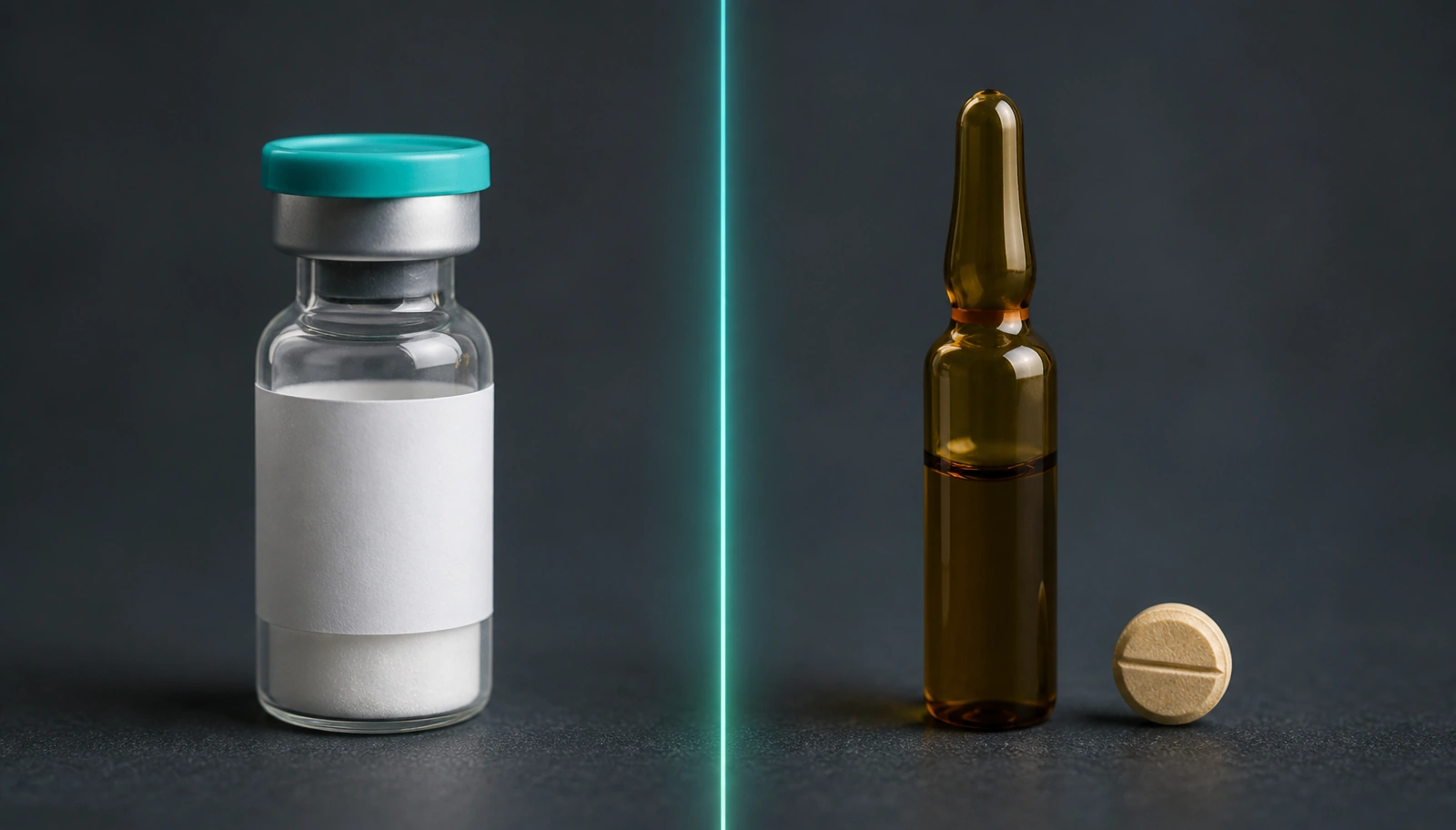
No. They are built from different materials and they work in different ways.
The legal gap is bigger than the chemistry gap. Steroids are controlled substances. Having them without a prescription is a federal crime. Most peptides are on no drug list at all, which is why one gets sold in gyms and the other on websites.
Most people arrive here having been told peptides are the safer choice. That claim gets a closer look near the end.
| Peptides | Anabolic steroids | |
|---|---|---|
| Built from | Amino acid chains | Four fused carbon rings, from cholesterol |
| How they act | Bind a receptor on the outside of the cell, triggering a signal | Pass through the cell wall, bind inside, change which genes are read |
| Effect on your own hormones | Growth hormone peptides ask the pituitary to work harder, so your own ceiling applies | Override your own system. Suppression of natural testosterone is near universal |
| US legal status | Mostly not on any DEA schedule. Governed by food and drug law, which restricts selling instead of holding | Schedule III controlled substances. Possession without a prescription is a federal crime |
| WADA class | S2, plus the S0 catch-all for anything unapproved | S1, alongside SARMs |
| Human safety evidence | Thin to absent for most research peptides. No long-term data | Decades of study. Harms are documented |
| Sold through | Websites, under a research use only label | Criminal underground |
Two exceptions sit outside the table. HGH carries criminal exposure closer to a steroid's under its own statute, and SARMs are neither category while being grouped with steroids by WADA.
The chemistry
A peptide is a chain of amino acids. Those are the same building blocks your body uses for every protein it makes. String a few dozen together and you have a peptide. Your body makes thousands of them.
A steroid is built on a different frame entirely. Four carbon rings fused together, made from cholesterol. Anabolic steroids are lab-made relatives of testosterone. Anabolic just means tissue-building, which is what they were made to do.
Chains on one side, rings on the other. There is no version of one that turns into the other, and nothing about the two structures is related.
The word steroid covers two families, and they need keeping apart. Anabolic steroids are the testosterone relatives used for muscle. Corticosteroids, like prednisone or a hydrocortisone cream, are anti-inflammatory drugs. This page is about the first kind.
Which peptide are you asking about
The word turns up in three places that have almost nothing to do with each other, and the answer depends on which one sent you here.
Injectable research peptides. BPC-157, ipamorelin, CJC-1295, TB-500. Sold online under a research use only label, injected, and discussed in the same rooms as steroids. The rest of this page is about these.
Cosmetic peptides in skincare. Matrixyl, Argireline and similar cosmetic ingredients. Applied to skin, sold over the counter, and about as far from a steroid as a molecule can be while still sharing a name. Copper peptides such as GHK-Cu are sold both ways, as skincare and in vials for injection. If a face serum sent you here, the answer is no and there is nothing else to worry about.
Collagen peptides in supplements. Protein fragments you swallow, sold in tubs, and closer to food than to medicine.
All three are peptides by chemistry. Only the first is in any conversation with steroids, and only because of who sells it and what people want from it.
What each one does in a body
The mechanisms are as different as the molecules.
Steroids go inside the cell. They dissolve in fat, so they pass straight through the cell wall, bind a receptor inside, and that pair travels to the cell's control center and changes which genes get read. The instruction is direct: make more muscle protein.
Most peptides stay outside and knock. They bind a receptor on the outside of the cell and set off a chain of signals within. The instruction is indirect, and your body decides how to answer it.
That difference produces the most useful practical distinction between the two.
Steroids override your own hormone system. Growth hormone peptides ask it to work harder.
A peptide like ipamorelin tells your pituitary to release its own growth hormone, so the ceiling is whatever your pituitary can make. Injected testosterone has no ceiling, which is why it works more reliably and why it shuts your own production down. Almost every steroid user experiences that shutdown, and restarting your own production afterward is a whole separate undertaking.
The legal difference is the big one
This is where the two categories actually diverge in ways that affect you.
Anabolic steroids are Schedule III controlled substances in the United States, under the Anabolic Steroid Control Act. Having them without a prescription is a federal crime. The Act was also written broadly, covering anything chemically and pharmacologically similar to testosterone instead of just a list of names.123
The vast majority of peptides are not on any DEA schedule.4 They fall under a different law, the Food, Drug and Cosmetic Act, which governs what may be sold and marketed as a drug, not what you may have.
That one difference explains why the two markets look so different. Steroids move through a criminal underground because having them is a crime. Peptides sell openly on websites under a research use only label, because the illegality sits with the seller and the claim, not with you holding a vial.
Our guide on the legal position works through what that actually means, because unscheduled is a long way from legal.
One peptide is an exception, and sources disagree about how
Human growth hormone is treated more harshly than other peptides, and the details matter.
HGH is covered by its own law, 21 U.S.C. 333(e), which makes handing it out for non-approved purposes a federal offence.5 Some sources instead call HGH a Schedule III controlled substance classified as an anabolic steroid.8 Those are different claims and the second is wrong: HGH is not chemically related to testosterone, so it cannot meet the statutory definition of an anabolic steroid. A substance can carry criminal penalties without appearing on a DEA schedule, and HGH is the standard example.
The practical answer either way is that HGH is the one peptide where the legal exposure looks like a steroid's.
In tested sport, the distinction disappears
For anyone drug-tested in sport, this entire page becomes academic.
The World Anti-Doping Agency bans both, in adjacent sections of the same list. S1 covers anabolic agents, meaning anything that builds tissue: steroids and SARMs. S2 covers peptide hormones and growth factors, along with anything built to imitate one.6
Both are banned at all times, in and out of competition, and both sit in the tier that carries the heavier standard penalty.7
S2 names the compounds people actually buy, sorted by how they work.
Copies of the brain signal that tells the pituitary to release growth hormone: CJC-1293, CJC-1295, sermorelin, tesamorelin.
Compounds that trigger the same release through the hunger-hormone route: anamorelin, ibutamoren (MK-677), ipamorelin, hexarelin, and GHRP-1 through GHRP-6.
And thymosin beta-4 with anything derived from it, which is what catches TB-500.6
And a catch-all sits underneath. S0 bans any substance that no health regulator anywhere has approved for people.6 Nearly every research peptide qualifies. BPC-157 was already banned under S0 before WADA named it outright in 2022.
So picking a peptide over a steroid does nothing for a tested athlete. Both are banned, testing for peptide hormones has improved a great deal, and legal to own and allowed in your sport are two unrelated questions. How each is actually tested for is its own guide.
And SARMs are neither
The third thing in this conversation, and the one that settles what the categories are actually built on.
SARMs are small molecules, not amino acid chains, so they fail the peptide definition. They have no four-ring structure either, so they fail the steroid one. What they do have is an effect on the androgen receptor, the pathway testosterone uses.
WADA files them under S1, alongside anabolic steroids, and not under S2 with the peptides.6
That tells you what the anti-doping categories track. Not what a molecule is made of, but what it does. SARMs are shaped like neither steroids nor peptides and get grouped with steroids because they pull the same lever.
The other comparison people make gets its own page. Our guide on peptides and SARMs covers the full comparison, including what the liver case reports say and what testing found inside the bottles.
The claim that brought you here
Almost everyone arriving at this question has met some version of the same sentence: peptides are the safer alternative to steroids.
The sentence is doing more work than it has earned.
We know a great deal about what steroids do to people, including the harm. Decades of use, study and medical supervision built a detailed picture: suppressed testosterone, changed cholesterol, effects on the liver and heart. The risks are written down because somebody looked.
For most research peptides, no such picture exists. No long-term human data, and in many cases no human trial at all. The safety record is quiet because nobody looked, and a quiet record is not a clean one.
So calling the second one safer compares a measured risk against an unmeasured one and hands the prize to the unmeasured one. That is not a comparison, it is the absence of one.
Some of the difference is probably real. The pituitary ceiling on growth hormone peptides is a genuine limit that injected testosterone does not have, and it plausibly caps both the effect and the harm. Probably real and demonstrated are different claims, though, and the marketing makes the second one.
There is also a risk on the peptide side that steroids mostly do not carry. A vial bought online is unregulated, and lab testing of grey-market products has found purity far below what the labels claim, along with bacterial contamination. Whatever the molecule does, the vial is a separate hazard, and our safety guide covers it.
Where the two do overlap
The categories are less tidy than the chemistry suggests, and they blur in a few places.
Both classes contain hormones. Insulin is a peptide hormone. So is growth hormone. Testosterone is a steroid hormone. So hormone is not the word that separates them, and anyone using it that way has picked the wrong distinction. What separates them is what they are built from.
Some peptides build tissue too. Insulin does. Growth hormone peptides raise IGF-1, the signal that actually tells muscle to grow. They take a different route to an overlapping destination.
People use them together. The two are frequently stacked, which is part of why the categories blur in conversation. Nothing in this page implies that the peptide half of a stack is the harmless half, and no study has examined the combination.
Both are sold in the same rooms. Same forums, same suppliers, same conversations, same goals. Most of the confusion behind this question comes from that, not from anyone mistaking a ring for a chain.
Common questions
Are peptides steroids?
No. Peptides are chains of amino acids. Anabolic steroids are built from four fused carbon rings and are synthetic relatives of testosterone. Different molecules, different mechanisms, different legal status.
Are peptides safer than steroids?
Not established. Steroid harms are well known because steroids were studied for decades. Most research peptides have no long-term human data and often no human trial at all, so a quiet safety record reflects an absence of looking. There is also a contamination risk on the peptide side, coming from the unregulated market and not the molecule.
Are peptides legal when steroids are not?
Mostly, in a narrow sense. Nearly all peptides are not DEA-scheduled while anabolic steroids are Schedule III. Unscheduled is not the same as legal, though. Selling an unapproved compound for human use breaks other laws, and the research use only label exists to work around that.
Will peptides suppress my testosterone?
Most do not. Peptides like ipamorelin and CJC-1295 act on the growth hormone pathway without directly touching testosterone. Steroids suppress natural testosterone in almost every user, which is one of the sharpest differences between the two.
Is HGH a steroid?
No, it is a peptide hormone. It is the one peptide whose legal exposure resembles a steroid's, covered by its own federal law making distribution for non-approved purposes an offence. Some sources call it a Schedule III controlled substance classified as an anabolic steroid, which looks inaccurate.
Is Ozempic a steroid?
No. Semaglutide and tirzepatide are peptides that copy gut hormones, and they are approved prescription medicines. Nothing about them is a steroid by chemical or legal definition.
Will a peptide show up on a steroid test?
Not on a standard workplace panel, which looks for something else entirely. In tested sport, yes. Both sit on the WADA list, peptides under S2 and the catch-all S0, and testing has improved a great deal.
Are SARMs peptides?
No, and they are not steroids either. SARMs are small molecules without the four-ring structure, so they fail the steroid definition, and they are not amino acid chains, so they fail the peptide one. They act on the androgen receptor, the same pathway testosterone uses, which is why WADA files them under S1 with the steroids and not S2 with the peptides.
Are the peptides in my face cream steroids?
No, and they are a different thing from the injectable peptides this page is mostly about. Matrixyl, Argireline and similar cosmetic ingredients go on skin, are sold over the counter, and have no relationship to steroids at all. Copper peptides such as GHK-Cu are sold both ways, as skincare and in vials for injection. Collagen peptides in supplements are protein fragments you swallow.
Can you take peptides and steroids together?
People do, and it is common enough that the two get discussed as one subject. No study has looked at the combination, and nothing about peptides being a different chemical class makes them the harmless half of a stack.
Sources
1. 21 U.S.C. 802(41). Definitions, Controlled Substances Act. Statute, read at source. Defines an anabolic steroid as any drug or hormonal substance chemically and pharmacologically related to testosterone, other than estrogens, progestins, corticosteroids and dehydroepiandrosterone, followed by an enumerated list. Text current to 8 August 2026.
2. Anabolic Steroids Control Act of 1990, H.R. 4658, 101st Congress. Statute, read at source. Added anabolic steroids to Schedule III of the Controlled Substances Act, effective 27 February 1991.
3. DEA, Implementation of the Anabolic Steroid Control Act of 2004, Federal Register, 16 December 2005. Rulemaking, read at source. The 2004 Act replaced the definition, removing the requirement to prove muscle growth, and named 59 specific substances as anabolic steroids, effective 20 January 2005. See also Implementation of the Designer Anabolic Steroid Control Act of 2014, Federal Register, 1 August 2023, which sets out how a substance meeting the criteria but not listed may be added.
4. The absence of peptides from the drug schedules. No primary document states a negative. The claim rests on two things a reader can check: the anabolic steroid definition at 21 U.S.C. 802(41) requires a substance to be chemically and pharmacologically related to testosterone, which an amino acid chain is not, and peptides do not appear in the schedules at 21 U.S.C. 812.
5. 21 U.S.C. 333(e). Prohibited distribution of human growth hormone. Statute, read at source. Knowingly distributing, or possessing with intent to distribute, human growth hormone for any use in humans other than treatment of a disease or other recognised medical condition authorised by the Secretary and ordered by a physician is punishable by up to 5 years in prison, rising to 10 where a person under 18 is involved. A conviction counts as a felony violation of the Controlled Substances Act for forfeiture purposes. The subsection defines human growth hormone as somatrem, somatropin, or an analogue of either. The DEA is authorised to investigate.
6. World Anti-Doping Agency. The Prohibited List. Governing body, official publication. S0 covers any substance not addressed elsewhere on the list and not currently approved by any governmental regulatory health authority for human therapeutic use. S1 covers anabolic agents, including anabolic androgenic steroids and SARMs. S2 covers peptide hormones, growth factors, related substances and mimetics, including growth hormone analogues, GHRH analogues, growth hormone secretagogues, GH-releasing peptides, and thymosin beta-4 with its derivatives. Both S1 and S2 are prohibited at all times.
7. International Weightlifting Federation, New WADA Prohibited List enforced since January 1, 2026. Signatory federation, reporting the current edition. The 2026 list took effect on 1 January 2026 and added further examples and clarifications to S1, S2, S4 and S6. Cited to fix the edition this page describes, since the list is republished annually.
8. On the disagreement about HGH scheduling. Some commercial sources describe HGH as a Schedule III controlled substance classified as an anabolic steroid. The statute at 21 U.S.C. 333(e) and the definition at 802(41) together show why that is wrong: HGH is not chemically related to testosterone and is not scheduled, and its criminal exposure comes from a separate provision of food and drug law. The disagreement is kept visible here because the wrong version is widely repeated.