
Matrixyl (Palmitoyl Pentapeptide-4)_Dosage, benefits & legal status
Also known as palmitoyl pentapeptide-4, pal-KTTKS, Matrixyl, Matrixyl 3000, KTTKS
A topical collagen-boosting peptide that firms skin over time.
Common vial size is what vendors typically sell, not a recommendation. Enter your own vial in the calculator.
8 of 12 listings we track are vials from research sellers, not finished skincare or hair products.
What is Matrixyl (Palmitoyl Pentapeptide-4)?
Plain language first. The technical label stays, but it never stands alone.Overview
Matrixyl is the trade name for a cosmetic ingredient containing palmitoyl pentapeptide-4 (Pal-KTTKS), a synthetic peptide derived from a collagen-related sequence. It is used in topical skincare products intended to improve the appearance of fine lines and wrinkles.
A 12-week randomized, placebo-controlled study involving 93 women found improvements in wrinkles and fine lines with a moisturizer containing Pal-KTTKS compared with the same moisturizer without it. That supports a potential topical benefit, but it does not establish that every Matrixyl product works equally well or that the peptide is effective when injected.
Matrixyl should not be confused with Matrixyl 3000 or Matrixyl Synthe'6, which contain different peptides.
What it's used for
A topical collagen-boosting peptide used to firm skin and smooth fine lines over time. It is a skincare staple.
Can Matrixyl be injected?
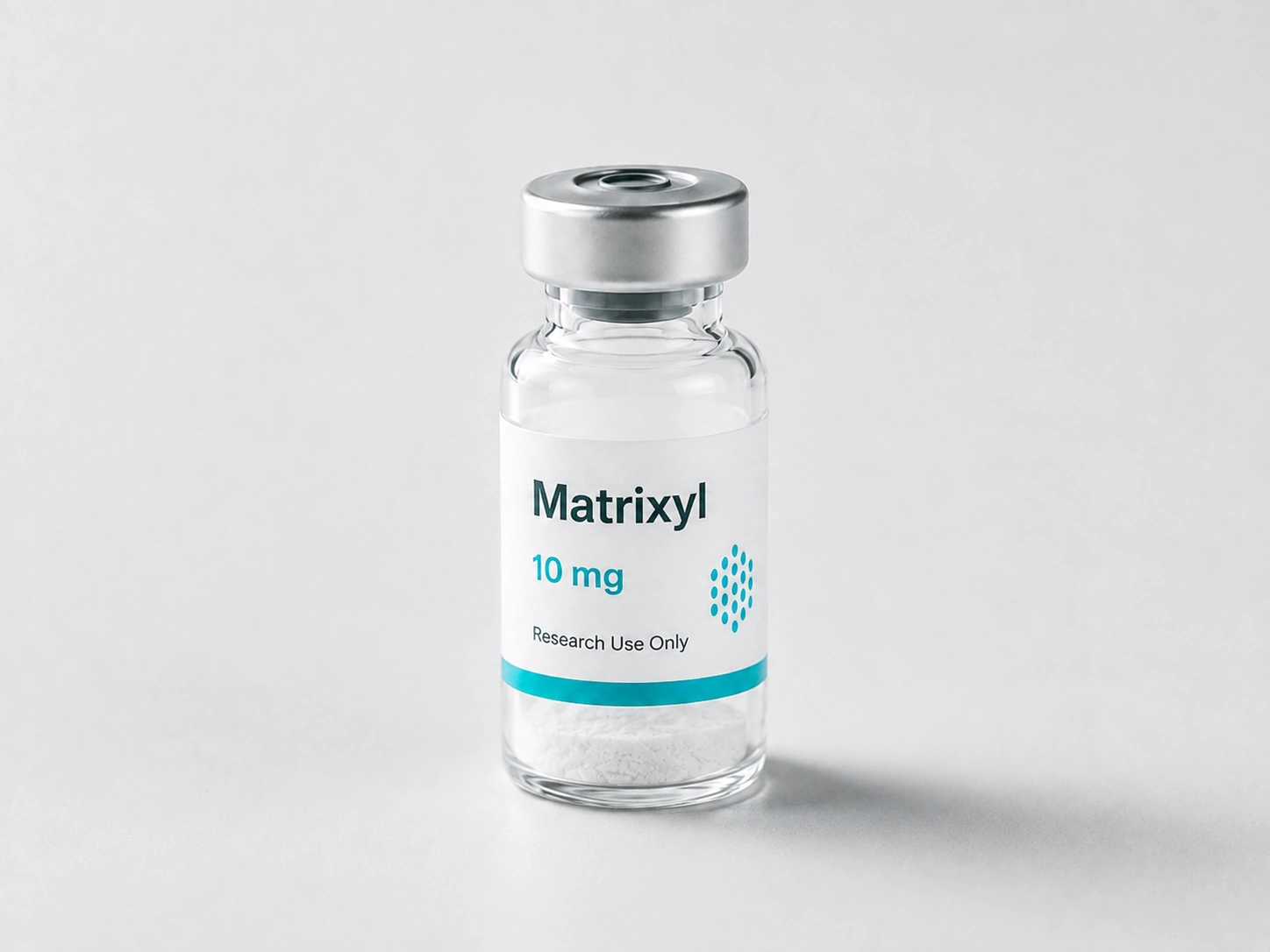
Matrixyl is primarily a topical cosmetic ingredient. Some research-peptide vendors sell it as freeze-dried powder in vials, which can make it look like an injectable peptide. However, vial packaging does not establish that a product is sterile, formulated for injection, or safe to inject.
Published human research on palmitoyl pentapeptide-4 focuses on topical formulations. No validated human subcutaneous injection dose, injection schedule, or injectable safety profile has been established.
Are people injecting Matrixyl?
The question has appeared in Reddit peptide communities, where users have reported buying Matrixyl vials or considering injections. However, the discussions reviewed did not provide a clearly documented firsthand injection experience with an established dose and outcome.
Matrixyl should not be treated as an injectable peptide simply because it appears in a research-peptide catalog. Its evidence-supported route remains topical.
Matrixyl 3000 is also a different formulation. Research findings for original Matrixyl cannot automatically be applied to Matrixyl 3000 or vice versa.
How does Matrixyl (Palmitoyl Pentapeptide-4) work?
What it does in the body, and where.Matrixyl is five amino acids with a palmitic acid tail attached, and the tail is the clever part.
- 01The fragment mimics broken collagenSkin interprets collagen fragments as evidence of damage and responds by making more. The peptide is a fragment of collagen type I.
- 02The palmitoyl tail is intended to improve delivery through the skin barrierA fatty acid attached to a water-soluble peptide is intended to improve interaction with and delivery through the skin barrier. The degree of penetration depends on the formulation, and reaching dermal fibroblasts has not been established for every product.
- 03Human research supports a topical benefitIn a 2005 randomized, double-blind study involving 93 women, a moisturizer containing palmitoyl pentapeptide-4 improved measured fine lines and wrinkles compared with the same moisturizer without the peptide. The study was conducted by Procter & Gamble researchers, so independent confirmation remains important. These findings concern topical use, not injections.
- 04Results take monthsCollagen turnover is slow. Anything claiming visible change in days is not describing this mechanism.

What else is it used for?
Each use below carries its own evidence level. Approved means regulators have cleared it for that purpose. Investigational means it is in trials. Early research means it is being studied and is not established.
- Firming skin and smoothing fine lines over time, applied to the skinSupplement or cosmetic
- Boosting collagen productionEarly research
The published record
Papers and trials about Matrixyl (Palmitoyl Pentapeptide-4)
Searched: Matrixyl, palmitoyl pentapeptide-4, pal-KTTKS, Matrixyl 3000, KTTKS.
26 papers tagged human · 16 not reviews or lab · 3 clinical trial publications
Furthest stage reached: Published trials only, 3 clinical trial publications, no phased trial registered
Counted from Europe PMC indexing, not read by a person; a human tag can land on reviews, commentary or lab papers; clinical trial publications is the narrower count.
At a glance
Four things to know about Matrixyl (Palmitoyl Pentapeptide-4)
Evidence
Cosmetic
Category
Skin and cosmetic
Common vial
10 mg
Half-life
Not measured, and not the right question
How much, and do you cycle it?
The range, and whether you take breaks.Per finished product instructions, daily. No established cycling protocol for topical use Published human trial
Matrixyl is generally used as part of a regular topical skincare routine. In the best-documented human study, participants applied a moisturizer containing 3 ppm Pal-KTTKS over 12 weeks.
That concentration describes the formulation researchers tested, not a universal dosing recommendation. Commercial products may contain different concentrations, carriers, and combinations of peptides.
There is no established medical cycling schedule for topical Matrixyl, and no validated human injection dose.
Not measured, and not the right questionNo figure
This is a topical cosmetic ingredient. A blood half-life measures how fast something leaves the bloodstream, and these are not intended to reach it in meaningful amounts. What matters for a topical is how much penetrates the skin and how long it stays in the tissue, which is a different measurement and one that is rarely published.
You can compare this against the whole library to see where it sits.
What does it cost?
Typical dose and cost, in plain numbers.No established injectable Matrixyl dose
The listed products are taken on the skin (topical). In the best-documented human study, participants applied a moisturizer containing 3 ppm (0.0003%) Pal-KTTKS over 12 weeks. That concentration describes the formulation researchers tested, not a universal dosing recommendation. Commercial products may contain different concentrations, carriers, and combinations of peptides.
Matrixyl (Palmitoyl Pentapeptide-4) starts at $21.99 across 10 vendors, typically $0.14 – $9.03 per mg.
12 listings, last read Oct 24, 2026. Shipping and card fees are not included.
These are research-vial prices, not prices for finished cosmetic serums.
How do you store it?
Before mixing, and after.Finished products: follow the label. Research powders: check the product's documentation.
Finished skincare products: Follow the manufacturer's storage instructions. Most finished serums and creams are designed for ordinary cosmetic storage, but temperature and stability requirements vary by formulation.
Research powders: Lyophilized Matrixyl sold by peptide vendors is not the same as a finished cosmetic product. Storage conditions should be checked against the product's documentation, including any available stability information.
A powdered product should not be assumed suitable for injection, and adding bacteriostatic water does not establish sterility or injectable safety.
What are the side effects and cautions?
Known cautions and warnings for this compound.Who should avoid it
- A known allergy to the ingredient
- Broken skin
Stop and get help
- Rapidly spreading swelling, or swelling of the face, lips, or tongue
- Trouble breathing or any other sign of a severe allergic reaction
Common effects
- Generally well tolerated with a good record as a cosmetic ingredient
- Occasional mild irritation or redness: stop use and assess
Injected use has not been established as safe. No validated human injection dose or injectable safety profile exists.
Where this page says nothing is established, that means nobody has studied it, not that a compound is safe.
Is Matrixyl (Palmitoyl Pentapeptide-4) approved?
And where the numbers on this page come from.Not as a medicine. Matrixyl (Palmitoyl Pentapeptide-4) is sold without a prescription as a cosmetic ingredient, which is a different thing from being approved as a drug.
- Approval statusCosmeticSold without a prescription as an ingredient in cosmetics, such as skincare and hair products. The FDA does not approve cosmetics before they are sold, and being easy to buy says nothing about whether it works.
- RouteOn the skin (topical)
- Checked22 July 2026
- DoseFrom product labeling and published use.
- Vial sizeFrom what vendors typically list; not a recommendation.
- Sources
What has happened recently
We have not yet written a full regulatory note for this compound. The status above is current as of the date shown.
You can compare this against the whole library, or read how to check a seller.
What else is like Matrixyl (Palmitoyl Pentapeptide-4)?
Others in Skin and cosmetic, side by side.If you're weighing Matrixyl (Palmitoyl Pentapeptide-4), it's worth reading PTD-DBM, SYN-AKE, and Palmitoyl Tripeptide-1 in the same class.
A topical collagen-boosting peptide that firms skin over time.
- Dose
- Per finished product instructions
- How often
- Daily
A hair-regrowth peptide from a single Korean lab, tested only in mice.
- Dose
- Topical, per product
- How often
- Daily
A snake venom mimic sold as a topical alternative to injectables, with an evidence problem worth knowing.
- Dose
- Serum or cream, typically 4% of a supplied 200 mg batch
- How often
- Daily
A topical collagen peptide that firms and smooths skin.
- Dose
- Serum, per product
- How often
- Daily
Guides for this compound
- mcg vs mg: The Peptide Dosing Mistake to Avoid
Your vial says mg and your protocol says mcg. Here is the conversion and how to check it.
- How to Read a Peptide COA
What the purity number does and does not tell you, and how to spot an edited report.
- How to Vet a Peptide Vendor
Independent COAs, HPLC purity, and the red flags that mean walk away.
Sources
- Robinson LR, et al. (2005). Topical palmitoyl pentapeptide provides improvement in photoaged human facial skin. International Journal of Cosmetic Science, 27(3), 155–160.(2005)A randomized, double-blind, placebo-controlled, split-face study involving 93 women over 12 weeks.
- Croda Beauty / Sederma. Matrixyl product documentation.Manufacturer documentation identifying original Matrixyl as a formulation containing palmitoyl pentapeptide-4.
- PubChem. Palmitoyl Pentapeptide-4, CID 9897237.Chemical identity, molecular formula, structure, and alternative names.
The topical evidence does not establish injectable safety or efficacy.
Beyond these, 56 records are indexed. Browse the records