
Ipamorelin vs CJC-1295
Ipamorelin and CJC-1295 push growth hormone through two different doors, so most protocols use both at once. Each has been tested separately in people. The combination that almost everyone actually buys has never been tested in a human trial for any purpose.
This pair sits inside a larger group. For the map of all eleven growth hormone compounds and how they relate, start with the growth hormone peptides guide.
- Growth hormone
- Usually sold as a blend
- Neither FDA approved
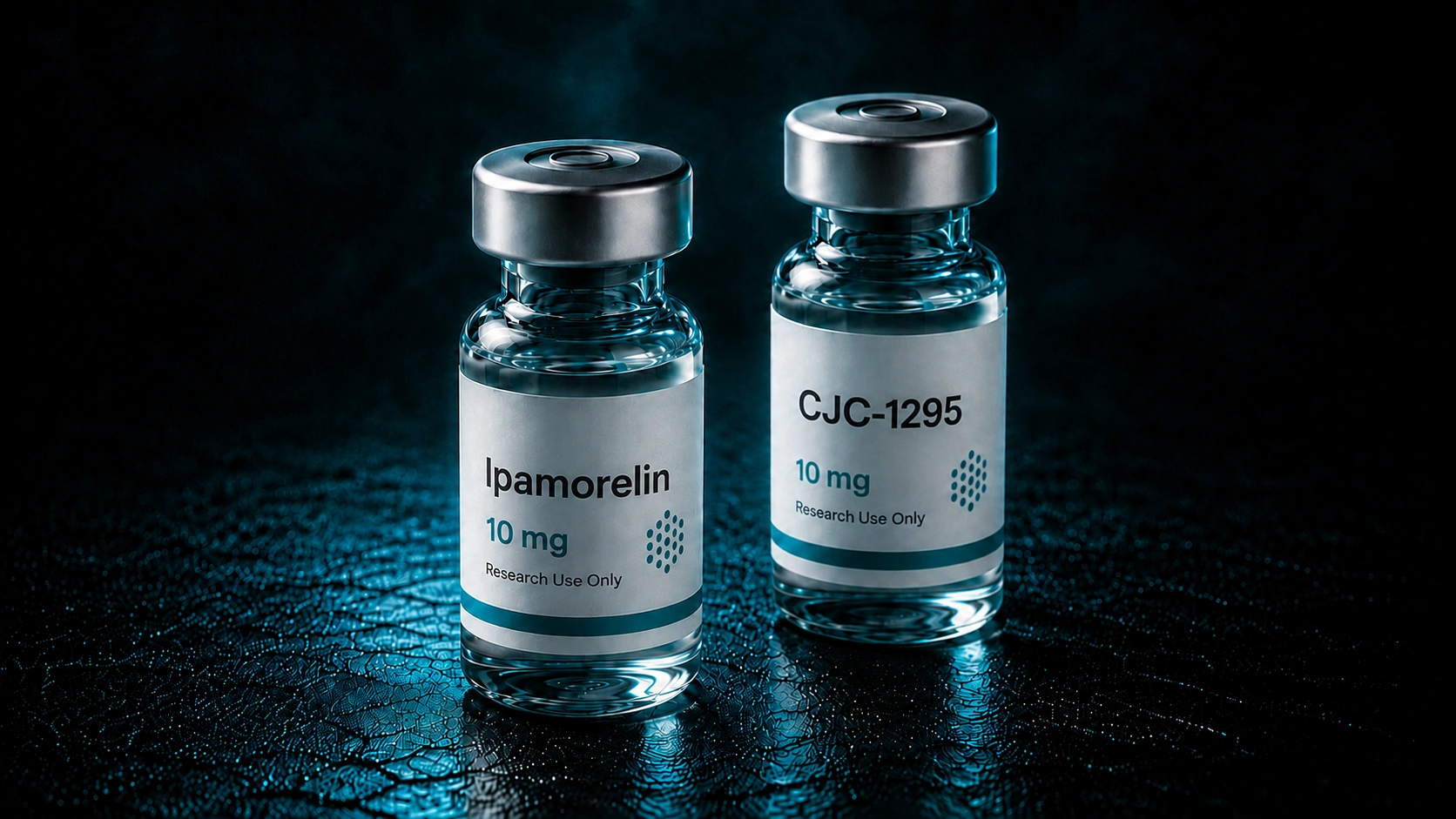
Are these two alternatives, or sold in the same vial?
Each acts on a different receptor on the pituitary, and each has its own human trial record. The blend almost everyone buys has none.
| Attribute | Ipamorelin | CJC-1295 |
|---|---|---|
| Length | 5 amino acids | 29 or 30, depending on version |
| Origin | Designed from scratch | Built from a natural hormone |
| Acts on | The ghrelin receptor | The GHRH receptor |
| Best human trial | Phase 2, 114 patients, missed its endpoint [5] | Phase 1, healthy adults, randomized and placebo controlled [1] |
| Half-life | About 2 hours [4] | 5.8 to 8.1 days with DAC [1] |
| Developed by | Novo Nordisk, then Helsinn | ConjuChem |
| Both programs | Discontinued | Discontinued |
"CJC-1295" covers two different molecules. See the structure section below.
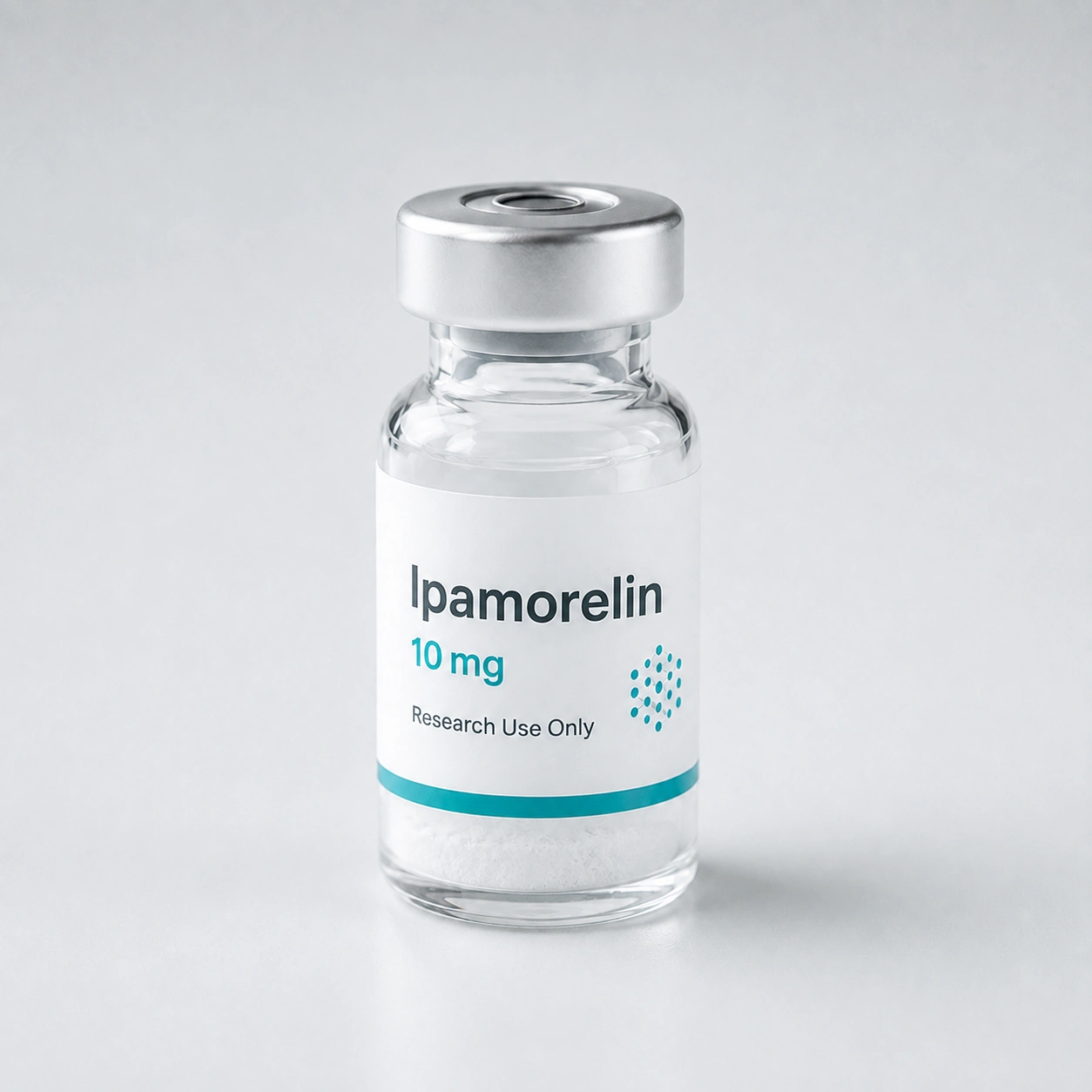
Ipamorelin
A five amino acid chain that copies ghrelin, the hunger hormone, at one specific receptor on the pituitary. Its selling point is what it does not do: older compounds in its class also pushed up cortisol and prolactin, and ipamorelin was built to leave those alone.
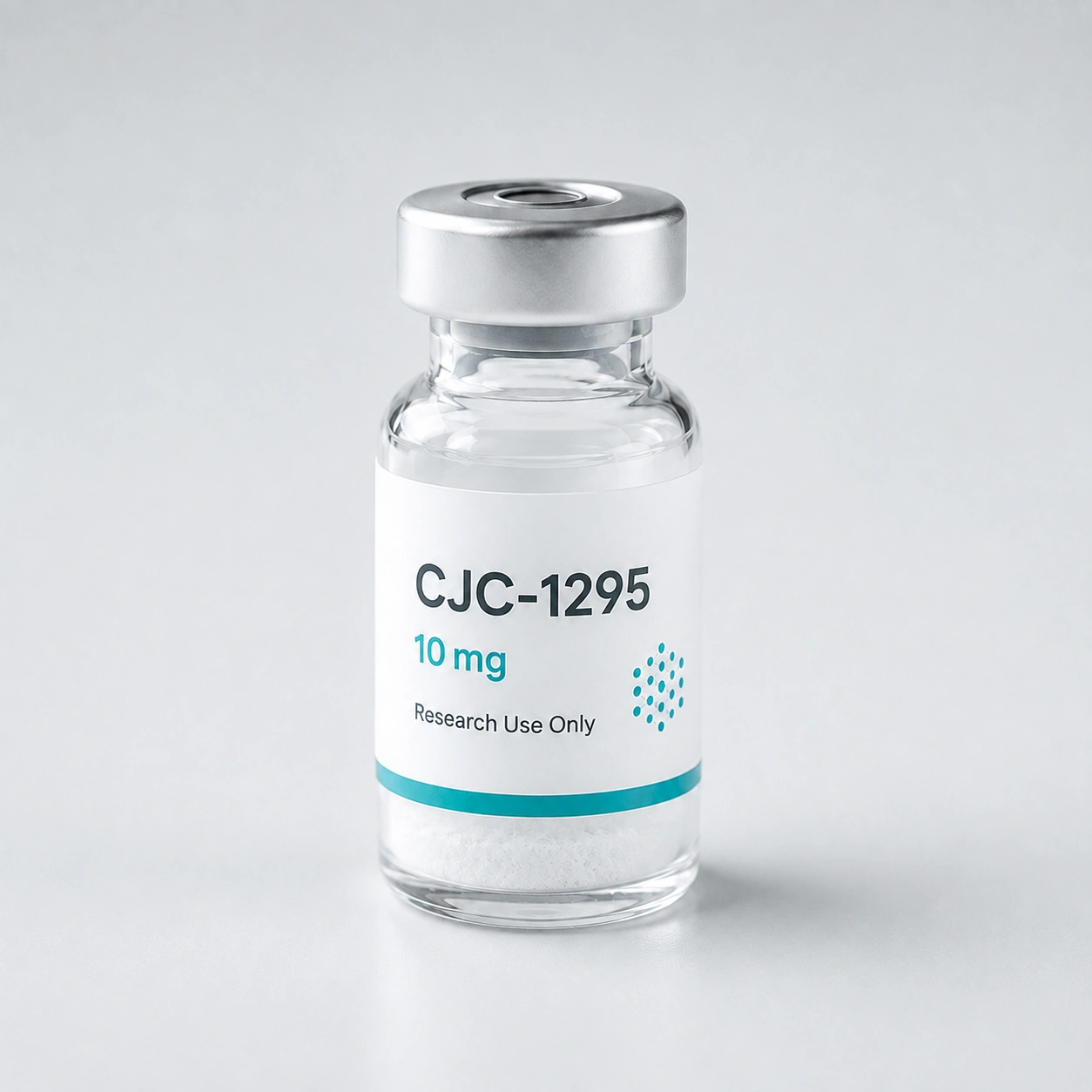
CJC-1295
A synthetic version of GHRH, the hormone your hypothalamus uses to signal the pituitary. Four amino acids were swapped so it survives longer in the blood than natural GHRH.
Are they even the same kind of thing?
Semax and Selank share a tail. BPC-157 and TB-500 are both fragments of larger proteins. These two share nothing.
Two doors, one room. The pituitary has separate receptors for ghrelin and for GHRH. Each compound knocks on a different one.
Six times the size. Ipamorelin is five amino acids, two of which are not the standard building blocks your body uses. CJC-1295 is 29 or 30, taken from GHRH with four positions swapped. They are not variants of each other.
One name, two molecules. "CJC-1295" covers a version with an albumin hook lasting days and a version lasting minutes. That difference is bigger than anything on this page, and it has its own comparison.
What does the evidence actually show?
Why were both development programs stopped, and who studied the combination?
Novo Nordisk characterizes the molecule
Raun and colleagues report that ipamorelin releases growth hormone about as strongly as older compounds in its class, without raising cortisol or prolactin even far above the effective dose. [3]
Eur J Endocrinol 1998;139(5):552-61Animal and laboratory study · rat pituitary cells and swine
The only human pharmacokinetic data
Gobburu and colleagues give ipamorelin intravenously to healthy volunteers. Growth hormone release is dose-proportional, it peaks around 30 to 40 minutes after the dose, and the terminal half-life is about 2 hours. [4]
Pharm Res 1999;16(9):1412-6Human pharmacokinetic study · intravenous
The albumin-binding version is identified
Jetté and colleagues identify CJC-1295 as the albumin-binding version and describe it as long lasting. [6]
Endocrinology 2005;146(7):3052-8Animal study · rats
Two Phase 1 trials in healthy adults
Teichman publishes two randomized, placebo controlled, double blind trials in healthy adults aged 21 to 61. A single injection raises growth hormone 2 to 10 times above baseline for six days or more, and IGF-1 1.5 to 3 times for nine to eleven days. Half-life 5.8 to 8.1 days. [1] Ionescu and Frohman publish alongside, showing growth hormone still comes out in bursts. [2]
J Clin Endocrinol Metab 2006Human trials · randomized, placebo controlled, double blind
- randomized
- placebo controlled
- hormone levels only
The Phase 2 trial is halted
The Phase 2 trial in 192 people with HIV related visceral obesity is halted. A participant in Argentina died of a heart attack roughly three hours after his eleventh weekly injection. The attending physician concluded it was undiagnosed coronary artery disease with a plaque rupture, unrelated to the drug. Causality was never established. ConjuChem ended development as a precaution and no efficacy results were ever published. [7]
ClinicalTrials.gov NCT00267527Trial registry entry · no results published
The one efficacy trial, and it missed
114 patients, testing ipamorelin for postoperative ileus, a condition where the gut stalls after surgery. Dosing was 0.03 milligrams per kilogram intravenously, for up to seven days. The primary endpoint was a composite of three things happening: tolerating solid food, a first bowel movement, and passing gas.
Median time to first tolerated meal was 25.3 hours against 32.6 on placebo, about seven hours sooner. It missed the endpoint, at p=0.15. Ipamorelin was well tolerated, with adverse event rates comparable to placebo. Helsinn discontinued development. [5]
Int J Colorectal Dis 2014;29(12):1527-34 · NCT00672074Human Phase 2 · randomized, double blind, placebo controlled
- double blind
- placebo controlled
- missed its endpoint
Category 2 at the FDA
The FDA places CJC-1295 and ipamorelin acetate in Category 2 of its 503A bulk substances list, the category for substances that may present significant safety risks. [8]
FDA 503A bulk substances listRegulatory action
Off Category 2, then turned down anyway
Both come off Category 2 on 27 September after the nominations are withdrawn, then go to the advisory committee anyway. Ipamorelin is reviewed on 29 October, for growth hormone deficiency and postoperative ileus. CJC-1295 is reviewed on 4 December. The committee votes against both. [9]
Pharmacy Compounding Advisory Committee · Docket FDA-2024-N-4188Regulatory action
The blend has never been in a trial
No human trial of the two together has ever been published, for any endpoint.
Both programs stopped, and neither stopped because the drug worked. CJC-1295 ended when a trial was halted and never restarted. Ipamorelin ended when its one efficacy trial missed the mark it was designed to hit. Between them there is one clean Phase 1 result about hormone levels and no evidence at all about outcomes people actually want. And the thing almost everyone buys, the two of them mixed in one vial, has never been in a trial.
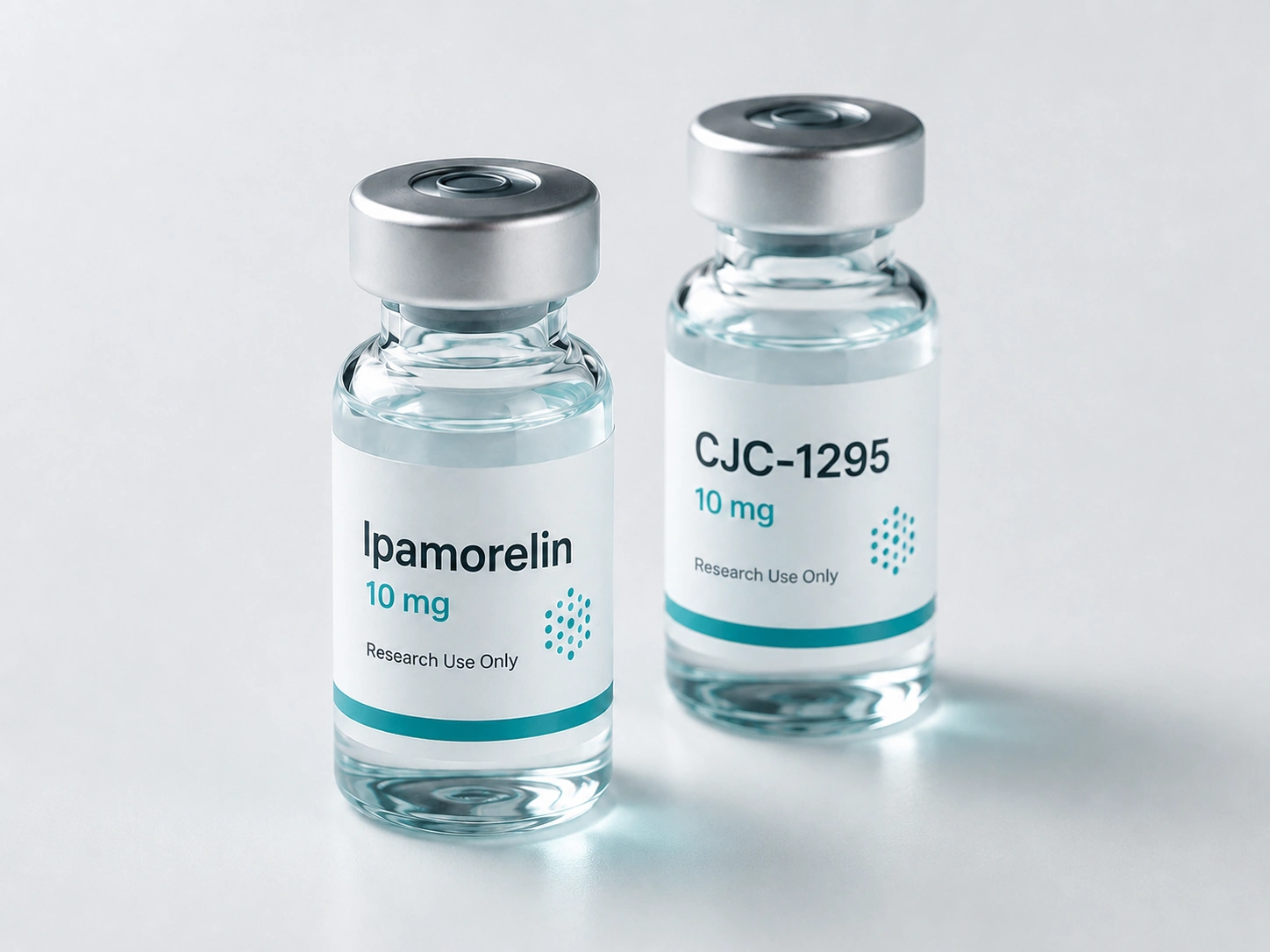
How do they compare, side by side?
How do they compare, side by side?
| Attribute | Ipamorelin | CJC-1295 |
|---|---|---|
| What it is | Pentapeptide, five amino acids, designed | GHRH analog, 29 or 30 amino acids |
| Acts on | The ghrelin receptor on the pituitary | The GHRH receptor on the pituitary |
| What it does | Triggers release of stored growth hormone | Signals the pituitary to produce growth hormone |
| Selectivity | Reported not to raise cortisol or prolactin, unlike older compounds in its class [3] | No rise in cortisol, prolactin, TSH or LH in the Phase 1 trial [1] |
| Half-life | About 2 hours, measured in humans [4] | With DAC, 5.8 to 8.1 days, measured. Without, never measured [1] |
| Best human evidence | Phase 2, 114 patients, missed its primary endpoint at p=0.15 [5] | Two Phase 1 trials, randomized, placebo controlled, double blind [1][2] |
| What that evidence showed | No significant benefit for the condition tested | Growth hormone up 2 to 10 times for six days or more [1] |
| Development status | Discontinued | Discontinued |
| FDA status | Never approved. Not permitted for compounding [8][9] | Never approved. Not permitted for compounding [8][9] |
| WADA status | Named on the Prohibited List [10] | Named on the Prohibited List [10] |
| Combination | Never tested in a human trial | Never tested in a human trial |
How does each one reach the same result?
Ipamorelin
Your pituitary keeps growth hormone in reserve and releases it in bursts. Ghrelin is one of the signals that triggers a burst. Ipamorelin copies that signal at a receptor called GHS-R1a.
Other compounds that hit the same receptor also raise cortisol, prolactin and appetite. Raun's 1998 work found ipamorelin released growth hormone at similar strength while leaving those alone, even at doses far above the effective range. That selectivity is why it became the standard partner for CJC-1295. [3] That work was done in rat cells and in pigs, and the selectivity has not been tested in people at the doses people actually use.
What has been measured in people is the shape of the response. Growth hormone peaks around 30 to 40 minutes after a dose and the compound clears with a half-life of about 2 hours. [4] A short, sharp signal, which is why ipamorelin is dosed more often than its partner.
CJC-1295
GHRH is the hypothalamus telling the pituitary to make growth hormone. Natural GHRH breaks down within minutes. CJC-1295 swaps four amino acids to slow that, and one version adds a hook that grabs albumin in the blood and stretches the effect to days.
One finding worth knowing. Even with the long acting version holding the signal up for days, growth hormone still came out in discrete bursts rather than a flat line. Ionescu and Frohman reported this alongside the Teichman trials. [2] Continuous growth hormone exposure and pulsed exposure do different things in the body, so this mattered.
What are the key differences?
What actually separates them?
What has nobody answered?
Which three gaps has nobody answered?
The combination has never been tested.No published human trial has studied ipamorelin and CJC-1295 together, for any endpoint. Not body composition, not sleep, not recovery, not safety. Every claim about the stack is inference from two compounds studied apart.
Neither has an outcome trial behind it.The CJC-1295 trials measured hormones in the blood over 28 and 49 days. [1] The one ipamorelin efficacy trial measured recovery after bowel surgery and missed its endpoint. [5] Nobody has published a trial showing either compound changes body composition, sleep, recovery or anything else a person would buy it for.
Nobody has looked at long term use.The longest published trial of either ran 49 days. Growth hormone raises blood sugar and raises IGF-1, and large studies link higher natural IGF-1 to higher rates of several cancers. Those studies measured the IGF-1 people naturally have rather than IGF-1 raised by a drug, and association is not proof of cause. The honest position is that the question is open for both compounds and for the whole drug class.
What are the side effects, and what are you buying?
What has testing found, and what gaps remain?
Both have been given to people in trials, so some of this is measured. The rest is market conditions.
Reported effects
From the published trials.
- Injection site reactions with CJC-1295, about 70 percent in the first trial and all subjects in the second [1]cjc-1295
- Headache in 63 percent against 14 percent on placebo [1]cjc-1295
- Flushing, warmth or a brief drop in blood pressure [1]cjc-1295
- Ipamorelin's trial reported it as generally well tolerated [5]ipamorelin
Nobody has looked
Nobody has run these studies. That is different from a clean result.
- The two taken together, in any human trialno trial
- Either one taken for months or yearsno data
- Use in pregnancy, in children, or alongside other medicationsno data
- Effects on blood sugar over time; no fasting insulin or HbA1c was measured [1]not measured
What is in the vial
Blends make this harder, not easier.
- Which CJC-1295 the blend contains is often not stated on the labellabeling
- Seized peptides tested 5 to 75 percent pure, plus arsenic and lead [11]analysis
- One US lab reported problems in almost 30 percent of samples, including bacteria [12]testing
- A high purity certificate does not rule out contaminants standard testing misses [13]caveat
*Where this page says nothing is established, it means nobody has studied it. It does not mean a compound is safe.
The blend problem is worth spelling out. Most vials sold as "CJC-1295 and ipamorelin" contain the short acting version of CJC-1295, properly called Modified GRF 1-29, which clears in minutes rather than days. Someone following a once-weekly schedule they read somewhere is dosing a short acting compound once a week. Our comparison of the two CJC-1295 versions covers this in full, and our guide on reading a certificate of analysis covers what to check before you buy.
Are they banned in sport?
Are both named, with no ambiguity?
This reflects the 2026 Prohibited List, in force from 1 January 2026. WADA publishes a new list each September, so check the current version if you are reading this later in the year.
Some peptides sit in grey areas. These two do not.
Section S2.2.4 covers growth hormone releasing factors and secretagogues. CJC-1295 is named in it as a GHRH analog, alongside CJC-1293, sermorelin and tesamorelin. Ipamorelin is named in it as a growth hormone secretagogue, alongside MK-677, anamorelin and others. [10]
Both are prohibited at all times, in and out of competition. There is no off season. Substances in this class are non-specified, which means a default four year ban.
Are they FDA approved?
Why were both turned down after review?
2023, into Category 2. Neither ipamorelin nor CJC-1295 has ever been approved by the FDA for any use, in any country. In September 2023 the FDA placed both in Category 2 of its 503A bulk substances list, the category for substances that may present significant safety risks. Compounding pharmacies could no longer make either one. [8]
2024, off the list, which is not clearance. In September 2024 both came off Category 2. That removal gets cited constantly as the FDA clearing them. It is not what happened. The parties who nominated them withdrew their nominations. The FDA states on its own page that a substance it has flagged as a potential safety risk might be absent from Category 2 because its nomination was withdrawn.
2024, the votes. The FDA took both to its advisory committee anyway. Ipamorelin was reviewed on 29 October 2024, for growth hormone deficiency and postoperative ileus, and the committee voted against adding it, one of four substances turned down that day alongside ibutamoren, better known as MK-677. CJC-1295 was reviewed on 4 December 2024, and the committee voted against all five CJC-1295 related substances, four of them unanimously at 13 to nothing and the fifth at 12 to 1. [9]
Worth comparing. When the same committee reviewed a different set of peptides on 23 and 24 July 2026, it went the other way on six of seven, recommending them at 8 to 6 over the objection of FDA scientists who had advised against all of them. Ipamorelin and CJC-1295 got no such vote. They were reviewed first, and they were turned down. As things stand, neither is on the 503A list, neither is on the 503B outsourcing facility list, neither has a USP monograph, and neither is part of any approved drug. There is no legal route to compound either one for human use.
Questions people ask
Should I pick ipamorelin or CJC-1295?
The question does not really fit. They act on different receptors and are almost always used together, often premixed in one vial. If you are choosing between them, you are probably reading a page that framed them as rivals.
Is the CJC-1295 and ipamorelin stack proven?
The two compounds have been studied separately in people. The combination has not been studied in people at all, for any purpose.
Which CJC-1295 is in the blend?
Usually the short acting version, properly called Modified GRF 1-29. That is not guaranteed and it is not always stated on the label. Ask before you buy and check the certificate of analysis.
Are they FDA approved?
No. Neither has been approved for any use anywhere. Both were reviewed by the FDA's advisory committee in 2024 and both were turned down for compounding.
Where does “5 days on, 2 days off” come from?
Not from any published trial. That schedule circulates widely and has no study behind it. The same goes for most of the timing advice attached to these two.
Are they banned in sport?
Yes, both by name, under section S2.2.4 of the WADA Prohibited List. Prohibited at all times.
Did ipamorelin work in its trial?
Not to the standard the trial was designed to test. Patients recovered about seven hours sooner than on placebo, 25.3 hours against 32.6, but the difference did not reach statistical significance at p=0.15. The program was discontinued afterward.
What this page is built on
- 01Teichman SL, Neale A, Lawrence B, Gagnon C, Castaigne JP, Frohman LA. Prolonged stimulation of growth hormone (GH) and insulin-like growth factor I secretion by CJC-1295, a long-acting analog of GH-releasing hormone, in healthy adults. J Clin Endocrinol Metab. 2006;91(3):799-805. PMID 16352683. Human clinical trial, CJC-1295 with DAC.
- 02Ionescu M, Frohman LA. Pulsatile secretion of growth hormone (GH) persists during continuous stimulation by CJC-1295, a long-acting GH-releasing hormone analog. J Clin Endocrinol Metab. 2006;91(12):4792-7. PMID 17018654. Human study, CJC-1295 with DAC.
- 03Raun K, Hansen BS, Johansen NL, Thøgersen H, Madsen K, Ankersen M, Andersen PH. Ipamorelin, the first selective growth hormone secretagogue. Eur J Endocrinol. 1998;139(5):552-61. Animal and laboratory study, rat pituitary cells and swine.
- 04Gobburu JV, Agersø H, Jusko WJ, Ynddal L. Pharmacokinetic-pharmacodynamic modeling of ipamorelin, a growth hormone releasing peptide, in human volunteers. Pharm Res. 1999;16(9):1412-6. PMID 10496658. Human pharmacokinetic study, intravenous. Terminal half-life about 2 hours, growth hormone peak around 30 to 40 minutes, dose-proportional response. The only human PK data ipamorelin has.
- 05Beck DE, Sweeney WB, McCarter MD; Ipamorelin 201 Study Group. Prospective, randomized, controlled, proof-of-concept study of the ghrelin mimetic ipamorelin for the management of postoperative ileus in bowel resection patients. Int J Colorectal Dis. 2014;29(12):1527-34. PMID 25331030. Trial NCT00672074. Human Phase 2, randomized, double blind, placebo controlled. 114 patients, 0.03 mg/kg intravenously for up to 7 days. Missed its primary composite endpoint at p=0.15. Median time to first tolerated meal 25.3 hours against 32.6 on placebo. Well tolerated. Development discontinued. One secondary source reports n=87; 114 is the figure reported consistently elsewhere.
- 06Jetté L, et al. Human growth hormone-releasing factor (hGRF)1-29-albumin bioconjugates activate the GRF receptor on the anterior pituitary in rats: identification of CJC-1295 as a long-lasting GRF analog. Endocrinology. 2005;146(7):3052-8. PMID 15817669. Animal and laboratory study.
- 07ClinicalTrials.gov NCT00267527. A study to evaluate CJC-1295 in HIV patients with visceral obesity. Trial registry. Halted 17 July 2006. No results published.
- 08US Food and Drug Administration. 503A bulk drug substances category updates, September 29, 2023. CJC-1295 and ipamorelin acetate added to Category 2. Regulatory document.
- 09US Food and Drug Administration. Category 2 removals announced 20 September 2024, effective 27 September, following withdrawal of nominations. Pharmacy Compounding Advisory Committee meeting of 29 October 2024, summary minutes at fda.gov/media/185412, reviewing ipamorelin acetate and ipamorelin free base. Meeting of 4 December 2024 reviewing five CJC-1295 related substances, all rejected. Docket FDA-2024-N-4188. Regulatory documents.
- 10World Anti-Doping Agency. The 2026 Prohibited List, section S2.2.4. Effective 1 January 2026. Regulatory document.
- 11Janvier S, Cheyns K, Canfyn M, Goscinny S, De Spiegeleer B, Vanhee C, Deconinck E. Impurity profiling of the most frequently encountered falsified polypeptide drugs on the Belgian market. Talanta. 2018;188:795-807. Peer-reviewed analytical study.
- 12NBC Washington. Lab finds problems in 30% of peptide vials tested. December 2024. News report of commercial laboratory testing, not peer reviewed.
- 13Castellino F, et al. Mutagenic contaminants in azide-coupled synthetic peptides. 1991. Peer-reviewed analytical study.