
Tesamorelin vs CJC-1295
Both are synthetic versions of GHRH, and both were tested in people with HIV-related belly fat. Tesamorelin finished two Phase 3 trials and was approved in 2010 as Egrifta. CJC-1295's Phase 2 stopped in 2006 and never restarted.
- Growth hormone
- Same class & target
- One approved, one abandoned
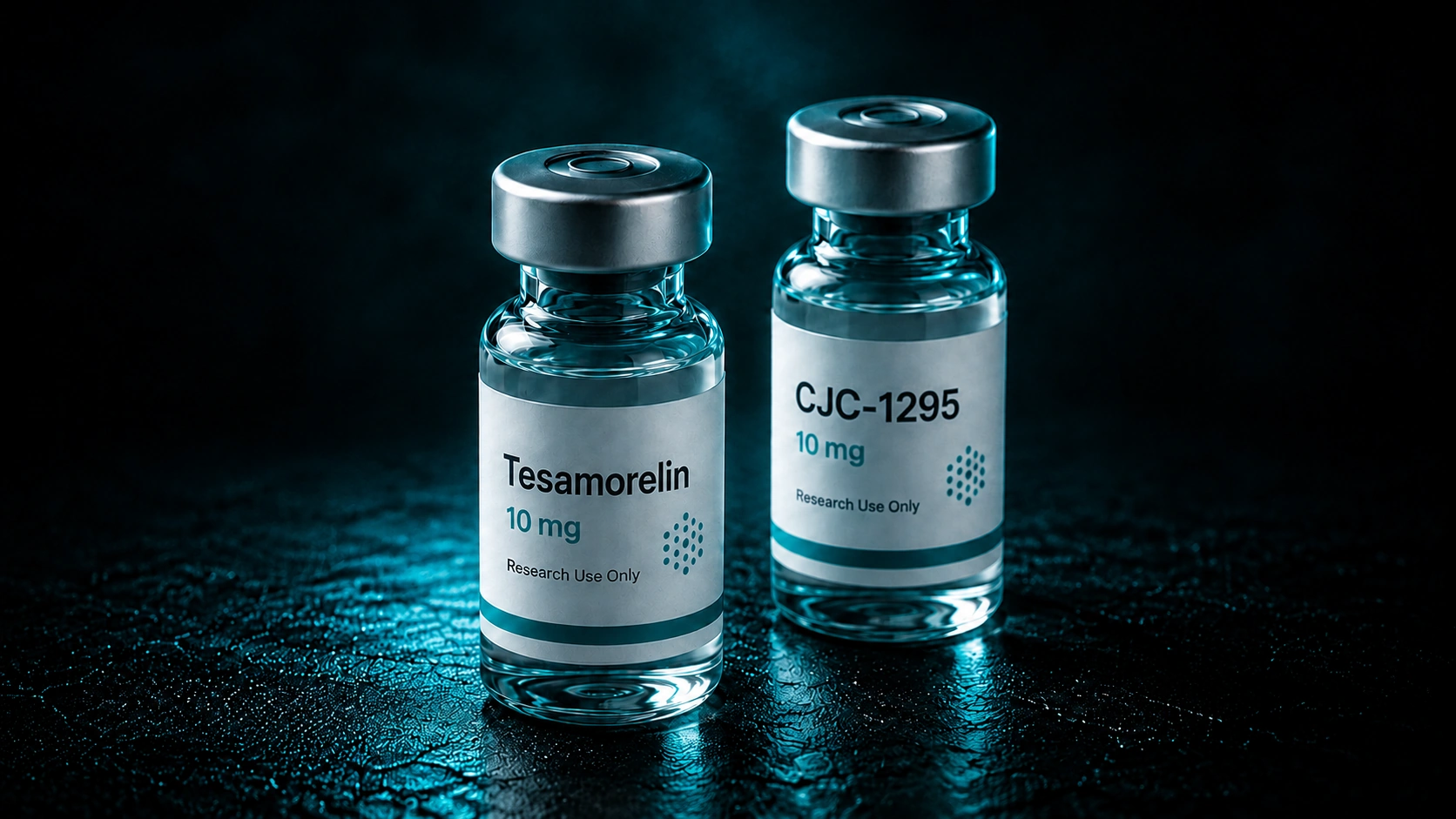
Same drug class, same condition — so why did only one of them finish?
Tesamorelin is an approved prescription medicine with two Phase 3 trials behind it. CJC-1295 is a research chemical whose only controlled program stopped eighteen years ago. The approved one is the short-acting daily injection, not the week-long one.
This pair sits inside a larger group. For the map of all eleven growth hormone compounds and how they relate, start with the growth hormone peptides guide.
| Attribute | Tesamorelin | CJC-1295 |
|---|---|---|
| Length | 44 amino acids, the full hormone | 29 or 30, a fragment |
| Sold as | Egrifta, on prescription | Research chemical |
| FDA status | Approved November 2010 [1] | Never approved [6] |
| Dosing | 2 mg daily [1] | Weekly, with DAC [6] |
| Phase 3 patients | 816 [2][3] | None |
| What happened | Approved and marketed | Trial halted 2006, development ended [7] |
Both were tested for the same condition, excess visceral fat in people with HIV.
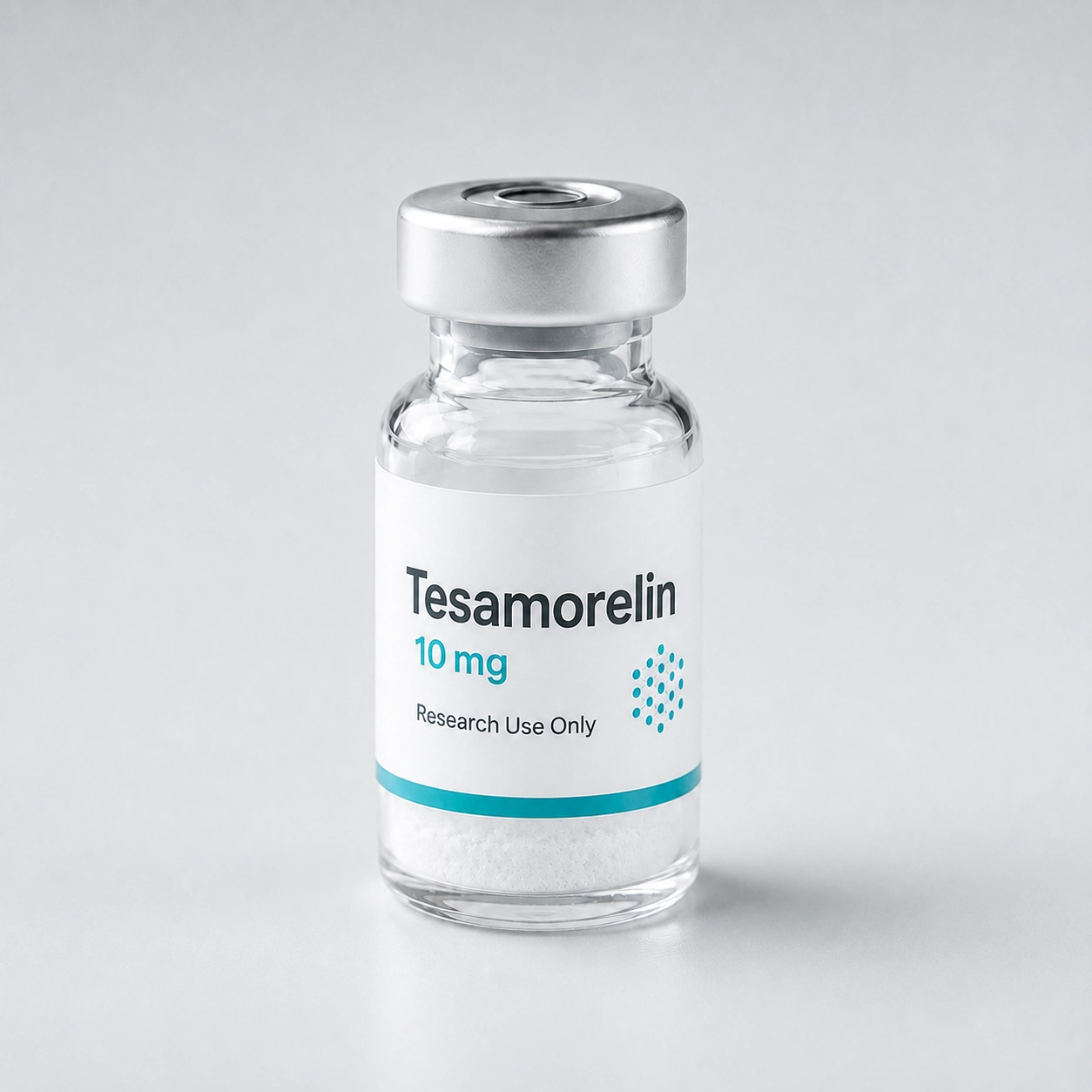
Tesamorelin
A synthetic copy of the full GHRH hormone, with a small chemical group added to the front to slow it breaking down. Sold as Egrifta. In plain terms: an approved prescription medicine that reduces deep belly fat in people with HIV-related fat redistribution, injected daily.
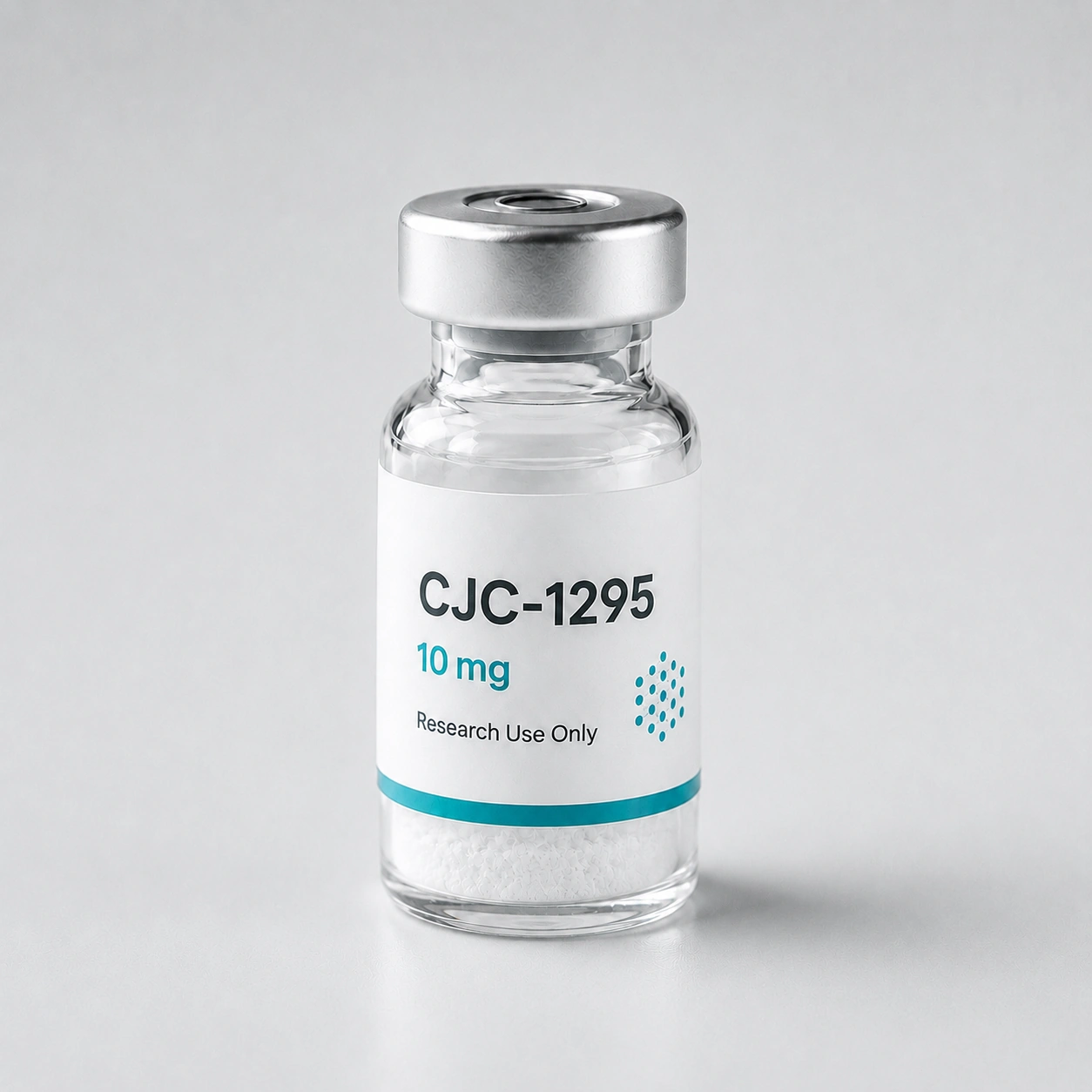
CJC-1295
A shortened version of the same hormone, 29 amino acids with four swapped out, and in one version a hook that grabs onto albumin in the blood so it lasts about a week. In plain terms: the long-acting one, developed and then dropped.
Which one is the whole hormone, and which is a piece of it?
GHRH is the hormone your hypothalamus uses to tell the pituitary to make growth hormone, and it is 44 amino acids long. Tesamorelin is the whole thing, with a small group called trans-3-hexenoic acid attached to the front end to slow the enzyme that breaks it down. CJC-1295 is the first 29 residues, the active front section, with four amino acids swapped for stability, and in the DAC version a thirtieth residue carrying a hook that latches onto albumin.
Both are GHRH. Same hormone, same receptor, different amounts of it.
Longer molecule, shorter action. Tesamorelin is bigger and clears faster. Length and duration are not related here.
The short one got approved. Whatever the advantage of a week-long signal is, it has never been demonstrated in a completed trial.
The counterintuitive part. You would expect the drug that lasts a week to be the more advanced one. It was not the one that finished. Tesamorelin clears quickly and is injected every day, and that is a deliberate design choice, because a short signal lets growth hormone come out in bursts the way your body releases it naturally.
The albumin hook is the whole innovation. It is what stretches CJC-1295 from minutes to days, and it is the reason the compound exists. It is also the part that never made it through a completed trial.
What does the evidence actually show?
How did two drugs in the same class, aimed at the same condition, end up five years apart?
The albumin-binding version is described
Jetté and colleagues identify CJC-1295 as the albumin-binding version of GHRH(1-29) and describe it as long lasting. [9]
EndocrinologySource type: animal and laboratory study
- rats, not people
Two small human trials
Teichman publishes two randomized, placebo controlled, double blind trials in healthy adults. A single injection raises growth hormone 2 to 10 times above baseline for six days or more. Half-life 5.8 to 8.1 days. No antibody formation detected. These measured hormones in blood, not outcomes. [8]
J Clin Endocrinol MetabSource type: randomized controlled human trials, 66 subjects total
- randomized
- no clinical outcome
The Phase 2 is halted
The Phase 2 trial in 192 people with HIV related visceral fat is halted. A participant died of a heart attack roughly three hours after his eleventh weekly injection. The attending physician attributed it to undiagnosed coronary artery disease with a plaque rupture, and causality was never established. Development ended as a precaution, and no efficacy results were ever published. [7]
ClinicalTrials.gov NCT00267527Source type: trial registry record
- no results published
- development ended
The first Phase 3
412 patients with HIV and excess abdominal fat, randomized two to one, 2 milligrams daily for 26 weeks. Visceral fat measured by CT scan fell 15.2 percent while rising 5.0 percent on placebo, a between-group difference of about 20 percent, p less than 0.001. Triglycerides fell about 50 mg/dL more than placebo, and IGF-1 rose about 81 percent. [2]
New England Journal of MedicineSource type: randomized controlled Phase 3 trial
- randomized
- placebo controlled
- published
The extension results
Patients who continued for 52 weeks held their visceral fat reduction at around 18 percent. Those switched to placebo drifted back toward where they started. [3]
AIDSSource type: Phase 3 extension
The FDA approves Egrifta
Approved for reducing excess abdominal fat in people with HIV-associated lipodystrophy, on the strength of two Phase 3 trials totalling 816 patients. It remains the only approved GHRH analog. [1]
US Food and Drug AdministrationSource type: regulatory approval record
FDA approvalThe liver signal
Stanley and colleagues report that liver fat fell with tesamorelin independently of the visceral fat reduction. The first signal that the effect on the liver is not simply a consequence of shifting belly fat. [5]
JAMASource type: randomized human trial
The liver trial, with biopsies
61 HIV-positive adults with fatty liver disease, randomized, double blind, 2 milligrams daily for 12 months, run at Massachusetts General Hospital and the National Institutes of Health. Liver fat measured by MRI fell 4.1 percentage points against a 0.9 point rise on placebo, p equals 0.006. Biopsies at both ends showed less progression of scarring. A reformulated version, Egrifta SV, was also approved this year. [4][1]
The Lancet HIVSource type: randomized controlled trial with biopsy endpoints
- biopsy confirmed
- 61 people, all with HIV
Category 2
The FDA places CJC-1295 in Category 2 of its 503A bulk substances list, the shelf for ingredients that may carry significant safety risks, meaning compounding pharmacies cannot use it. [6]
US Food and Drug AdministrationSource type: regulatory listing
The advisory committee votes against it
The FDA's Pharmacy Compounding Advisory Committee reviews five CJC-1295 related substances and votes against all of them, four unanimously. It came off the Category 2 list in September 2024 after the nominations were withdrawn, which is not the same as being cleared. [6]
US Food and Drug AdministrationSource type: advisory committee record
- cannot be compounded
Where that leaves them
Tesamorelin is prescribed, compounded and still being studied. CJC-1295 has produced nothing since 2006 and is sold as a research chemical.
Tesamorelin ran two Phase 3 trials, submitted a file, was reviewed, got a label, and carries a monitoring requirement and a system watching for problems afterward. CJC-1295 got as far as a Phase 2 that stopped in 2006 and has produced nothing since. That is the difference between the two products, and it is larger than any difference between the two molecules.
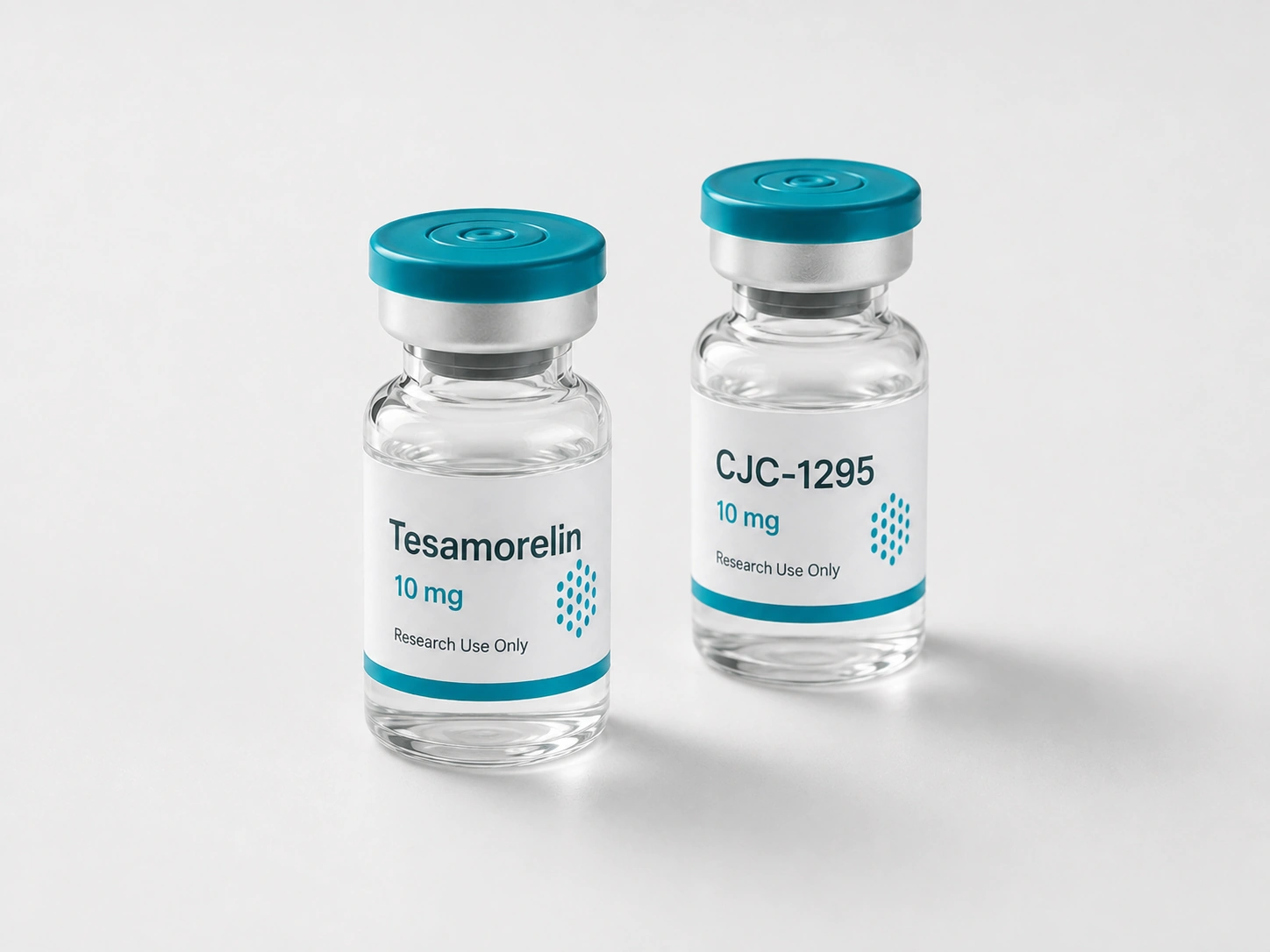
How do they compare, side by side?
How do they compare, side by side?
| Attribute | Tesamorelin | CJC-1295 |
|---|---|---|
| Full name | Tesamorelin, developed as TH9507 | CJC-1295, with or without DAC |
| Brand | Egrifta and Egrifta SV | None |
| What it is | GHRH(1-44) with a front-end modification | GHRH(1-29) with four substitutions |
| Duration | Short. Cleared quickly | 5.8 to 8.1 days with DAC. Unmeasured without [8] |
| Dosing | 2 mg subcutaneously, every day [1] | Weekly or fortnightly, with DAC |
| Why that dosing | To preserve natural pulses of growth hormone | To reduce injection frequency |
| Phase 3 trials | Two, 816 patients total [2][3] | None |
| Phase 2 | Completed | Halted July 2006, no results published [7] |
| Primary result | Visceral fat down 15.2 percent against a 5.0 percent rise on placebo [2] | No efficacy result exists |
| IGF-1 change | Up about 81 percent [2] | Up 1.5 to 3 times baseline [8] |
| Antibodies | Detected in about half of patients [1] | None detected [8] |
| FDA status | Approved November 2010 [1] | Never approved. Advisory committee voted against it in 2024 [6] |
| Available how | Prescription as Egrifta, and legally compounded | Research chemical only. Cannot be compounded [6] |
Why does an identical mechanism take opposite approaches to timing?
GHRH docks with a receptor on the pituitary and tells it to produce growth hormone. Growth hormone raises IGF-1, and IGF-1 drives the breakdown of fat. Visceral fat, the deep kind wrapped around your organs, has more growth hormone receptors than the fat under your skin, which is why the effect showed up there and not elsewhere. In the trials, subcutaneous fat and body weight barely moved. [2]
Tesamorelin
It keeps it brief on purpose. It clears quickly, so a daily injection produces a pulse and then stops.
Your body releases growth hormone in bursts, mostly overnight, with quiet stretches in between, and those quiet stretches appear to matter for how tissues respond. A short-acting daily drug imitates that pattern.
That design is the one with two Phase 3 trials and an approval behind it.
CJC-1295
With DAC it does the opposite. The albumin hook keeps the signal running for days.
Ionescu and Frohman found that growth hormone still came out in discrete bursts even under that sustained stimulation, which was a reassuring finding. [11] But nobody ever completed a trial showing that a week-long signal produces better outcomes than a daily pulse.
So the design question is unresolved, and the score is one to nothing.
Why is tesamorelin's most discussed current use not its approved one?
What was actually shown. Stanley and colleagues ran a randomized, double blind trial in 61 HIV-positive adults with fatty liver disease, giving 2 milligrams daily for 12 months. Liver fat measured by MRI fell 4.1 percentage points while rising 0.9 on placebo, and biopsies taken at the start and end showed less progression of scarring. [4] An earlier study had already found the liver effect held up independently of how much visceral fat came off. [5]
What was not shown. Everyone in that trial had HIV. Sixty-one people is small. And fatty liver disease in the general population is not necessarily the same condition. No large trial has tested tesamorelin for fatty liver in people without HIV, and that is precisely where most of the current off-label prescribing sits.
Why it belongs on this page. CJC-1295 has no equivalent. There is no liver data, no organ-level outcome, no biopsy study. The gap between these two compounds is not really about half-lives. It is that one has a body of evidence that kept growing after approval, and the other stopped in 2006.
And one more finding worth knowing. A separate trial found that 20 weeks of a lower dose improved executive function in older adults and in people with mild cognitive impairment. [10] That is a small study in a different population, and it is another line of evidence CJC-1295 does not have.
What are the key differences?
What actually separates them?
What has nobody answered?
Which four gaps has nobody answered?
The fat comes back.Tesamorelin's own review documentation states that once treatment stops, visceral fat returns. The effect is real while you take it, and it is not a cure. That is stated plainly in coverage documents and is easy to miss in the marketing around off-label use. [12]
Long-term safety was never established.Beyond one year, there is no data. The long-term cardiovascular risk or benefit has not been shown, and the consequences of years of elevated IGF-1 are unknown. Those are the reviewers' own words, not a critic's. [12]
Nobody knows if a week-long signal is better or worse.CJC-1295's whole premise is fewer injections. Whether sustained stimulation produces the same, better or worse results than a daily pulse has never been tested to completion in anyone.
Nobody has tested the liver effect outside HIV.The liver trial enrolled 61 people, all of whom had HIV. Most current off-label prescribing is for fatty liver in people who do not, and that has not been tested at scale. [4]
And nobody has compared them.No trial has put tesamorelin against CJC-1295, despite them being the same class aimed at the same condition. What exists is one approval and one halted study.
What are the side effects, and what are you buying?
Which has a label listing everything, and which has a short study and a halted trial?
Tesamorelin, from its label
Everything here is public because an approved drug has to report it.
- Anti-drug antibodies in about half of patients at 26 weeks, and in about 85 percent of those with a hypersensitivity reaction [1]rate
- IGF-1 more than 2 standard deviations above normal in about 47 percent, and more than 3 in about 36 percent, by 26 weeks [1]rate
- Fluid retention, causing swelling and musculoskeletal discomfort [1]label
- Injection site reactions, the most common complaint [1]label
Nobody has looked
Nobody has run these studies. That is different from a clean result.
- Any safety data on tesamorelin beyond one year [12]no data
- Long-term cardiovascular risk or benefit for either compound [12]no data
- What years of raised IGF-1 do, in anyone [12]no data
- Any efficacy result at all for CJC-1295, since its Phase 2 was never published [7]no data
What you are actually buying
One comes from a pharmacy. One does not.
- Egrifta is dispensed on prescription and made under pharmaceutical manufacturing controlsregulated
- Compounded tesamorelin is legal, because it is an approved drug substance. Quality still varies by pharmacypharmacy
- CJC-1295 cannot be legally compounded, and has no approved product to compare a vial against [6]regulatory
- Testing of seized peptides found purity between 5 and 75 percent, plus arsenic and lead [13]analysis
- One US lab reported problems in almost 30 percent of samples, including bacteria [14]testing
*Where this page says nothing is established, it means nobody has studied it. It does not mean a compound is safe.
The antibody comparison is the part that misleads people. Tesamorelin's label reports anti-drug antibodies in about half of patients. Teichman's CJC-1295 trials found none at all. Read quickly, CJC-1295 looks cleaner. What actually happened is that tesamorelin was studied in 816 patients for up to a year with mandatory reporting, while CJC-1295 was studied in fewer than seventy healthy adults for at most seven weeks and then abandoned. Tesamorelin's antibodies turned out not to affect how well it worked, which is a thing you can only know because somebody checked. A longer list of documented problems usually means a longer look.
The IGF-1 numbers deserve a moment. The tesamorelin label tells prescribers to consider stopping the drug if IGF-1 stays more than 3 standard deviations above normal, especially if the fat reduction is not convincing. That is a monitoring instruction, and it exists because someone is meant to be checking your bloodwork every three months. [1] Nobody is checking anyone's IGF-1 on a research chemical.
Our guide on reading a certificate of analysis covers what a vendor document can and cannot tell you.
Are they banned in sport?
Are both named, with no ambiguity?
Section S2.2.4 covers growth hormone releasing factors, and it names GHRH and its analogs, giving CJC-1293, CJC-1295, sermorelin and tesamorelin as the examples. [15] Both compounds on this page are named outright. Both are prohibited at all times, in and out of competition. Everything in S2 is a non-specified substance, which carries a default four year ban for a first violation. Being an approved prescription drug makes no difference here. This reflects the 2026 Prohibited List, in force from 1 January 2026, and WADA publishes a new list each September.
Are they FDA approved?
Why is this the clearest possible contrast within one drug class?
Tesamorelin is approved. The FDA approved it in November 2010 for reducing excess abdominal fat in people with HIV-associated lipodystrophy, on two Phase 3 trials totalling 816 patients. A reformulated version, Egrifta SV, followed in 2019. It is the only GHRH analog ever approved. The indication is narrow: one population, one condition. Use for anything else is off-label, which is a prescriber's decision and responsibility. [1]
CJC-1295 is not approved anywhere. The FDA placed it in Category 2 of its 503A bulk substances list in September 2023, meaning compounding pharmacies could not use it. It came off that list in September 2024 after the nominations were withdrawn, which is not the same as being cleared. The FDA took it to its advisory committee anyway, and on 4 December 2024 the committee voted against all five CJC-1295 related substances, four of them unanimously. [6]
One practical consequence people run into. Because tesamorelin is an approved drug substance, compounding pharmacies can legally prepare it, and compounded tesamorelin is widely available through 503A and 503B pharmacies. CJC-1295 cannot be compounded at all. So if you have seen both sold, that is why they look similarly available and are not. One route runs through a licensed pharmacy against a prescription. The other does not exist legally, and what is sold under that name is a research chemical.
Questions people ask
Are they the same kind of drug?
Yes. Both are synthetic GHRH acting on the same pituitary receptor. Tesamorelin is the full 44 amino acid hormone. CJC-1295 is the first 29 with modifications.
Why did tesamorelin get approved and CJC-1295 not?
Tesamorelin completed two Phase 3 trials in 816 patients showing a measured reduction in visceral fat. CJC-1295's Phase 2 was halted in 2006 after a participant died, causality was never established, and development ended. No efficacy data was ever published.
Is the weekly one better because it lasts longer?
Unknown, and the evidence points the other way. Tesamorelin was deliberately designed to clear quickly so growth hormone still comes in bursts, and that is the one that finished. Nobody has completed a trial showing a week-long signal works better.
Does tesamorelin work for regular belly fat?
It was tested in people with HIV-related fat redistribution. Whether it does the same thing in anyone else has not been established in an approved indication, and off-label use is a decision for a prescriber.
Does the fat stay off?
No. Visceral fat returns after treatment stops.
Why does tesamorelin cause antibodies and CJC-1295 not?
That comparison does not hold up. Tesamorelin's antibody rate comes from 816 patients over up to a year with mandatory reporting. CJC-1295's clean result comes from fewer than seventy healthy adults over at most seven weeks. Tesamorelin's antibodies also did not reduce how well it worked.
Does tesamorelin work for fatty liver?
There is one randomized trial, in 61 HIV-positive adults, showing liver fat fell 4.1 percentage points against a 0.9 point rise on placebo over 12 months, with less scarring progression on biopsy. Everyone in it had HIV, and the off-label prescribing happening now is mostly in people who do not.
Why can I buy compounded tesamorelin but not CJC-1295?
Because tesamorelin is an approved drug substance, so a compounding pharmacy may legally prepare it against a prescription. CJC-1295 is not, and the advisory committee voted against allowing it.
Are they banned in sport?
Yes, both by name, under section S2.2.4 of the 2026 Prohibited List.
What this page is built on
- 01EGRIFTA and EGRIFTA SV (tesamorelin for injection) prescribing information. Initial US approval November 2010, reformulated version approved 2019. Theratechnologies. FDA label. Anti-tesamorelin IgG antibodies in 49.5 percent of patients at 26 weeks and 47.4 percent at 52 weeks, and in 85.2 percent of those with hypersensitivity reactions. Antibodies did not alter efficacy. IGF-1 above 2 SDS in 47.4 percent and above 3 SDS in 35.6 percent at 26 weeks.
- 02Falutz J, Allas S, Blot K, Potvin D, Kotler D, Somero M, et al. Metabolic effects of a growth hormone-releasing factor in patients with HIV. N Engl J Med. 2007;357(23):2359-2370. PMID 18057338. Human Phase 3. 412 patients randomized 2:1, 2 mg daily for 26 weeks. Visceral adipose tissue down 15.2 percent against a 5.0 percent rise on placebo, p less than 0.001. IGF-1 up about 81 percent.
- 03Falutz J, Allas S, Mamputu JC, Potvin D, Kotler D, Somero M, et al. Long-term safety and effects of tesamorelin in HIV patients with abdominal fat accumulation. AIDS. 2008;22(14):1719-1728. PMID 18690162. Human Phase 3 extension to 52 weeks. Visceral fat reduction sustained at around 18 percent in patients who continued. The two Phase 3 trials totaled 816 patients.
- 04Stanley TL, Fourman LT, Feldpausch MN, Purdy J, Zheng I, Pan CS, et al. Effects of tesamorelin on non-alcoholic fatty liver disease in HIV: a randomized, double-blind, multicentre trial. Lancet HIV. 2019;6(12):e821-e830. PMID 31611038. Human randomized controlled trial. 61 HIV-positive adults, 2 mg daily for 12 months. Hepatic fat fraction fell 4.1 percentage points against a 0.9 point rise on placebo, p equals 0.006. Biopsies showed reduced fibrosis progression.
- 05Stanley TL, et al. Effects of tesamorelin on hepatic fat in HIV-infected patients with abdominal fat accumulation. JAMA. 2014. Human randomized trial. Liver fat fell independently of visceral fat reduction.
- 06US Food and Drug Administration. 503A bulk drug substances category updates, September 2023, Category 2 removals September 2024, and Pharmacy Compounding Advisory Committee meeting of 4 December 2024 reviewing five CJC-1295 related substances, all rejected. Regulatory documents.
- 07ClinicalTrials.gov NCT00267527. A study to evaluate CJC-1295 in HIV patients with visceral obesity. Trial registry. Phase 2, 192 participants, halted 17 July 2006. No results published.
- 08Teichman SL, Neale A, Lawrence B, Gagnon C, Castaigne JP, Frohman LA. Prolonged stimulation of growth hormone and insulin-like growth factor I secretion by CJC-1295 in healthy adults. J Clin Endocrinol Metab. 2006;91(3):799-805. PMID 16352683. Human clinical trial. Two studies, 42 and 24 subjects. Half-life 5.8 to 8.1 days. No significant antibody formation detected.
- 09Jetté L, et al. Human growth hormone-releasing factor (hGRF)1-29-albumin bioconjugates activate the GRF receptor on the anterior pituitary in rats. Endocrinology. 2005;146(7):3052-8. PMID 15817669. Animal and laboratory study.
- 10Baker LD, et al. Effects of growth hormone-releasing hormone on cognitive function in adults with mild cognitive impairment and healthy older adults. 2012. Human randomized trial. 20 weeks of tesamorelin at 1 mg daily improved executive function.
- 11Ionescu M, Frohman LA. Pulsatile secretion of growth hormone persists during continuous stimulation by CJC-1295. J Clin Endocrinol Metab. 2006;91(12):4792-7. PMID 17018654. Human study.
- 12Payer coverage review documentation for Egrifta SV. States that visceral fat returns once treatment stops, that long-term safety beyond one year has not been established, and that the long-term risks of elevated IGF-1 are unknown.
- 13Janvier S, Cheyns K, Canfyn M, Goscinny S, De Spiegeleer B, Vanhee C, Deconinck E. Impurity profiling of the most frequently encountered falsified polypeptide drugs on the Belgian market. Talanta. 2018;188:795-807. Peer-reviewed analytical study.
- 14NBC Washington. Lab finds problems in 30% of peptide vials tested. December 2024. News report of commercial laboratory testing, not peer reviewed.
- 15World Anti-Doping Agency. The 2026 Prohibited List, section S2.2.4, naming CJC-1293, CJC-1295, sermorelin and tesamorelin among GHRH analogs. Effective 1 January 2026. Regulatory document.